Introduction
Content Moderation Platforms are software systems designed to detect, review, filter, and manage user-generated content (UGC) across digital environments such as social media apps, marketplaces, forums, gaming platforms, and community networks. These platforms help organizations enforce community guidelines, prevent harmful content, and maintain brand safety at scale using a combination of AI automation, rule engines, and human moderation workflows.
As digital ecosystems expand, the volume of text, images, videos, and live content being uploaded every second has made manual moderation impossible. Modern platforms now rely heavily on machine learning models, real-time scanning, and multi-layered trust systems to identify toxic behavior, spam, fraud, hate speech, and policy violations.
Real-world use cases
- Moderating social media posts and comments in real time
- Filtering harmful or illegal content in marketplaces
- Detecting fraud and abuse in fintech or gig platforms
- Reviewing gaming chat and live streaming content
- Ensuring compliance with global regulations (DSA, GDPR, etc.)
What buyers should evaluate
- AI accuracy across text, image, video, and audio
- Real-time vs batch moderation capability
- Workflow automation and escalation systems
- Policy customization flexibility
- Human-in-the-loop support
- Integration with existing platforms and APIs
- False positive/negative handling
- Scalability for high-volume environments
- Audit logs and compliance reporting
- Security and data privacy controls
Best for:
Content Moderation Platforms are best for social media companies, marketplaces, SaaS communities, gaming platforms, fintech apps, and any organization handling large-scale user-generated content.
Not ideal for:
Small static websites, brochure-style apps, or businesses without user-generated content typically do not require dedicated moderation platforms.
Key Trends in Content Moderation Platforms
- AI-first moderation pipelines replacing rule-based filtering systems
- Hybrid moderation models (AI + human reviewers) becoming standard
- Real-time content analysis replacing delayed moderation queues
- Multimodal moderation (text, image, video, audio) becoming mainstream
- Generative AI detection tools emerging to detect synthetic content
- Behavior-based risk scoring systems improving precision
- Regulatory-driven compliance tools increasing due to global laws
- Automated escalation workflows reducing human workload
- Cross-platform moderation orchestration enabling unified enforcement
- Context-aware NLP models improving toxicity detection accuracy
How We Selected These Tools (Methodology)
- Prioritized widely adopted content moderation platforms
- Included AI-driven and enterprise-grade moderation tools
- Focused on multimodal content analysis capabilities
- Evaluated scalability for high-volume UGC platforms
- Considered workflow automation and policy enforcement strength
- Reviewed integration ecosystems and API capabilities
- Included both enterprise and developer-first moderation platforms
- Balanced between AI-native tools and hybrid service providers
- Assessed real-time moderation performance capability
- Considered compliance readiness and audit support
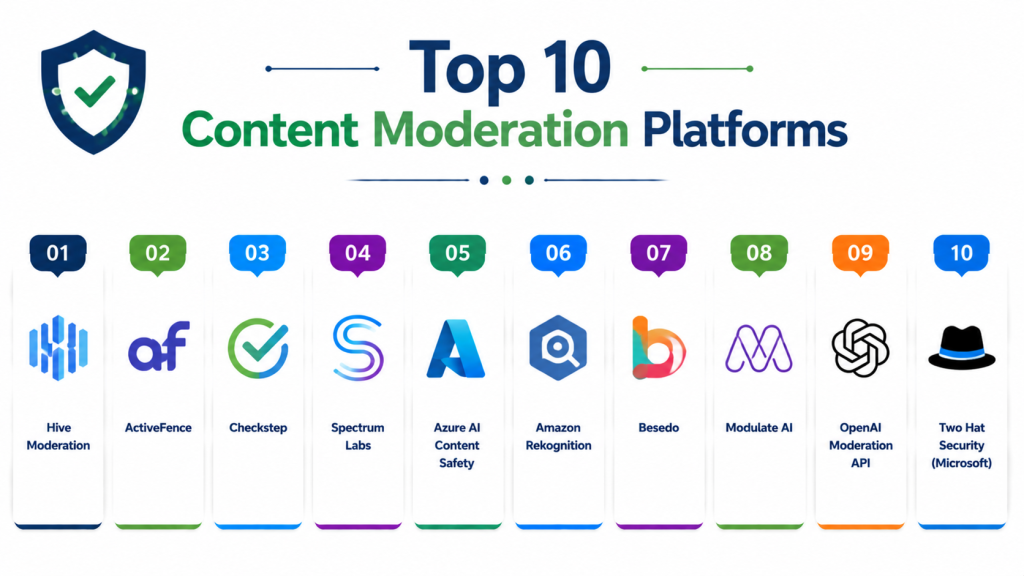
Top 10 Content Moderation Platforms
#1 — Hive Moderation
Short description:
Hive Moderation is an AI-powered content moderation platform that analyzes text, images, and videos for harmful or policy-violating content. It is widely used by social media, gaming, and UGC platforms. It focuses on scalable API-driven moderation workflows. It is best suited for real-time automated content screening.
Key Features
- Multi-modal moderation (text, image, video)
- AI-based toxicity detection
- Spam and abuse filtering
- Real-time API processing
- Custom moderation categories
- Scalable cloud infrastructure
- Automated flagging system
Pros
- Strong AI accuracy across media types
- Easy API integration for developers
- High scalability for large platforms
Cons
- Limited governance dashboards
- Requires tuning for niche content types
- Less human moderation support
Platforms / Deployment
Cloud
Security & Compliance
Encryption and secure API access supported. Certifications: Not publicly stated.
Integrations & Ecosystem
- Social platforms
- Messaging apps
- CMS systems
- API integrations
- Analytics tools
Support & Community
Developer documentation and technical support available.
#2 — ActiveFence
Short description:
ActiveFence is an enterprise Trust & Safety intelligence platform focused on detecting online threats, harmful behavior, and coordinated abuse. It uses AI-driven intelligence systems for proactive moderation. It is widely used by large digital platforms. It is best suited for enterprise-grade safety monitoring.
Key Features
- Threat intelligence detection
- AI-driven risk analysis
- Fraud and abuse prevention
- Deepfake detection capabilities
- Real-time monitoring dashboards
- Policy enforcement automation
- Global safety intelligence feeds
Pros
- Strong enterprise security focus
- Advanced threat detection capabilities
- Scales for global platforms
Cons
- Complex deployment process
- Not ideal for small platforms
- Limited pricing transparency
Platforms / Deployment
Cloud
Security & Compliance
Enterprise-grade controls, audit logs, and RBAC supported.
Integrations & Ecosystem
- Social platforms
- Messaging systems
- Marketplace APIs
- Security tools
- Custom integrations
Support & Community
Enterprise onboarding and dedicated support available.
#3 — Checkstep
Short description:
Checkstep is an AI-powered content moderation platform designed for scalable policy enforcement and trust & safety workflows. It helps automate content detection and moderation decisions. It is widely used in growing digital platforms. It is best suited for scalable SaaS communities.
Key Features
- AI moderation engine
- Policy management tools
- Automated enforcement workflows
- Real-time content monitoring
- Multi-language support
- Risk scoring systems
- Moderation dashboards
Pros
- Easy policy configuration
- Strong automation capabilities
- Suitable for scaling platforms
Cons
- Enterprise depth varies
- Requires tuning for accuracy
- Limited transparency on pricing
Platforms / Deployment
Cloud
Security & Compliance
Secure authentication and logging supported. Certifications: Not publicly stated.
Integrations & Ecosystem
- APIs
- Social platforms
- SaaS tools
- Messaging systems
- Analytics platforms
Support & Community
Documentation and onboarding support available.
#4 — Spectrum Labs
Short description:
Spectrum Labs provides behavioral AI moderation that detects toxicity, harassment, and harmful user behavior patterns. It focuses on behavioral signals rather than simple keyword filtering. It is widely used in social platforms and gaming ecosystems. It is best suited for behavioral risk detection systems.
Key Features
- Behavioral AI models
- Toxicity detection engine
- Real-time moderation
- Risk scoring system
- Community health analytics
- Multi-language detection
- Policy enforcement tools
Pros
- Strong behavioral intelligence
- Reduces false positives
- Effective for social ecosystems
Cons
- Complex model tuning required
- Less general-purpose moderation tools
- Enterprise focus only
Platforms / Deployment
Cloud
Security & Compliance
Enterprise security controls supported. Certifications: Not publicly stated.
Integrations & Ecosystem
- Social apps
- Gaming platforms
- Messaging systems
- APIs
- Analytics tools
Support & Community
Enterprise support available.
#5 — Azure AI Content Safety
Short description:
Azure AI Content Safety is a cloud-based moderation service that detects harmful text and image content using machine learning models. It is designed for enterprise applications requiring scalable moderation infrastructure. It integrates deeply with cloud ecosystems. It is best suited for cloud-native enterprise platforms.
Key Features
- Text and image moderation APIs
- AI-based harmful content detection
- Real-time moderation capabilities
- Policy configuration tools
- Cloud integration support
- Scalable inference engine
- Developer APIs
Pros
- Highly scalable cloud infrastructure
- Strong enterprise reliability
- Seamless cloud ecosystem integration
Cons
- Requires technical implementation
- Limited out-of-box workflows
- Cloud dependency
Platforms / Deployment
Cloud
Security & Compliance
Enterprise-grade encryption and access control supported.
Integrations & Ecosystem
- Cloud services
- AI pipelines
- Data platforms
- Security tools
- API integrations
Support & Community
Enterprise cloud support available.
#6 — Besedo
Short description:
Besedo is a hybrid content moderation platform combining AI automation with human moderation services. It is widely used in marketplaces, dating apps, and UGC platforms. It focuses on fraud detection and content safety workflows. It is best suited for hybrid moderation environments.
Key Features
- Human + AI moderation
- Fraud detection tools
- Real-time review queues
- Policy enforcement workflows
- Multilingual moderation
- Risk scoring system
- Escalation management
Pros
- Strong hybrid moderation model
- Good for marketplace platforms
- Flexible workflows
Cons
- Slower automation compared to AI-first tools
- Requires operational coordination
- Limited self-serve flexibility
Platforms / Deployment
Cloud / Hybrid
Security & Compliance
Role-based access and secure workflows supported.
Integrations & Ecosystem
- Marketplaces
- CRM systems
- Payment systems
- APIs
- Support tools
Support & Community
Managed moderation support available.
#7 — LiveWorld
Short description:
LiveWorld provides human-powered moderation combined with AI-assisted workflows for brand safety and community moderation. It is widely used in regulated industries and enterprise social platforms. It focuses on engagement and safety monitoring. It is best suited for managed moderation services.
Key Features
- Human moderation teams
- AI-assisted review tools
- Brand safety enforcement
- Social media moderation
- Workflow automation
- Content filtering systems
- Compliance monitoring
Pros
- Strong human moderation expertise
- Good for regulated industries
- Flexible service model
Cons
- Less automation-heavy
- Service-based pricing model
- Slower scaling vs AI-first platforms
Platforms / Deployment
Cloud / Hybrid
Security & Compliance
Secure workflows and enterprise controls supported.
Integrations & Ecosystem
- Social platforms
- CRM tools
- Marketing systems
- APIs
- Analytics platforms
Support & Community
Managed service support available.
#8 — Amazon Rekognition
Short description:
Amazon Rekognition is a machine learning service that detects unsafe or inappropriate visual content in images and videos. It is widely used for scalable moderation of media content. It integrates with cloud ecosystems for enterprise applications. It is best suited for visual content moderation.
Key Features
- Image and video moderation APIs
- Explicit content detection
- Object recognition
- Facial analysis tools
- Real-time processing
- Scalable cloud inference
- Custom labels support
Pros
- Highly scalable infrastructure
- Strong image/video detection
- Easy cloud integration
Cons
- Limited text moderation capability
- Requires technical setup
- AWS ecosystem dependency
Platforms / Deployment
Cloud
Security & Compliance
Enterprise cloud security controls supported.
Integrations & Ecosystem
- AWS services
- Media platforms
- AI pipelines
- Storage systems
- APIs
Support & Community
Cloud-based enterprise support available.
#9 — Modulate AI
Short description:
Modulate AI specializes in voice and audio moderation, particularly for real-time communication platforms such as gaming and voice chat systems. It detects toxic speech and harmful audio behavior. It is widely used in gaming ecosystems. It is best suited for voice-based moderation.
Key Features
- Real-time voice moderation
- Toxic speech detection
- Audio streaming analysis
- Behavioral risk scoring
- API integration support
- Custom moderation rules
- Gaming-focused tools
Pros
- Strong voice moderation capability
- Real-time detection performance
- Ideal for gaming platforms
Cons
- Limited text/image moderation
- Niche focus on audio
- Requires integration effort
Platforms / Deployment
Cloud
Security & Compliance
Secure API-based processing supported. Certifications: Not publicly stated.
Integrations & Ecosystem
- Gaming platforms
- Voice chat systems
- Communication APIs
- Streaming tools
- Moderation workflows
Support & Community
Developer documentation and support available.
#10 — Sentropy (Moderation Technology Stack)
Short description:
Sentropy developed AI-based moderation systems focused on detecting harmful content, harassment, and coordinated abuse. Its technology is widely referenced in trust & safety systems after acquisition and integration into larger platforms. It is best suited for advanced AI moderation frameworks.
Key Features
- AI toxicity detection models
- Harassment detection systems
- Community risk scoring
- Content filtering tools
- Policy enforcement engines
- Behavioral analysis
- Scalable moderation APIs
Pros
- Strong AI moderation foundation
- Good behavioral analysis
- Useful for large platforms
Cons
- Limited standalone product availability
- Requires integration into larger systems
- Not independently evolving
Platforms / Deployment
Varies / Integrated systems
Security & Compliance
Enterprise-level security depends on integration environment.
Integrations & Ecosystem
- Social platforms
- AI moderation pipelines
- API-based systems
- Safety tools
- Analytics platforms
Support & Community
Varies depending on integration ecosystem.
Comparison Table
| Tool Name | Best For | Platform Supported | Deployment | Standout Feature | Public Rating |
|---|---|---|---|---|---|
| Hive Moderation | AI content moderation | Web | Cloud | Multi-modal AI detection | N/A |
| ActiveFence | Enterprise safety intelligence | Web | Cloud | Threat intelligence engine | N/A |
| Checkstep | SaaS moderation workflows | Web | Cloud | Policy automation engine | N/A |
| Spectrum Labs | Behavioral moderation | Web | Cloud | Behavioral AI models | N/A |
| Azure AI Content Safety | Enterprise cloud apps | Web | Cloud | AI safety APIs | N/A |
| Besedo | Hybrid moderation | Web | Cloud/Hybrid | Human + AI workflows | N/A |
| LiveWorld | Managed moderation | Web | Cloud/Hybrid | Human moderation services | N/A |
| Amazon Rekognition | Visual moderation | Web | Cloud | Image/video AI detection | N/A |
| Modulate AI | Voice moderation | Web | Cloud | Real-time voice analysis | N/A |
| Sentropy Stack | AI safety systems | Web | Integrated | Advanced toxicity detection | N/A |
Evaluation & Scoring of Content Moderation Platforms
| Tool Name | Core (25%) | Ease (15%) | Integrations (15%) | Security (10%) | Performance (10%) | Support (10%) | Value (15%) | Weighted Total |
|---|---|---|---|---|---|---|---|---|
| Hive Moderation | 9 | 9 | 8 | 8 | 9 | 8 | 9 | 8.7 |
| ActiveFence | 9 | 7 | 8 | 9 | 9 | 8 | 7 | 8.4 |
| Checkstep | 8 | 8 | 8 | 8 | 8 | 8 | 8 | 8.0 |
| Spectrum Labs | 8 | 7 | 7 | 8 | 8 | 8 | 7 | 7.8 |
| Azure AI Content Safety | 9 | 7 | 9 | 9 | 9 | 8 | 8 | 8.6 |
| Besedo | 8 | 8 | 7 | 8 | 8 | 9 | 8 | 8.0 |
| LiveWorld | 7 | 8 | 7 | 8 | 7 | 9 | 7 | 7.6 |
| Amazon Rekognition | 9 | 8 | 9 | 9 | 9 | 8 | 8 | 8.7 |
| Modulate AI | 8 | 8 | 8 | 8 | 9 | 8 | 8 | 8.2 |
| Sentropy Stack | 8 | 7 | 7 | 8 | 8 | 7 | 7 | 7.6 |
Score Interpretation
- Higher scores indicate stronger AI capabilities and scalability.
- Mid-tier tools balance usability and automation features.
- Enterprise tools prioritize compliance, security, and scale over simplicity.
- AI-native tools perform best in real-time moderation scenarios.
- Hybrid platforms are stronger in human-context decision-making.
- Final selection should depend on content risk level and platform size.
Which Content Moderation Platform Is Right for You?
Solo / Freelancer
Use lightweight API-based tools like Hive Moderation for basic content filtering needs.
SMB
Checkstep and Besedo provide a balanced mix of automation and human moderation workflows.
Mid-Market
Spectrum Labs, LiveWorld, and Azure AI Content Safety provide scalable moderation and behavioral intelligence.
Enterprise
ActiveFence, Amazon Rekognition, and Azure AI Content Safety are ideal for high-scale, high-risk environments.
Budget vs Premium
Budget solutions rely on APIs and automation, while premium tools offer full governance and enterprise compliance.
Feature Depth vs Ease of Use
AI-first APIs are easier to deploy but less comprehensive than enterprise governance platforms.
Integrations & Scalability
Platforms with strong API ecosystems and cloud-native architectures scale best for global traffic.
Security & Compliance Needs
Regulated industries should prioritize audit logs, encryption, and compliance-ready platforms.
Frequently Asked Questions
1. What are Content Moderation Platforms?
They are systems that automatically or manually filter, review, and manage user-generated content for safety and compliance.
2. How do these platforms work?
They use AI models, rule engines, and human reviewers to detect harmful or inappropriate content.
3. What types of content do they analyze?
Text, images, videos, audio, and user behavior signals across platforms.
4. Are these tools fully automated?
No. Most systems use a hybrid approach combining AI and human moderation.
5. Do small apps need these tools?
Only if they handle user-generated content; otherwise, they may not be necessary.
6. Can they detect AI-generated content?
Some advanced platforms now include AI-generated content detection capabilities.
7. What industries use these tools?
Social media, gaming, fintech, marketplaces, and SaaS communities.
8. Are these tools compliant with regulations?
Enterprise tools often support compliance frameworks, but certification varies.
9. How accurate are AI moderation systems?
Accuracy depends on training data, model type, and continuous tuning.
10. What is the biggest challenge in moderation?
Balancing content safety with freedom of expression while minimizing false positives.
Conclusion
Content Moderation Platforms are essential infrastructure for any digital ecosystem that relies on user-generated content. As online interactions continue to grow, AI-powered moderation combined with human oversight has become the standard approach for ensuring safety, compliance, and trust at scale. From AI-native platforms like Hive Moderation to enterprise systems like ActiveFence and Azure AI Content Safety, each tool serves different levels of complexity and scale. The right choice depends on content risk level, user volume, integration needs, and regulatory requirements. As digital ecosystems evolve, investing in robust moderation infrastructure is critical to maintaining platform safety and user trust.