Introduction
Information is currently being produced at a speed that was once thought impossible. However, having information is not the same as being able to use it. Many companies struggle because their data is messy, slow to move, and difficult to trust. This is where DataOps becomes essential. It is the practice of bringing the speed of DevOps to the world of data.
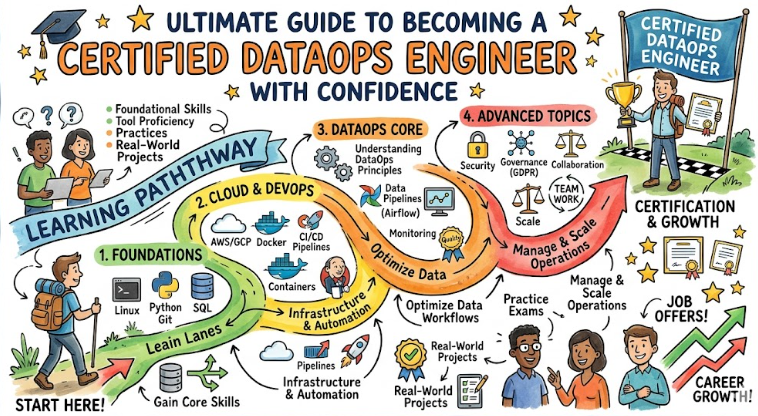
The CDOE – Certified DataOps Engineer program is designed to solve these problems. It is not just about learning a single tool. It is about learning a new way to work. By combining people, processes, and technology, data can be moved from its source to the user with much higher quality and speed. This guide is created to help professionals understand how this certification can change their career path and how the complex world of data pipelines can be mastered.
What is CDOE – Certified DataOps Engineer?
The CDOE – Certified DataOps Engineer is a professional designation that proves a person knows how to manage the full lifecycle of data. It is focused on automation, quality control, and collaboration between data scientists and operations teams. The certification is built to ensure that data flows through a company just as smoothly as code flows through a software pipeline.
Why it Matters Today?
Business decisions are now made based on real-time data. If the data is late or wrong, the decision will be bad. Most organizations find that their data teams are overworked and their systems are prone to breaking. DataOps is needed to fix these broken systems. By following the principles taught in the CDOE program, the time taken to create new data insights is reduced from months to days. It allows for a more stable and reliable environment where data is treated as a high-quality product.
Why CDOE – Certified DataOps Engineer Certifications are Important
A certification acts as a standard of quality. It shows that a professional has been tested against industry requirements. For a CDOE – Certified DataOps Engineer, the certification is important because:
- Standardization: It provides a common language for data and operations teams to use.
- Trust: Employers are given confidence that the engineer can handle sensitive and complex data systems.
- Skill Validation: It proves that the engineer is not just familiar with tools but understands the underlying philosophy of data flow.
- Career Growth: It opens doors to high-level roles in data engineering and platform management.
Why Choose DataOpsSchool?
When a place for learning is selected, the focus should be on practical results. DataOpsSchool is chosen by many because the training is grounded in real-world scenarios. The concepts are taught in a way that can be used immediately on the job. The curriculum is updated regularly to ensure that the most relevant techniques are being shared. By choosing this institution, a learner is given access to mentors who understand the deep technical challenges of the industry. The focus is always on making sure the student succeeds, not just in the exam, but in their professional life.
CDOE – Certified DataOps Engineer Deep-Dive
What is this certification?
The CDOE – Certified DataOps Engineer is a comprehensive validation of an engineer’s ability to automate data pipelines. It focuses on the intersection of data engineering, DevOps, and quality assurance.
Who should take this certification?
This program is intended for Data Engineers, DevOps Professionals, Cloud Architects, and anyone involved in the movement or management of organizational data. It is also highly beneficial for Engineering Managers who want to understand the modern data landscape.
Certification Overview Table
| Track | Level | Who it’s for | Prerequisites | Skills Covered | Recommended Order |
| Core DataOps | Associate | Beginners in Data | Basic Linux knowledge | Data Lifecycle, Automation basics | 1st |
| Pipeline Automation | Professional | Data Engineers | Core DataOps Cert | CI/CD for Data, Orchestration | 2nd |
| Data Quality & Governance | Specialist | QA and Compliance | Basic SQL knowledge | Testing data, Security, Compliance | 3rd |
| Infrastructure for Data | Expert | Platform Engineers | Cloud experience | Containerization, Scaling data pods | 4th |
| DataOps Leadership | Management | Leads and Managers | 5+ years experience | Strategy, Team building, ROI | 5th |
Skills You Will Gain
- The ability to build automated data pipelines is developed.
- Expertise in data version control and environment management is gained.
- Advanced techniques for testing data quality are mastered.
- The knowledge of how to scale data infrastructure using cloud tools is acquired.
- Deep understanding of data security and governance is established.
- Collaborative workflows between data and operations teams are implemented.
Real-World Projects You Should Be Able to Do
- A fully automated end-to-end data pipeline is constructed.
- A system for real-time data monitoring and alerting is deployed.
- A self-service data platform for data scientists is created.
- Automated data masking and security protocols are integrated into pipelines.
- A multi-cloud data migration strategy is executed.
Preparation Plan
7–14 Days Plan (The Intensive Review)
- The official exam objectives are reviewed daily.
- Practice tests are taken to identify weak spots.
- Basic data orchestration concepts are refreshed.
- The core philosophy of DataOps is memorized.
30 Days Plan (The Balanced Path)
- One hour is spent every day studying the official curriculum.
- Hands-on labs are completed for at least two pipelines.
- Study groups are joined to discuss complex topics.
- Weekends are used for full-length practice exams.
60 Days Plan (The Mastery Approach)
- The first month is dedicated to deep-dive reading and theory.
- Real-world projects are built from scratch during the second month.
- All technical documentation for major tools is read.
- Two weeks of rigorous testing and review are completed before the exam.
Common Mistakes to Avoid
- Focusing only on tools while ignoring the cultural mindset.
- Skipping the fundamental concepts of data quality.
- Underestimating the importance of data security during the build phase.
- Not spending enough time on hands-on lab exercises.
Best Next Certification After This
- Same Track: Advanced DataOps Architect.
- Cross-Track: Certified DevSecOps Professional (to focus on security).
- Leadership / Management: Certified Engineering Manager or Data Strategy Leader.
Choose Your Learning Path
DevOps Path This is best for those already managing code deployments. The focus is shifted from software artifacts to data sets. It helps in understanding how “Infrastructure as Code” applies to databases.
DevSecOps Path This is best for security-focused engineers. It teaches how to insert security checks directly into the data flow without slowing down the pipeline.
Site Reliability Engineering (SRE) Path This is best for those who care about uptime and performance. The focus is on making data systems more resilient and ensuring data is always available.
AIOps / MLOps Path This is best for those working with Machine Learning. It covers how to provide clean data to models and how to manage the lifecycle of an ML project.
DataOps Path This is the core path. It is best for data engineers who want to automate their daily tasks and reduce manual errors in data delivery.
FinOps Path This is best for those managing cloud costs. It teaches how to optimize the storage and processing costs of massive data sets.
Role → Recommended Certifications Mapping
| Role | Primary Certification | Secondary Certification |
| DevOps Engineer | CDOE | DevSecOps Professional |
| SRE | CDOE | Site Reliability Expert |
| Platform Engineer | CDOE | Cloud Architect |
| Cloud Engineer | CDOE | FinOps Practitioner |
| Security Engineer | CDOE | Security Specialist |
| Data Engineer | CDOE | MLOps Engineer |
| FinOps Practitioner | CDOE | Cloud Cost Optimizer |
| Engineering Manager | CDOE | Leadership Track |
Next Certifications to Take
Same-Track: Advanced DataOps Specialist This certification is pursued to gain deeper technical knowledge. Complex data architectures and high-scale environments are the main focus here.
Cross-Track: Certified DevSecOps Engineer A transition into security is made with this certification. It is designed for those who want to ensure that every step of the pipeline is shielded from threats.
Leadership: Certified Data Strategy Leader A move toward management is supported by this program. It focuses on how data can be used to drive business value and how large teams are organized.
Training & Certification Support Institutions
DevOpsSchool This institution provides a very wide range of technical training. A strong focus is placed on the practical side of DevOps and DataOps. Students are supported through every step of their learning journey.
Cotocus Highly specialized training programs are offered here. The focus is often on the latest cloud technologies and how they are used in large-scale industries. Practical knowledge is always prioritized.
ScmGalaxy This is a well-known community and training hub. Information is shared through various blogs and tutorials. It is an excellent place for those who want to stay updated on industry trends.
BestDevOps Comprehensive courses on automation and infrastructure are provided. The training is structured to help professionals move into higher-paying roles by mastering complex tools.
devsecopsschool.com This site is dedicated entirely to the intersection of security and operations. Training is focused on how to make systems safe without breaking them.
sreschool.com The focus here is on reliability and performance. Courses are designed for those who want to ensure that systems stay running under heavy pressure.
aiopsschool.com This institution bridges the gap between Artificial Intelligence and operations. It is where the future of automated monitoring and management is taught.
dataopsschool.com The main source for DataOps education. Everything related to the CDOE certification and data automation is found here. It is the primary place for data professionals to grow.
finopsschool.com Financial management in the cloud is the core topic here. Professionals are taught how to save money while maintaining high-quality cloud services.
Frequently Asked Questions (FAQs)
- What is the difficulty level of the CDOE exam?
The exam is considered moderate to high in difficulty. It requires both theoretical knowledge and practical application to pass. - How much time is required to prepare for this certification?
Most professionals need 30 to 60 days of consistent study, depending on prior experience with data systems. - What are the prerequisites for the CDOE program?
Basic knowledge of data engineering and some familiarity with Linux or cloud environments is recommended. - In what sequence should these certifications be taken?
It is best to start with the Core DataOps track and then move into Pipeline Automation or Security. - What is the career value of becoming a CDOE?
The career value is very high. It sets professionals apart from traditional data engineers and often leads to higher salary offers. - Which job roles benefit most from this?
Data Engineers, DevOps Engineers, and Cloud Architects see the most immediate benefit. - Is the certification recognized globally?
Yes, the certification is recognized worldwide as a standard for DataOps expertise. - How long is the certification valid?
Typically two to three years, after which a renewal process ensures skills stay current. - Can I take the exam online?
Yes, online proctored exams are usually available for convenience. - Are there any coding requirements?
A basic understanding of scripting and SQL is very helpful for the practical parts of the program. - How does this help in job growth?
It proves the ability to handle modern, automated data workflows, a skill currently in high demand. - Does this cover cloud platforms like AWS or Azure?
Principles are universal, but examples often demonstrate implementations on major cloud providers like AWS and Azure.
Additional FAQs for CDOE – Certified DataOps Engineer
- What makes CDOE different from a standard Data Engineering certificate?
The CDOE emphasizes the “Ops” aspect — focusing on automation, speed, and quality control — rather than just writing queries or processing data. - Is hands-on experience mandatory for the CDOE?
While not strictly required, hands-on experience is highly recommended because many questions test real-world problem-solving. - Does the CDOE program cover data privacy laws?
Yes, the program integrates basic governance and compliance concepts to ensure awareness of data privacy and regulations. - How is the CDOE exam structured?
The exam usually contains multiple-choice questions and may include scenario-based questions that evaluate practical problem-solving skills. - Are there study materials provided by DataOpsSchool?
Yes, students receive comprehensive guides, video tutorials, and lab environments for practice. - Can a manager benefit from the CDOE?
Absolutely. Managers gain insight into technical hurdles their teams face and learn how to set better goals and expectations. - How often is the CDOE curriculum updated?
The curriculum is reviewed and updated at least once a year to keep pace with evolving technologies and industry practices. - What is the passing score for the CDOE exam?
The typical passing score is 70%, though it may vary slightly depending on the exam version.
User Experiences
The way I look at data pipelines was completely changed. I no longer just build them; I ensure they are automated and reliable. It gave me a lot of confidence.
— Rohan
A clear path for my career was finally found. The program helped me bridge the gap between operations and data science, which made me more valuable to my team.
— Sarah
My skills in automation were greatly improved. I was able to take the things I learned and apply them to our company’s projects the very next week.
— Vikram
The real-world examples were the most helpful part. I finally understood how to handle security in our data flow without making everything slow.
— Elena
I now have a much better understanding of how to lead my engineering team. We have reduced our errors significantly by following the DataOps principles.
— David
Conclusion
The journey to becoming a CDOE – Certified DataOps Engineer is one of the most beneficial steps a modern professional can take. As data continues to grow in importance, the people who can manage it efficiently will be the ones who lead the industry. This certification provides the tools, the mindset, and the validation needed to succeed.
Strategic learning is encouraged for everyone. By following a clear path and choosing the right training partners like DataOpsSchool, long-term career benefits are secured. The world of data is changing, and being a certified expert ensures that you are not left behind.