Introduction
Actuarial Modeling Software is used by insurers, financial institutions, and risk professionals to model future financial outcomes, assess risk, and support pricing, reserving, and capital planning decisions. These platforms allow actuaries to simulate complex scenarios involving mortality, claims, market volatility, and regulatory requirements using statistical and mathematical models.
These tools are essential because actuarial work has evolved from spreadsheet-based calculations to high-performance, data-driven modeling environments. Organizations now require faster simulations, regulatory compliance, and real-time insights to stay competitive. Common use cases include insurance pricing, liability valuation, capital modeling, risk forecasting, and regulatory reporting.
Buyers should evaluate modeling flexibility, performance and scalability, integration with data sources, regulatory support, analytics capabilities, ease of use, automation, cloud readiness, auditability, and vendor support.
Best for: Actuaries, insurance companies, reinsurers, financial analysts, risk managers, and enterprise finance teams handling complex modeling and forecasting.
Not ideal for: Small businesses with basic financial modeling needs or teams that can rely on spreadsheets for simple calculations.
Key Trends in Actuarial Modeling Software
- Cloud-based modeling platforms enabling scalable simulations
- AI and machine learning integration improving predictive accuracy
- High-performance computing for faster model execution
- Regulatory-driven modeling frameworks supporting compliance
- Scenario-based stress testing becoming standard practice
- Integration with big data platforms for enhanced insights
- Automation of actuarial workflows reducing manual effort
- Real-time analytics dashboards for faster decision-making
- API-first platforms enabling system integration
- Low-code modeling environments improving usability
How We Selected These Tools
- Strong adoption among actuarial and financial professionals
- Capability to handle complex actuarial models
- Support for life, health, and property insurance modeling
- Integration with financial and data systems
- Performance and scalability for large datasets
- Availability of cloud or modern deployment models
- Regulatory and compliance support signals
- Usability for actuaries and analysts
- Vendor ecosystem and extensibility
- Fit across mid-market and enterprise organizations
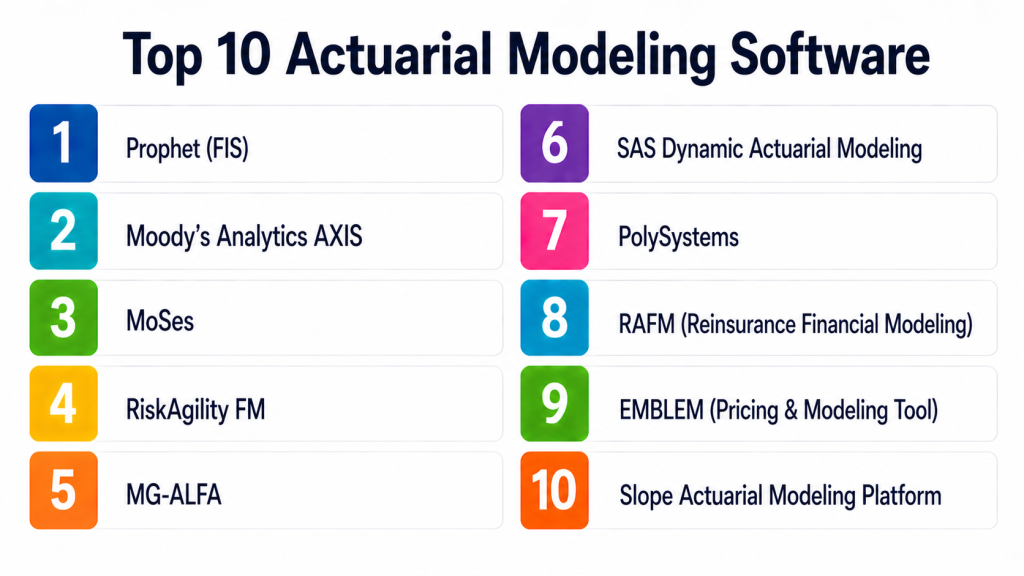
Top 10 Actuarial Modeling Software
#1 — Prophet
Short description: Prophet is a widely used actuarial modeling platform designed for life insurance and financial modeling. It enables actuaries to run complex simulations and manage risk effectively. It is best suited for enterprise insurers and financial institutions.
Key Features
- Financial modeling and projections
- Scenario testing
- Regulatory reporting
- High-performance calculations
- Integration with data systems
- Automation tools
- Risk analysis
Pros
- Industry-standard tool
- Strong modeling capabilities
- Scalable
- Reliable performance
Cons
- Complex setup
- Requires training
- High cost
- Enterprise-focused
Platforms / Deployment
Windows / Web
Cloud / On-prem
Security & Compliance
Not publicly stated
Integrations & Ecosystem
Prophet integrates with financial and insurance systems for advanced modeling workflows.
- Data platforms
- Reporting tools
- Financial systems
- Analytics tools
Support & Community
Strong enterprise support with established user community.
#2 — Moody’s Analytics AXIS
Short description: AXIS is a high-performance actuarial modeling system used for life insurance, capital modeling, and financial forecasting. It is known for scalability and analytics.
Key Features
- Financial projections
- Risk modeling
- Scenario analysis
- Regulatory reporting
- Data integration
- High-performance computing
Pros
- Strong analytics capabilities
- Scalable
- Reliable performance
- Suitable for enterprise
Cons
- Complex implementation
- Requires expertise
- Pricing varies
- Enterprise-focused
Platforms / Deployment
Windows
Cloud / On-prem
Security & Compliance
Not publicly stated
Integrations & Ecosystem
AXIS integrates with financial and risk systems.
- Data platforms
- Reporting systems
- Analytics tools
- API integrations
Support & Community
Enterprise support and professional services available.
#3 — MoSes
Short description: MoSes is an actuarial modeling platform used for life insurance modeling and risk analysis, offering flexibility and scalability.
Key Features
- Life insurance modeling
- Scenario testing
- Risk analysis
- Data integration
- Automation tools
Pros
- Flexible modeling
- Strong life insurance focus
- Scalable
- Reliable
Cons
- Requires expertise
- Complex setup
- Limited SMB use
- Pricing varies
Platforms / Deployment
Windows
Cloud / On-prem
Security & Compliance
Not publicly stated
Integrations & Ecosystem
MoSes integrates with financial and insurance systems.
- Data platforms
- Reporting tools
- Analytics tools
Support & Community
Support available with enterprise focus.
#4 — RiskAgility FM
Short description: RiskAgility FM is a financial modeling platform designed for actuarial modeling, capital management, and enterprise risk management.
Key Features
- Financial modeling
- Scenario analysis
- Risk management
- Data integration
- Automation tools
Pros
- Strong financial modeling
- Scalable
- Flexible workflows
- Enterprise-ready
Cons
- Requires setup effort
- Pricing varies
- Complex configuration
- Limited SMB focus
Platforms / Deployment
Windows / Web
Cloud / On-prem
Security & Compliance
Not publicly stated
Integrations & Ecosystem
RiskAgility integrates with financial systems.
- Data platforms
- Reporting tools
- Analytics systems
Support & Community
Enterprise support available.
#5 — MG-ALFA
Short description: MG-ALFA is an actuarial modeling solution used for life insurance valuation, projections, and risk analysis.
Key Features
- Life insurance modeling
- Financial projections
- Scenario testing
- Reporting tools
- Data integration
Pros
- Strong life insurance focus
- Reliable performance
- Scalable
- Flexible
Cons
- Limited outside life insurance
- Requires expertise
- Pricing varies
- Implementation effort
Platforms / Deployment
Windows
Cloud / On-prem
Security & Compliance
Not publicly stated
Integrations & Ecosystem
MG-ALFA integrates with actuarial and financial systems.
- Data platforms
- Reporting tools
- Analytics tools
Support & Community
Support available with enterprise focus.
#6 — SAS Dynamic Actuarial Modeling
Short description: SAS provides actuarial modeling capabilities with strong analytics and data integration features.
Key Features
- Advanced analytics
- Risk modeling
- Data integration
- Scenario analysis
- Automation tools
Pros
- Strong analytics
- Scalable
- Reliable
- Flexible
Cons
- Requires SAS expertise
- Pricing varies
- Complex setup
- Enterprise-focused
Platforms / Deployment
Web / Windows
Cloud / On-prem
Security & Compliance
Not publicly stated
Integrations & Ecosystem
SAS integrates with enterprise data platforms.
- Data warehouses
- Analytics tools
- Reporting systems
Support & Community
Strong support and global ecosystem.
#7 — PolySystems
Short description: PolySystems is a comprehensive actuarial modeling system used for life insurance and financial projections.
Key Features
- Financial modeling
- Risk analysis
- Scenario testing
- Reporting tools
- Data integration
Pros
- Reliable
- Scalable
- Industry-focused
- Strong modeling
Cons
- Limited flexibility
- Requires expertise
- Pricing varies
- Enterprise focus
Platforms / Deployment
Windows
Cloud / On-prem
Security & Compliance
Not publicly stated
Integrations & Ecosystem
PolySystems integrates with actuarial systems.
- Data platforms
- Reporting tools
- Analytics systems
Support & Community
Support available with industry focus.
#8 — RAFM
Short description: RAFM is a reinsurance financial modeling tool used for projections, pricing, and capital analysis.
Key Features
- Financial modeling
- Reinsurance analysis
- Scenario testing
- Risk assessment
- Reporting tools
Pros
- Strong reinsurance focus
- Flexible
- Useful for actuaries
- Scalable
Cons
- Niche use case
- Limited enterprise ecosystem
- Integration requirements
- Pricing varies
Platforms / Deployment
Windows
On-prem / Varies
Security & Compliance
Not publicly stated
Integrations & Ecosystem
RAFM integrates with financial systems.
- Data platforms
- Reporting tools
- Analytics tools
Support & Community
Limited compared to larger platforms.
#9 — EMBLEM
Short description: EMBLEM is a pricing and actuarial modeling tool used for predictive modeling and risk segmentation.
Key Features
- Predictive modeling
- Pricing analysis
- Risk segmentation
- Data integration
- Analytics tools
Pros
- Strong pricing capabilities
- Advanced analytics
- Scalable
- Flexible
Cons
- Focused on pricing
- Requires expertise
- Pricing varies
- Limited general modeling
Platforms / Deployment
Windows
Cloud / On-prem
Security & Compliance
Not publicly stated
Integrations & Ecosystem
EMBLEM integrates with analytics and data systems.
- Data platforms
- Analytics tools
- Reporting systems
Support & Community
Support available with analytics focus.
#10 — Slope Actuarial Modeling Platform
Short description: Slope is a modern actuarial modeling platform designed for flexible financial modeling and risk analysis.
Key Features
- Financial modeling
- Scenario analysis
- Data integration
- Automation tools
- Reporting dashboards
Pros
- Modern platform
- Flexible
- Easy to use
- Scalable
Cons
- Smaller ecosystem
- Limited enterprise adoption
- Integration requirements
- Pricing varies
Platforms / Deployment
Web
Cloud
Security & Compliance
Not publicly stated
Integrations & Ecosystem
Slope integrates with data and financial systems.
- Data platforms
- Analytics tools
- Reporting systems
Support & Community
Growing support and ecosystem.
Comparison Table
| Tool Name | Best For | Platform(s) Supported | Deployment | Standout Feature | Public Rating |
|---|---|---|---|---|---|
| Prophet | Enterprise insurers | Windows/Web | Cloud/On-prem | Industry-standard modeling | N/A |
| AXIS | Financial modeling | Windows | Cloud/On-prem | High-performance computing | N/A |
| MoSes | Life insurance | Windows | Cloud/On-prem | Flexible modeling | N/A |
| RiskAgility | Risk management | Windows/Web | Cloud/On-prem | Financial modeling | N/A |
| MG-ALFA | Life insurance | Windows | Cloud/On-prem | Valuation modeling | N/A |
| SAS | Analytics-driven modeling | Web/Windows | Cloud/On-prem | Advanced analytics | N/A |
| PolySystems | Actuarial modeling | Windows | Cloud/On-prem | Reliable projections | N/A |
| RAFM | Reinsurance modeling | Windows | On-prem | Reinsurance focus | N/A |
| EMBLEM | Pricing models | Windows | Cloud/On-prem | Predictive analytics | N/A |
| Slope | Modern modeling | Web | Cloud | Flexible platform | N/A |
Evaluation & Scoring
| Tool | Core | Ease | Integrations | Security | Performance | Support | Value | Total |
|---|---|---|---|---|---|---|---|---|
| Prophet | 9 | 7 | 8.5 | 8 | 9 | 8 | 7 | 8.2 |
| AXIS | 9 | 7 | 8.5 | 8 | 9 | 8 | 7 | 8.2 |
| MoSes | 8.5 | 7 | 8 | 8 | 8.5 | 8 | 7 | 8.0 |
| RiskAgility | 8.5 | 7.5 | 8 | 8 | 8.5 | 8 | 7.5 | 8.1 |
| MG-ALFA | 8.5 | 7 | 8 | 8 | 8.5 | 8 | 7 | 8.0 |
| SAS | 8.5 | 7.5 | 8.5 | 8 | 8.5 | 8 | 7.5 | 8.1 |
| PolySystems | 8 | 7 | 7.5 | 7.5 | 8 | 7.5 | 7 | 7.7 |
| RAFM | 7.5 | 7.5 | 7 | 7.5 | 8 | 7 | 7.5 | 7.5 |
| EMBLEM | 8 | 7.5 | 8 | 7.5 | 8 | 7.5 | 7.5 | 7.8 |
| Slope | 7.5 | 8 | 7.5 | 7.5 | 8 | 7.5 | 8 | 7.8 |
Scores are comparative and highlight relative strengths. Enterprise tools score higher in modeling power, while modern tools offer better usability and flexibility.
Which Actuarial Modeling Software Is Right for You?
Solo / Freelancer
Simple tools or spreadsheets may be sufficient.
SMB
Choose Slope or RAFM for flexibility and ease of use.
Mid-Market
Consider RiskAgility, SAS, or EMBLEM for balanced performance.
Enterprise
Use Prophet, AXIS, or MoSes for large-scale modeling.
Budget vs Premium
Budget tools focus on usability, while premium tools offer advanced modeling and analytics.
Feature Depth vs Ease of Use
Enterprise tools provide deep modeling, while modern tools focus on usability.
Integrations & Scalability
Ensure integration with data, finance, and insurance systems.
Security & Compliance Needs
Verify access controls and compliance features before selection.
Frequently Asked Questions
1. What is actuarial modeling software?
It is software used to simulate financial risks and forecast future outcomes.
2. Why is it important?
It helps insurers manage risk, pricing, and financial planning.
3. Who uses it?
Actuaries, insurers, and financial analysts.
4. What features matter most?
Modeling flexibility, analytics, integration, and scalability.
5. Are these tools cloud-based?
Many modern tools support cloud deployment.
6. Can they use AI?
Yes, some platforms include AI and predictive analytics.
7. How long does implementation take?
It varies from weeks to months.
8. Do they integrate with other systems?
Yes, with data, finance, and insurance systems.
9. Are they secure?
Security varies by vendor.
10. What are alternatives?
Spreadsheets or custom models, though they lack scalability.
Conclusion
Actuarial modeling software plays a critical role in modern insurance and financial operations. These tools enable accurate forecasting, risk management, and regulatory compliance. Enterprise platforms like Prophet, AXIS, and SAS provide powerful modeling capabilities for large organizations. Meanwhile, tools like Slope and EMBLEM offer flexible and user-friendly alternatives. The right choice depends on modeling complexity, data needs, and organizational size. Organizations should evaluate performance, integration, and scalability before selecting a platform. Running pilot projects can help validate capabilities and usability. Ultimately, the best solution is one that aligns with your risk management and financial goals.