Introduction
Port Community Systems (PCS) are digital platforms that connect all stakeholders in a port ecosystem—such as shipping lines, customs authorities, logistics providers, and terminal operators—into a single unified system. In simple terms, they act as a “single window” for sharing data, managing documents, and coordinating port activities efficiently.
These systems are critical for modern ports because they reduce paperwork, improve transparency, and speed up cargo movement. By enabling real-time data exchange and automation, PCS platforms help ports operate more efficiently, reduce congestion, and enhance global trade competitiveness.
Common use cases include:
- Cargo and vessel tracking
- Digital documentation and approvals
- Customs and regulatory compliance
- Payment processing and billing
- Coordination between logistics stakeholders
What buyers should evaluate:
- Real-time data sharing capabilities
- Integration with customs and government systems
- Workflow automation and document management
- Scalability across ports and terminals
- Security and compliance features
- API and interoperability support
- Ease of onboarding stakeholders
- Reporting and analytics
- Deployment flexibility (cloud/on-premise)
Best for: Port authorities, logistics operators, government agencies, and shipping companies managing complex trade ecosystems.
Not ideal for: Small logistics businesses without multi-stakeholder coordination needs.
Key Trends in Port Community Systems
- Single-window digital platforms for trade facilitation
- AI-driven forecasting and analytics for port operations
- Integration with national logistics and customs systems
- Cloud-native deployment for scalability
- Real-time cargo visibility and tracking
- API-first architecture for ecosystem integration
- Automation of documentation and compliance workflows
- Blockchain-based secure data exchange (emerging)
- Mobile access for port stakeholders
- Smart port initiatives and digital twins
How We Selected These Tools (Methodology)
- Evaluated adoption across global ports
- Assessed data exchange and collaboration capabilities
- Compared integration with customs and logistics systems
- Reviewed scalability and performance
- Evaluated automation and workflow features
- Considered security and compliance readiness
- Assessed vendor reputation and ecosystem
- Evaluated usability for multiple stakeholders
- Balanced national-level and commercial PCS solutions
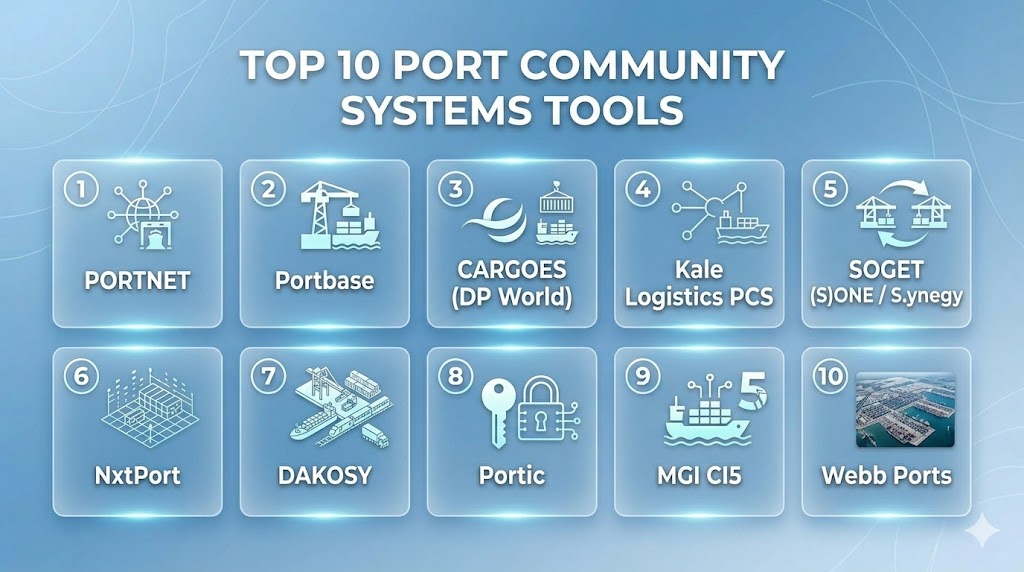
Top 10 Port Community Systems Tools
#1 — PORTNET
Short description: PORTNET is a national-level Port Community System that integrates all stakeholders across ports into a single digital platform. It supports end-to-end trade processes and government integration. It is widely considered a benchmark PCS model.
Key Features
- National single window system
- End-to-end logistics process management
- Integrated payment system
- Cargo and vessel tracking
- Government and customs integration
Pros
- Strong government integration
- Comprehensive coverage
Cons
- Limited flexibility for customization
- Mainly region-focused
Platforms / Deployment
Web
Cloud
Security & Compliance
Not publicly stated
Integrations & Ecosystem
Supports full ecosystem integration.
- Customs systems
- Payment gateways
- APIs
Support & Community
Government-backed support ecosystem.
#2 — CARGOES PCS (DP World)
Short description: CARGOES PCS is a modern platform designed to streamline cargo processes and regulatory compliance. It provides real-time visibility and connects all stakeholders digitally.
Key Features
- Customs integration
- Document management
- Billing and payments
- Cargo tracking
- Workflow automation
Pros
- Strong visibility features
- Scalable platform
Cons
- Enterprise-focused
- Implementation complexity
Platforms / Deployment
Web / Mobile
Cloud
Security & Compliance
Not publicly stated
Integrations & Ecosystem
Extensive integrations.
- Regulatory systems
- APIs
- Logistics systems
Support & Community
Enterprise-level support.
#3 — Portbase PCS
Short description: Portbase PCS is one of Europe’s largest port community platforms, connecting thousands of companies. It enables efficient data sharing and collaboration across the logistics chain.
Key Features
- Centralized data exchange
- Multi-cargo support
- Identity and access management
- Messaging system
- API-based services
Pros
- Large user ecosystem
- Strong data-sharing infrastructure
Cons
- Region-focused
- Complex onboarding
Platforms / Deployment
Web
Cloud
Security & Compliance
Access management and secure data exchange
Integrations & Ecosystem
Broad ecosystem.
- Logistics systems
- APIs
- Stakeholder platforms
Support & Community
Large active community.
#4 — Portall PCS
Short description: Portall PCS is a smart port platform that enables seamless data exchange, document processing, and stakeholder collaboration. It is used across multiple ports globally.
Key Features
- Digital documentation and e-sign
- AI-powered analytics
- Payment processing
- Stakeholder integration
- Real-time dashboards
Pros
- Strong automation
- Flexible deployment
Cons
- Customization required
- Adoption varies
Platforms / Deployment
Web
Cloud / On-premise
Security & Compliance
Not publicly stated
Integrations & Ecosystem
Wide integration support.
- Shipping lines
- Banks
- APIs
Support & Community
Enterprise support.
#5 — Global PORTNET (CrimsonLogic)
Short description: Global PORTNET is a scalable PCS platform designed for global ports and terminals. It connects stakeholders and enables digital trade processes.
Key Features
- Single-window system
- Cargo tracking
- Payment processing
- Document automation
- Real-time visibility
Pros
- Proven large-scale system
- Strong transaction handling
Cons
- Enterprise-level complexity
- Cost may vary
Platforms / Deployment
Web
Cloud
Security & Compliance
Not publicly stated
Integrations & Ecosystem
Strong ecosystem.
- Government systems
- APIs
Support & Community
Enterprise-grade support.
#6 — iPortman PCS (Envision)
Short description: iPortman PCS is a modular platform designed to automate port communication and improve efficiency. It supports integration with multiple port subsystems.
Key Features
- Electronic communication platform
- Workflow automation
- KPI monitoring
- Integration with ERP systems
- Planning and scheduling
Pros
- Modular design
- Flexible deployment
Cons
- Requires customization
- Limited global adoption
Platforms / Deployment
Web
Cloud / On-premise
Security & Compliance
Not publicly stated
Integrations & Ecosystem
Supports integrations.
- ERP systems
- APIs
Support & Community
24/7 support available.
#7 — Infoport PCS
Short description: Infoport PCS is a digital platform supporting port operations, logistics, and stakeholder collaboration. It is widely used for smart port initiatives.
Key Features
- Cargo and vessel management
- Booking and documentation
- Transport coordination
- Mobile access
- Real-time tracking
Pros
- Strong operational coverage
- Supports smart port strategy
Cons
- Complex setup
- Region-focused
Platforms / Deployment
Web / Mobile
Cloud
Security & Compliance
Not publicly stated
Integrations & Ecosystem
Supports integrations.
- Logistics systems
- APIs
Support & Community
Standard enterprise support.
#8 — dbh Port Community System
Short description: dbh PCS provides a central communication platform connecting transport, logistics, and government systems. It focuses on interoperability and scalability.
Key Features
- Central communication hub
- Data exchange platform
- Scalable architecture
- Integration support
- Web-based access
Pros
- High data quality
- Scalable system
Cons
- Limited global visibility
- Customization required
Platforms / Deployment
Web
Cloud
Security & Compliance
Not publicly stated
Integrations & Ecosystem
Supports integrations.
- Transport systems
- APIs
Support & Community
Standard support.
#9 — Wärtsilä Port Community System
Short description: Wärtsilä PCS focuses on connecting stakeholders and improving operational efficiency through data-driven collaboration.
Key Features
- Data exchange platform
- Smart port integration
- Analytics tools
- Collaboration features
- Real-time insights
Pros
- Strong integration with smart port solutions
- Data-driven approach
Cons
- Requires integration effort
- Enterprise-focused
Platforms / Deployment
Web
Cloud
Security & Compliance
Not publicly stated
Integrations & Ecosystem
Supports integrations.
- Smart port systems
- APIs
Support & Community
Enterprise support.
#10 — MGI CI5 PCS
Short description: CI5 is a port community platform focused on managing goods flow and improving coordination across port stakeholders.
Key Features
- Data aggregation
- Workflow automation
- Supply chain integration
- Reporting tools
- EDI connectivity
Pros
- Strong data management
- Flexible system
Cons
- Limited awareness globally
- Customization needed
Platforms / Deployment
Web
Cloud
Security & Compliance
Not publicly stated
Integrations & Ecosystem
Supports integrations.
- EDI systems
- APIs
Support & Community
Standard support.
Comparison Table (Top 10)
| Tool Name | Best For | Platform(s) Supported | Deployment | Standout Feature | Public Rating |
|---|---|---|---|---|---|
| PORTNET | National ports | Web | Cloud | Single window | N/A |
| CARGOES PCS | Enterprise | Web, Mobile | Cloud | End-to-end visibility | N/A |
| Portbase | European ports | Web | Cloud | Large ecosystem | N/A |
| Portall | Smart ports | Web | Hybrid | AI analytics | N/A |
| Global PORTNET | Global ports | Web | Cloud | High transaction scale | N/A |
| iPortman | Modular PCS | Web | Hybrid | Workflow automation | N/A |
| Infoport | Smart ports | Web, Mobile | Cloud | Multi-process coverage | N/A |
| dbh PCS | Communication hub | Web | Cloud | Interoperability | N/A |
| Wärtsilä PCS | Smart ports | Web | Cloud | Data-driven insights | N/A |
| MGI CI5 | Logistics hubs | Web | Cloud | Data aggregation | N/A |
Evaluation & Scoring of Port Community Systems
| Tool Name | Core (25%) | Ease (15%) | Integrations (15%) | Security (10%) | Performance (10%) | Support (10%) | Value (15%) | Weighted Total |
|---|---|---|---|---|---|---|---|---|
| PORTNET | 10 | 6 | 9 | 8 | 9 | 9 | 7 | 8.5 |
| CARGOES PCS | 9 | 7 | 9 | 8 | 9 | 9 | 7 | 8.4 |
| Portbase | 9 | 7 | 9 | 8 | 9 | 8 | 7 | 8.3 |
| Portall | 8 | 8 | 8 | 7 | 8 | 8 | 8 | 8.0 |
| Global PORTNET | 9 | 6 | 9 | 8 | 9 | 8 | 7 | 8.2 |
| iPortman | 8 | 7 | 8 | 7 | 8 | 7 | 8 | 7.8 |
| Infoport | 8 | 7 | 8 | 7 | 8 | 7 | 8 | 7.8 |
| dbh PCS | 8 | 7 | 7 | 7 | 8 | 7 | 7 | 7.5 |
| Wärtsilä PCS | 8 | 7 | 8 | 7 | 8 | 8 | 7 | 7.8 |
| MGI CI5 | 7 | 7 | 7 | 6 | 7 | 7 | 7 | 7.2 |
How to interpret scores:
- Higher scores indicate stronger overall capability
- National systems excel in integrations and scale
- Modular tools offer better flexibility and value
- Choose based on ecosystem size and integration needs
Which Port Community System Is Right for You?
Solo / Freelancer
Not applicable.
SMB
MGI CI5, iPortman.
Mid-Market
Infoport, Portall.
Enterprise
PORTNET, CARGOES PCS, Portbase.
Budget vs Premium
- Budget: MGI CI5
- Premium: PORTNET, CARGOES PCS
Feature Depth vs Ease of Use
- Feature-rich: PORTNET
- Easier tools: Portall
Integrations & Scalability
- Strong: Portbase, Global PORTNET
Security & Compliance Needs
- Enterprise-grade PCS recommended
Frequently Asked Questions (FAQs)
Q1: What is a Port Community System?
A PCS is a digital platform that connects all stakeholders in a port for data sharing and operations management.
Q2: Who uses PCS platforms?
Port authorities, shipping companies, logistics providers, and government agencies.
Q3: Why are PCS important?
They improve efficiency, reduce paperwork, and enable real-time coordination.
Q4: Are PCS platforms cloud-based?
Most modern PCS solutions are cloud-based or hybrid.
Q5: Do PCS systems integrate with customs?
Yes, integration with customs and regulatory systems is a key feature.
Q6: Can PCS reduce delays?
Yes, by improving coordination and automation.
Q7: Are they secure?
Security features vary, but they focus on secure data exchange.
Q8: How long does implementation take?
It can take months depending on complexity.
Q9: Are PCS customizable?
Many platforms offer customization options.
Q10: What are common challenges?
Integration complexity and stakeholder onboarding.
Conclusion
Port Community Systems are essential for modern port ecosystems, enabling seamless collaboration between multiple stakeholders. They transform traditional port operations into efficient, digital-first environments with real-time visibility and automation. The best PCS depends on the scale and complexity of your port operations. National-level systems provide deep integration and coverage, while modular platforms offer flexibility and faster deployment. As global trade continues to grow, PCS platforms will play a key role in improving efficiency, reducing delays, and supporting smart port initiatives. To make the right choice, shortlist a few solutions, evaluate integration capabilities, and run pilot implementations to validate performance and stakeholder adoption.