Introduction
Building Energy Management Systems (BEMS) are software platforms designed to monitor, control, and optimize energy consumption within buildings. These systems integrate with infrastructure such as HVAC, lighting, power systems, and IoT sensors to provide real-time visibility and automation for energy usage.
As energy costs rise and sustainability becomes a core business priority, organizations are increasingly adopting BEMS to reduce waste, improve efficiency, and meet regulatory requirements. Modern BEMS platforms go beyond monitoring—they use analytics and automation to actively optimize energy performance across facilities.
Real-world use cases
- Energy consumption monitoring – Track electricity, heating, and cooling usage
- HVAC optimization – Automatically adjust systems based on occupancy
- Sustainability reporting – Measure and reduce carbon footprint
- Facility automation – Control lighting and equipment usage
- Cost reduction – Identify inefficiencies and reduce energy bills
What buyers should evaluate
- Integration with HVAC and building systems
- Real-time monitoring and analytics capabilities
- Automation and control features
- Scalability across multiple buildings
- IoT and sensor compatibility
- Reporting and compliance tracking
- Ease of deployment and usability
- Security and data protection
- Total cost of ownership
Best for: Enterprises, facility managers, real estate operators, smart building teams, and sustainability-focused organizations.
Not ideal for: Small buildings with minimal energy consumption or organizations without automation requirements.
Key Trends in Building Energy Management Systems
- AI-driven energy optimization for predictive control
- IoT integration for real-time monitoring
- Cloud-based BEMS platforms replacing legacy systems
- Smart building automation and digital twins
- Energy usage forecasting and demand response systems
- Integration with sustainability and ESG platforms
- Mobile dashboards for facility teams
- Edge computing for faster processing
- Automated compliance and reporting
- Renewable energy integration (solar, storage)
How We Selected These Tools (Methodology)
- Market adoption and industry credibility
- Feature depth in energy monitoring and control
- Performance and reliability
- Security and compliance readiness
- Integration with building systems and IoT
- Suitability across SMB, mid-market, and enterprise
- Ease of implementation and usability
- Cost efficiency and scalability
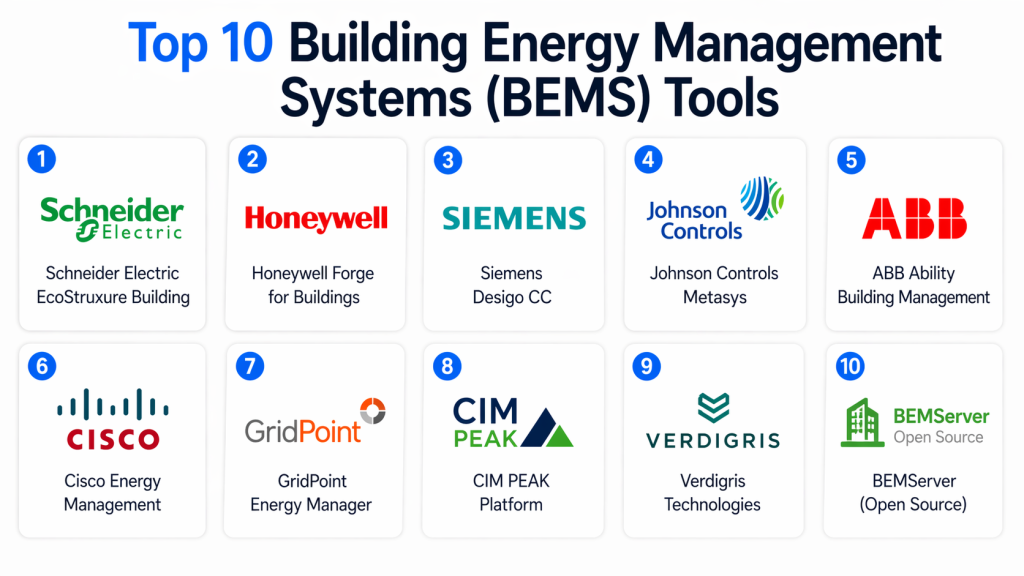
Top 10 Building Energy Management Systems (BEMS)
#1 — Schneider Electric EcoStruxure Building
Short description: EcoStruxure Building is a comprehensive BEMS platform that combines IoT, analytics, and automation to optimize building energy performance and operations.
Key Features
- Real-time energy monitoring
- HVAC and lighting control
- IoT integration
- Advanced analytics dashboards
- Automation workflows
- Sustainability tracking
Pros
- Strong IoT capabilities
- Scalable enterprise solution
Cons
- Complex setup
- Premium pricing
Platforms / Deployment
Cloud / Hybrid
Security & Compliance
Encryption, enterprise controls (Not publicly stated fully)
Integrations & Ecosystem
Integrates with building systems and enterprise tools.
- IoT devices
- HVAC systems
- APIs
Support & Community
Strong enterprise support and partner ecosystem.
#2 — Honeywell Forge for Buildings
Short description: Honeywell Forge provides advanced energy management with AI-driven insights and building automation features.
Key Features
- Energy analytics
- Predictive maintenance
- Real-time monitoring
- Automation controls
- Reporting dashboards
Pros
- Strong analytics capabilities
- Enterprise-grade performance
Cons
- High cost
- Complex implementation
Platforms / Deployment
Cloud
Security & Compliance
Not publicly stated
Integrations & Ecosystem
- Building systems
- IoT platforms
- APIs
Support & Community
Enterprise-level support.
#3 — Siemens Desigo CC
Short description: Desigo CC is an integrated building management system that includes energy monitoring and control capabilities.
Key Features
- Energy monitoring
- HVAC integration
- Building automation
- Real-time dashboards
- Alarm management
Pros
- Comprehensive platform
- Strong automation features
Cons
- Requires expertise
- Expensive
Platforms / Deployment
On-premise / Hybrid
Security & Compliance
Not publicly stated
Integrations & Ecosystem
- Building systems
- IoT devices
- APIs
Support & Community
Strong enterprise support.
#4 — Johnson Controls Metasys
Short description: Metasys is a building automation system that includes energy management features for monitoring and controlling building operations.
Key Features
- Energy monitoring
- HVAC control
- Automation workflows
- Analytics dashboards
- Alarm management
Pros
- Reliable platform
- Scalable
Cons
- Complex setup
- High cost
Platforms / Deployment
Cloud / On-premise
Security & Compliance
Not publicly stated
Integrations & Ecosystem
- Building systems
- APIs
- IoT devices
Support & Community
Enterprise support and services.
#5 — ABB Ability Building Management
Short description: ABB Ability provides energy monitoring and automation tools for optimizing building performance and efficiency.
Key Features
- Energy analytics
- Automation controls
- IoT integration
- Real-time monitoring
- Reporting dashboards
Pros
- Strong industrial integration
- Scalable
Cons
- Complex deployment
- Premium pricing
Platforms / Deployment
Cloud
Security & Compliance
Not publicly stated
Integrations & Ecosystem
- Industrial systems
- IoT platforms
- APIs
Support & Community
Enterprise-level support.
#6 — Cisco Energy Management
Short description: Cisco Energy Management leverages network infrastructure to monitor and optimize energy usage across connected devices and buildings.
Key Features
- Energy monitoring
- Device-level tracking
- Network-based analytics
- Automation tools
- Reporting
Pros
- Strong networking integration
- Real-time insights
Cons
- Limited building-specific features
- Requires Cisco ecosystem
Platforms / Deployment
Cloud
Security & Compliance
Not publicly stated
Integrations & Ecosystem
- Network systems
- APIs
- IoT devices
Support & Community
Reliable enterprise support.
#7 — GridPoint Energy Manager
Short description: GridPoint offers cloud-based energy management solutions focused on cost savings and sustainability.
Key Features
- Energy monitoring
- HVAC control
- Analytics dashboards
- Demand response
- Reporting
Pros
- Easy to use
- Strong analytics
Cons
- Limited enterprise features
- Less customization
Platforms / Deployment
Cloud
Security & Compliance
Not publicly stated
Integrations & Ecosystem
- IoT devices
- APIs
- Energy systems
Support & Community
Good customer support.
#8 — CIM PEAK Platform
Short description: CIM PEAK is an analytics-driven platform for managing building performance and energy usage.
Key Features
- Energy analytics
- Data visualization
- Performance optimization
- Reporting tools
- Integration support
Pros
- Strong analytics
- Flexible platform
Cons
- Requires data integration
- Learning curve
Platforms / Deployment
Cloud
Security & Compliance
Not publicly stated
Integrations & Ecosystem
- Data platforms
- APIs
- IoT systems
Support & Community
Good documentation and support.
#9 — Verdigris Technologies
Short description: Verdigris uses AI and machine learning to analyze energy consumption and optimize building performance.
Key Features
- AI-driven insights
- Real-time monitoring
- Predictive analytics
- Energy optimization
- Reporting dashboards
Pros
- Strong AI capabilities
- Easy deployment
Cons
- Limited enterprise customization
- Hardware dependency
Platforms / Deployment
Cloud
Security & Compliance
Not publicly stated
Integrations & Ecosystem
- IoT devices
- APIs
- Energy systems
Support & Community
Responsive support.
#10 — BEMServer
Short description: BEMServer is an open-source energy management platform designed for monitoring and analyzing building energy usage.
Key Features
- Energy monitoring
- Data analytics
- Open-source flexibility
- Reporting tools
- Integration support
Pros
- Open-source
- Flexible customization
Cons
- Requires technical expertise
- Limited enterprise support
Platforms / Deployment
Self-hosted / Cloud
Security & Compliance
Not publicly stated
Integrations & Ecosystem
- APIs
- Data systems
Support & Community
Community-driven support.
Comparison Table (Top 10)
| Tool Name | Best For | Platform(s) Supported | Deployment | Standout Feature | Public Rating |
|---|---|---|---|---|---|
| EcoStruxure | Enterprise | Web | Hybrid | IoT integration | N/A |
| Honeywell Forge | Enterprise | Web | Cloud | AI analytics | N/A |
| Siemens Desigo | Large buildings | Web | Hybrid | Automation | N/A |
| Metasys | Facility control | Web | Hybrid | HVAC control | N/A |
| ABB Ability | Industrial buildings | Web | Cloud | Energy analytics | N/A |
| Cisco Energy | Network-based | Web | Cloud | Device tracking | N/A |
| GridPoint | SMB | Web | Cloud | Cost optimization | N/A |
| CIM PEAK | Analytics | Web | Cloud | Data insights | N/A |
| Verdigris | AI insights | Web | Cloud | ML optimization | N/A |
| BEMServer | Open-source | Web | Self-hosted | Flexibility | N/A |
Evaluation & Scoring of Building Energy Management Systems
| Tool Name | Core (25%) | Ease (15%) | Integrations (15%) | Security (10%) | Performance (10%) | Support (10%) | Value (15%) | Weighted Total |
|---|---|---|---|---|---|---|---|---|
| EcoStruxure | 9 | 6 | 9 | 8 | 9 | 9 | 6 | 8.2 |
| Honeywell Forge | 9 | 6 | 8 | 8 | 9 | 9 | 6 | 8.1 |
| Siemens Desigo | 9 | 6 | 8 | 8 | 9 | 9 | 6 | 8.1 |
| Metasys | 8 | 6 | 8 | 7 | 8 | 8 | 6 | 7.7 |
| ABB Ability | 8 | 6 | 8 | 7 | 8 | 8 | 6 | 7.7 |
| Cisco Energy | 7 | 7 | 8 | 7 | 7 | 7 | 7 | 7.3 |
| GridPoint | 7 | 8 | 7 | 6 | 7 | 7 | 8 | 7.4 |
| CIM PEAK | 8 | 7 | 7 | 6 | 8 | 7 | 7 | 7.5 |
| Verdigris | 8 | 8 | 7 | 6 | 8 | 7 | 7 | 7.6 |
| BEMServer | 7 | 6 | 7 | 6 | 7 | 6 | 9 | 7.1 |
How to interpret scores:
These scores provide a comparative benchmark across tools based on features, usability, integrations, and value. Higher scores indicate stronger capabilities, but the best choice depends on your organization’s requirements and infrastructure.
Which Building Energy Management Systems Tool Is Right for You?
Solo / Freelancer
Not required unless managing a dedicated facility.
SMB
GridPoint and Verdigris are suitable for smaller deployments.
Mid-Market
CIM PEAK and ABB Ability provide balanced features.
Enterprise
EcoStruxure, Honeywell Forge, Siemens Desigo, and Metasys are best for large-scale operations.
Budget vs Premium
- Budget: BEMServer
- Premium: EcoStruxure, Honeywell
Feature Depth vs Ease of Use
- Advanced: Siemens Desigo
- Easy: GridPoint
Integrations & Scalability
Choose IoT-enabled platforms like EcoStruxure.
Security & Compliance Needs
Enterprise tools offer stronger security controls.
Frequently Asked Questions (FAQs)
1. What is a Building Energy Management System?
A BEMS is software that monitors and controls energy usage in buildings to improve efficiency and reduce costs.
2. How does BEMS work?
It collects data from sensors and building systems, analyzes it, and automates energy control processes.
3. What are the benefits of BEMS?
Reduced energy costs, improved efficiency, and better sustainability tracking.
4. Who should use BEMS?
Facility managers, enterprises, and organizations with large buildings benefit most.
5. Does BEMS require hardware?
Yes, most systems rely on sensors and IoT devices.
6. Is BEMS expensive?
Costs vary depending on scale and features.
7. Can BEMS integrate with existing systems?
Yes, most tools integrate with building and enterprise systems.
8. Does BEMS support sustainability goals?
Yes, it helps track and reduce energy consumption.
9. How long does implementation take?
From weeks to months depending on complexity.
10. Can small buildings use BEMS?
Yes, but simpler solutions are recommended.
Conclusion
Building Energy Management Systems are essential for organizations looking to optimize energy usage, reduce operational costs, and improve sustainability outcomes. By providing real-time insights and automation capabilities, these tools enable smarter building operations and better resource utilization. However, the right solution depends on your building size, infrastructure, and operational goals. Enterprise platforms offer deep analytics and scalability, while smaller tools focus on simplicity and affordability. Before selecting a BEMS platform, it is important to evaluate integration capabilities, ease of use, and long-term value. Running a pilot project can help ensure the system meets your requirements. When implemented effectively, a BEMS can transform building operations into a more efficient, sustainable, and data-driven system.