Introduction
Payment Orchestration Platforms are software solutions that centralize and manage multiple payment gateways, processors, and payment methods through a single integration layer. They enable merchants, fintechs, and enterprises to optimize transaction routing, increase approval rates, reduce declines, and simplify global payment operations.
These platforms are essential because businesses often work with multiple payment providers, currencies, and geographies. Manual routing and separate integrations create complexity, delays, and operational inefficiencies. Common use cases include multi-gateway management, intelligent routing, transaction reconciliation, fraud management, and reporting dashboards.
Buyers should evaluate gateway integration coverage, routing intelligence, API flexibility, real-time reporting, global payment support, fraud detection, scalability, settlement management, and vendor support.
Best for: Large merchants, fintechs, marketplaces, and enterprises with multi-currency and multi-region payment needs.
Not ideal for: Small businesses with only a single gateway or minimal transaction volume.
Key Trends in Payment Orchestration Platforms
- Multi-gateway optimization to increase transaction success rates
- Real-time routing intelligence using AI and analytics
- Global multi-currency support for cross-border commerce
- Fraud detection and compliance integration
- Plug-and-play integrations with gateways and processors
- Subscription and recurring payment orchestration
- Cloud-native and API-first architectures
- Embedded payments in apps and marketplaces
- Automated reconciliation and reporting
- Scalable platforms for high-volume transactions
How We Selected These Tools
- Strong adoption across merchants, fintechs, and marketplaces
- Support for multiple payment gateways and processors
- Intelligent routing and transaction optimization
- API-first and developer-friendly architecture
- Scalability for high-volume, multi-region payments
- Security and compliance readiness signals
- Integration with fraud, ERP, and CRM systems
- Real-time reporting and analytics
- Reliability and uptime metrics
- Vendor ecosystem and support quality
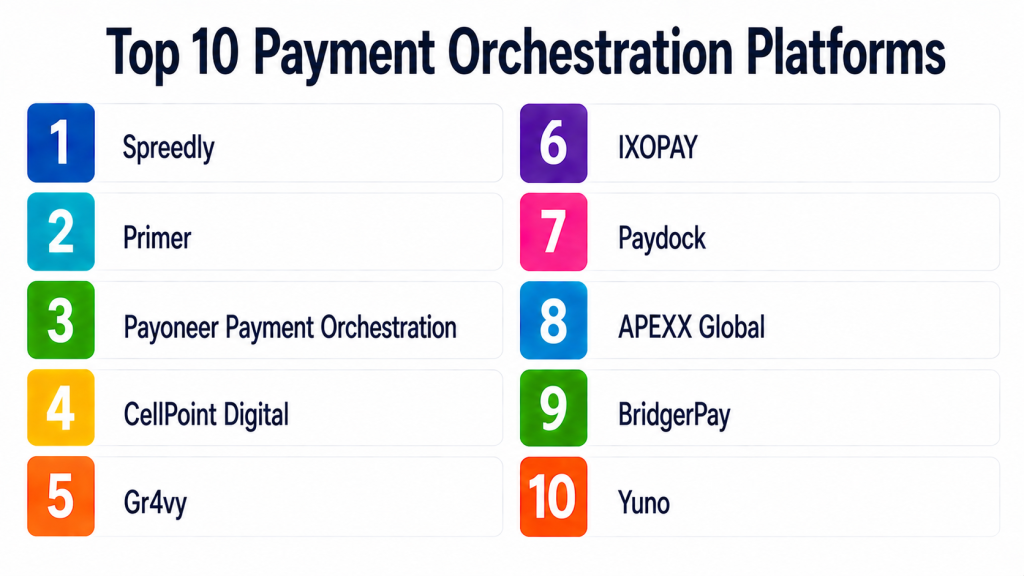
Top 10 Payment Orchestration Platforms
#1 — Spreedly
Short description: Spreedly provides a gateway-agnostic payment orchestration platform that connects merchants with multiple payment providers, enabling optimized routing and secure tokenization.
Key Features
- Multi-gateway connectivity
- Tokenization and security
- Routing intelligence
- Fraud detection integration
- API-first platform
- Reporting dashboards
Pros
- High flexibility
- Scalable
- Developer-friendly
- Enterprise-ready
Cons
- Requires integration effort
- Pricing varies
- Not suitable for small merchants
- Feature depth requires setup
Platforms / Deployment
Web
Cloud
Security & Compliance
PCI DSS compliant
Not publicly stated
Integrations & Ecosystem
- Payment gateways
- Fraud tools
- eCommerce platforms
- CRM and ERP systems
Support & Community
Strong developer support and documentation.
#2 — Primer
Short description: Primer offers an intelligent payment orchestration platform that unifies multiple gateways, processors, and fraud tools into a single API.
Key Features
- Gateway aggregation
- AI-powered routing
- Fraud detection integration
- Multi-currency support
- Real-time analytics
Pros
- Flexible orchestration
- AI optimization
- Scalable
- Developer-focused
Cons
- Enterprise-focused
- Setup effort required
- Pricing varies
- Customization needed
Platforms / Deployment
Web
Cloud
Security & Compliance
PCI DSS compliant
Not publicly stated
Integrations & Ecosystem
- Stripe, Adyen, PayPal
- Fraud detection services
- Analytics platforms
Support & Community
Developer-friendly support and ecosystem.
#3 — Payoneer Payment Orchestration
Short description: Payoneer offers a platform for managing multiple payment methods and gateways with intelligent routing for global merchants.
Key Features
- Multi-gateway management
- Global currency support
- Routing optimization
- Fraud prevention tools
- Reporting and reconciliation
Pros
- Strong international reach
- Scalable
- Reliable
- Enterprise-ready
Cons
- Limited customization
- Integration effort needed
- Pricing varies
- Enterprise focus
Platforms / Deployment
Web
Cloud
Security & Compliance
PCI DSS compliant
Not publicly stated
Integrations & Ecosystem
- Payment processors
- ERP and CRM tools
- Analytics platforms
Support & Community
Enterprise support available.
#4 — CellPoint Digital
Short description: CellPoint Digital provides orchestration services focusing on intelligent routing and payment optimization for airlines and travel businesses.
Key Features
- Multi-gateway orchestration
- Intelligent routing
- Fraud and risk tools
- Real-time reporting
- Multi-currency support
Pros
- Industry-specific solutions
- High reliability
- Scalable
- Analytics-focused
Cons
- Niche focus
- Enterprise setup required
- Pricing varies
- Limited for general merchants
Platforms / Deployment
Web
Cloud
Security & Compliance
PCI DSS compliant
Not publicly stated
Integrations & Ecosystem
- Payment gateways
- Travel and booking systems
- Fraud tools
Support & Community
Industry-focused enterprise support.
#5 — Gr4vy
Short description: Gr4vy is a flexible payment orchestration platform designed for marketplaces, SaaS, and eCommerce companies.
Key Features
- Multi-gateway connectivity
- API-first architecture
- Real-time analytics
- Routing optimization
- Subscription and recurring payments
Pros
- Flexible integration
- Scalable
- Developer-friendly
- Supports modern commerce
Cons
- Enterprise features require setup
- Pricing varies
- Integration effort
- Smaller ecosystem
Platforms / Deployment
Web
Cloud
Security & Compliance
PCI DSS compliant
Not publicly stated
Integrations & Ecosystem
- Stripe, Adyen, PayPal
- Fraud detection
- Analytics and ERP
Support & Community
Developer-focused support.
#6 — IXOPAY
Short description: IXOPAY provides a global payment orchestration platform with extensive gateway connectivity and routing intelligence.
Key Features
- Multi-gateway orchestration
- Payment routing
- Fraud integration
- Reporting dashboards
- Multi-currency support
Pros
- Enterprise-ready
- Global reach
- Flexible
- Scalable
Cons
- Complex setup
- Pricing varies
- Integration effort
- Enterprise focus
Platforms / Deployment
Web
Cloud
Security & Compliance
PCI DSS compliant
Not publicly stated
Integrations & Ecosystem
- Payment gateways
- ERP systems
- Fraud tools
Support & Community
Strong enterprise support.
#7 — Paydock
Short description: Paydock offers a developer-friendly orchestration platform with centralized control over multiple payment providers and methods.
Key Features
- Multi-gateway support
- API integrations
- Fraud management
- Routing optimization
- Analytics dashboards
Pros
- Flexible
- Developer-friendly
- Scalable
- Easy integration
Cons
- Limited enterprise depth
- Pricing varies
- Integration effort
- Smaller ecosystem
Platforms / Deployment
Web
Cloud
Security & Compliance
PCI DSS compliant
Not publicly stated
Integrations & Ecosystem
- Stripe, PayPal, Adyen
- ERP and analytics platforms
Support & Community
Support focused on developers.
#8 — APEXX Global
Short description: APEXX provides payment orchestration for global merchants with multi-gateway connectivity and routing intelligence.
Key Features
- Gateway aggregation
- Payment routing
- Fraud tools integration
- Multi-currency support
- Analytics dashboards
Pros
- Global reach
- Scalable
- Flexible
- Reliable
Cons
- Enterprise-focused
- Pricing varies
- Setup required
- Integration complexity
Platforms / Deployment
Web
Cloud
Security & Compliance
PCI DSS compliant
Not publicly stated
Integrations & Ecosystem
- Payment processors
- Fraud detection services
- ERP and CRM
Support & Community
Enterprise support available.
#9 — BridgerPay
Short description: BridgerPay offers multi-gateway payment orchestration with advanced routing and international payment capabilities.
Key Features
- Multi-gateway support
- Intelligent routing
- Fraud management
- Multi-currency processing
- Reporting tools
Pros
- Flexible routing
- International support
- Scalable
- Enterprise-ready
Cons
- Integration effort
- Pricing varies
- Enterprise focus
- Setup required
Platforms / Deployment
Web
Cloud
Security & Compliance
PCI DSS compliant
Not publicly stated
Integrations & Ecosystem
- Payment gateways
- ERP and CRM tools
- Fraud detection services
Support & Community
Enterprise-focused support.
#10 — Yuno
Short description: Yuno is a cloud-based payment orchestration platform focused on simplicity and connectivity across multiple payment providers.
Key Features
- Multi-gateway orchestration
- API-first architecture
- Routing optimization
- Analytics dashboards
- Fraud integration
Pros
- Easy setup
- Flexible
- Developer-friendly
- Scalable
Cons
- Limited enterprise features
- Pricing varies
- Integration effort
- Smaller ecosystem
Platforms / Deployment
Web
Cloud
Security & Compliance
PCI DSS compliant
Not publicly stated
Integrations & Ecosystem
- Stripe, PayPal, Adyen
- Fraud and analytics tools
Support & Community
Developer-focused support.
Comparison Table
| Tool Name | Best For | Platform(s) Supported | Deployment | Standout Feature | Public Rating |
|---|---|---|---|---|---|
| Spreedly | Enterprise & fintech | Web | Cloud | Multi-gateway orchestration | N/A |
| Primer | Developers & merchants | Web | Cloud | AI-powered routing | N/A |
| Payoneer | Global merchants | Web | Cloud | International reach | N/A |
| CellPoint | Travel & airlines | Web | Cloud | Industry-specific routing | N/A |
| Gr4vy | SaaS & marketplaces | Web | Cloud | API-first orchestration | N/A |
| IXOPAY | Enterprise merchants | Web | Cloud | Global reach | N/A |
| Paydock | Developers & SMB | Web | Cloud | Developer-friendly APIs | N/A |
| APEXX | Global merchants | Web | Cloud | Payment routing | N/A |
| BridgerPay | International merchants | Web | Cloud | Multi-currency support | N/A |
| Yuno | Developers & SMB | Web | Cloud | Simplicity & connectivity | N/A |
Evaluation & Scoring of Payment Orchestration Platforms
| Tool | Core | Ease | Integrations | Security | Performance | Support | Value | Weighted Total |
|---|---|---|---|---|---|---|---|---|
| Spreedly | 9 | 7.5 | 9 | 8 | 9 | 8 | 7.5 | 8.3 |
| Primer | 8.5 | 8 | 8.5 | 8 | 8.5 | 8 | 8 | 8.2 |
| Payoneer | 8.5 | 7.5 | 8 | 8 | 8.5 | 8 | 7.5 | 8.0 |
| CellPoint | 8 | 7.5 | 8 | 8 | 8 | 7.5 | 7.5 | 7.8 |
| Gr4vy | 8.5 | 8 | 8.5 | 8 | 8.5 | 8 | 8 | 8.2 |
| IXOPAY | 8.5 | 7.5 | 8.5 | 8 | 8.5 | 8 | 7.5 | 8.1 |
| Paydock | 8 | 8 | 8 | 8 | 8 | 7.5 | 7.5 | 7.9 |
| APEXX | 8.5 | 7.5 | 8.5 | 8 | 8.5 | 8 | 7.5 | 8.1 |
| BridgerPay | 8.5 | 7.5 | 8.5 | 8 | 8.5 | 8 | 7.5 | 8.1 |
| Yuno | 8 | 8 | 8 | 8 | 8 | 7.5 | 7.5 | 7.9 |
Scores reflect comparative strengths, highlighting enterprise-grade scalability versus developer-friendly flexibility.
Which Payment Orchestration Platform Is Right for You?
Solo / Freelancer
Not required; basic payment gateways suffice.
SMB
Choose Paydock or Yuno for simplicity and easy integration.
Mid-Market
Consider Gr4vy, Primer, or Spreedly for scalability and multi-gateway support.
Enterprise
Use IXOPAY, APEXX, or BridgerPay for global operations and routing intelligence.
Budget vs Premium
Budget tools focus on ease of use; premium platforms provide AI routing and multi-gateway orchestration.
Feature Depth vs Ease of Use
Enterprise platforms provide complex routing and analytics, while SMB-focused tools prioritize usability.
Integrations & Scalability
Ensure integration with gateways, processors, fraud tools, and analytics platforms.
Security & Compliance Needs
Verify PCI DSS compliance and tokenization support before selecting a platform.
Frequently Asked Questions
1. What is a payment orchestration platform?
It is software that manages multiple payment gateways, processors, and methods through a single integration.
2. Why is it important?
It improves transaction success rates, reduces declines, and simplifies global payments.
3. Who uses these platforms?
Merchants, fintechs, marketplaces, and enterprises with high transaction volumes.
4. What features matter most?
Routing intelligence, multi-gateway support, APIs, and fraud prevention.
5. Are these cloud-based?
Most modern platforms are cloud-native.
6. Can they handle global payments?
Yes, they support multiple currencies and regions.
7. How long does integration take?
It varies from days to weeks depending on complexity.
8. Do they improve approval rates?
Yes, intelligent routing increases authorization success.
9. Are they secure?
Yes, most platforms comply with PCI DSS and use tokenization.
10. What are alternatives?
Manual gateway integration or relying on a single provider.
Conclusion
Payment Orchestration Platforms are essential for businesses managing multiple gateways and global transactions. They enable smarter routing, higher approval rates, and unified payment operations. Enterprise platforms like IXOPAY, APEXX, and BridgerPay offer robust capabilities for global merchants. Meanwhile, Gr4vy, Primer, and Spreedly provide flexibility and developer-focused orchestration. The right platform depends on transaction volume, geography, and integration needs. Organizations should evaluate scalability, routing intelligence, and compliance features carefully. Running pilot implementations can validate performance and ROI. Ultimately, the best platform aligns with your payments strategy and growth objectives.