Introduction
Maritime Vessel Management Software is used by shipping companies, fleet operators, and maritime organizations to manage vessels, crew, maintenance, compliance, and operations from a centralized platform. In simple terms, it acts as a digital control system that helps ensure ships operate safely, efficiently, and in compliance with international regulations.
With increasing global trade and stricter maritime regulations, managing vessels manually is no longer practical. Modern platforms provide real-time tracking, predictive maintenance, and automated compliance workflows. These tools help reduce downtime, improve safety, and optimize operational costs across fleets.
Common use cases include:
- Fleet and vessel performance monitoring
- Planned maintenance and repair scheduling
- Crew management and certification tracking
- Compliance with maritime regulations (ISM, SOLAS)
- Voyage planning and fuel optimization
What buyers should evaluate:
- Fleet management and maintenance capabilities
- Compliance tracking and audit readiness
- Real-time monitoring and analytics
- Integration with logistics and ERP systems
- Ease of use and onboarding
- Mobile and offline accessibility (for ships at sea)
- Scalability for multi-vessel fleets
- Reporting and dashboards
- Security and data control
Best for: Shipping companies, fleet operators, offshore operators, and maritime logistics providers managing multiple vessels.
Not ideal for: Small operators with a single vessel and minimal operational complexity.
Key Trends in Maritime Vessel Management Software
- AI-powered predictive maintenance and alerts
- Real-time vessel tracking using AIS and GPS
- Cloud and hybrid deployment for onboard + shore sync
- Automation of compliance and audit workflows
- Integration with logistics and supply chain platforms
- Digital twins for vessel simulation and optimization
- Mobile-first platforms for onboard crew usage
- Fuel efficiency and sustainability tracking
- API-first architecture for interoperability
- Centralized dashboards for fleet-wide visibility
How We Selected These Tools (Methodology)
- Evaluated global adoption in maritime industry
- Assessed fleet, crew, and maintenance capabilities
- Compared compliance and regulatory features
- Reviewed real-time monitoring and analytics
- Considered scalability across fleets
- Evaluated integration with logistics and ERP systems
- Assessed usability for onboard and shore teams
- Reviewed vendor reputation and reliability
- Balanced enterprise and mid-market solutions
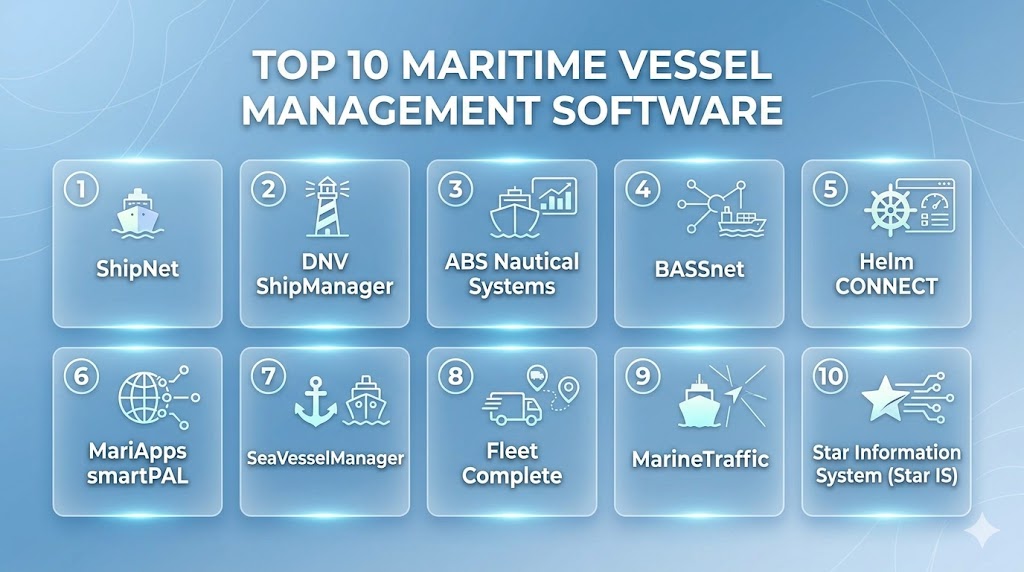
Top 10 Maritime Vessel Management Software
#1 — ShipNet
Short description: ShipNet is a comprehensive maritime ERP platform designed for large shipping companies. It connects commercial, technical, and operational workflows in one system. It is best suited for enterprises managing complex fleet operations.
Key Features
- Maritime ERP system
- Maintenance and dry-docking management
- Procurement and supplier portal
- Crew management and payroll
- Voyage and chartering tools
- Business intelligence dashboards
Pros
- Deep functionality across operations
- Strong industry reputation
Cons
- Complex implementation
- Steep learning curve
Platforms / Deployment
Web
Cloud / On-premise
Security & Compliance
Not publicly stated
Integrations & Ecosystem
Integrates with enterprise systems.
- ERP tools
- Procurement systems
- APIs
Support & Community
Enterprise-level support.
#2 — DNV ShipManager
Short description: DNV ShipManager is a widely used vessel management system focusing on safety, compliance, and performance. It supports the entire vessel lifecycle from maintenance to risk management.
Key Features
- Maintenance and inspection management
- Risk and compliance tools
- Fleet performance analytics
- Document management
- Procurement workflows
Pros
- Strong compliance support
- Reliable and scalable
Cons
- Requires training
- Enterprise-focused
Platforms / Deployment
Web
Cloud
Security & Compliance
Supports maritime regulations
Other: Not publicly stated
Integrations & Ecosystem
Integrates with maritime systems.
- Compliance tools
- APIs
Support & Community
Strong enterprise support.
#3 — ABS Nautical Systems
Short description: ABS Nautical Systems provides fleet management solutions focusing on compliance, maintenance, and safety. It is widely used in regulated maritime environments.
Key Features
- Planned maintenance system
- Compliance tracking
- Safety management
- Reporting tools
- Fleet monitoring
Pros
- Strong compliance features
- Industry-recognized solution
Cons
- Interface may feel outdated
- Customization required
Platforms / Deployment
Web
Cloud / On-premise
Security & Compliance
Not publicly stated
Integrations & Ecosystem
Supports integrations.
- APIs
- Fleet systems
Support & Community
Enterprise support.
#4 — Helm CONNECT
Short description: Helm CONNECT is a modern maritime software platform designed for fleet maintenance and operations. It is known for ease of use and cloud-based deployment.
Key Features
- Maintenance tracking
- Work order management
- Inventory tracking
- Reporting dashboards
- Mobile access
Pros
- User-friendly interface
- Quick deployment
Cons
- Limited enterprise depth
- Feature scope may vary
Platforms / Deployment
Web / Mobile
Cloud
Security & Compliance
Not publicly stated
Integrations & Ecosystem
Supports integrations.
- APIs
- Operational systems
Support & Community
Good support and onboarding.
#5 — MariApps smartPAL
Short description: smartPAL is a digital maritime platform offering end-to-end vessel management solutions. It focuses on automation and real-time data visibility.
Key Features
- Fleet management
- Crew management
- Maintenance system
- Procurement tools
- Analytics dashboards
Pros
- Modern digital platform
- Integrated modules
Cons
- Requires setup effort
- Adoption varies
Platforms / Deployment
Web
Cloud
Security & Compliance
Not publicly stated
Integrations & Ecosystem
API-based integrations.
- ERP systems
- APIs
Support & Community
Standard enterprise support.
#6 — SeaVesselManager
Short description: SeaVesselManager is a vessel management system offering maintenance, compliance, and fleet tracking features. It supports cloud, on-premise, and hybrid deployments.
Key Features
- Fleet dashboard and tracking
- Planned maintenance system
- Crew management
- Compliance tracking
- Spare parts management
- AI-powered insights
Pros
- Flexible deployment options
- Strong maintenance features
Cons
- Newer platform
- Ecosystem still growing
Platforms / Deployment
Web
Cloud / On-premise / Hybrid
Security & Compliance
Role-based access
Other: Not publicly stated
Integrations & Ecosystem
Supports integrations.
- APIs
- Fleet systems
Support & Community
Growing community support.
#7 — Fleet Complete
Short description: Fleet Complete provides real-time fleet tracking and asset management solutions. It is suitable for maritime and logistics operators.
Key Features
- GPS tracking
- Asset monitoring
- Maintenance alerts
- Analytics dashboards
- Compliance reporting
Pros
- Strong tracking capabilities
- Scalable solution
Cons
- Limited maritime-specific depth
- Customization varies
Platforms / Deployment
Web / Mobile
Cloud
Security & Compliance
Not publicly stated
Integrations & Ecosystem
Supports integrations.
- IoT devices
- APIs
Support & Community
Standard support.
#8 — MarineTraffic
Short description: MarineTraffic is widely known for vessel tracking and maritime data analytics. It provides real-time insights into vessel movements globally.
Key Features
- AIS vessel tracking
- Voyage analytics
- Fleet monitoring
- Data insights
- Reporting tools
Pros
- Strong global tracking data
- Easy to use
Cons
- Limited full management features
- Not a complete ERP
Platforms / Deployment
Web / Mobile
Cloud
Security & Compliance
Not publicly stated
Integrations & Ecosystem
Data integrations available.
- APIs
- Maritime data systems
Support & Community
Large global user base.
#9 — Kongsberg Vessel Insight
Short description: Vessel Insight is a digital platform focused on data collection, analytics, and performance optimization for ships. It helps improve operational efficiency.
Key Features
- Data integration platform
- Performance analytics
- Real-time monitoring
- Cloud connectivity
- Visualization dashboards
Pros
- Strong analytics capabilities
- Modern architecture
Cons
- Focused on analytics
- Requires integration
Platforms / Deployment
Web
Cloud
Security & Compliance
Not publicly stated
Integrations & Ecosystem
Supports integrations.
- IoT systems
- APIs
Support & Community
Enterprise support.
#10 — BASSnet
Short description: BASSnet is a well-established maritime ERP system covering fleet management, compliance, and financial operations. It is widely used by shipping companies.
Key Features
- Fleet and asset management
- Maintenance system
- Procurement tools
- Compliance management
- Financial modules
Pros
- Comprehensive platform
- Strong industry presence
Cons
- Complex setup
- Requires training
Platforms / Deployment
Web
Cloud / On-premise
Security & Compliance
Not publicly stated
Integrations & Ecosystem
Enterprise integrations.
- ERP systems
- APIs
Support & Community
Strong global support.
Comparison Table (Top 10)
| Tool Name | Best For | Platform(s) Supported | Deployment | Standout Feature | Public Rating |
|---|---|---|---|---|---|
| ShipNet | Enterprise fleets | Web | Hybrid | Maritime ERP | N/A |
| DNV ShipManager | Compliance-focused | Web | Cloud | Risk management | N/A |
| ABS Nautical | Regulated fleets | Web | Hybrid | Compliance tools | N/A |
| Helm CONNECT | SMB fleets | Web, Mobile | Cloud | Ease of use | N/A |
| smartPAL | Digital fleets | Web | Cloud | Integrated modules | N/A |
| SeaVesselManager | Flexible ops | Web | Hybrid | AI maintenance | N/A |
| Fleet Complete | Tracking-focused | Web, Mobile | Cloud | GPS tracking | N/A |
| MarineTraffic | Data insights | Web, Mobile | Cloud | AIS tracking | N/A |
| Vessel Insight | Analytics | Web | Cloud | Performance data | N/A |
| BASSnet | Enterprise | Web | Hybrid | Full ERP | N/A |
Evaluation & Scoring of Maritime Vessel Management Software
| Tool Name | Core (25%) | Ease (15%) | Integrations (15%) | Security (10%) | Performance (10%) | Support (10%) | Value (15%) | Weighted Total |
|---|---|---|---|---|---|---|---|---|
| ShipNet | 10 | 6 | 9 | 8 | 9 | 9 | 6 | 8.4 |
| DNV | 9 | 7 | 8 | 8 | 9 | 9 | 7 | 8.3 |
| ABS | 9 | 6 | 7 | 8 | 8 | 8 | 7 | 7.9 |
| Helm | 8 | 9 | 7 | 6 | 8 | 7 | 9 | 7.9 |
| smartPAL | 8 | 7 | 8 | 7 | 8 | 7 | 8 | 7.8 |
| SeaVesselManager | 8 | 8 | 7 | 6 | 8 | 7 | 9 | 7.8 |
| Fleet Complete | 7 | 8 | 7 | 6 | 8 | 7 | 8 | 7.4 |
| MarineTraffic | 7 | 9 | 6 | 6 | 8 | 7 | 8 | 7.3 |
| Vessel Insight | 8 | 7 | 8 | 7 | 8 | 7 | 7 | 7.6 |
| BASSnet | 9 | 6 | 8 | 8 | 8 | 8 | 7 | 8.0 |
How to interpret scores:
- Higher scores indicate better overall capability
- Enterprise tools excel in features and integrations
- SMB tools offer better ease of use and value
- Choose based on fleet size and complexity
Which Maritime Vessel Management Software Is Right for You?
Solo / Freelancer
Not suitable for individuals.
SMB
Helm CONNECT, SeaVesselManager.
Mid-Market
smartPAL, Vessel Insight.
Enterprise
ShipNet, DNV ShipManager, BASSnet.
Budget vs Premium
- Budget: SeaVesselManager
- Premium: ShipNet, DNV
Feature Depth vs Ease of Use
- Feature-rich: ShipNet
- Easy: Helm CONNECT
Integrations & Scalability
- Strong: DNV, BASSnet
Security & Compliance Needs
- Enterprise tools recommended
Frequently Asked Questions (FAQs)
Q1: What is maritime vessel management software?
It is software used to manage ships, crew, maintenance, and operations.
Q2: Who uses it?
Shipping companies, fleet operators, and maritime organizations.
Q3: Does it support real-time tracking?
Yes, many tools include GPS and AIS tracking.
Q4: Is it cloud-based?
Most modern solutions are cloud or hybrid.
Q5: Can it manage crew?
Yes, many tools include crew management features.
Q6: Does it help with compliance?
Yes, compliance tracking is a key feature.
Q7: How long does implementation take?
It can take weeks to months.
Q8: Can small fleets use it?
Yes, some tools are designed for smaller fleets.
Q9: Is it secure?
Security features vary by platform.
Q10: What are common challenges?
Integration complexity and training requirements.
Conclusion
Maritime vessel management software has become essential for modern shipping operations. These platforms bring together fleet management, maintenance, compliance, and analytics into a single system, helping organizations improve efficiency and safety. The right solution depends on the size of your fleet and operational complexity. Smaller operators benefit from easy-to-use tools, while large enterprises require comprehensive ERP-style platforms. With advancements in AI, real-time tracking, and automation, these systems are evolving rapidly to meet the demands of global maritime operations.