Introduction
Loan Servicing Platforms are software systems that help lenders manage loans after disbursement—covering repayment tracking, interest calculations, collections, customer communication, and compliance. These platforms automate day-to-day servicing tasks, replacing manual processes with streamlined workflows.
They are essential because loan servicing involves continuous financial tracking, borrower engagement, regulatory reporting, and risk management. Without automation, lenders face delays, errors, and compliance risks. Common use cases include payment processing, delinquency management, customer account servicing, loan restructuring, and reporting.
Buyers should evaluate automation capabilities, repayment management, collections workflows, scalability, compliance features, integrations, analytics, borrower experience, deployment model, and security controls. Modern systems significantly reduce turnaround time and improve revenue by automating collections and payment tracking .
Best for: Banks, NBFCs, fintech lenders, loan servicers, and enterprises managing active loan portfolios.
Not ideal for: Very small lenders with minimal servicing needs or businesses relying on basic accounting tools.
Key Trends in Loan Servicing Platforms
- AI-driven collections and prioritization improving recovery rates
- Cloud-native servicing platforms replacing legacy systems
- Automated repayment and billing workflows reducing manual work
- Real-time portfolio analytics dashboards
- Integration with LOS and core banking systems
- Self-service borrower portals for transparency
- Regulatory automation and audit tracking
- API-first platforms enabling fintech integrations
- Digital communication tools for borrower engagement
- End-to-end lifecycle platforms combining origination + servicing
How We Selected These Tools
- Strong adoption across lending and servicing operations
- Capability to manage end-to-end loan servicing lifecycle
- Automation of repayment, collections, and reporting
- Integration with loan origination and banking systems
- Scalability for high-volume loan portfolios
- Availability of cloud or hybrid deployment
- Reporting and compliance capabilities
- Usability for servicing teams
- Vendor ecosystem and extensibility
- Fit across SMB, mid-market, and enterprise lenders
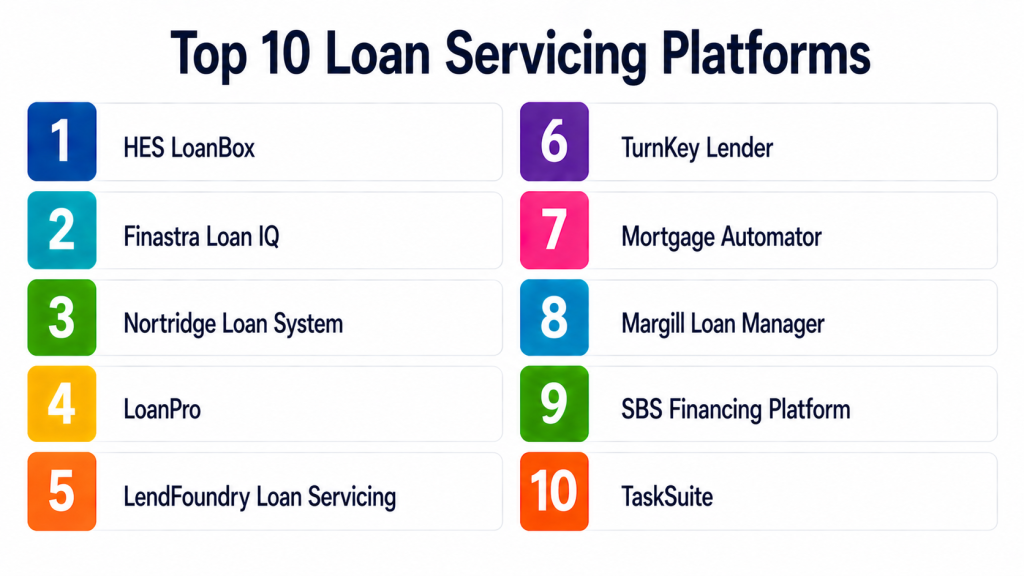
Top 10 Loan Servicing Platforms
#1 — HES LoanBox
Short description: HES LoanBox is a modern loan servicing platform offering full lifecycle automation, portfolio tracking, and AI-driven collections. It is ideal for fintech lenders and enterprises.
Key Features
- Automated repayment workflows
- Portfolio tracking
- AI-driven collections
- Interest and fee calculations
- Reporting dashboards
- API integrations
Pros
- Full automation
- Strong AI capabilities
- Highly customizable
- Scalable
Cons
- Requires configuration
- Pricing varies
- Implementation effort
- Integration setup needed
Platforms / Deployment
Web
Cloud
Security & Compliance
Not publicly stated
Integrations & Ecosystem
- Credit systems
- Payment gateways
- CRM tools
- Analytics platforms
Support & Community
Support available with onboarding services.
#2 — Finastra Loan IQ
Short description: Loan IQ is a leading enterprise loan servicing platform used by major global banks to manage complex lending portfolios.
Key Features
- Syndicated loan servicing
- Portfolio management
- Payment processing
- Workflow automation
- Compliance tools
Pros
- Enterprise-grade platform
- Handles complex loans
- Highly scalable
- Trusted by global banks
Cons
- Complex implementation
- High cost
- Requires expertise
- Enterprise-focused
Platforms / Deployment
Web
Cloud / Hybrid
Security & Compliance
Not publicly stated
Integrations & Ecosystem
- Core banking systems
- Financial platforms
- Analytics tools
- API integrations
Support & Community
Strong enterprise support ecosystem.
#3 — Nortridge Loan System
Short description: Nortridge Loan System is a flexible loan servicing platform offering end-to-end lifecycle management and strong workflow automation.
Key Features
- Loan servicing automation
- Workflow management
- Collections tools
- Reporting dashboards
- Multi-loan support
Pros
- Highly configurable
- Supports multiple loan types
- Strong workflows
- Reliable
Cons
- Setup effort required
- Pricing varies
- UI may feel outdated
- Integration complexity
Platforms / Deployment
Web
Cloud / On-prem
Security & Compliance
Not publicly stated
Integrations & Ecosystem
- Loan origination systems
- CRM tools
- Financial systems
- Analytics platforms
Support & Community
Established support and user base.
#4 — LoanPro
Short description: LoanPro is a modern loan servicing platform designed for flexibility, automation, and scalability across various lending products.
Key Features
- Full lifecycle servicing
- Payment automation
- Interest calculations
- Workflow automation
- API integrations
Pros
- Highly configurable
- Supports diverse loan types
- Modern platform
- Scalable
Cons
- Requires setup effort
- Pricing varies
- Integration complexity
- Learning curve
Platforms / Deployment
Web
Cloud
Security & Compliance
Not publicly stated
Integrations & Ecosystem
- Payment systems
- CRM tools
- Analytics platforms
- API integrations
Support & Community
Support available with developer ecosystem.
#5 — LendFoundry Loan Servicing
Short description: LendFoundry provides a cloud-based loan servicing platform focused on automation, compliance, and borrower experience.
Key Features
- Automated loan servicing
- Collections management
- Compliance tools
- Reporting dashboards
- Integration APIs
Pros
- Cloud-native
- Strong automation
- Scalable
- Improves borrower experience
Cons
- Implementation effort
- Pricing varies
- Enterprise focus
- Integration setup needed
Platforms / Deployment
Web
Cloud
Security & Compliance
Not publicly stated
Integrations & Ecosystem
- CRM tools
- Data platforms
- Analytics systems
- API integrations
Support & Community
Support available with onboarding services.
#6 — TurnKey Lender (Servicing)
Short description: TurnKey Lender provides AI-driven loan servicing with automation, decisioning, and risk management capabilities.
Key Features
- AI-based servicing automation
- Payment tracking
- Risk scoring
- Workflow automation
- Reporting tools
Pros
- Strong AI capabilities
- Flexible workflows
- Scalable
- Automation-focused
Cons
- Requires customization
- Pricing varies
- Integration setup needed
- Not servicing-only
Platforms / Deployment
Web
Cloud
Security & Compliance
Not publicly stated
Integrations & Ecosystem
- Financial systems
- CRM tools
- Data platforms
- Analytics tools
Support & Community
Support available with AI expertise.
#7 — Mortgage Automator
Short description: Mortgage Automator is a loan servicing platform designed for private lenders with strong automation and borrower management features.
Key Features
- Payment tracking
- Borrower management
- Loan reporting
- Workflow automation
- Investor tools
Pros
- Easy to use
- Strong automation
- Good reporting
- Suitable for SMB
Cons
- Limited enterprise capabilities
- Integration limitations
- Pricing varies
- Niche focus
Platforms / Deployment
Web
Cloud
Security & Compliance
Not publicly stated
Integrations & Ecosystem
- CRM tools
- Reporting systems
- Payment platforms
Support & Community
Support available with onboarding resources.
#8 — Margill Loan Manager
Short description: Margill Loan Manager is a loan servicing solution focused on interest calculations and payment tracking.
Key Features
- Amortization schedules
- Payment tracking
- Interest calculations
- Reporting tools
- Loan monitoring
Pros
- Easy to use
- Strong calculation engine
- Affordable
- Flexible
Cons
- Limited enterprise features
- Basic integrations
- Smaller ecosystem
- Not fully automated
Platforms / Deployment
Windows / Web
On-prem / Cloud
Security & Compliance
Not publicly stated
Integrations & Ecosystem
- Accounting systems
- Reporting tools
- Data exports
Support & Community
Support available with documentation.
#9 — SBS Financing Platform
Short description: SBS Financing Platform provides loan servicing capabilities integrated with digital banking systems.
Key Features
- Loan servicing automation
- Payment tracking
- Workflow management
- Reporting dashboards
- Integration APIs
Pros
- Banking integration
- Scalable
- Reliable
- Strong workflows
Cons
- Enterprise-focused
- Implementation complexity
- Pricing varies
- Customization needed
Platforms / Deployment
Web
Cloud
Security & Compliance
Not publicly stated
Integrations & Ecosystem
- Core banking systems
- CRM tools
- Analytics platforms
Support & Community
Enterprise support available.
#10 — TaskSuite
Short description: TaskSuite is a loan servicing platform designed for lenders managing private loans and portfolios.
Key Features
- Loan tracking
- Payment management
- Reporting dashboards
- Workflow automation
- Portfolio management
Pros
- Easy to use
- Affordable
- Flexible
- Good for SMB
Cons
- Limited enterprise features
- Integration limitations
- Smaller ecosystem
- Feature depth varies
Platforms / Deployment
Web
Cloud
Security & Compliance
Not publicly stated
Integrations & Ecosystem
- CRM tools
- Reporting systems
- Data platforms
Support & Community
Support available with onboarding assistance.
Comparison Table
| Tool Name | Best For | Platform(s) Supported | Deployment | Standout Feature | Public Rating |
|---|---|---|---|---|---|
| HES LoanBox | Digital lenders | Web | Cloud | AI-driven servicing | N/A |
| Loan IQ | Enterprise banks | Web | Cloud/Hybrid | Complex loan servicing | N/A |
| Nortridge | Flexible lending | Web | Cloud/On-prem | Configurable workflows | N/A |
| LoanPro | Modern lenders | Web | Cloud | High configurability | N/A |
| LendFoundry | Digital servicing | Web | Cloud | Automation focus | N/A |
| TurnKey | AI lending | Web | Cloud | AI automation | N/A |
| Mortgage Automator | Private lenders | Web | Cloud | Investor tools | N/A |
| Margill | SMB lenders | Windows/Web | Hybrid | Interest calculations | N/A |
| SBS | Banks | Web | Cloud | Banking integration | N/A |
| TaskSuite | SMB lenders | Web | Cloud | Simplicity | N/A |
Evaluation & Scoring
| Tool | Core | Ease | Integrations | Security | Performance | Support | Value | Total |
|---|---|---|---|---|---|---|---|---|
| HES | 8.5 | 8 | 8.5 | 7.5 | 8 | 7.5 | 8 | 8.1 |
| Loan IQ | 9 | 7 | 8.5 | 8 | 9 | 8 | 7 | 8.3 |
| Nortridge | 8.5 | 7.5 | 8 | 7.5 | 8 | 7.5 | 7.5 | 8.0 |
| LoanPro | 8.5 | 8 | 8.5 | 7.5 | 8 | 7.5 | 7.5 | 8.1 |
| LendFoundry | 8.5 | 7.5 | 8.5 | 8 | 8.5 | 8 | 7.5 | 8.1 |
| TurnKey | 8.5 | 8 | 8.5 | 7.5 | 8 | 7.5 | 7.5 | 8.0 |
| Mortgage Automator | 7.5 | 8.5 | 7.5 | 7.5 | 8 | 7.5 | 8 | 7.9 |
| Margill | 7.5 | 8 | 7 | 7.5 | 7.5 | 7.5 | 8.5 | 7.7 |
| SBS | 8.5 | 7.5 | 8 | 8 | 8.5 | 8 | 7.5 | 8.1 |
| TaskSuite | 7.5 | 8.5 | 7.5 | 7.5 | 8 | 7.5 | 8 | 7.8 |
Scores are comparative and highlight relative strengths. Enterprise platforms excel in scalability, while SMB tools offer better usability and affordability.
Which Loan Servicing Platform Is Right for You?
Solo / Freelancer
Basic tools or spreadsheets may be sufficient.
SMB
Choose TaskSuite or Mortgage Automator for simplicity and affordability.
Mid-Market
Consider LoanPro, LendFoundry, or Nortridge for scalability.
Enterprise
Use Loan IQ or HES LoanBox for full-scale servicing.
Budget vs Premium
Budget tools focus on usability, while premium platforms provide automation and analytics.
Feature Depth vs Ease of Use
Enterprise tools provide deep functionality, while SMB tools focus on simplicity.
Integrations & Scalability
Ensure integration with LOS, CRM, and payment systems.
Security & Compliance Needs
Verify audit logs, compliance tools, and data protection features.
Frequently Asked Questions
1. What is loan servicing software?
It is software that manages loans after disbursement, including payments and collections.
2. Why is it important?
It improves efficiency and reduces errors in loan management.
3. Who uses it?
Banks, lenders, fintech companies, and loan servicers.
4. What features matter most?
Automation, repayment tracking, integration, and reporting.
5. Are these platforms cloud-based?
Most modern tools are cloud-based.
6. Can they automate collections?
Yes, many platforms include automated collections workflows.
7. How long does implementation take?
It varies depending on complexity.
8. Do they integrate with LOS?
Yes, most integrate with loan origination systems.
9. Are they secure?
Security varies by vendor.
10. What are alternatives?
Manual processes or spreadsheets, though they lack scalability.
Conclusion
Loan Servicing Platforms are essential for managing active loan portfolios efficiently and at scale.
They automate repayments, reduce delinquency, and improve borrower experience.
Enterprise solutions like Loan IQ and HES LoanBox provide deep functionality for large institutions.
Meanwhile, tools like TaskSuite and Mortgage Automator offer simpler options for smaller lenders.
The right platform depends on loan volume, complexity, and compliance needs.
Organizations should evaluate automation, integrations, and scalability carefully.
Running a pilot helps validate performance and usability.
Ultimately, the best platform aligns with your servicing strategy and operational goals.