Introduction
Airport Operations Management Software is a centralized system that helps airports manage daily operations like flight coordination, gate assignments, passenger flow, and ground services. In simple terms, it acts as the “control center” that connects different airport departments and stakeholders into one unified platform.
Modern airports operate like complex ecosystems with constant movement of aircraft, passengers, staff, and equipment. These platforms bring real-time data together to improve decision-making, reduce delays, and ensure safety and compliance. They also help airports handle disruptions more effectively and maintain smooth operations across terminals.
Common use cases include:
- Gate and stand allocation
- Flight scheduling and turnaround coordination
- Passenger flow and terminal management
- Resource planning (staff, vehicles, equipment)
- Incident and disruption management
What buyers should evaluate:
- Real-time data visibility and dashboards
- Integration with AODB, FIDS, and airline systems
- Resource and workforce planning capabilities
- Automation and alerting features
- Scalability across terminals or airports
- Mobile accessibility for ground staff
- Reporting and analytics capabilities
- Security and compliance controls
- Ease of use and onboarding
Best for: Airport authorities, operations teams, ground handlers, and aviation IT teams managing complex airport environments.
Not ideal for: Small airstrips or organizations without multi-department operational complexity.
Key Trends in Airport Operations Management Software
- Real-time “single source of truth” dashboards for operations
- AI-driven predictive analytics to reduce delays
- Automation of inspections, reporting, and compliance workflows
- Cloud-based deployment for scalability and remote access
- Integration with IoT devices for real-time tracking
- Passenger flow analytics and crowd management
- Collaborative decision-making (A-CDM) systems
- Mobile-first tools for field staff and operations teams
- Digital twins for airport simulation and planning
- Sustainability tracking and energy optimization
How We Selected These Tools (Methodology)
- Evaluated adoption across global airports
- Assessed operational coverage (airside + landside)
- Compared real-time data and automation capabilities
- Reviewed integration with airline and airport systems
- Considered scalability and flexibility
- Evaluated usability and training requirements
- Assessed reporting and analytics features
- Reviewed vendor reliability and industry presence
- Balanced enterprise and mid-size airport solutions
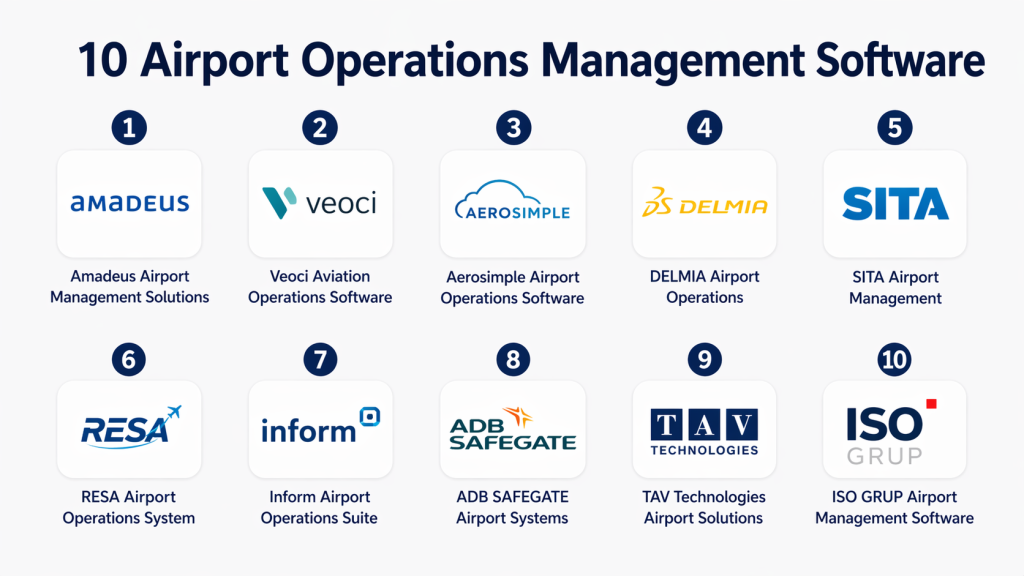
Top 10 Airport Operations Management Software
#1 — Amadeus Airport Management Solutions
Short description: A comprehensive airport platform that manages passenger processing, resource allocation, and operational data in one system. It is widely used by large international airports. The solution focuses on scalability and deep airline integration.
Key Features
- Airport Operational Database (AODB)
- Resource Management System
- Passenger processing tools
- Real-time analytics
- Collaboration tools
Pros
- Strong global ecosystem
- End-to-end operational coverage
Cons
- Complex implementation
- High cost
Platforms / Deployment
Web
Cloud
Security & Compliance
ISO 27001, GDPR (enterprise-level)
Integrations & Ecosystem
Integrates deeply with airline and airport systems.
- Airline systems
- FIDS and AODB
- APIs
Support & Community
Enterprise-grade global support.
#2 — SITA Airport Management
Short description: A widely adopted platform offering integrated airport operations and passenger processing solutions. It is known for its global connectivity and data-sharing capabilities.
Key Features
- Passenger processing
- Flight and resource management
- Real-time data sharing
- Analytics tools
- Security features
Pros
- Strong global presence
- Reliable infrastructure
Cons
- Enterprise-focused
- Customization may require effort
Platforms / Deployment
Web
Cloud
Security & Compliance
Not publicly stated
Integrations & Ecosystem
Extensive integrations.
- Airlines
- Airport systems
- APIs
Support & Community
Global enterprise support.
#3 — AeroCloud Airport OS
Short description: A cloud-native airport operations system providing real-time operational visibility and automation. It is designed for modern, data-driven airports.
Key Features
- Flight tracking
- Gate allocation automation
- Resource management
- Real-time dashboards
- Predictive analytics
Pros
- Modern interface
- Strong automation
Cons
- Adoption still growing
- Feature depth varies
Platforms / Deployment
Web
Cloud
Security & Compliance
Not publicly stated
Integrations & Ecosystem
API-first integrations.
- Airline systems
- Data platforms
Support & Community
Growing support ecosystem.
#4 — PDC AirportSuite
Short description: A comprehensive suite for managing airport operations, resource scheduling, and collaboration. It supports integration across multiple airport systems.
Key Features
- Resource planning
- Gate and stand allocation
- Workforce management
- Business intelligence
- Integrated modules
Pros
- Modular architecture
- Strong integration
Cons
- Complex deployment
- Requires training
Platforms / Deployment
Web
Cloud
Security & Compliance
Not publicly stated
Integrations & Ecosystem
Supports multiple systems.
- AODB
- FIDS
- APIs
Support & Community
Enterprise support available.
#5 — DELMIA Airport Operations
Short description: A solution focused on optimizing airport logistics, workforce planning, and operational efficiency. It helps manage disruptions and improve resource allocation.
Key Features
- Workforce optimization
- Resource planning
- Real-time scheduling
- Simulation tools
- Operational analytics
Pros
- Strong optimization capabilities
- Handles complex operations
Cons
- Learning curve
- Enterprise-focused
Platforms / Deployment
Web
Cloud
Security & Compliance
Not publicly stated
Integrations & Ecosystem
Integrates with logistics systems.
- Workforce systems
- APIs
Support & Community
Enterprise-level support.
#6 — Aerosimple
Short description: A user-friendly airport operations platform focused on inspections, reporting, and compliance management. It is popular among small to mid-sized airports.
Key Features
- Airfield inspections
- Work order management
- Asset tracking
- Incident reporting
- Real-time dashboards
Pros
- Easy to use
- Affordable solution
Cons
- Limited enterprise features
- Basic analytics
Platforms / Deployment
Web / iOS / Android
Cloud
Security & Compliance
FAA compliance support
Other: Not publicly stated
Integrations & Ecosystem
Supports integrations.
- APIs
- Operational systems
Support & Community
Strong support with onboarding.
#7 — ProDIGIQ SANTORINI
Short description: A configurable airport operations system that automates inspections, compliance, and operational workflows. It provides real-time insights and alerts.
Key Features
- Real-time alerts
- Compliance tracking
- Operations logging
- KPI dashboards
- Training management
Pros
- Highly configurable
- Strong compliance focus
Cons
- Limited global adoption
- Customization needed
Platforms / Deployment
Web
Cloud
Security & Compliance
FAA, ICAO support
Other: Not publicly stated
Integrations & Ecosystem
Supports integrations.
- APIs
- Data systems
Support & Community
Standard support.
#8 — INFORM Airport Operations Suite
Short description: A data-driven platform focused on optimizing airport processes and improving operational efficiency through analytics.
Key Features
- Predictive analytics
- Resource optimization
- Real-time monitoring
- Reporting tools
- Integration capabilities
Pros
- Strong analytics
- Optimization-focused
Cons
- Complex setup
- Requires expertise
Platforms / Deployment
Web
Cloud
Security & Compliance
Not publicly stated
Integrations & Ecosystem
Supports integrations.
- Airport systems
- APIs
Support & Community
Enterprise support.
#9 — ADB SAFEGATE Airport Systems
Short description: A platform focused on airside operations, including runway safety, lighting systems, and performance optimization.
Key Features
- Airside management
- Safety monitoring
- Performance analytics
- Automation tools
- Real-time data
Pros
- Strong safety focus
- Reliable systems
Cons
- Limited landside features
- Specialized use case
Platforms / Deployment
Web
Cloud
Security & Compliance
Not publicly stated
Integrations & Ecosystem
Supports integrations.
- Airside systems
- APIs
Support & Community
Strong enterprise support.
#10 — RESA Airport Operations System
Short description: A modular airport operations platform designed to manage resources, scheduling, and passenger flow efficiently.
Key Features
- Resource allocation
- Scheduling tools
- Passenger flow management
- Reporting
- Integration support
Pros
- Modular design
- Flexible deployment
Cons
- Limited visibility globally
- Feature depth varies
Platforms / Deployment
Web
Cloud
Security & Compliance
Not publicly stated
Integrations & Ecosystem
Supports integrations.
- Airport systems
- APIs
Support & Community
Standard support.
Comparison Table (Top 10)
| Tool Name | Best For | Platform(s) Supported | Deployment | Standout Feature | Public Rating |
|---|---|---|---|---|---|
| Amadeus | Enterprise | Web | Cloud | Full airport suite | N/A |
| SITA | Enterprise | Web | Cloud | Global connectivity | N/A |
| AeroCloud | Modern airports | Web | Cloud | Real-time dashboards | N/A |
| PDC AirportSuite | Enterprise | Web | Cloud | Modular integration | N/A |
| DELMIA | Large operations | Web | Cloud | Optimization tools | N/A |
| Aerosimple | SMB airports | Web, Mobile | Cloud | Easy inspections | N/A |
| SANTORINI | Compliance-heavy | Web | Cloud | Real-time alerts | N/A |
| INFORM | Analytics-driven | Web | Cloud | Predictive analytics | N/A |
| ADB SAFEGATE | Airside ops | Web | Cloud | Safety systems | N/A |
| RESA | Flexible ops | Web | Cloud | Modular platform | N/A |
Evaluation & Scoring of Airport Operations Management Software
| Tool Name | Core (25%) | Ease (15%) | Integrations (15%) | Security (10%) | Performance (10%) | Support (10%) | Value (15%) | Weighted Total |
|---|---|---|---|---|---|---|---|---|
| Amadeus | 10 | 6 | 9 | 8 | 9 | 9 | 6 | 8.4 |
| SITA | 9 | 7 | 9 | 8 | 9 | 9 | 6 | 8.3 |
| AeroCloud | 8 | 9 | 8 | 7 | 8 | 8 | 8 | 8.2 |
| PDC | 8 | 7 | 8 | 7 | 8 | 8 | 7 | 7.8 |
| DELMIA | 9 | 6 | 8 | 7 | 8 | 8 | 6 | 7.7 |
| Aerosimple | 7 | 9 | 6 | 6 | 7 | 7 | 9 | 7.5 |
| SANTORINI | 8 | 7 | 7 | 7 | 8 | 7 | 8 | 7.6 |
| INFORM | 8 | 7 | 8 | 7 | 8 | 8 | 7 | 7.7 |
| ADB SAFEGATE | 8 | 6 | 7 | 7 | 8 | 8 | 6 | 7.4 |
| RESA | 7 | 7 | 7 | 6 | 7 | 7 | 7 | 7.0 |
How to interpret scores:
- Higher scores indicate better overall balance
- Enterprise tools excel in features and integrations
- SMB tools score higher in usability and value
- Choose based on airport size and complexity
Which Airport Operations Management Software Is Right for You?
Solo / Freelancer
Not applicable for individuals.
SMB
Aerosimple, SANTORINI.
Mid-Market
AeroCloud, INFORM, RESA.
Enterprise
Amadeus, SITA, DELMIA, PDC.
Budget vs Premium
- Budget: Aerosimple
- Premium: Amadeus, SITA
Feature Depth vs Ease of Use
- Feature-rich: Amadeus
- Easy-to-use: Aerosimple
Integrations & Scalability
- Strong integrations: Amadeus, SITA
Security & Compliance Needs
- Enterprise tools recommended
Frequently Asked Questions (FAQs)
Q1: What is airport operations management software?
It is a system that helps airports manage daily operations, resources, and coordination.
Q2: Who uses these systems?
Airport authorities, airlines, and ground handling teams.
Q3: Are these systems cloud-based?
Most modern platforms are cloud-based.
Q4: Do they improve efficiency?
Yes, they automate processes and reduce delays.
Q5: Can they handle real-time data?
Yes, real-time monitoring is a core feature.
Q6: Are they secure?
Most provide enterprise-level security, but details vary.
Q7: Do they integrate with airline systems?
Yes, integration is a key capability.
Q8: How long does implementation take?
It can take weeks to months depending on complexity.
Q9: Can small airports use them?
Yes, there are solutions designed for smaller airports.
Q10: What are common challenges?
Integration complexity and training requirements.
Conclusion
Airport operations management software plays a critical role in ensuring smooth, safe, and efficient airport functioning. These platforms bring together multiple systems, teams, and processes into a unified environment, enabling better coordination and decision-making. The right solution depends heavily on the size of the airport and the complexity of its operations. Large international hubs require highly integrated enterprise platforms, while smaller airports benefit from simpler and more affordable tools. Modern solutions are evolving with real-time data, automation, and predictive analytics, helping airports move from reactive to proactive operations. This shift improves efficiency, reduces delays, and enhances passenger experience.