Introduction
Airline Crew Scheduling Tools are specialized systems used by airlines to plan, assign, and manage crew members for flights. These tools ensure that pilots and cabin crew are scheduled efficiently while complying with safety regulations, labor laws, and operational constraints. They play a critical role in maintaining on-time performance and reducing operational risks.
With increasing flight volumes and complex global operations, manual scheduling is no longer practical. Modern crew scheduling tools use automation, optimization algorithms, and real-time data to handle disruptions, last-minute changes, and compliance requirements. They also improve crew satisfaction by balancing workloads and preferences.
Common use cases include:
- Assigning pilots and cabin crew to flights
- Managing duty hours and legal compliance
- Handling disruptions like delays or cancellations
- Optimizing crew utilization and costs
- Tracking crew availability and preferences
What buyers should evaluate:
- Compliance with aviation regulations
- Optimization and automation capabilities
- Real-time scheduling adjustments
- Integration with airline operations systems
- User interface and ease of use
- Scalability for large operations
- Reporting and analytics
- Mobile access for crew members
- Security and data protection
Best for: Airlines, aviation operators, and crew management teams handling complex flight operations and workforce scheduling.
Not ideal for: Small organizations without complex scheduling needs or industries outside aviation.
Key Trends in Airline Crew Scheduling Tools
- AI-driven crew optimization and forecasting
- Real-time disruption management and re-scheduling
- Mobile apps for crew self-service and updates
- Integration with flight operations and HR systems
- Predictive analytics for crew availability
- Automation of compliance checks
- Cloud-based deployment for scalability
- Personalized crew preferences and bidding systems
- Increased focus on crew well-being and fatigue management
- API-based integrations for ecosystem expansion
How We Selected These Tools (Methodology)
- Evaluated adoption across airlines globally
- Assessed scheduling and optimization capabilities
- Reviewed compliance management features
- Compared scalability and system performance
- Evaluated integration with airline systems
- Considered ease of use and user experience
- Analyzed reporting and analytics capabilities
- Reviewed vendor support and reliability
- Balanced enterprise and mid-market solutions
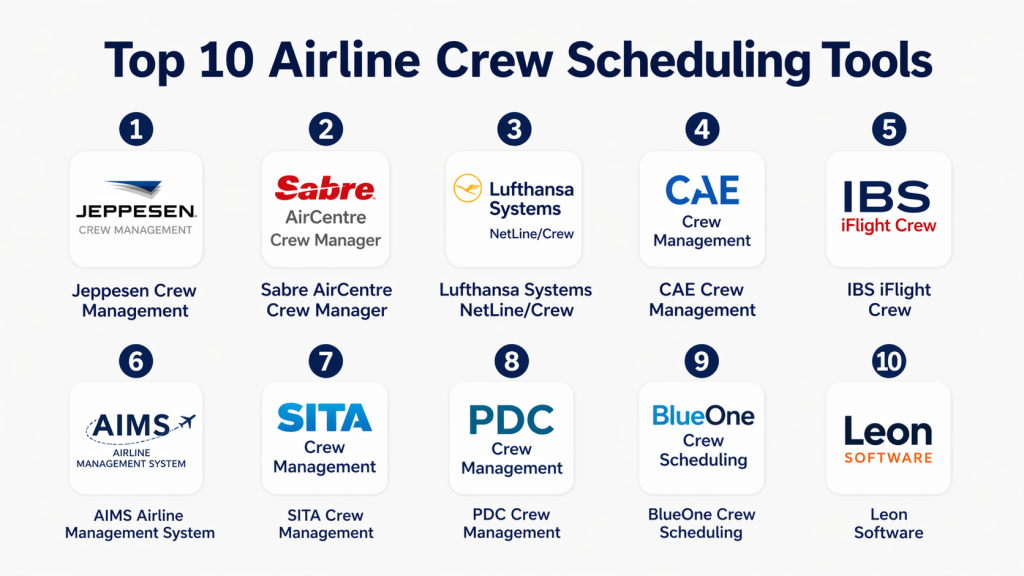
Top 10 Airline Crew Scheduling Tools
#1 — Jeppesen Crew Management
Short description: Jeppesen Crew Management is a comprehensive solution designed for airlines to manage crew planning, scheduling, and operations. It focuses on optimization and regulatory compliance. The platform is widely used by large airlines.
Key Features
- Crew planning and scheduling
- Compliance management
- Optimization algorithms
- Real-time updates
- Reporting tools
Pros
- Highly optimized scheduling
- Strong compliance features
Cons
- Complex implementation
- Requires training
Platforms / Deployment
Web
Cloud
Security & Compliance
Not publicly stated
Integrations & Ecosystem
Integrates with airline systems.
- Flight operations systems
- HR platforms
- APIs
Support & Community
Enterprise-level support available.
#2 — Sabre AirCentre Crew Manager
Short description: Sabre AirCentre Crew Manager helps airlines manage crew scheduling and operations efficiently. It provides tools for planning, tracking, and compliance management. It is suitable for large-scale airline operations.
Key Features
- Crew scheduling
- Compliance tracking
- Real-time updates
- Analytics tools
- Integration capabilities
Pros
- Strong integration ecosystem
- Reliable performance
Cons
- Learning curve
- High cost
Platforms / Deployment
Web
Cloud
Security & Compliance
Not publicly stated
Integrations & Ecosystem
Supports integrations.
- Airline systems
- APIs
Support & Community
Enterprise support.
#3 — Lufthansa Systems NetLine/Crew
Short description: NetLine/Crew is a crew management solution designed for airlines requiring efficient planning and scheduling. It focuses on automation and optimization. It is widely used in global aviation.
Key Features
- Crew planning
- Scheduling optimization
- Compliance management
- Reporting tools
- Integration support
Pros
- Efficient planning tools
- Strong optimization
Cons
- Complex UI
- Requires training
Platforms / Deployment
Web
Cloud
Security & Compliance
Not publicly stated
Integrations & Ecosystem
Supports integrations.
- Airline systems
- APIs
Support & Community
Enterprise-level support.
#4 — AIMS Crew Management
Short description: AIMS Crew Management is a modular solution designed for airlines of different sizes. It provides tools for scheduling, tracking, and compliance management.
Key Features
- Crew scheduling
- Duty time tracking
- Compliance tools
- Reporting
- Integration capabilities
Pros
- Modular approach
- Flexible deployment
Cons
- Interface may feel dated
- Customization required
Platforms / Deployment
Web / Windows
Cloud / On-premise
Security & Compliance
Not publicly stated
Integrations & Ecosystem
Supports integrations.
- HR systems
- APIs
Support & Community
Standard support services.
#5 — PDC AIMS eCrew
Short description: eCrew is a crew scheduling module designed to manage airline crew operations efficiently. It focuses on automation and ease of use.
Key Features
- Scheduling automation
- Compliance tracking
- Reporting tools
- Real-time updates
- Integration support
Pros
- Easy to use
- Good automation
Cons
- Limited advanced features
- Scalability constraints
Platforms / Deployment
Web
Cloud
Security & Compliance
Not publicly stated
Integrations & Ecosystem
Basic integrations.
- APIs
Support & Community
Standard support.
#6 — IBS iFly Crew
Short description: IBS iFly Crew is a modern crew management solution designed for digital-first airlines. It focuses on efficiency and user experience.
Key Features
- Crew scheduling
- Optimization tools
- Analytics
- Mobile access
- Integration capabilities
Pros
- Modern interface
- Strong analytics
Cons
- Limited adoption
- Customization required
Platforms / Deployment
Web
Cloud
Security & Compliance
Not publicly stated
Integrations & Ecosystem
API-driven integrations.
- Airline systems
- HR tools
Support & Community
Enterprise support available.
#7 — Hexaware RAPID Crew
Short description: RAPID Crew is a scheduling solution designed to optimize crew allocation and operations. It focuses on automation and performance.
Key Features
- Crew scheduling
- Optimization algorithms
- Reporting tools
- Integration support
- Real-time updates
Pros
- Efficient optimization
- Scalable solution
Cons
- Limited public information
- Requires customization
Platforms / Deployment
Web
Cloud
Security & Compliance
Not publicly stated
Integrations & Ecosystem
Supports integrations.
- APIs
- Airline systems
Support & Community
Not publicly stated
#8 — Blue One Crew Scheduling
Short description: Blue One provides crew scheduling solutions tailored for airlines and aviation operators. It focuses on operational efficiency and compliance.
Key Features
- Scheduling tools
- Compliance tracking
- Reporting
- Integration support
- Real-time updates
Pros
- Simple interface
- Efficient scheduling
Cons
- Limited scalability
- Feature depth varies
Platforms / Deployment
Web
Cloud
Security & Compliance
Not publicly stated
Integrations & Ecosystem
Basic integrations.
- APIs
Support & Community
Standard support.
#9 — Merlot Aero Crew Scheduling
Short description: Merlot Aero offers crew scheduling solutions designed for airlines needing efficient planning and optimization. It supports operational flexibility.
Key Features
- Crew scheduling
- Planning tools
- Reporting
- Compliance management
- Integration support
Pros
- Flexible solution
- Good planning tools
Cons
- Limited global presence
- Feature depth varies
Platforms / Deployment
Web
Cloud
Security & Compliance
Not publicly stated
Integrations & Ecosystem
Supports integrations.
- APIs
Support & Community
Standard support.
#10 — RAIDO Crew Scheduling
Short description: RAIDO provides crew scheduling tools focused on automation and operational efficiency. It is designed for airlines seeking simple solutions.
Key Features
- Scheduling tools
- Reporting
- Integration support
- Compliance tracking
- Real-time updates
Pros
- Easy to use
- Quick setup
Cons
- Limited enterprise features
- Basic integrations
Platforms / Deployment
Web
Cloud
Security & Compliance
Not publicly stated
Integrations & Ecosystem
Basic integrations.
- APIs
Support & Community
Standard support.
Comparison Table (Top 10)
| Tool Name | Best For | Platform(s) Supported | Deployment | Standout Feature | Public Rating |
|---|---|---|---|---|---|
| Jeppesen Crew Management | Enterprise | Web | Cloud | Optimization algorithms | N/A |
| Sabre AirCentre Crew Manager | Enterprise | Web | Cloud | Integration ecosystem | N/A |
| NetLine/Crew | Enterprise | Web | Cloud | Efficient planning | N/A |
| AIMS Crew Management | Mid-market | Web, Windows | Hybrid | Modular design | N/A |
| eCrew | SMB | Web | Cloud | Ease of use | N/A |
| IBS iFly Crew | Mid-market | Web | Cloud | Modern interface | N/A |
| RAPID Crew | Enterprise | Web | Cloud | Optimization | N/A |
| Blue One | SMB | Web | Cloud | Simplicity | N/A |
| Merlot Aero | Mid-market | Web | Cloud | Flexibility | N/A |
| RAIDO | SMB | Web | Cloud | Quick setup | N/A |
Evaluation & Scoring of Airline Crew Scheduling Tools
| Tool Name | Core (25%) | Ease (15%) | Integrations (15%) | Security (10%) | Performance (10%) | Support (10%) | Value (15%) | Weighted Total |
|---|---|---|---|---|---|---|---|---|
| Jeppesen | 10 | 6 | 9 | 8 | 9 | 9 | 6 | 8.4 |
| Sabre AirCentre | 9 | 6 | 9 | 8 | 9 | 9 | 6 | 8.2 |
| NetLine/Crew | 9 | 6 | 8 | 8 | 9 | 8 | 6 | 8.0 |
| AIMS | 8 | 7 | 7 | 7 | 8 | 7 | 7 | 7.5 |
| eCrew | 7 | 8 | 6 | 6 | 7 | 7 | 8 | 7.2 |
| IBS iFly Crew | 8 | 7 | 8 | 7 | 8 | 7 | 7 | 7.6 |
| RAPID Crew | 8 | 7 | 7 | 7 | 8 | 7 | 7 | 7.5 |
| Blue One | 7 | 8 | 6 | 6 | 7 | 7 | 8 | 7.1 |
| Merlot Aero | 7 | 7 | 6 | 6 | 7 | 7 | 8 | 7.0 |
| RAIDO | 6 | 8 | 5 | 6 | 6 | 6 | 8 | 6.8 |
How to interpret scores:
- Higher scores indicate stronger overall capability
- Enterprise tools rank higher in features and integration
- SMB tools perform better in ease of use and value
- Choose based on operational scale
Which Airline Crew Scheduling Tool Is Right for You?
Solo / Freelancer
Not applicable.
SMB
eCrew, Blue One, RAIDO.
Mid-Market
AIMS, IBS iFly Crew, Merlot Aero.
Enterprise
Jeppesen, Sabre AirCentre, NetLine/Crew, RAPID Crew.
Budget vs Premium
- Budget: RAIDO, Blue One
- Premium: Jeppesen, Sabre
Feature Depth vs Ease of Use
- Feature-rich: Jeppesen
- Easy: eCrew
Integrations & Scalability
- Strong: Sabre, Jeppesen
Security & Compliance Needs
- Enterprise tools recommended
Frequently Asked Questions (FAQs)
Q1: What are airline crew scheduling tools?
They are systems used to assign and manage airline crew efficiently.
Q2: Who uses these tools?
Airlines and aviation operators.
Q3: Are these tools automated?
Yes, most include automation and optimization.
Q4: Do they ensure compliance?
Yes, compliance management is a core feature.
Q5: Can they handle disruptions?
Yes, modern tools support real-time updates.
Q6: Are they cloud-based?
Most modern tools are cloud-based.
Q7: Do they integrate with other systems?
Yes, integration with airline systems is common.
Q8: How long does implementation take?
It can take weeks to months.
Q9: Are they customizable?
Some tools offer customization options.
Q10: What are common challenges?
Complex setup and training requirements.
Conclusion
Airline crew scheduling tools are essential for managing complex airline operations and ensuring compliance with regulations. These platforms help optimize crew utilization, reduce costs, and improve operational efficiency.The best tool depends on the size and complexity of your airline operations. Enterprise solutions provide advanced features and integrations, while smaller tools focus on ease of use and affordability. Modern platforms are increasingly leveraging automation, real-time data, and predictive analytics to enhance scheduling accuracy and responsiveness. These capabilities are critical in handling disruptions and maintaining service quality.