Introduction
Sales & Operations Planning Software helps organizations align sales forecasts, supply chain operations, and financial planning into a single unified strategy. These platforms ensure that demand, supply, and business goals are synchronized, enabling better decision-making and operational efficiency.
S&OP is not just a forecasting tool—it is a cross-functional planning process involving sales, operations, finance, and supply chain teams to create a realistic and profitable plan . With increasing supply chain complexity, businesses now rely on S&OP software for real-time insights, scenario planning, and automation.
Common Use Cases
- Aligning sales forecasts with production capacity
- Balancing supply and demand across regions
- Improving inventory and production planning
- Supporting financial and revenue planning
- Managing risks and disruptions
What Buyers Should Evaluate
- Forecast accuracy and analytics capabilities
- Integration with ERP, CRM, and supply chain systems
- Scenario planning and simulation tools
- Collaboration across departments
- Real-time dashboards and reporting
- Scalability and flexibility
- Automation features
- Security and compliance
- Ease of use
Best for: Enterprises, supply chain leaders, finance teams, and organizations managing complex demand and supply networks
Not ideal for: Small businesses with simple inventory or limited planning complexity
Key Trends in Sales & Operations Planning Software
- AI-driven demand and supply alignment
- Real-time planning and analytics
- Scenario modeling for risk mitigation
- Collaborative planning across departments
- Integration with financial planning systems
- Cloud-based deployment replacing legacy systems
- Automation of planning workflows
- Demand sensing using external data
- Digital twin simulations
- Focus on agility and resilience
How We Selected These Tools Methodology
- Evaluated global adoption and enterprise usage
- Assessed S&OP feature completeness
- Reviewed forecasting and analytics capabilities
- Considered integration ecosystems
- Analyzed scalability and performance
- Included tools for SMB, mid-market, and enterprise
- Focused on usability and dashboards
- Balanced innovation with reliability
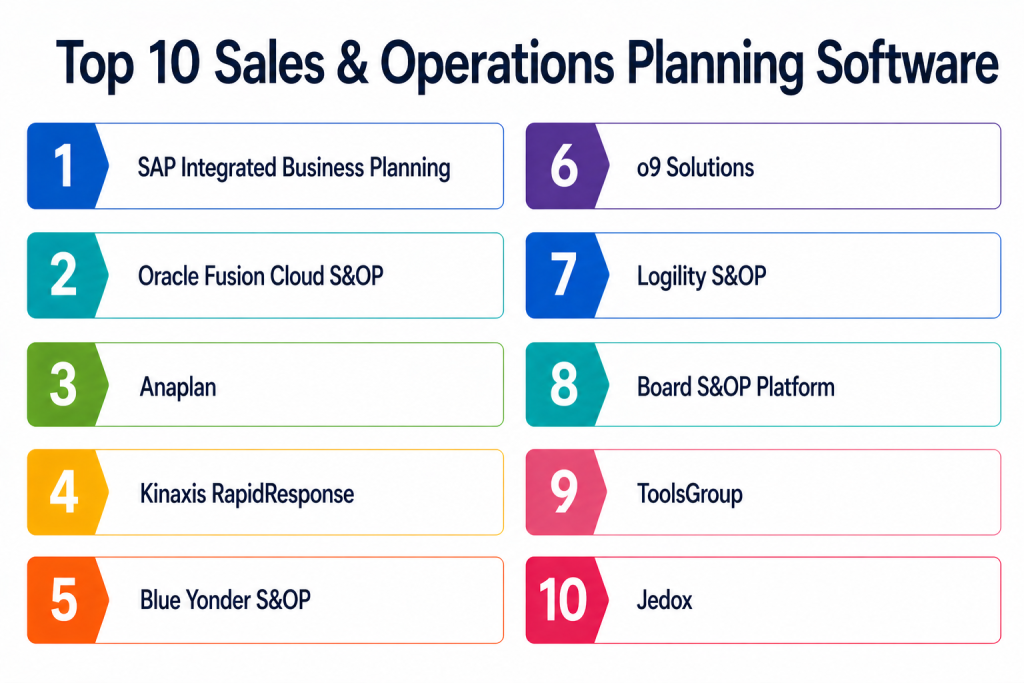
Top 10 Sales & Operations Planning Software
#1 — SAP Integrated Business Planning
Short description: SAP IBP is a comprehensive S&OP platform designed for large enterprises. It offers real-time planning, forecasting, and deep integration with SAP systems.
Key Features
- Real-time demand and supply planning
- Scenario simulation
- Inventory optimization
- Advanced analytics
- Financial integration
Pros
- Strong enterprise capabilities
- Highly scalable
Cons
- Complex implementation
- Requires SAP ecosystem
Platforms / Deployment
Web — Cloud
Security & Compliance
SSO, encryption — Not publicly stated
Integrations & Ecosystem
Integrates with SAP ERP and enterprise systems.
- ERP systems
- Analytics tools
- APIs
Support & Community
Enterprise support
#2 — Oracle Fusion Cloud S&OP
Short description: Oracle provides a cloud-native S&OP platform with AI-driven forecasting and strong financial integration.
Key Features
- AI-powered forecasting
- Demand sensing
- Scenario planning
- Financial alignment
- Real-time dashboards
Pros
- Strong analytics
- Cloud-native
Cons
- Complex setup
- Higher cost
Platforms / Deployment
Web — Cloud
Security & Compliance
Not publicly stated
Integrations & Ecosystem
Integrates with Oracle Cloud and ERP systems.
- ERP
- Supply chain tools
Support & Community
Enterprise-grade support
#3 — Anaplan
Short description: Anaplan offers collaborative S&OP with strong financial planning capabilities. It connects business functions into a unified planning model.
Key Features
- Collaborative planning
- Scenario modeling
- Financial integration
- Real-time updates
- Dashboards
Pros
- Strong collaboration
- Flexible modeling
Cons
- Learning curve
- Pricing varies
Platforms / Deployment
Web — Cloud
Security & Compliance
Not publicly stated
Integrations & Ecosystem
Connects with enterprise systems.
- ERP
- Finance tools
Support & Community
Strong community
#4 — Kinaxis RapidResponse
Short description: Kinaxis provides real-time S&OP planning with fast scenario analysis and decision-making capabilities.
Key Features
- Real-time data synchronization
- Scenario simulation
- Concurrent planning
- Analytics dashboards
- Collaboration tools
Pros
- Fast decision-making
- Strong planning capabilities
Cons
- Learning curve
- Premium pricing
Platforms / Deployment
Web — Cloud
Security & Compliance
Not publicly stated
Integrations & Ecosystem
Integrates with supply chain systems.
- ERP
- Planning tools
Support & Community
Enterprise support
#5 — Blue Yonder S&OP
Short description: Blue Yonder offers AI-powered S&OP with strong capabilities in retail and manufacturing industries.
Key Features
- AI-based forecasting
- Demand sensing
- Inventory optimization
- Scenario planning
- Analytics
Pros
- Strong AI capabilities
- Industry-focused solutions
Cons
- Complex implementation
- Requires training
Platforms / Deployment
Web — Cloud
Security & Compliance
Not publicly stated
Integrations & Ecosystem
Integrates with supply chain systems.
- ERP
- Logistics tools
Support & Community
Professional support
#6 — o9 Solutions
Short description: o9 Solutions provides advanced AI-driven S&OP with integrated analytics and planning capabilities.
Key Features
- AI-driven forecasting
- Scenario modeling
- Demand sensing
- Real-time analytics
- Collaboration tools
Pros
- Strong analytics
- Enterprise-ready
Cons
- Complex setup
- Requires expertise
Platforms / Deployment
Web — Cloud
Security & Compliance
Not publicly stated
Integrations & Ecosystem
Integrates with enterprise systems.
- ERP
- Data platforms
Support & Community
Professional support
#7 — RELEX Solutions
Short description: RELEX focuses on retail S&OP with strong forecasting and inventory optimization capabilities.
Key Features
- Retail demand forecasting
- Inventory optimization
- Real-time analytics
- Automation
- Scenario planning
Pros
- High accuracy
- Retail specialization
Cons
- Industry-specific
- Complex setup
Platforms / Deployment
Web — Cloud
Security & Compliance
Not publicly stated
Integrations & Ecosystem
Supports retail integrations.
- ERP
- Retail systems
Support & Community
Professional support
#8 — Logility S&OP
Short description: Logility offers demand planning and S&OP capabilities for mid-market organizations with strong analytics.
Key Features
- Demand forecasting
- Inventory optimization
- Collaboration tools
- Analytics dashboards
- Scenario planning
Pros
- Balanced features
- Good for mid-market
Cons
- Interface complexity
- Implementation effort
Platforms / Deployment
Web — Cloud
Security & Compliance
Not publicly stated
Integrations & Ecosystem
Integrates with enterprise systems.
- ERP
- Supply chain tools
Support & Community
Standard support
#9 — Board S&OP Platform
Short description: Board offers an integrated S&OP platform combining planning, analytics, and business intelligence.
Key Features
- Unified planning
- Financial integration
- Analytics dashboards
- Scenario modeling
- Collaboration tools
Pros
- Strong BI integration
- Flexible
Cons
- Learning curve
- Customization required
Platforms / Deployment
Web — Cloud
Security & Compliance
Not publicly stated
Integrations & Ecosystem
Integrates with enterprise tools.
- ERP
- BI tools
Support & Community
Professional support
#10 — Netstock S&OP
Short description: Netstock provides S&OP capabilities for SMBs with a focus on inventory and demand alignment.
Key Features
- Demand forecasting
- Inventory optimization
- Reporting tools
- Collaboration
- Analytics
Pros
- Easy to use
- SMB-friendly
Cons
- Limited enterprise features
- Smaller ecosystem
Platforms / Deployment
Web — Cloud
Security & Compliance
Not publicly stated
Integrations & Ecosystem
Integrates with ERP systems.
- ERP
- Inventory tools
Support & Community
Standard support
Comparison Table
| Tool Name | Best For | Platform Supported | Deployment | Standout Feature | Public Rating |
|---|---|---|---|---|---|
| SAP IBP | Enterprise | Web | Cloud | Real-time planning | N/A |
| Oracle | Enterprise | Web | Cloud | AI forecasting | N/A |
| Anaplan | Mid-market | Web | Cloud | Collaboration | N/A |
| Kinaxis | Enterprise | Web | Cloud | Concurrent planning | N/A |
| Blue Yonder | Enterprise | Web | Cloud | AI demand sensing | N/A |
| o9 Solutions | Enterprise | Web | Cloud | Advanced analytics | N/A |
| RELEX | Retail | Web | Cloud | Retail forecasting | N/A |
| Logility | Mid-market | Web | Cloud | Balanced features | N/A |
| Board | Enterprise | Web | Cloud | BI integration | N/A |
| Netstock | SMB | Web | Cloud | Inventory focus | N/A |
Evaluation & Scoring of Sales & Operations Planning Software
| Tool Name | Core | Ease | Integrations | Security | Performance | Support | Value | Weighted Total |
|---|---|---|---|---|---|---|---|---|
| SAP IBP | 9 | 7 | 9 | 8 | 9 | 9 | 6 | 8.3 |
| Oracle | 9 | 7 | 9 | 8 | 9 | 8 | 6 | 8.2 |
| Anaplan | 8 | 8 | 8 | 7 | 8 | 8 | 7 | 7.9 |
| Kinaxis | 9 | 8 | 8 | 8 | 9 | 8 | 6 | 8.2 |
| Blue Yonder | 9 | 7 | 8 | 8 | 9 | 8 | 6 | 8.1 |
| o9 Solutions | 9 | 7 | 8 | 8 | 9 | 8 | 6 | 8.1 |
| RELEX | 8 | 7 | 7 | 7 | 8 | 8 | 7 | 7.8 |
| Logility | 8 | 7 | 7 | 7 | 8 | 7 | 7 | 7.6 |
| Board | 8 | 7 | 8 | 7 | 8 | 8 | 7 | 7.8 |
| Netstock | 7 | 9 | 6 | 7 | 7 | 7 | 9 | 7.8 |
These scores are comparative and reflect relative strengths. Organizations should align tool selection with their operational needs and complexity.
Which Sales & Operations Planning Software Is Right for You
Solo / Small Business
Basic inventory tools are sufficient. Full S&OP tools may not be necessary.
SMB
Netstock offers simplicity and affordability.
Mid-Market
Anaplan and Logility provide balanced features and scalability.
Enterprise
SAP IBP, Oracle, Kinaxis, and Blue Yonder offer advanced capabilities.
Budget vs Premium
SMB tools are cost-effective, while enterprise tools require higher investment.
Feature Depth vs Ease of Use
Enterprise tools offer depth, while SMB tools focus on usability.
Integrations & Scalability
SAP and Oracle provide strong integration ecosystems.
Security & Compliance Needs
Large enterprises should prioritize enterprise-grade platforms.
Frequently Asked Questions
1. What is Sales and Operations Planning software
It is a platform that helps align sales forecasts, supply chain operations, and financial plans into a unified strategy.
2. Why is S&OP important
It ensures balance between demand and supply, improving efficiency and profitability.
3. How does S&OP software work
It integrates data from multiple departments to create a unified planning model.
4. Do these tools use AI
Yes, modern tools use AI for forecasting and analytics.
5. Can they integrate with ERP systems
Yes, integration with ERP and CRM systems is essential.
6. How long does implementation take
It varies from weeks to months depending on complexity.
7. What industries use S&OP software
Manufacturing, retail, logistics, and enterprise organizations.
8. What are common challenges
Data integration and cross-team collaboration.
9. Can forecasts be adjusted
Yes, most tools allow scenario-based adjustments.
10. What are alternatives
Basic demand planning tools or spreadsheets for smaller needs.
Conclusion
Sales and Operations Planning software plays a critical role in modern supply chain and business planning. It helps organizations align demand, supply, and financial goals into a single, actionable plan. The right tool depends on your organization’s size, complexity, and planning maturity. Smaller businesses may need simple tools, while enterprises require advanced platforms with deep integration capabilities. Modern S&OP solutions are evolving with AI, automation, and real-time insights, enabling faster and more accurate decision-making. Choosing the right platform requires careful evaluation of features, integrations, and scalability. A practical approach is to shortlist a few tools and test them through pilot programs.