Introduction
Emergency Notification Systems are software platforms that help organizations quickly send alerts and critical messages during emergencies. These systems ensure that employees, customers, or the public receive timely information through multiple channels such as SMS, email, mobile apps, voice calls, and more.
In today’s fast-moving environment, rapid communication during crises is essential. Whether it’s a natural disaster, workplace incident, IT outage, or security threat, organizations need reliable systems to deliver alerts instantly and ensure people take the right action.
Real-world use cases:
- Enterprises sending alerts during IT outages or security incidents
- Schools and universities notifying students and staff during emergencies
- Government agencies issuing public safety alerts
- Healthcare organizations coordinating emergency response
- Logistics companies managing operational disruptions
What buyers should evaluate:
- Speed and reliability of message delivery
- Multi-channel communication support
- Ease of use and setup
- Automation and escalation workflows
- Geographic targeting and segmentation
- Integration with existing systems
- Scalability for large audiences
- Security and data protection
- Reporting and analytics capabilities
Best for: IT teams, operations managers, HR departments, public safety organizations, and enterprises that require fast and reliable communication during emergencies.
Not ideal for: Very small teams or organizations that only need basic messaging tools without advanced alerting capabilities.
Key Trends in Emergency Notification Systems
- AI-driven alert prioritization and automation
- Multi-channel messaging including apps, SMS, and voice
- Geo-targeted alerts for location-based notifications
- Integration with IoT and monitoring systems
- Cloud-based scalability for mass communication
- Real-time dashboards and delivery tracking
- Automation of escalation workflows
- Increased focus on data security and compliance
- API-first platforms for integrations
- Mobile-first design for faster response
How We Selected These Tools (Methodology)
- Evaluated market adoption and industry trust
- Assessed reliability and message delivery speed
- Reviewed feature completeness and usability
- Considered scalability for different use cases
- Analyzed integration capabilities and APIs
- Evaluated security and compliance readiness
- Reviewed support and onboarding quality
- Balanced enterprise and SMB solutions
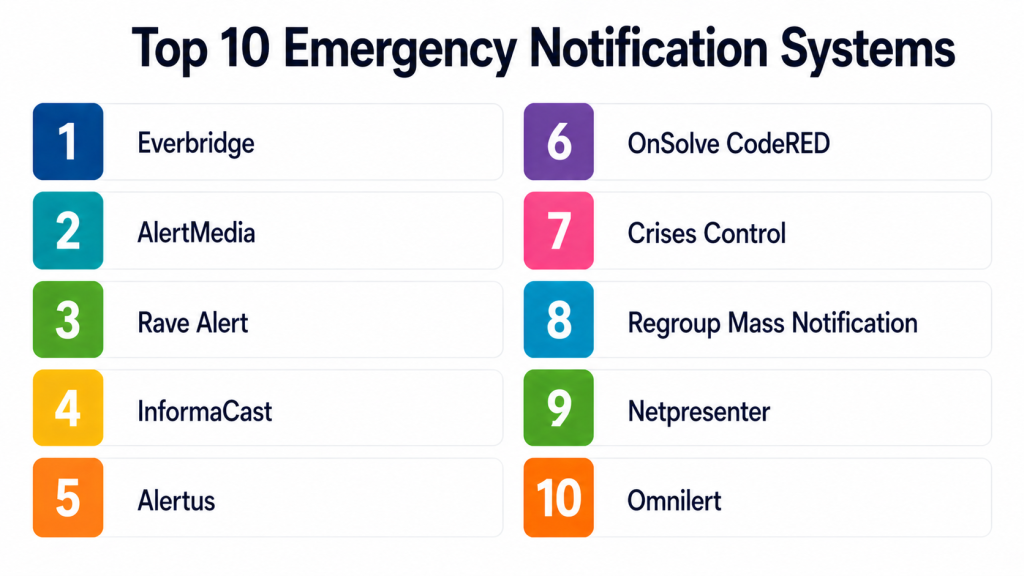
Top 10 Emergency Notification Systems
#1 — Everbridge
Short description:
A leading enterprise-grade emergency notification platform used for critical event management and mass communication.
Key Features
- Multi-channel alerting (SMS, email, voice, app)
- Real-time incident management
- Geo-targeted notifications
- Automation workflows
- Reporting and analytics
- Crisis management tools
Pros
- Highly reliable delivery
- Strong enterprise features
- Scalable for large audiences
Cons
- Complex setup
- Higher cost
- Requires training
Platforms / Deployment
Web / iOS / Android
Cloud
Security & Compliance
SSO/SAML, MFA, RBAC, audit logs
Not publicly stated
Integrations & Ecosystem
Supports integrations with enterprise systems and monitoring tools.
- APIs
- IT monitoring tools
- Security systems
Support & Community
Enterprise-level support and onboarding.
#2 — AlertMedia
Short description:
A user-friendly emergency communication platform designed for fast alerts and workforce safety.
Key Features
- Mass notification
- Two-way communication
- Geo-targeting
- Mobile alerts
- Threat intelligence feeds
Pros
- Easy to use
- Fast deployment
- Strong mobile experience
Cons
- Limited advanced customization
- Pricing not transparent
- Some enterprise features limited
Platforms / Deployment
Web / iOS / Android
Cloud
Security & Compliance
SSO, encryption
Not publicly stated
Integrations & Ecosystem
Supports integrations with common business tools.
- APIs
- HR systems
- Communication tools
Support & Community
Strong customer support and onboarding.
#3 — Rave Mobile Safety
Short description:
A public safety-focused platform widely used by universities, governments, and enterprises.
Key Features
- Mass notification
- Panic button integration
- Location-based alerts
- Incident management
- Analytics
Pros
- Strong public safety focus
- Reliable alerts
- Good mobile capabilities
Cons
- Interface can be complex
- Customization may require support
- Pricing varies
Platforms / Deployment
Web / Mobile
Cloud
Security & Compliance
Not publicly stated
Integrations & Ecosystem
Supports integrations with safety systems.
- APIs
- Security tools
- Campus systems
Support & Community
Professional support available.
#4 — OnSolve (CodeRED)
Short description:
A mass notification system used for public safety and enterprise alerting.
Key Features
- Emergency alerts
- Geo-targeting
- Multi-channel messaging
- Incident management
- Reporting
Pros
- Strong public alert capabilities
- Scalable
- Reliable
Cons
- Complex interface
- Higher cost
- Setup effort required
Platforms / Deployment
Web
Cloud
Security & Compliance
Not publicly stated
Integrations & Ecosystem
Supports integrations.
- APIs
- Government systems
Support & Community
Enterprise support available.
#5 — xMatters
Short description:
An incident response and notification platform focused on IT and DevOps teams.
Key Features
- Automated alerting
- Incident workflows
- On-call management
- Integrations with monitoring tools
- Analytics
Pros
- Strong automation
- Ideal for IT teams
- Deep integrations
Cons
- Not focused on general safety use cases
- Learning curve
- Pricing varies
Platforms / Deployment
Web / Mobile
Cloud
Security & Compliance
SSO, RBAC
Not publicly stated
Integrations & Ecosystem
Extensive integrations with DevOps tools.
- Monitoring tools
- IT systems
- APIs
Support & Community
Strong developer-focused support.
#6 — Singlewire InformaCast
Short description:
A notification system designed for schools and enterprises with strong voice and paging capabilities.
Key Features
- Mass notification
- Voice alerts and paging
- Mobile alerts
- Incident workflows
- Integrations
Pros
- Strong voice communication
- Good for campus environments
- Reliable
Cons
- Interface may feel outdated
- Limited customization
- Setup required
Platforms / Deployment
Web / Mobile
Cloud / On-premise
Security & Compliance
Not publicly stated
Integrations & Ecosystem
Supports integrations with communication systems.
- VoIP systems
- APIs
- Messaging tools
Support & Community
Standard support available.
#7 — Regroup Mass Notification
Short description:
A flexible mass notification platform suitable for enterprises and educational institutions.
Key Features
- Multi-channel alerts
- Two-way communication
- Geo-targeting
- Reporting dashboards
- Automation
Pros
- Flexible and scalable
- Easy to use
- Good feature balance
Cons
- Limited advanced analytics
- Interface improvements needed
- Pricing varies
Platforms / Deployment
Web / Mobile
Cloud
Security & Compliance
Not publicly stated
Integrations & Ecosystem
Supports integrations.
- APIs
- Communication tools
Support & Community
Good customer support.
#8 — Blackboard Connect
Short description:
A communication platform widely used in education for emergency alerts and messaging.
Key Features
- Mass notification
- Multi-channel messaging
- Scheduling alerts
- Reporting
- Contact management
Pros
- Strong education focus
- Easy to use
- Reliable
Cons
- Limited enterprise features
- Basic analytics
- Customization limits
Platforms / Deployment
Web / Mobile
Cloud
Security & Compliance
Not publicly stated
Integrations & Ecosystem
Supports integrations.
- APIs
- School systems
Support & Community
Strong support in education sector.
#9 — Omnilert
Short description:
A modern emergency notification platform with AI-powered alerting capabilities.
Key Features
- Mass alerts
- AI-based threat detection
- Multi-channel messaging
- Geo-targeting
- Analytics
Pros
- Innovative AI features
- Fast alerts
- Easy to use
Cons
- Newer platform compared to others
- Limited enterprise depth
- Pricing varies
Platforms / Deployment
Web / Mobile
Cloud
Security & Compliance
Not publicly stated
Integrations & Ecosystem
Supports integrations.
- APIs
- Security systems
Support & Community
Growing support ecosystem.
#10 — Send Word Now
Short description:
A reliable emergency communication system focused on mass notification and incident response.
Key Features
- Multi-channel alerts
- Incident management
- Reporting tools
- Automation
- Contact management
Pros
- Reliable delivery
- Strong core features
- Scalable
Cons
- Interface may feel outdated
- Limited advanced features
- Pricing varies
Platforms / Deployment
Web
Cloud
Security & Compliance
Not publicly stated
Integrations & Ecosystem
Supports integrations.
- APIs
- Business systems
Support & Community
Professional support available.
Comparison Table
| Tool Name | Best For | Platform(s) Supported | Deployment | Standout Feature | Public Rating |
|---|---|---|---|---|---|
| Everbridge | Enterprise alerts | Web, Mobile | Cloud | Critical event management | N/A |
| AlertMedia | Workforce safety | Web, Mobile | Cloud | Ease of use | N/A |
| Rave Mobile Safety | Public safety | Web, Mobile | Cloud | Panic button integration | N/A |
| OnSolve | Public alerts | Web | Cloud | Geo-targeting | N/A |
| xMatters | IT teams | Web, Mobile | Cloud | Automation workflows | N/A |
| InformaCast | Schools & enterprises | Web, Mobile | Cloud/On-prem | Voice alerts | N/A |
| Regroup | Flexible teams | Web, Mobile | Cloud | Two-way messaging | N/A |
| Blackboard Connect | Education | Web, Mobile | Cloud | Easy communication | N/A |
| Omnilert | AI alerts | Web, Mobile | Cloud | AI detection | N/A |
| Send Word Now | Mass notification | Web | Cloud | Reliable delivery | N/A |
Evaluation & Scoring of Emergency Notification Systems
| Tool Name | Core (25%) | Ease (15%) | Integrations (15%) | Security (10%) | Performance (10%) | Support (10%) | Value (15%) | Weighted Total |
|---|---|---|---|---|---|---|---|---|
| Everbridge | 9 | 6 | 8 | 8 | 9 | 8 | 6 | 7.9 |
| AlertMedia | 8 | 9 | 7 | 7 | 8 | 8 | 8 | 8.1 |
| Rave Mobile Safety | 8 | 7 | 7 | 7 | 8 | 7 | 7 | 7.4 |
| OnSolve | 8 | 6 | 7 | 7 | 8 | 7 | 6 | 7.2 |
| xMatters | 8 | 7 | 9 | 7 | 8 | 8 | 7 | 7.8 |
| InformaCast | 7 | 7 | 7 | 6 | 7 | 7 | 7 | 7.0 |
| Regroup | 7 | 8 | 7 | 6 | 7 | 7 | 8 | 7.4 |
| Blackboard Connect | 6 | 8 | 6 | 6 | 7 | 7 | 7 | 6.9 |
| Omnilert | 7 | 8 | 6 | 6 | 7 | 7 | 7 | 7.1 |
| Send Word Now | 7 | 6 | 7 | 6 | 8 | 7 | 6 | 6.9 |
How to interpret scores:
- Scores are comparative, not absolute
- Higher scores indicate stronger overall capability
- Ease matters more for small teams, while core features matter for enterprises
- Use scores as a shortlist guide
Which Emergency Notification System Is Right for You?
Solo / Freelancer
- Basic tools or messaging platforms are sufficient
SMB
- AlertMedia or Regroup
- Focus on ease of use and quick setup
Mid-Market
- xMatters or Rave Mobile Safety
- Balance features and integrations
Enterprise
- Everbridge or OnSolve
- Focus on scalability and reliability
Budget vs Premium
- Budget: Regroup, Blackboard Connect
- Premium: Everbridge, AlertMedia
Feature Depth vs Ease of Use
- Advanced: Everbridge, xMatters
- Easy: AlertMedia, Regroup
Integrations & Scalability
- High: xMatters, Everbridge
- Moderate: AlertMedia
Security & Compliance Needs
- High: Everbridge
- Moderate: AlertMedia
Frequently Asked Questions (FAQs) (numbring )
Q1: What is an emergency notification system?
It is a platform used to send alerts quickly during emergencies to ensure safety and coordination.
Q2: Do these systems support multiple channels?
Yes, most support SMS, email, voice, and mobile notifications.
Q3: Are they suitable for small businesses?
Yes, many tools offer scalable solutions for smaller teams.
Q4: How fast are notifications delivered?
Most systems deliver messages within seconds depending on network conditions.
Q5: Can alerts be automated?
Yes, automation is a core feature in most platforms.
Q6: Are these systems secure?
Most offer encryption and access controls, though features vary.
Q7: Can they integrate with other systems?
Yes, APIs and integrations are commonly available.
Q8: What industries use these tools?
Healthcare, education, government, logistics, and enterprises.
Q9: Are mobile apps available?
Yes, most platforms provide mobile apps.
Q10: Is training required?
Basic tools require minimal training, while enterprise systems may need onboarding.
Conclusion
Emergency Notification Systems are essential for ensuring fast and reliable communication during critical situations. They help organizations protect people, minimize risks, and respond effectively to emergencies. Different tools serve different needs, from simple alerting platforms to advanced enterprise systems with automation and analytics. The right choice depends on your organization’s size, complexity, and communication requirements. It is important to focus on reliability, ease of use, and integration capabilities when selecting a tool. Testing a few options can help identify the best fit for your workflows.