Introduction
Parental Control Software helps parents monitor, manage, and guide their children’s digital activity across devices like smartphones, tablets, and computers. In simple terms, these tools act as a digital safety layer, allowing parents to set limits, filter harmful content, and understand how their kids interact with technology.
In today’s always-connected world, children spend significant time online—making digital safety a real concern. Modern parental control platforms now go beyond basic restrictions and include AI-driven monitoring, behavioral insights, screen time automation, and zero-trust security controls. These tools help parents strike a balance between protection and independence.
Common use cases include:
- Managing screen time and device usage
- Blocking inappropriate websites and apps
- Tracking location and ensuring safety
- Monitoring social media and communication risks
- Encouraging healthy digital habits
Key evaluation criteria:
- Content filtering and web safety
- Screen time management
- App blocking and device control
- Real-time alerts and reporting
- Ease of setup and usability
- Cross-platform compatibility
- Privacy and security features
- Pricing and scalability
Parental control apps typically combine content filtering, usage controls, and monitoring features to protect children online .
Best for: Parents, guardians, and families managing children’s digital exposure across devices and platforms.
Not ideal for: Users looking for basic device restrictions or those relying only on manual supervision without automation.
Key Trends in Parental Control Software
- AI-based monitoring: Detect risky behavior and harmful content automatically
- Screen time automation: Daily limits, bedtime schedules, and device pauses
- Cross-device control: Manage phones, tablets, PCs, and consoles
- Behavioral insights: Focus on usage patterns instead of raw surveillance
- Social media monitoring: Detect cyberbullying and unsafe interactions
- Location tracking & geofencing: Real-time child safety alerts
- Cloud dashboards: Remote control from anywhere
- Privacy-first controls: Balance safety with child independence
- Integration with OS-level tools: Built-in controls like Apple Screen Time and Google Family Link
- Gamified discipline: Reward-based screen time extensions
How We Evaluated Parental Control Software (Methodology)
- Assessed market adoption and trustworthiness
- Evaluated content filtering and monitoring capabilities
- Reviewed screen time and app control features
- Analyzed security posture and privacy safeguards
- Measured performance and reliability
- Compared ease of use for parents
- Evaluated cross-platform support
- Considered pricing and value
- Reviewed support and ecosystem maturity
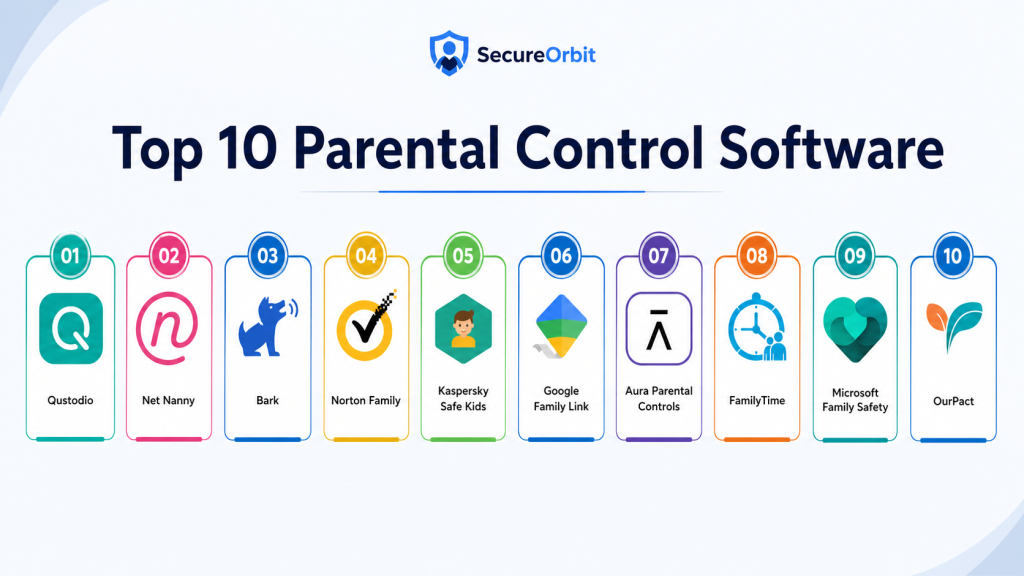
Top 10 Parental Control Software
#1 — Qustodio
Short description: Qustodio is one of the most comprehensive parental control platforms, offering advanced monitoring, screen time limits, and web filtering. It supports multiple devices and provides detailed activity reports. Known for its balanced approach between control and usability. Suitable for families needing full digital oversight. It helps parents understand behavior trends. Ideal for all age groups.
Key Features
- Screen time management
- Website filtering
- App blocking
- Activity reports
- Location tracking
- Alerts
Pros
- Feature-rich platform
- Strong cross-device support
Cons
- Premium pricing
- Limited free plan
Platforms / Deployment
Windows / macOS / Android / iOS / Web
Cloud
Security & Compliance
Encryption, secure access controls
Integrations & Ecosystem
Integrates across devices and operating systems
- Multi-device dashboards
- App and web monitoring
Support & Community
Strong global user base and documentation.
#2 — Net Nanny
Short description: Net Nanny is known for real-time content filtering and intuitive parental controls. It analyzes web content dynamically. Suitable for families focused on internet safety. It offers strong filtering capabilities. Ideal for younger children.
Key Features
- Real-time web filtering
- Screen time controls
- App blocking
- Alerts
- Reports
Pros
- Best-in-class filtering
- Easy to use
Cons
- Expensive
- Limited platform consistency
Platforms / Deployment
Windows / macOS / Android / iOS
Cloud
Security & Compliance
Encryption
Integrations & Ecosystem
Supports cross-device management.
Support & Community
Reliable support.
#3 — Bark
Short description: Bark focuses on AI-based monitoring of social media, messages, and online behavior. It detects risks like cyberbullying or harmful content. Suitable for teens and social media-heavy usage.
Key Features
- Social media monitoring
- AI alerts
- Screen time controls
- Content filtering
- Reporting
Pros
- Strong AI insights
- Excellent for social platforms
Cons
- Limited device control
- Subscription required
Platforms / Deployment
Android / iOS / Web
Cloud
Security & Compliance
Encryption
Integrations & Ecosystem
Integrates with messaging and social apps.
Support & Community
Strong support ecosystem.
#4 — Norton Family
Short description: Norton Family offers web monitoring, screen time management, and parental insights. It integrates with Norton’s broader security ecosystem.
Key Features
- Web monitoring
- Screen time limits
- Activity reports
- Location tracking
- Alerts
Pros
- Trusted brand
- Good integration
Cons
- Limited advanced features
- UI improvements needed
Platforms / Deployment
Windows / Android / iOS
Cloud
Security & Compliance
Encryption
Integrations & Ecosystem
Part of Norton ecosystem.
Support & Community
Strong enterprise support.
#5 — Kaspersky Safe Kids
Short description: Kaspersky Safe Kids is an affordable parental control solution with app filtering, screen time management, and location tracking.
Key Features
- App filtering
- Screen time control
- Location tracking
- Safe browsing
- Alerts
Pros
- Budget-friendly
- Good basic features
Cons
- Limited advanced analytics
- Privacy concerns in some regions
Platforms / Deployment
Windows / macOS / Android / iOS
Cloud
Security & Compliance
Encryption
Integrations & Ecosystem
Supports multi-device monitoring.
Support & Community
Good support.
#6 — Google Family Link
Short description: Google Family Link is a free parental control tool designed for Android ecosystems. It allows app approvals, screen time limits, and device monitoring.
Key Features
- Screen time limits
- App approvals
- Device monitoring
- Location tracking
- Activity reports
Pros
- Free to use
- Easy setup
Cons
- Limited filtering
- Android-focused
Platforms / Deployment
Android / Web
Cloud
Security & Compliance
Google security ecosystem
Integrations & Ecosystem
Deep Android integration
Support & Community
Strong ecosystem support.
#7 — Aura Parental Controls
Short description: Aura combines parental controls with identity protection and cybersecurity tools, offering an all-in-one solution.
Key Features
- Content monitoring
- Identity protection
- Screen time control
- Alerts
- Reports
Pros
- All-in-one security
- Strong protection
Cons
- Expensive
- Overkill for basic users
Platforms / Deployment
Web / Mobile
Cloud
Security & Compliance
Encryption, identity protection
Integrations & Ecosystem
Supports multiple devices.
Support & Community
Strong support.
#8 — FamilyTime
Short description: FamilyTime provides app blocking, screen time control, and location tracking with a simple interface.
Key Features
- Screen time control
- App blocking
- Location tracking
- Alerts
- Reports
Pros
- Easy to use
- Feature-rich
Cons
- Paid features
- UI could improve
Platforms / Deployment
Android / iOS
Cloud
Security & Compliance
Encryption
Integrations & Ecosystem
Mobile-focused ecosystem.
Support & Community
Moderate support.
#9 — Microsoft Family Safety
Short description: Microsoft Family Safety offers parental controls integrated with Windows and Xbox ecosystems. Suitable for gaming-focused households.
Key Features
- Screen time management
- App restrictions
- Activity reports
- Location tracking
- Purchase controls
Pros
- Strong Microsoft integration
- Good for gaming control
Cons
- Limited outside ecosystem
- Basic filtering
Platforms / Deployment
Windows / Xbox / Mobile
Cloud
Security & Compliance
Encryption
Integrations & Ecosystem
Microsoft ecosystem integration.
Support & Community
Strong support.
#10 — OurPact
Short description: OurPact provides screen time control, app blocking, and geofencing. It is especially strong for iOS users.
Key Features
- Screen time scheduling
- App blocking
- Geofencing
- Alerts
- Remote control
Pros
- Strong iOS support
- Flexible controls
Cons
- Setup complexity
- Limited filtering
Platforms / Deployment
Android / iOS / Web
Cloud
Security & Compliance
Encryption
Integrations & Ecosystem
Supports multi-device management.
Support & Community
Good support.
Comparison Table
| Tool Name | Best For | Platform(s) Supported | Deployment | Standout Feature | Public Rating |
|---|---|---|---|---|---|
| Qustodio | Full control | All platforms | Cloud | Advanced monitoring | N/A |
| Net Nanny | Web filtering | All platforms | Cloud | Real-time filtering | N/A |
| Bark | Social monitoring | Mobile/Web | Cloud | AI alerts | N/A |
| Norton Family | Families | Windows/Android | Cloud | Integration | N/A |
| Kaspersky | Budget users | All platforms | Cloud | Affordable | N/A |
| Family Link | Android users | Android/Web | Cloud | Free tool | N/A |
| Aura | All-in-one | Mobile/Web | Cloud | Identity protection | N/A |
| FamilyTime | Simplicity | Mobile | Cloud | Ease of use | N/A |
| Microsoft Family | Gaming families | Windows/Xbox | Cloud | Gaming controls | N/A |
| OurPact | iOS users | Mobile/Web | Cloud | Geofencing | N/A |
Evaluation & Scoring of Parental Control Software
| Tool Name | Core | Ease | Integrations | Security | Performance | Support | Value | Weighted Total |
|---|---|---|---|---|---|---|---|---|
| Qustodio | 9 | 9 | 9 | 9 | 9 | 8 | 8 | 8.8 |
| Net Nanny | 9 | 9 | 8 | 9 | 9 | 8 | 7 | 8.6 |
| Bark | 9 | 8 | 8 | 8 | 8 | 8 | 8 | 8.2 |
| Norton Family | 8 | 8 | 8 | 9 | 8 | 8 | 8 | 8.2 |
| Kaspersky | 8 | 8 | 7 | 8 | 8 | 7 | 9 | 8.1 |
| Family Link | 7 | 9 | 7 | 8 | 8 | 7 | 10 | 8.0 |
| Aura | 9 | 8 | 8 | 9 | 8 | 8 | 7 | 8.3 |
| FamilyTime | 8 | 8 | 7 | 8 | 8 | 7 | 8 | 8.0 |
| Microsoft Family | 8 | 8 | 8 | 8 | 8 | 8 | 8 | 8.1 |
| OurPact | 8 | 8 | 7 | 8 | 8 | 7 | 8 | 8.0 |
How to interpret scores:
- Higher scores = better overall control and monitoring
- AI-based tools excel in insights
- Free tools offer value but fewer features
- Choose based on your child’s age and device ecosystem
Which Parental Control Software Is Right for You?
Solo / Freelancer Parents
Google Family Link for basic and free control
SMB Families
Qustodio or Norton Family for balanced features
Mid-Market Families
Net Nanny or Bark for advanced monitoring
Enterprise / Large Families
Aura or Microsoft Family Safety
Budget vs Premium
Budget: Family Link, Kaspersky
Premium: Net Nanny, Aura
Feature Depth vs Ease of Use
Feature-rich: Qustodio, Bark
User-friendly: Family Link
Integrations & Scalability
Best: Qustodio, Microsoft
Moderate: FamilyTime
Security & Compliance Needs
High: Aura, Qustodio
Moderate: Free tools
Frequently Asked Questions (FAQs)
1. What is parental control software?
Parental control software helps parents monitor and manage children’s digital activity. It includes features like filtering, tracking, and usage limits. It improves online safety. It supports responsible usage.
2. How do parental control apps work?
They are installed on devices and allow parents to set rules. These include screen limits, app restrictions, and monitoring. They provide reports and alerts.
3. Are parental control apps necessary?
Yes, as children spend more time online, these tools help reduce risks and promote safe usage .
4. Can these apps track location?
Yes, many apps include GPS tracking and geofencing features to monitor child safety.
5. Are parental control apps safe?
Most use encryption and secure systems. However, parents should choose trusted tools and review privacy policies.
6. Can kids bypass parental controls?
Some tech-savvy children may bypass controls. Strong apps reduce this risk, but parental guidance remains important.
7. What features should I prioritize?
Focus on screen time control, content filtering, and monitoring features.
8. Are free apps enough?
Free apps are good for basic needs. Paid apps offer advanced monitoring and control.
9. Do these apps work across devices?
Most modern tools support multiple devices and platforms.
10. Are parental controls enough for safety?
No tool is perfect—active parental involvement is still essential alongside software.
Conclusion
Parental Control Software has become a vital component of modern parenting, offering tools to protect children while guiding their digital habits. From basic screen time management to advanced AI-driven monitoring, these platforms provide the flexibility needed to adapt to different parenting styles and child age groups. Tools like Qustodio and Net Nanny deliver comprehensive control, while solutions like Bark focus on behavioral insights and social safety. Ultimately, the best choice depends on your family’s needs, device ecosystem, and level of supervision required. Instead of relying solely on software, combine these tools with open communication and digital education. Start by testing two or three options, evaluate usability and effectiveness, and choose the one that aligns best with your parenting approach and your child’s digital lifestyle.
Easy to understand guide explaining features, pros, and limitations of popular parental control software platforms clearly.
This article explains parental control software in simple language and helps parents improve children’s online safety and screen time management.