Introduction
Patient Portal Platforms are secure digital interfaces that allow patients to access their medical information, communicate with healthcare providers, and manage healthcare activities online. These platforms are typically integrated with EHR/EMR systems and provide 24/7 access to health records, lab results, appointments, and billing information.
In modern healthcare, patient portals are essential for improving engagement, reducing administrative workload, and enhancing communication between patients and providers. They empower patients to take an active role in managing their health while enabling providers to streamline operations.
Common use cases include:
- Accessing medical records and lab results
- Scheduling appointments and managing visits
- Secure messaging with healthcare providers
- Online billing and payment management
- Prescription refill requests
What buyers should evaluate:
- Ease of use and patient experience
- Integration with EHR/EMR systems
- Security features (MFA, encryption, access control)
- Mobile accessibility
- Workflow automation and notifications
- Customization and branding options
- Reporting and analytics
- Telehealth integration
Best for: Hospitals, clinics, telehealth providers, and healthcare organizations aiming to improve patient engagement and digital experience.
Not ideal for: Organizations without digital infrastructure or those with minimal patient interaction needs.
Key Trends in Patient Portal Platforms
- AI-powered patient engagement and chatbots
- Mobile-first and app-based patient portals
- Integration with wearable devices and IoT health data
- Telehealth and virtual consultation integration
- Automated reminders and care coordination
- Multi-omics and health data integration
- Enhanced cybersecurity with MFA and encryption
- API-driven interoperability with healthcare systems
- Personalized patient dashboards and analytics
- Growth of cloud-native patient portal solutions
How We Selected These Tools (Methodology)
- Evaluated adoption across healthcare providers
- Assessed feature completeness and usability
- Reviewed integration with EHR/EMR systems
- Analyzed scalability across healthcare organizations
- Considered patient experience and accessibility
- Reviewed security and compliance capabilities
- Included both enterprise and SMB solutions
- Assessed vendor ecosystem and support quality
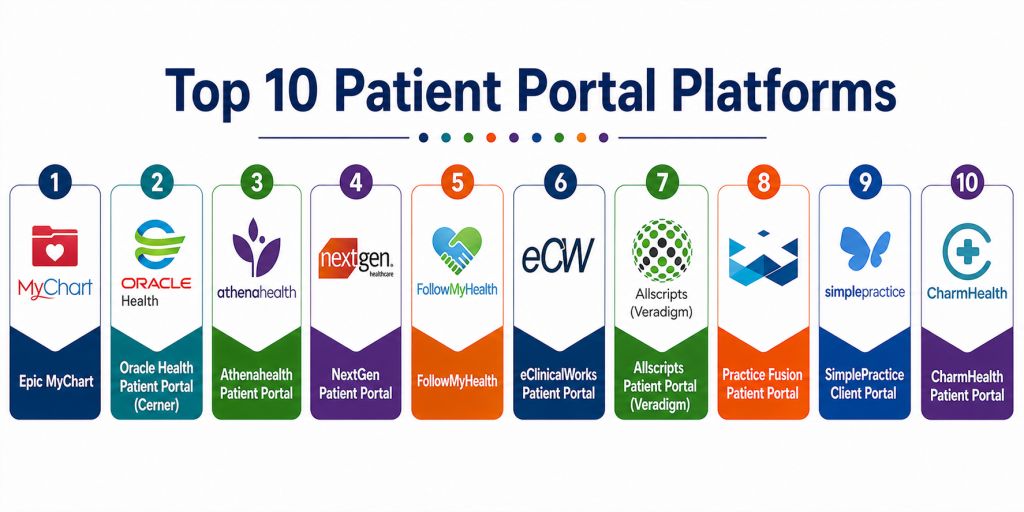
Top 10 Patient Portal Platforms
#1 — Epic MyChart
Short description: A widely adopted patient portal platform integrated with Epic systems, offering comprehensive patient engagement features.
Key Features
- Access to medical records and test results
- Appointment scheduling
- Secure messaging
- Billing and payments
- Mobile app support
Pros
- Highly integrated with Epic ecosystem
- Strong user adoption
Cons
- Limited outside Epic systems
- Complex setup
Platforms / Deployment
Web / iOS / Android / Cloud
Security & Compliance
Varies / N/A
Integrations & Ecosystem
Deep integration with Epic EHR
- API ecosystem
- Healthcare data exchange
Support & Community
Enterprise-level support
#2 — Oracle Health Patient Portal (Cerner)
Short description: A patient engagement platform designed for large healthcare organizations with strong interoperability features.
Key Features
- Patient data access
- Messaging tools
- Appointment management
- Billing integration
- Health tracking
Pros
- Strong interoperability
- Enterprise-ready
Cons
- Complex UI
- Cost considerations
Platforms / Deployment
Web / Mobile / Cloud
Security & Compliance
Varies / N/A
Integrations & Ecosystem
Integrates with Cerner systems
- API-based integration
Support & Community
Strong enterprise support
#3 — Athenahealth Patient Portal
Short description: A cloud-based patient portal focused on usability and patient engagement for clinics and SMB healthcare providers.
Key Features
- Patient communication
- Appointment scheduling
- Billing tools
- Health records access
- Analytics dashboards
Pros
- Easy to use
- Cloud-native
Cons
- Limited customization
- Pricing variability
Platforms / Deployment
Web / Cloud
Security & Compliance
Varies / N/A
Integrations & Ecosystem
API-driven integrations
- Healthcare app ecosystem
Support & Community
Strong support system
#4 — NextGen Patient Portal
Short description: A flexible patient portal designed for specialty practices with customizable workflows.
Key Features
- Patient records access
- Appointment management
- Messaging tools
- Billing integration
- Workflow customization
Pros
- Customizable workflows
- Good integration support
Cons
- Learning curve
- Interface complexity
Platforms / Deployment
Web / Cloud
Security & Compliance
Varies / N/A
Integrations & Ecosystem
Supports healthcare integrations
- API ecosystem
Support & Community
Moderate support
#5 — FollowMyHealth
Short description: A widely used patient portal platform offering strong interoperability and patient engagement features.
Key Features
- Unified health records
- Secure messaging
- Appointment scheduling
- Health tracking
- Mobile access
Pros
- Interoperable platform
- User-friendly interface
Cons
- Limited advanced features
- Performance variability
Platforms / Deployment
Web / Mobile / Cloud
Security & Compliance
Varies / N/A
Integrations & Ecosystem
Supports integration with healthcare systems
- API-based connections
Support & Community
Growing community
#6 — eClinicalWorks Patient Portal
Short description: A cloud-based portal offering integrated clinical and patient engagement features for ambulatory care.
Key Features
- Patient records
- Telehealth integration
- Appointment scheduling
- Billing tools
- Patient messaging
Pros
- Easy deployment
- Telehealth support
Cons
- Performance issues
- Support concerns
Platforms / Deployment
Web / Cloud
Security & Compliance
Varies / N/A
Integrations & Ecosystem
Integrates with EHR systems
- API support
Support & Community
Mixed support feedback
#7 — Allscripts Patient Portal (Veradigm)
Short description: A customizable patient portal offering strong integration with clinical workflows and data systems.
Key Features
- Health record access
- Messaging tools
- Appointment management
- Billing integration
- Data analytics
Pros
- Flexible platform
- Strong integrations
Cons
- Complex UI
- Implementation challenges
Platforms / Deployment
Web / Cloud
Security & Compliance
Varies / N/A
Integrations & Ecosystem
Supports multiple integrations
- API ecosystem
Support & Community
Moderate support
#8 — Practice Fusion Patient Portal
Short description: A simple and affordable patient portal designed for small practices.
Key Features
- Patient records
- Scheduling tools
- Messaging
- Billing integration
- Reporting
Pros
- Easy to use
- Affordable
Cons
- Limited advanced features
- Not scalable
Platforms / Deployment
Web / Cloud
Security & Compliance
Varies / N/A
Integrations & Ecosystem
Basic integrations
- Limited API support
Support & Community
Suitable for small practices
#9 — SimplePractice Client Portal
Short description: A portal platform focused on behavioral health and small practices with strong patient engagement features.
Key Features
- Appointment scheduling
- Messaging
- Billing tools
- Telehealth support
- Client engagement
Pros
- User-friendly
- Strong telehealth
Cons
- Niche focus
- Limited enterprise features
Platforms / Deployment
Web / Cloud
Security & Compliance
Varies / N/A
Integrations & Ecosystem
Supports healthcare integrations
- API support
Support & Community
Strong SMB support
#10 — CharmHealth Patient Portal
Short description: A cloud-based portal offering integrated patient engagement and health record access for small to mid-sized practices.
Key Features
- Patient records
- Messaging
- Appointment scheduling
- Billing tools
- Reporting
Pros
- Affordable
- Easy to deploy
Cons
- Limited advanced features
- Smaller ecosystem
Platforms / Deployment
Web / Cloud
Security & Compliance
Varies / N/A
Integrations & Ecosystem
Supports integrations with healthcare systems
- API support
Support & Community
Growing support ecosystem
Comparison Table
| Tool Name | Best For | Platform(s) Supported | Deployment | Standout Feature | Public Rating |
|---|---|---|---|---|---|
| Epic MyChart | Large hospitals | Web/Mobile | Cloud | Deep integration | N/A |
| Oracle Health | Enterprise hospitals | Web/Mobile | Cloud | Interoperability | N/A |
| Athenahealth | SMB clinics | Web | Cloud | Ease of use | N/A |
| NextGen | Specialty practices | Web | Cloud | Custom workflows | N/A |
| FollowMyHealth | Interoperability | Web/Mobile | Cloud | Unified records | N/A |
| eClinicalWorks | Ambulatory care | Web | Cloud | Telehealth | N/A |
| Allscripts | Flexible workflows | Web | Cloud | Customization | N/A |
| Practice Fusion | Small clinics | Web | Cloud | Affordability | N/A |
| SimplePractice | Behavioral health | Web | Cloud | Client engagement | N/A |
| CharmHealth | SMB practices | Web | Cloud | Ease of deployment | N/A |
Evaluation & Scoring of Patient Portal Platforms
| Tool Name | Core (25%) | Ease (15%) | Integrations (15%) | Security (10%) | Performance (10%) | Support (10%) | Value (15%) | Weighted Total |
|---|---|---|---|---|---|---|---|---|
| Epic MyChart | 10 | 7 | 9 | 9 | 9 | 9 | 6 | 8.9 |
| Oracle Health | 9 | 6 | 9 | 9 | 8 | 9 | 6 | 8.5 |
| Athenahealth | 8 | 9 | 8 | 8 | 8 | 8 | 7 | 8.2 |
| NextGen | 8 | 7 | 8 | 8 | 7 | 7 | 7 | 7.7 |
| FollowMyHealth | 8 | 8 | 8 | 8 | 7 | 7 | 7 | 7.8 |
| eClinicalWorks | 7 | 8 | 7 | 7 | 7 | 6 | 8 | 7.4 |
| Allscripts | 8 | 7 | 8 | 8 | 7 | 7 | 7 | 7.8 |
| Practice Fusion | 6 | 9 | 6 | 7 | 6 | 6 | 9 | 7.2 |
| SimplePractice | 7 | 9 | 7 | 7 | 7 | 7 | 8 | 7.6 |
| CharmHealth | 7 | 8 | 7 | 7 | 7 | 7 | 8 | 7.5 |
How to interpret scores:
These scores are relative comparisons based on real-world usage scenarios. Higher scores indicate enterprise-ready platforms with strong integration and security, while mid-range scores highlight tools suitable for smaller practices or niche use cases.
Which Patient Portal Platform Is Right for You?
Solo / Freelancer
- Practice Fusion, SimplePractice
- Easy and affordable solutions
SMB
- Athenahealth, CharmHealth
- Cloud-based and user-friendly
Mid-Market
- NextGen, FollowMyHealth
- Balanced features and scalability
Enterprise
- Epic MyChart, Oracle Health
- Full-scale patient engagement platforms
Budget vs Premium
- Budget: Practice Fusion, CharmHealth
- Premium: Epic, Oracle Health
Feature Depth vs Ease of Use
- Deep features: Epic, Oracle Health
- Ease of use: Athenahealth
Integrations & Scalability
- Enterprise tools offer strong interoperability
- SMB tools focus on simplicity
Security & Compliance Needs
- Enterprise platforms better for regulated environments
Frequently Asked Questions (FAQs)
1. What is a patient portal platform?
A patient portal is an online system that allows patients to access medical records and interact with healthcare providers.
2. What features do patient portals include?
They typically include appointment scheduling, secure messaging, access to records, billing, and prescription management.
3. Are patient portals secure?
Yes, they use secure access controls and encryption to protect patient data.
4. Can patients access records anytime?
Yes, most portals provide 24/7 access to health information.
5. Do patient portals improve care?
They improve communication, engagement, and patient satisfaction.
6. Are these platforms cloud-based?
Many modern portals are cloud-based, though some support hybrid deployment.
7. Can portals integrate with EHR systems?
Yes, integration with EHR/EMR systems is a core capability.
8. What are common challenges?
Low adoption rates, usability issues, and integration complexity.
9. Do portals support telehealth?
Many platforms include telehealth and virtual consultation features.
10. How do I choose the right portal?
Evaluate based on usability, integration, security, and scalability.
Conclusion
Patient portal platforms have become a vital component of modern healthcare by enabling seamless communication, improving patient engagement, and reducing administrative burdens. They provide patients with direct access to their health information while helping providers streamline workflows and enhance care delivery. The right platform depends on your organization’s size, patient engagement goals, and technical infrastructure. Enterprise platforms offer deep integration and scalability, while smaller solutions focus on simplicity and cost efficiency. Before making a decision, organizations should evaluate usability, integration capabilities, and security features. It is also important to consider how well the platform aligns with existing healthcare systems. Instead of choosing a single platform immediately, shortlist a few options and test them through pilot programs. This helps validate real-world performance and adoption rates. Ultimately, the best patient portal platform is the one that improves patient experience, enhances communication, and aligns with your long-term digital healthcare strategy.