Introduction
Media Mix Modeling Tools help businesses measure how different marketing channels contribute to business outcomes such as sales, revenue, conversions, customer acquisition, and brand growth. These platforms analyze historical marketing and business data to estimate the impact of advertising across channels like search, social media, TV, radio, email, display advertising, influencer marketing, retail media, and offline campaigns.
As privacy regulations tighten and third-party cookies become less reliable, Media Mix Modeling (MMM) has become increasingly important for marketers seeking privacy-safe and statistically grounded marketing measurement. Modern MMM platforms combine statistical modeling, AI-powered forecasting, scenario planning, incrementality testing, and automated budget optimization to help organizations allocate marketing spend more effectively.
Common real-world use cases include:
- Measuring cross-channel marketing ROI
- Optimizing media budget allocation
- Forecasting campaign performance
- Identifying diminishing returns across channels
- Supporting privacy-first marketing measurement strategies
Buyers evaluating Media Mix Modeling Tools should consider:
- Modeling accuracy and methodology
- Scenario planning and forecasting support
- AI-powered optimization capabilities
- Integration with advertising and analytics platforms
- Privacy-safe measurement support
- Dashboard and reporting usability
- Automation and refresh frequency
- Scalability for enterprise media operations
- Security and governance capabilities
- Ease of onboarding and operational management
Best for: enterprise marketing teams, media agencies, consumer brands, retail and ecommerce companies, DTC brands, analytics teams, performance marketing organizations, and businesses managing multi-channel advertising budgets.
Not ideal for: very small businesses with minimal advertising spend, organizations without historical marketing data, or teams relying only on simple attribution reporting.
Key Trends in Media Mix Modeling Tools
- Privacy-first measurement strategies are accelerating adoption of MMM platforms.
- AI-powered budget optimization is improving media planning and campaign forecasting.
- Open-source MMM frameworks are becoming more accessible to internal analytics teams.
- Incrementality testing and MMM are increasingly combined for better causal measurement.
- Daily and near real-time model refreshes are replacing slow quarterly analysis cycles.
- Retail media and ecommerce channel modeling are becoming more important.
- Bayesian statistical approaches are increasingly common in modern MMM workflows.
- Automated scenario planning is helping marketers simulate budget allocation strategies.
- Enterprise dashboards are becoming more collaborative for finance and marketing alignment.
- Generative AI summaries are accelerating executive reporting and insight interpretation.
How We Selected These Tools
The tools included in this list were selected based on measurement capabilities, scalability, analytics sophistication, integration ecosystems, and practical usability across marketing organizations.
Evaluation factors included:
- Media mix modeling functionality
- AI-powered forecasting and optimization
- Incrementality and attribution support
- Dashboard and reporting quality
- Integration ecosystem maturity
- Security and governance capabilities
- Enterprise scalability
- Ease of onboarding and operational workflows
- Industry reputation and adoption
- Support and implementation quality
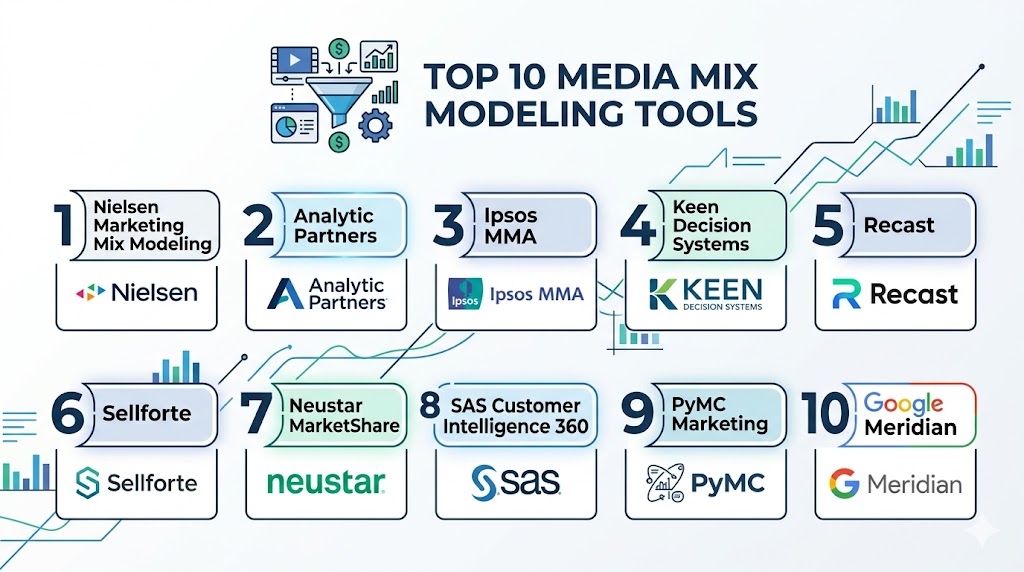
Top 10 Media Mix Modeling Tools
#1 — Nielsen Marketing Mix Modeling
Short description: Nielsen Marketing Mix Modeling is an enterprise-grade marketing measurement solution designed for large organizations managing online and offline advertising investments. It supports advanced econometric modeling, cross-channel performance analysis, and strategic budget optimization. It is especially strong for brands with substantial traditional media investments.
Key Features
- Cross-channel media measurement
- Econometric modeling
- Budget optimization workflows
- Offline and online media analysis
- Scenario planning
- ROI forecasting
- Enterprise analytics dashboards
Pros
- Strong enterprise-scale measurement support
- Excellent offline media analysis capabilities
- Trusted industry reputation
Cons
- Premium enterprise pricing
- Longer onboarding timelines
- Less suitable for SMBs
Platforms / Deployment
- Web
- Cloud
Security & Compliance
- SSO support
- Access controls
- Enterprise governance workflows
- Additional certifications not publicly stated
Integrations & Ecosystem
Nielsen integrates with enterprise analytics and media planning ecosystems to support centralized marketing measurement operations.
- CRM systems
- Media planning platforms
- Analytics dashboards
- APIs
- Business intelligence tools
- Reporting systems
Support & Community
Strong enterprise consulting, onboarding, and analytics support for large-scale media organizations.
#2 — Analytic Partners GPS Enterprise
Short description: Analytic Partners GPS Enterprise is a marketing effectiveness and commercial analytics platform designed for enterprise media measurement and scenario planning. It combines MMM with broader business drivers such as pricing, distribution, and macroeconomic conditions. It is especially valuable for global enterprises seeking strategic planning capabilities.
Key Features
- Marketing mix modeling
- Scenario planning
- Forecasting workflows
- Commercial analytics
- Budget optimization
- Cross-functional reporting
- AI-assisted analytics
Pros
- Strong enterprise forecasting capabilities
- Excellent scenario planning support
- Useful for strategic business analytics
Cons
- Enterprise-focused pricing
- Complex onboarding workflows
- Requires analytics maturity
Platforms / Deployment
- Web
- Cloud
Security & Compliance
- RBAC controls
- Enterprise governance workflows
- Access management support
- Additional certifications not publicly stated
Integrations & Ecosystem
Analytic Partners integrates with enterprise finance, marketing, analytics, and planning systems to support large-scale decision-making workflows.
- CRM systems
- Finance systems
- APIs
- Analytics platforms
- Reporting systems
- Business intelligence tools
Support & Community
High-touch enterprise onboarding and consulting support for global marketing and analytics teams.
#3 — Adobe Mix Modeler
Short description: Adobe Mix Modeler is an enterprise marketing measurement platform built within the Adobe Experience ecosystem. It helps marketers combine planning, measurement, and optimization using privacy-safe data and AI-powered analytics. It is best suited for organizations already invested in Adobe marketing technologies.
Key Features
- Marketing mix modeling
- Media planning workflows
- AI-powered optimization
- Incrementality measurement
- Campaign forecasting
- Privacy-safe analytics
- Enterprise dashboards
Pros
- Strong Adobe ecosystem integration
- Good AI-assisted planning capabilities
- Useful enterprise media optimization workflows
Cons
- Best suited for Adobe-centric organizations
- Enterprise pricing structure
- Advanced implementation complexity
Platforms / Deployment
- Web
- Cloud
Security & Compliance
- SSO support
- RBAC workflows
- Enterprise governance support
- Additional certifications not publicly stated
Integrations & Ecosystem
Adobe Mix Modeler integrates tightly with Adobe Experience Cloud and enterprise marketing ecosystems.
- Adobe Analytics
- Adobe Experience Platform
- CRM systems
- APIs
- Data warehouses
- Marketing automation tools
Support & Community
Strong enterprise onboarding and ecosystem support for Adobe-focused marketing organizations.
#4 — Measured
Short description: Measured is a marketing measurement platform focused on combining media mix modeling with incrementality testing and digital marketing optimization. It is especially popular among DTC and digital-first brands seeking actionable media insights with faster turnaround times.
Key Features
- MMM and incrementality testing
- Campaign-level optimization
- Budget forecasting
- AI-powered analytics
- Real-time dashboards
- Media performance insights
- Automated reporting workflows
Pros
- Strong digital-first measurement workflows
- Useful incrementality integration
- Faster insights compared with traditional MMM
Cons
- Less focused on large offline media environments
- Enterprise customization may require support
- Advanced analytics workflows may need onboarding
Platforms / Deployment
- Web
- Cloud
Security & Compliance
- Access controls
- GDPR support
- Enterprise governance workflows
- Additional certifications not publicly stated
Integrations & Ecosystem
Measured integrates with digital advertising, ecommerce, and analytics systems to centralize performance measurement workflows.
- Meta Ads
- Google Ads
- Shopify
- APIs
- Analytics systems
- Ecommerce platforms
Support & Community
Strong onboarding support and customer success resources for ecommerce and DTC marketing teams.
#5 — Sellforte
Short description: Sellforte is a next-generation MMM platform focused on ecommerce, retail, and DTC businesses. It supports campaign-level optimization, AI-driven recommendations, and automated spend allocation workflows. It is designed for marketers seeking actionable optimization instead of only high-level reporting.
Key Features
- Campaign-level MMM
- AI-powered optimization
- Budget allocation recommendations
- Ecommerce measurement workflows
- Daily model refreshes
- Incrementality support
- Media planning analytics
Pros
- Strong ecommerce optimization support
- Good AI-assisted recommendations
- Faster operational insights
Cons
- Primarily focused on retail and ecommerce
- Enterprise onboarding may require support
- Less suited for traditional media-heavy brands
Platforms / Deployment
- Web
- Cloud
Security & Compliance
- Access controls
- Enterprise governance workflows
- GDPR support
- Additional certifications not publicly stated
Integrations & Ecosystem
Sellforte integrates with advertising, ecommerce, and analytics ecosystems for automated media optimization workflows.
- Shopify
- Google Ads
- Meta Ads
- APIs
- Analytics platforms
- Ecommerce systems
Support & Community
Provides onboarding guidance and operational support for retail and ecommerce marketing teams.
#6 — Google Meridian
Short description: Google Meridian is an open-source Bayesian marketing mix modeling framework designed for enterprise analytics and data science teams. It supports privacy-safe marketing measurement and advanced statistical modeling workflows. It is best suited for organizations with internal technical expertise.
Key Features
- Bayesian MMM framework
- Open-source modeling
- Privacy-safe analytics
- Statistical forecasting
- Channel-level analysis
- Data science workflows
- Custom model configuration
Pros
- No licensing costs
- Strong statistical modeling flexibility
- Useful for advanced analytics teams
Cons
- Requires technical expertise
- No turnkey enterprise UI
- Implementation complexity can be high
Platforms / Deployment
- Web
- Self-hosted
- Cloud
Security & Compliance
- Security depends on deployment configuration
- Governance workflows vary by implementation
Integrations & Ecosystem
Google Meridian supports integration into enterprise analytics and cloud data ecosystems through custom workflows.
- Google Cloud
- Data warehouses
- Python workflows
- APIs
- Analytics systems
- Custom data pipelines
Support & Community
Strong open-source and data science community support with technical documentation and research resources.
#7 — Meta Robyn
Short description: Meta Robyn is an open-source automated MMM package developed in R for marketing measurement and budget optimization. It helps analytics teams automate hyperparameter tuning and media allocation workflows. It is widely adopted among marketing data science teams.
Key Features
- Automated MMM workflows
- Bayesian modeling support
- Budget optimization
- Hyperparameter tuning
- Response curve analysis
- Forecasting capabilities
- Open-source analytics
Pros
- Strong open-source adoption
- Useful automated optimization workflows
- Flexible for advanced analytics teams
Cons
- Requires R programming expertise
- Limited non-technical usability
- No enterprise-native UI
Platforms / Deployment
- Web
- Self-hosted
- Cloud
Security & Compliance
- Security depends on deployment model
- Governance workflows vary by implementation
Integrations & Ecosystem
Meta Robyn integrates into analytics engineering and data science ecosystems for advanced marketing measurement workflows.
- R environments
- Data warehouses
- APIs
- Analytics workflows
- Cloud infrastructure
- Custom dashboards
Support & Community
Large analytics and marketing science community with strong documentation and open-source collaboration.
#8 — Lifesight
Short description: Lifesight is a no-code marketing measurement and MMM platform designed for marketing teams without dedicated data science resources. It focuses on accessibility, automation, and operational simplicity while supporting media optimization workflows.
Key Features
- No-code MMM workflows
- Automated model building
- Marketing attribution support
- Budget optimization
- Reporting dashboards
- AI-assisted insights
- Data integrations
Pros
- Accessible for non-technical marketers
- Faster onboarding workflows
- Good operational simplicity
Cons
- Advanced customization is limited
- Enterprise statistical depth may vary
- Less flexible than open-source frameworks
Platforms / Deployment
- Web
- Cloud
Security & Compliance
- Access controls
- GDPR support
- Enterprise governance workflows
- Additional certifications not publicly stated
Integrations & Ecosystem
Lifesight integrates with advertising, CRM, and analytics systems to simplify media measurement operations.
- Meta Ads
- Google Ads
- CRM systems
- APIs
- Analytics dashboards
- Ecommerce platforms
Support & Community
Provides onboarding and customer support for marketing teams adopting MMM workflows without data science teams.
#9 — MASS Analytics
Short description: MASS Analytics is an always-on MMM platform designed for continuous model refreshes, real-time recommendations, and enterprise marketing analytics. It supports scenario planning, optimization, and integrated marketing measurement workflows.
Key Features
- Always-on MMM workflows
- Real-time model refreshes
- Scenario planning
- Integrated marketing measurement
- Budget optimization
- Analytics dashboards
- Data integration workflows
Pros
- Strong continuous modeling support
- Useful real-time optimization workflows
- Good enterprise analytics visibility
Cons
- Enterprise-focused implementation
- Requires operational alignment
- Premium analytics workflows may increase costs
Platforms / Deployment
- Web
- Cloud
Security & Compliance
- Access controls
- Enterprise governance support
- GDPR workflows
- Additional certifications not publicly stated
Integrations & Ecosystem
MASS Analytics integrates with enterprise analytics and media planning ecosystems for continuous optimization workflows.
- Data warehouses
- APIs
- Analytics systems
- CRM platforms
- Reporting tools
- Media planning systems
Support & Community
Provides enterprise onboarding, analytics consulting, and implementation support for large organizations.
#10 — Keen Decision Systems
Short description: Keen Decision Systems is a marketing optimization and MMM platform focused on forecasting, budget allocation, and marketing performance analysis. It helps organizations optimize investments across multiple channels using predictive analytics workflows.
Key Features
- Marketing forecasting
- Budget optimization
- Media allocation planning
- Predictive analytics
- ROI analysis
- Scenario modeling
- Executive dashboards
Pros
- Strong forecasting workflows
- Useful executive planning support
- Good budget optimization visibility
Cons
- Enterprise onboarding may require support
- Advanced workflows need analytics maturity
- Pricing may not suit SMBs
Platforms / Deployment
- Web
- Cloud
Security & Compliance
- Access controls
- Enterprise governance workflows
- Additional certifications not publicly stated
Integrations & Ecosystem
Keen Decision Systems integrates with marketing analytics and enterprise planning systems for centralized optimization workflows.
- CRM systems
- Analytics dashboards
- APIs
- Reporting workflows
- Media planning tools
- Data export systems
Support & Community
Provides onboarding and customer success support for enterprise marketing and analytics teams.
Comparison Table
| Tool Name | Best For | Platform(s) Supported | Deployment | Standout Feature | Public Rating |
|---|---|---|---|---|---|
| Nielsen MMM | Enterprise media measurement | Web | Cloud | Offline and online media analytics | N/A |
| Analytic Partners GPS Enterprise | Strategic scenario planning | Web | Cloud | Commercial mix analytics | N/A |
| Adobe Mix Modeler | Adobe ecosystem users | Web | Cloud | AI-powered media planning | N/A |
| Measured | DTC and digital brands | Web | Cloud | MMM with incrementality testing | N/A |
| Sellforte | Ecommerce and retail brands | Web | Cloud | Campaign-level optimization | N/A |
| Google Meridian | Technical analytics teams | Web | Self-hosted / Cloud | Open-source Bayesian MMM | N/A |
| Meta Robyn | Marketing data science teams | Web | Self-hosted / Cloud | Automated MMM optimization | N/A |
| Lifesight | Non-technical marketing teams | Web | Cloud | No-code MMM workflows | N/A |
| MASS Analytics | Continuous MMM operations | Web | Cloud | Always-on model refreshes | N/A |
| Keen Decision Systems | Budget forecasting workflows | Web | Cloud | Predictive marketing optimization | N/A |
Evaluation & Scoring of Media Mix Modeling Tools
| Tool Name | Core 25% | Ease 15% | Integrations 15% | Security 10% | Performance 10% | Support 10% | Value 15% | Weighted Total |
|---|---|---|---|---|---|---|---|---|
| Nielsen MMM | 9.5 | 7.2 | 8.8 | 8.7 | 9.2 | 8.9 | 7.1 | 8.6 |
| Analytic Partners GPS Enterprise | 9.4 | 7.3 | 8.8 | 8.6 | 9.1 | 8.8 | 7.2 | 8.5 |
| Adobe Mix Modeler | 9.0 | 7.8 | 9.0 | 8.5 | 8.9 | 8.5 | 7.5 | 8.4 |
| Measured | 8.8 | 8.4 | 8.5 | 8.0 | 8.8 | 8.5 | 8.2 | 8.5 |
| Sellforte | 8.9 | 8.3 | 8.4 | 8.0 | 8.8 | 8.4 | 8.3 | 8.5 |
| Google Meridian | 8.8 | 6.5 | 8.7 | 7.8 | 8.9 | 7.8 | 9.2 | 8.2 |
| Meta Robyn | 8.9 | 6.7 | 8.5 | 7.7 | 8.8 | 7.9 | 9.1 | 8.2 |
| Lifesight | 8.3 | 8.9 | 8.2 | 7.8 | 8.4 | 8.3 | 8.7 | 8.4 |
| MASS Analytics | 8.8 | 7.9 | 8.4 | 8.1 | 8.8 | 8.5 | 8.0 | 8.4 |
| Keen Decision Systems | 8.7 | 7.8 | 8.3 | 8.0 | 8.7 | 8.4 | 8.0 | 8.3 |
These scores are comparative rather than absolute. Enterprise platforms generally score higher in governance, forecasting, and scalability, while open-source tools score higher in flexibility and value. No-code platforms perform better in usability, while technical frameworks provide greater modeling customization. Organizations should prioritize the categories most aligned with their marketing maturity, technical resources, and operational requirements.
Which Media Mix Modeling Tools Tool Is Right for You?
Solo / Freelancer
Most solo marketers and freelancers do not need full enterprise MMM platforms because of the complexity and historical data requirements. Lightweight analytics and attribution tools are often sufficient unless media spend becomes substantial.
SMB
SMBs often need accessible and operationally simple MMM workflows without dedicated data science teams. Lifesight and Measured provide easier onboarding and actionable optimization support for growing marketing teams.
Mid-Market
Mid-market businesses usually require stronger forecasting, dashboard visibility, and cross-channel optimization. Sellforte, Measured, and MASS Analytics provide balanced operational usability and analytics depth for scaling organizations.
Enterprise
Large enterprises should prioritize Nielsen MMM, Analytic Partners GPS Enterprise, Adobe Mix Modeler, or MASS Analytics because of their governance capabilities, advanced forecasting, and scalability across global marketing operations.
Budget vs Premium
Budget-conscious organizations with technical expertise may benefit from Google Meridian or Meta Robyn because they are open-source frameworks. Premium enterprise platforms provide stronger consulting, automation, governance, and operational support.
Feature Depth vs Ease of Use
Lifesight prioritizes usability and no-code workflows, while Google Meridian and Meta Robyn offer deeper customization but require technical expertise. Enterprise platforms provide broader operational capabilities at the cost of complexity.
Integrations & Scalability
Organizations with complex analytics, CRM, ecommerce, and media planning ecosystems should prioritize Adobe Mix Modeler, Nielsen MMM, or Analytic Partners because of their broader integration support.
Security & Compliance Needs
Enterprises handling sensitive customer and advertising data should prioritize platforms supporting SSO, RBAC, governance controls, and centralized administration workflows.
Frequently Asked Questions
1. What is Media Mix Modeling?
Media Mix Modeling is a statistical analysis method used to estimate how different marketing channels contribute to business outcomes such as sales, conversions, revenue, and customer growth.
2. Why is MMM becoming more important?
As privacy regulations limit user-level tracking and cookies become less reliable, MMM provides a privacy-safe method for measuring marketing effectiveness across channels.
3. What channels can MMM measure?
MMM can analyze digital advertising, TV, radio, print, influencer campaigns, email marketing, retail media, outdoor advertising, and other marketing investments.
4. What is the difference between attribution and MMM?
Attribution focuses on individual user journeys, while MMM analyzes aggregated marketing data statistically to estimate channel contribution over time.
5. Do Media Mix Modeling Tools use AI?
Many modern MMM platforms now use AI for forecasting, budget optimization, automated summaries, anomaly detection, and scenario planning workflows.
6. Are open-source MMM tools practical?
Yes, but they usually require internal analytics and data science expertise. Google Meridian and Meta Robyn are popular among technically mature organizations.
7. How much historical data is needed?
Most MMM implementations require substantial historical marketing and business performance data to build accurate models and identify channel impacts reliably.
8. Are these platforms suitable for ecommerce brands?
Yes. Many modern MMM tools are optimized for ecommerce and DTC organizations managing cross-channel digital advertising campaigns.
9. What are common mistakes when implementing MMM?
Common mistakes include poor data quality, unrealistic expectations for instant results, weak alignment between finance and marketing teams, and relying solely on MMM without experimentation.
10. What are alternatives to Media Mix Modeling?
Alternatives include multi-touch attribution, incrementality testing, platform analytics, customer journey analysis, and traditional campaign reporting. Many organizations now combine multiple approaches.
Conclusion
Media Mix Modeling Tools help organizations understand how marketing investments influence business performance across increasingly fragmented and privacy-focused advertising environments. The right platform depends on marketing maturity, technical resources, budget size, operational complexity, and reporting needs. Smaller and mid-sized organizations may benefit from accessible platforms like Lifesight, Measured, or Sellforte, while enterprises often require the scalability and governance capabilities of Nielsen MMM, Analytic Partners, Adobe Mix Modeler, or MASS Analytics. Open-source frameworks like Google Meridian and Meta Robyn offer strong flexibility for technically mature analytics teams willing to manage implementation internally. Instead of choosing solely based on features, organizations should shortlist a few solutions, validate data readiness, involve finance and marketing stakeholders early, test reporting quality, and run pilot measurement workflows before committing to a long-term MMM strategy.
This blog clearly explains media mix modeling tools and how they help marketers measure campaign performance effectively.