Introduction
Concept Testing Platforms help businesses validate product ideas, campaign messages, designs, packaging, pricing concepts, brand positioning, and customer experiences before launching them in the market. These tools allow teams to collect structured feedback from target audiences, compare multiple concepts, identify customer preferences, and reduce the risk of launching ideas that do not resonate.
Concept testing is important because businesses often make expensive decisions based on assumptions. A new product, feature, campaign, or packaging idea may look strong internally but fail with real customers. Concept Testing Platforms help product teams, marketers, researchers, and innovation leaders test ideas earlier, gather evidence, and improve decisions before investing heavily.
Common real-world use cases include:
- Testing new product ideas before development
- Comparing multiple ad or campaign concepts
- Validating packaging, naming, and branding options
- Measuring purchase intent and customer appeal
- Identifying improvement areas before launch
Buyers evaluating Concept Testing Platforms should consider:
- Survey and research design flexibility
- Audience targeting and panel access
- Concept comparison capabilities
- AI-powered analysis and summaries
- Reporting and visualization quality
- Qualitative and quantitative feedback support
- Collaboration workflows
- Integrations with research and analytics tools
- Security and data privacy controls
- Ease of setup and study launch
Best for: product managers, market researchers, innovation teams, brand managers, agencies, consumer insights teams, UX researchers, startup founders, and enterprise strategy teams testing ideas before launch.
Not ideal for: teams that only need basic customer feedback forms, businesses with no structured product or marketing testing process, or organizations that already rely entirely on in-house research operations.
Key Trends in Concept Testing Platforms
- AI-powered summaries are helping teams analyze open-text responses faster.
- Faster self-service testing is reducing dependency on long traditional research cycles.
- Mobile-first respondent experiences are improving participation and completion rates.
- Visual concept testing is becoming more important for packaging, ads, and product design.
- Audience targeting is improving through demographic, behavioral, and professional filters.
- Quantitative and qualitative testing workflows are increasingly combined in one platform.
- Automated benchmark comparisons are helping teams interpret concept performance more clearly.
- Collaboration features are making it easier for product, marketing, and research teams to review results together.
- Privacy and consent workflows are becoming more important for customer and respondent data.
- Product-led companies are using concept testing earlier in feature planning and roadmap validation.
How We Selected These Tools
The tools included in this list were selected based on concept testing capabilities, research workflow quality, respondent access, usability, and business relevance.
Evaluation factors included:
- Concept testing and survey design support
- Audience panel and targeting capabilities
- Reporting and insight quality
- AI-assisted analysis and automation
- Quantitative and qualitative feedback workflows
- Collaboration and stakeholder review features
- Enterprise scalability and governance
- Ease of onboarding and usability
- Integration ecosystem maturity
- Fit across startups, SMBs, agencies, and enterprises
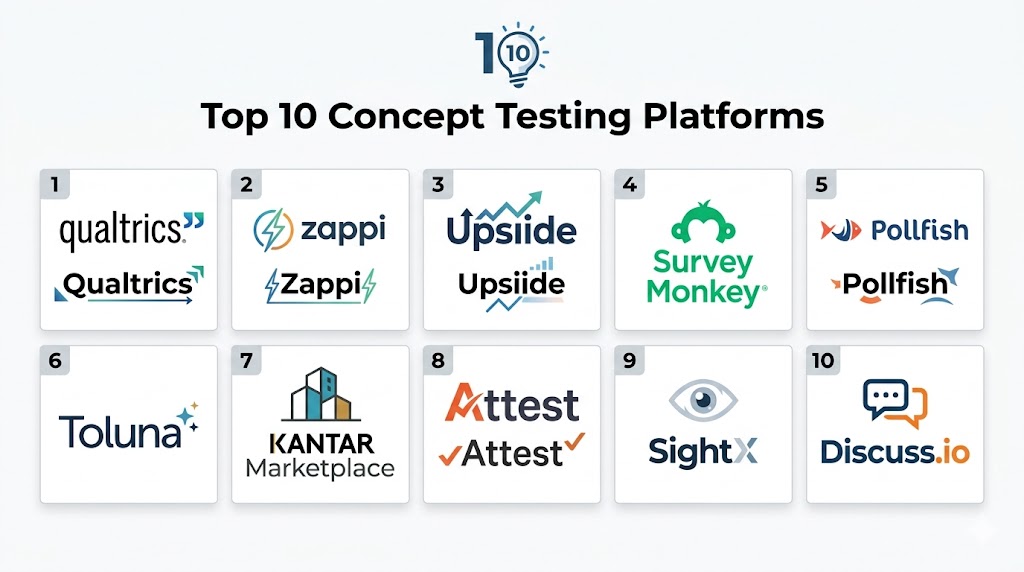
Top 10 Concept Testing Platforms
#1 — Qualtrics
Short description: Qualtrics is an enterprise research and experience management platform used for concept testing, product research, brand studies, and customer experience programs. It supports advanced survey logic, audience segmentation, dashboards, and analytics workflows. It is best suited for organizations that need scalable and structured research operations.
Key Features
- Advanced survey and concept testing workflows
- Product and brand research templates
- Audience segmentation
- AI-powered text analysis
- Dashboard reporting
- Statistical analysis support
- Enterprise collaboration tools
Pros
- Strong enterprise research capabilities
- Flexible survey logic and analytics
- Suitable for complex research programs
Cons
- Can be expensive for smaller teams
- Advanced workflows require learning
- Setup may need research expertise
Platforms / Deployment
- Web
- Cloud
Security & Compliance
- SSO/SAML support
- RBAC controls
- Audit logs
- GDPR support
- Additional certifications not publicly stated
Integrations & Ecosystem
Qualtrics integrates with enterprise research, analytics, CRM, and customer experience systems. It is useful for organizations that want concept testing connected with broader customer insight programs.
- Salesforce
- HubSpot
- Tableau
- Slack
- APIs
- Business intelligence tools
Support & Community
Qualtrics provides strong enterprise onboarding, training resources, documentation, and customer success support for research and experience management teams.
#2 — SurveyMonkey
Short description: SurveyMonkey is a widely used survey and feedback platform that supports concept testing through templates, audience targeting, and easy survey creation. It is suitable for startups, SMBs, marketers, and teams that need quick feedback without complex research operations.
Key Features
- Concept testing survey templates
- Drag-and-drop survey builder
- Audience targeting options
- Response analytics
- Question logic
- Collaboration features
- Data export tools
Pros
- Very easy to use
- Fast study setup
- Good fit for small and growing teams
Cons
- Advanced analytics are limited compared with enterprise tools
- Complex research designs may require workarounds
- Enterprise governance varies by plan
Platforms / Deployment
- Web
- Cloud
Security & Compliance
- MFA support
- Access controls
- GDPR support
- Additional certifications not publicly stated
Integrations & Ecosystem
SurveyMonkey connects with common productivity, CRM, and collaboration tools, making it useful for teams that want fast concept testing workflows.
- Salesforce
- HubSpot
- Slack
- Microsoft Teams
- Google Workspace
- APIs
Support & Community
SurveyMonkey has broad user adoption, helpful templates, documentation, and accessible support resources for quick survey-based research.
#3 — Attest
Short description: Attest is a consumer research platform designed to help brands test concepts, messaging, campaigns, pricing, and audience preferences quickly. It combines survey creation with audience access, making it useful for marketers and consumer insights teams. It is well suited for businesses needing fast and practical market feedback.
Key Features
- Concept testing surveys
- Consumer panel access
- Brand tracking workflows
- Audience segmentation
- Message testing
- Dashboard analytics
- Market research templates
Pros
- Fast consumer feedback collection
- Easy-to-use research workflow
- Good for brand and campaign testing
Cons
- Advanced customization may be limited
- Highly complex studies may require support
- Less suited for deep enterprise research operations
Platforms / Deployment
- Web
- Cloud
Security & Compliance
- GDPR support
- Access controls
- Additional certifications not publicly stated
Integrations & Ecosystem
Attest supports research workflows for marketing, product, and insights teams that need consumer feedback without building their own panel.
- Analytics tools
- Data export workflows
- CRM systems
- APIs
- Collaboration tools
- Reporting workflows
Support & Community
Attest provides practical onboarding, research guidance, and customer support for teams launching consumer concept testing studies.
#4 — Suzy
Short description: Suzy is a consumer insights platform built for fast market research, product validation, and concept testing. It helps teams gather targeted consumer feedback, analyze responses, and make faster decisions on product, marketing, and brand ideas. It is useful for agile research and consumer brand teams.
Key Features
- Rapid concept testing
- Targeted consumer panels
- Survey and feedback workflows
- Video response support
- AI-powered summaries
- Real-time analytics
- Collaborative workspaces
Pros
- Fast research turnaround
- Strong consumer feedback workflows
- Good for agile marketing and product teams
Cons
- Advanced research designs may be limited
- Premium workflows can increase cost
- Less ideal for highly technical B2B studies
Platforms / Deployment
- Web
- Cloud
Security & Compliance
- GDPR support
- Access controls
- Additional certifications not publicly stated
Integrations & Ecosystem
Suzy integrates with modern research and marketing workflows, helping teams move from concept testing to campaign and product planning.
- APIs
- Collaboration tools
- Analytics dashboards
- CRM workflows
- Data export systems
- Marketing workflows
Support & Community
Suzy offers onboarding support and research guidance for brand, product, and consumer insight teams.
#5 — Toluna Start
Short description: Toluna Start is a consumer insights platform that supports concept testing, product testing, brand tracking, and campaign validation. It provides access to global audiences and research workflows for brands and agencies. It is especially useful for businesses that need fast consumer feedback at scale.
Key Features
- Concept testing workflows
- Consumer panel access
- Product and packaging testing
- Brand research support
- Audience targeting
- Real-time dashboards
- Research automation
Pros
- Strong consumer panel access
- Good for product and brand testing
- Useful for global research needs
Cons
- Complex studies may need managed support
- Advanced customization varies by project
- Less focused on UX-specific testing
Platforms / Deployment
- Web
- Cloud
Security & Compliance
- GDPR support
- Privacy controls
- Additional certifications not publicly stated
Integrations & Ecosystem
Toluna Start supports consumer insight and research workflows for brands, agencies, and product teams.
- Research dashboards
- Data export workflows
- Analytics systems
- APIs
- Agency workflows
- Custom study setup
Support & Community
Toluna provides research guidance, onboarding support, and customer success assistance for consumer insights teams.
#6 — UserTesting
Short description: UserTesting is a human insight platform used for testing product concepts, prototypes, websites, apps, messaging, and customer experiences. It is especially valuable for UX research, product validation, and customer journey feedback. Teams use it to capture video-based feedback and understand how real users react to ideas.
Key Features
- Prototype and concept testing
- Video-based user feedback
- Audience targeting
- Usability testing
- Customer journey research
- Highlight reels and clips
- Research collaboration tools
Pros
- Strong qualitative feedback capabilities
- Excellent for UX and product teams
- Good video insight workflows
Cons
- Less focused on traditional quantitative concept scoring
- Premium pricing may be high for small teams
- Requires good test design for useful results
Platforms / Deployment
- Web
- Cloud
Security & Compliance
- SSO support
- Access controls
- GDPR support
- Additional certifications not publicly stated
Integrations & Ecosystem
UserTesting integrates with product, design, and collaboration tools to help teams test concepts before development or launch.
- Figma
- Slack
- Jira
- Product research workflows
- APIs
- Collaboration platforms
Support & Community
UserTesting has strong UX research adoption, practical education resources, and onboarding support for product and design teams.
#7 — Maze
Short description: Maze is a product research platform used for concept testing, prototype testing, usability studies, and product discovery. It helps product teams validate ideas quickly through surveys, tests, and research reports. It is especially useful for design, UX, and product-led teams.
Key Features
- Concept validation tests
- Prototype testing
- User surveys
- Usability analytics
- Automated reports
- Participant recruitment options
- Team collaboration workflows
Pros
- Easy for product and design teams
- Strong prototype testing workflows
- Fast research report generation
Cons
- Less suited for broad consumer market research
- Advanced panel depth may be limited
- Enterprise governance varies by plan
Platforms / Deployment
- Web
- Cloud
Security & Compliance
- SSO support on higher tiers
- GDPR support
- Access controls
- Additional certifications not publicly stated
Integrations & Ecosystem
Maze fits well into design and product development workflows, especially when teams need fast concept and prototype validation.
- Figma
- Sketch
- Adobe XD
- Slack
- Notion workflows
- APIs
Support & Community
Maze has strong adoption among product designers and UX researchers, with helpful templates and onboarding resources.
#8 — Zappi
Short description: Zappi is an automated consumer insights platform focused on testing ads, concepts, products, packaging, and brand ideas. It helps teams run repeatable research studies and compare performance across standardized methodologies. It is especially useful for large consumer brands and agencies.
Key Features
- Automated concept testing
- Ad and campaign testing
- Product idea validation
- Packaging research
- Consumer panel access
- Benchmarking workflows
- Dashboard reporting
Pros
- Strong standardized testing workflows
- Useful for consumer brands
- Good benchmarking and repeatable research support
Cons
- Less flexible for highly custom research
- Better suited for mature research teams
- Premium pricing may not fit small businesses
Platforms / Deployment
- Web
- Cloud
Security & Compliance
- Access controls
- GDPR support
- Additional certifications not publicly stated
Integrations & Ecosystem
Zappi supports repeatable consumer insight workflows for product, brand, and marketing teams.
- Consumer panels
- Analytics workflows
- Reporting dashboards
- APIs
- Data export systems
- Agency research workflows
Support & Community
Zappi provides strong research guidance, methodology support, and onboarding assistance for insight teams and agencies.
#9 — GutCheck
Short description: GutCheck is an agile market research platform that supports concept testing, brand research, consumer insights, and product development feedback. It is designed for teams that need fast research execution with expert support. It is useful for brands that want guided research without fully managing studies themselves.
Key Features
- Concept testing studies
- Consumer insights research
- Message and campaign testing
- Product development feedback
- Research design support
- Reporting dashboards
- Qualitative and quantitative workflows
Pros
- Good guided research support
- Useful for agile market research
- Combines speed with research expertise
Cons
- Less self-service than lightweight tools
- Pricing may vary by study scope
- Custom workflows may require support
Platforms / Deployment
- Web
- Cloud
Security & Compliance
- GDPR support
- Access controls
- Additional certifications not publicly stated
Integrations & Ecosystem
GutCheck supports research operations for teams that need quick concept testing with expert assistance.
- Research workflows
- Data export tools
- Analytics systems
- Custom study setup
- Reporting workflows
- Insight delivery systems
Support & Community
GutCheck provides research support, onboarding assistance, and expert guidance for study design and interpretation.
#10 — Typeform
Short description: Typeform is a form and survey platform that can be used for lightweight concept testing, creative feedback, and customer preference studies. It is popular with startups, marketers, and small teams because of its simple interface and engaging survey experience. It is best for basic concept validation rather than advanced research programs.
Key Features
- Interactive survey builder
- Visual question formats
- Conditional logic
- Feedback collection
- Template library
- Data export options
- Basic analytics
Pros
- Very easy to use
- Engaging respondent experience
- Good for lightweight concept validation
Cons
- Limited advanced research analytics
- No deep panel management by default
- Not ideal for complex enterprise studies
Platforms / Deployment
- Web
- Cloud
Security & Compliance
- GDPR support
- Access controls
- Additional certifications not publicly stated
Integrations & Ecosystem
Typeform integrates with marketing, CRM, automation, and collaboration workflows for quick concept feedback collection.
- HubSpot
- Salesforce
- Slack
- Google Sheets
- Zapier
- APIs
Support & Community
Typeform has strong documentation, broad user adoption, and accessible support resources for marketers and small teams.
Comparison Table
| Tool Name | Best For | Platform(s) Supported | Deployment | Standout Feature | Public Rating |
|---|---|---|---|---|---|
| Qualtrics | Enterprise research teams | Web | Cloud | Advanced research workflows | N/A |
| SurveyMonkey | Quick concept surveys | Web | Cloud | Easy survey creation | N/A |
| Attest | Consumer concept testing | Web | Cloud | Fast audience feedback | N/A |
| Suzy | Agile consumer research | Web | Cloud | Real-time consumer insights | N/A |
| Toluna Start | Global concept testing | Web | Cloud | Large consumer panel access | N/A |
| UserTesting | UX and product concepts | Web | Cloud | Video-based human feedback | N/A |
| Maze | Product and prototype testing | Web | Cloud | Fast prototype validation | N/A |
| Zappi | Consumer brand testing | Web | Cloud | Standardized concept benchmarks | N/A |
| GutCheck | Guided agile research | Web | Cloud | Expert-supported research workflows | N/A |
| Typeform | Lightweight concept feedback | Web | Cloud | Engaging survey experience | N/A |
Evaluation & Scoring of Concept Testing Platforms
| Tool Name | Core 25% | Ease 15% | Integrations 15% | Security 10% | Performance 10% | Support 10% | Value 15% | Weighted Total |
|---|---|---|---|---|---|---|---|---|
| Qualtrics | 9.5 | 7.8 | 9.2 | 9.0 | 9.1 | 8.9 | 7.5 | 8.8 |
| SurveyMonkey | 8.3 | 9.2 | 8.0 | 7.8 | 8.2 | 8.5 | 9.0 | 8.4 |
| Attest | 8.7 | 8.7 | 8.1 | 7.8 | 8.5 | 8.4 | 8.5 | 8.4 |
| Suzy | 8.8 | 8.8 | 8.0 | 7.7 | 8.5 | 8.4 | 8.4 | 8.4 |
| Toluna Start | 8.9 | 8.2 | 8.3 | 8.0 | 8.7 | 8.5 | 8.0 | 8.4 |
| UserTesting | 8.8 | 8.4 | 8.5 | 8.1 | 8.7 | 8.7 | 7.8 | 8.5 |
| Maze | 8.4 | 9.1 | 8.4 | 7.9 | 8.4 | 8.3 | 8.8 | 8.5 |
| Zappi | 9.0 | 8.0 | 8.4 | 8.0 | 8.8 | 8.5 | 7.8 | 8.5 |
| GutCheck | 8.6 | 8.1 | 8.0 | 7.8 | 8.4 | 8.7 | 8.0 | 8.3 |
| Typeform | 7.8 | 9.4 | 8.2 | 7.6 | 8.0 | 8.2 | 9.1 | 8.3 |
These scores are comparative rather than absolute. Enterprise research platforms usually score higher in governance, analytics, and complex study design, while lightweight tools score higher in ease of use and value. Product-focused platforms are stronger for prototype and UX validation, while consumer insight platforms are stronger for brand, packaging, and campaign concept testing. Buyers should prioritize the scoring categories that match their research maturity, audience needs, and decision-making process.
Which Concept Testing Platforms Tool Is Right for You?
Solo / Freelancer
Solo researchers, consultants, and small founders usually need fast setup, simple surveys, and affordable feedback collection. Typeform, SurveyMonkey, and Maze are strong options because they allow teams to test concepts quickly without needing complex research operations. These tools are useful for early idea validation, landing page testing, and lightweight customer preference studies.
SMB
SMBs need practical concept testing that balances usability, audience access, and reporting. SurveyMonkey, Attest, Suzy, and Maze are good fits depending on whether the team is testing marketing concepts, product ideas, or prototypes. These platforms help smaller teams make better decisions without heavy enterprise complexity.
Mid-Market
Mid-market organizations typically need stronger dashboards, collaboration, panel access, and repeatable research workflows. Attest, Suzy, Toluna Start, UserTesting, and Zappi provide better structure for teams running recurring concept tests across products, campaigns, and customer segments.
Enterprise
Enterprises should prioritize Qualtrics, Toluna Start, Zappi, UserTesting, and GutCheck when they need governance, scalable research operations, advanced analytics, and reliable study execution. These platforms are better suited for teams that run multiple studies across brands, regions, and departments.
Budget vs Premium
Budget-conscious teams should start with Typeform, SurveyMonkey, or Maze for quick concept validation. Premium buyers should evaluate Qualtrics, Zappi, Toluna Start, or UserTesting when they need advanced research methodology, panels, video insights, governance, and repeatable testing programs.
Feature Depth vs Ease of Use
Typeform and SurveyMonkey are easiest for simple testing, while Qualtrics and Zappi provide deeper research structures. Maze and UserTesting are stronger for product and UX concepts, while Attest and Suzy are stronger for consumer-facing ideas and brand studies.
Integrations & Scalability
Organizations needing CRM, analytics, design, product, and BI integrations should prioritize Qualtrics, UserTesting, Maze, or SurveyMonkey. Large consumer brands needing scalable panel-based studies should evaluate Toluna Start, Zappi, Attest, or Suzy.
Security & Compliance Needs
Enterprises and regulated organizations should look for SSO, RBAC, audit logs, consent workflows, data retention controls, and centralized administration. Qualtrics, UserTesting, and larger enterprise research platforms generally offer stronger governance capabilities.
Frequently Asked Questions
1. What is a Concept Testing Platform?
A Concept Testing Platform helps businesses test ideas, product concepts, campaign messages, packaging designs, names, or prototypes with target audiences before launch. It helps teams understand appeal, relevance, clarity, and purchase intent.
2. Why is concept testing important?
Concept testing reduces risk by validating ideas before major investment. It helps teams avoid weak launches, improve messaging, compare alternatives, and identify what customers actually value before development or campaign rollout.
3. What types of concepts can be tested?
Teams can test product ideas, packaging, advertisements, names, taglines, pricing options, landing pages, prototypes, feature ideas, brand positioning, and customer experience concepts. The best platform depends on the type of concept being tested.
4. Can concept testing platforms provide target audiences?
Many platforms offer audience panels or respondent recruitment options. Tools like Attest, Suzy, Toluna Start, and UserTesting can help teams reach specific customer segments without building their own panel.
5. Are these tools useful for product teams?
Yes. Product teams use concept testing platforms to validate feature ideas, prototypes, value propositions, and user journeys. Tools like Maze and UserTesting are especially useful for product and UX validation.
6. Do these platforms support AI analysis?
Many modern platforms include AI summaries, response tagging, sentiment analysis, and automated reporting. AI can help teams process open-text feedback faster, but human review is still important for final interpretation.
7. How difficult is implementation?
Lightweight platforms like Typeform and SurveyMonkey are easy to deploy quickly. Enterprise platforms like Qualtrics or Zappi may require more setup, governance planning, and research methodology alignment.
8. What are common mistakes in concept testing?
Common mistakes include testing unclear concepts, using the wrong audience, asking biased questions, comparing too many ideas at once, and treating feedback as final proof instead of decision support.
9. Are Concept Testing Platforms secure?
Most modern platforms include privacy controls, access management, and respondent data protection features. Enterprise buyers should evaluate SSO, RBAC, audit logs, consent management, and data handling policies.
10. What are alternatives to Concept Testing Platforms?
Alternatives include manual surveys, customer interviews, social media polls, landing page experiments, focus groups, research agencies, and in-house customer panels. These can work well but may be slower or harder to scale.
Conclusion
Concept Testing Platforms help organizations make smarter decisions before investing heavily in products, campaigns, packaging, messages, or customer experiences. The right platform depends on concept type, audience needs, research depth, budget, and team maturity. Smaller teams may prefer Typeform, SurveyMonkey, or Maze for fast and affordable validation, while growing brands may benefit from Attest, Suzy, UserTesting, or Toluna Start for stronger audience feedback and research workflows. Enterprises with complex testing programs should evaluate Qualtrics, Zappi, or GutCheck for governance, scalability, and advanced research support. The best next step is to shortlist two or three platforms, test them with a real concept, compare audience quality and reporting clarity, validate security needs, and choose the platform that best supports repeatable decision-making.