Introduction
Product Reviews & UGC Platforms help businesses collect, manage, moderate, and display customer-generated content such as ratings, reviews, photos, videos, testimonials, Q&A sections, and social proof across eCommerce stores and marketing channels. These platforms play a critical role in helping brands build trust, improve conversion rates, strengthen customer engagement, and enhance online buying experiences.
Modern shoppers increasingly rely on customer feedback before making purchasing decisions. Because of this shift, reviews and user-generated content have become a major part of digital commerce strategies. Businesses now use these platforms not only for displaying reviews but also for SEO optimization, influencer-driven commerce, social proof automation, AI-powered moderation, and omnichannel customer engagement.
Common real-world use cases include:
- Collecting verified customer reviews after purchases
- Displaying photo and video testimonials on product pages
- Improving SEO through review-rich snippets
- Moderating customer-generated content at scale
- Using UGC for social commerce and advertising campaigns
Buyers evaluating Product Reviews & UGC Platforms should consider:
- Review collection automation
- AI moderation capabilities
- Photo and video UGC support
- SEO optimization features
- Integration ecosystem
- Analytics and reporting
- Scalability for large catalogs
- Multi-language support
- Security and compliance controls
- Ease of onboarding and management
Best for: eCommerce retailers, DTC brands, marketplaces, beauty and fashion brands, consumer electronics companies, hospitality businesses, and omnichannel commerce teams.
Not ideal for: businesses without active digital storefronts, organizations with very low customer engagement volumes, or companies that only require basic testimonials without structured moderation and analytics.
Key Trends in Product Reviews & UGC Platforms
- AI-powered moderation is helping brands automatically detect spam, abusive content, and fake reviews.
- Video-based UGC is becoming increasingly important for social commerce and mobile shopping experiences.
- Review syndication across retailer networks is improving product visibility and trust signals.
- Visual commerce integrations are connecting UGC directly into product galleries and shopping experiences.
- Sentiment analysis tools are helping brands identify customer satisfaction trends automatically.
- Social commerce integrations with TikTok Shop, Instagram Shopping, and creator marketplaces are expanding rapidly.
- Localization and multilingual review support are becoming standard for global brands.
- AI-generated summaries are helping shoppers quickly understand large review volumes.
- Retail media and ad platforms are increasingly using ratings and reviews within advertising workflows.
- Privacy, authenticity verification, and review transparency controls are becoming stronger compliance priorities.
How We Selected These Tools
The tools in this list were selected based on operational capabilities, market adoption, scalability, and ecosystem maturity across different business sizes and industries.
Evaluation factors included:
- Industry adoption and brand reputation
- Review and UGC management capabilities
- AI moderation and automation features
- SEO and conversion optimization support
- Integration ecosystem strength
- Scalability across high review volumes
- Analytics and reporting capabilities
- Security and governance controls
- Ease of implementation and usability
- Suitability for SMB, mid-market, and enterprise organizations
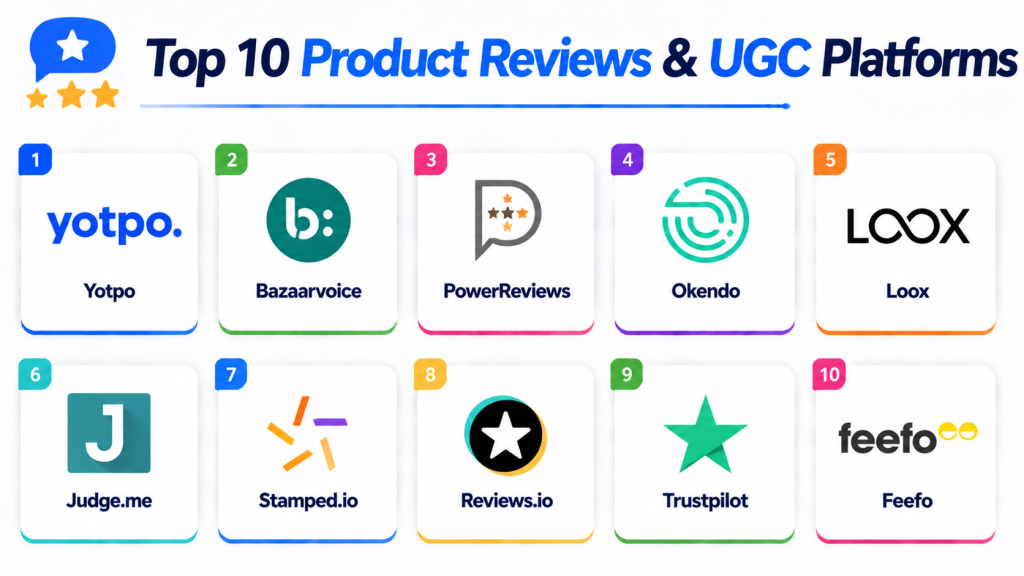
Top 10 Product Reviews & UGC Platforms Tools
#1 — Yotpo
Short description: Yotpo is one of the most widely used Product Reviews & UGC Platforms for eCommerce brands. It combines customer reviews, visual UGC, loyalty programs, SMS marketing, and retention tools into a unified commerce engagement ecosystem. It is especially popular among DTC and Shopify-focused brands.
Key Features
- Automated review request workflows
- Photo and video review collection
- AI-powered moderation
- SEO-rich review snippets
- Loyalty and rewards integrations
- SMS and retention marketing tools
- Review syndication support
Pros
- Strong eCommerce ecosystem integrations
- Excellent visual UGC support
- Unified customer engagement capabilities
Cons
- Advanced plans can become expensive
- Some features require premium tiers
- Enterprise setup may require onboarding assistance
Platforms / Deployment
- Web
- Cloud
Security & Compliance
- SSO support
- RBAC capabilities
- GDPR support
- Additional certifications not publicly stated
Integrations & Ecosystem
Yotpo integrates deeply into modern eCommerce ecosystems and marketing automation platforms.
- Shopify
- BigCommerce
- Magento
- Klaviyo
- Google Shopping
- Meta Commerce
Support & Community
Strong onboarding support with extensive documentation, active partner ecosystems, and a large eCommerce community presence.
#2 — Bazaarvoice
Short description: Bazaarvoice is an enterprise-grade UGC and ratings platform designed for global retailers and major consumer brands. The platform specializes in review syndication, retail network distribution, and large-scale customer engagement operations.
Key Features
- Ratings and reviews management
- Retail review syndication
- Visual UGC galleries
- AI moderation workflows
- Social commerce integrations
- Customer insights analytics
- Question and answer modules
Pros
- Massive retail syndication network
- Strong enterprise scalability
- Advanced analytics capabilities
Cons
- Higher enterprise pricing
- Complex implementation workflows
- Smaller businesses may not need full capabilities
Platforms / Deployment
- Web
- Cloud
Security & Compliance
- SSO/SAML support
- RBAC controls
- Audit logs
- GDPR support
Integrations & Ecosystem
Bazaarvoice supports extensive enterprise commerce and retail integrations.
- Salesforce Commerce Cloud
- Adobe Commerce
- Shopify
- Retailer syndication networks
- Google Seller Ratings
- Social commerce platforms
Support & Community
Comprehensive enterprise onboarding and consulting support with strong documentation and professional services.
#3 — Trustpilot
Short description: Trustpilot is a widely recognized customer review platform used across multiple industries for collecting and displaying public customer reviews. It is popular among service businesses, SaaS providers, and eCommerce brands focused on trust and reputation management.
Key Features
- Public review collection
- Business profile ratings
- SEO review snippets
- Review invitation automation
- AI fraud detection
- Analytics dashboards
- Reputation monitoring
Pros
- Strong consumer brand recognition
- Good SEO visibility
- Easy review collection workflows
Cons
- Public reviews can be difficult to manage
- Premium plans can be costly
- Limited advanced UGC merchandising
Platforms / Deployment
- Web
- Cloud
Security & Compliance
- MFA support
- GDPR support
- Additional certifications not publicly stated
Integrations & Ecosystem
Trustpilot integrates with marketing, CRM, and eCommerce ecosystems.
- Shopify
- WooCommerce
- Salesforce
- HubSpot
- Zendesk
- Google integrations
Support & Community
Strong customer documentation and onboarding resources with broad market adoption across industries.
#4 — PowerReviews
Short description: PowerReviews focuses on ratings, reviews, and visual UGC for retailers and brands seeking conversion optimization and customer trust enhancement. The platform is widely used in retail, beauty, and consumer product industries.
Key Features
- Ratings and reviews collection
- Visual UGC support
- Question and answer workflows
- Review syndication
- Analytics dashboards
- SEO optimization
- Sampling campaign support
Pros
- Strong retail-focused capabilities
- Good visual commerce support
- Effective conversion optimization features
Cons
- Enterprise-focused pricing
- Limited smaller-business flexibility
- Advanced customization may require support assistance
Platforms / Deployment
- Web
- Cloud
Security & Compliance
- GDPR support
- RBAC controls
- Additional certifications not publicly stated
Integrations & Ecosystem
PowerReviews supports integrations across major commerce and marketing ecosystems.
- Shopify
- Salesforce Commerce Cloud
- Adobe Commerce
- Google Seller Ratings
- Retail syndication networks
- CRM platforms
Support & Community
Strong enterprise onboarding with detailed documentation and responsive support teams.
#5 — Okendo
Short description: Okendo is a customer marketing and UGC platform designed primarily for Shopify merchants and modern DTC brands. It combines reviews, referrals, surveys, and loyalty workflows into a unified engagement platform.
Key Features
- Photo and video reviews
- Automated review requests
- Customer surveys
- Loyalty integrations
- Referral workflows
- AI moderation support
- Review display customization
Pros
- Excellent Shopify ecosystem support
- Modern and user-friendly interface
- Strong DTC-focused capabilities
Cons
- Limited enterprise workflow depth
- Best suited for Shopify ecosystems
- Some advanced automation requires higher plans
Platforms / Deployment
- Web
- Cloud
Security & Compliance
- GDPR support
- MFA support
- Additional certifications not publicly stated
Integrations & Ecosystem
Okendo integrates deeply with DTC commerce and retention marketing ecosystems.
- Shopify
- Klaviyo
- Gorgias
- Attentive
- Meta Commerce
- Loyalty platforms
Support & Community
Strong onboarding experience with helpful setup documentation and active Shopify-focused support communities.
#6 — Reviews.io
Short description: Reviews.io is a review and reputation management platform designed for eCommerce brands, agencies, and service providers. It supports customer reviews, visual UGC, video reviews, and Google seller integrations.
Key Features
- Customer review collection
- Video review support
- Google Seller Ratings integration
- AI moderation workflows
- SMS review requests
- Reputation management tools
- Review widgets
Pros
- Strong Google integration support
- Good value for SMB businesses
- Flexible review collection workflows
Cons
- Enterprise analytics are moderate
- Some integrations require configuration effort
- UI customization flexibility varies
Platforms / Deployment
- Web
- Cloud
Security & Compliance
- GDPR support
- MFA support
- Additional certifications not publicly stated
Integrations & Ecosystem
Reviews.io integrates with major eCommerce and customer engagement platforms.
- Shopify
- WooCommerce
- BigCommerce
- Google Seller Ratings
- Klaviyo
- Zapier
Support & Community
Good onboarding support with responsive documentation and accessible customer service resources.
#7 — Loox
Short description: Loox is a visual-first review platform focused on photo reviews, social proof, and conversion optimization for eCommerce stores. It is especially popular among Shopify merchants and DTC brands.
Key Features
- Photo review collection
- Referral workflows
- Automated email requests
- Review display widgets
- Visual social proof
- Discounts for reviewers
- Customizable review galleries
Pros
- Easy implementation
- Excellent visual review presentation
- Affordable for growing stores
Cons
- Limited enterprise governance
- Smaller analytics depth
- Best suited for Shopify ecosystems
Platforms / Deployment
- Web
- Cloud
Security & Compliance
- GDPR support
- Additional certifications not publicly stated
Integrations & Ecosystem
Loox integrates primarily within Shopify-focused commerce ecosystems.
- Shopify
- Klaviyo
- Google Shopping
- Meta Commerce
- Page builders
- Email marketing tools
Support & Community
Strong SMB onboarding support with practical tutorials and active eCommerce adoption.
#8 — Stamped.io
Short description: Stamped.io is a customer marketing platform offering reviews, loyalty programs, referrals, and visual UGC capabilities. It is designed for eCommerce brands seeking customer retention and trust-building tools.
Key Features
- Product reviews
- Visual UGC support
- Loyalty and rewards tools
- Referral management
- Net promoter score collection
- AI moderation support
- Review request automation
Pros
- Broad customer engagement features
- Strong Shopify compatibility
- Good value for SMB brands
Cons
- Enterprise workflow depth is moderate
- Advanced customization can require setup effort
- Analytics vary by subscription tier
Platforms / Deployment
- Web
- Cloud
Security & Compliance
- GDPR support
- MFA support
- Additional certifications not publicly stated
Integrations & Ecosystem
Stamped.io supports integrations across retention marketing and eCommerce ecosystems.
- Shopify
- BigCommerce
- Klaviyo
- Gorgias
- Meta Commerce
- Google Shopping
Support & Community
Helpful onboarding resources and responsive customer support for SMB and mid-market brands.
#9 — Feefo
Short description: Feefo is a verified reviews platform focused on trust, authenticity, and customer insight collection. It is commonly used by retailers, travel companies, and service providers looking for verified customer feedback systems.
Key Features
- Verified customer reviews
- AI sentiment analysis
- Review moderation
- Analytics dashboards
- Survey capabilities
- Reputation management
- Review widgets
Pros
- Strong authenticity focus
- Good analytics capabilities
- Verified review workflows improve trust
Cons
- Smaller UGC ecosystem compared to competitors
- Visual commerce capabilities are moderate
- Enterprise integrations vary
Platforms / Deployment
- Web
- Cloud
Security & Compliance
- GDPR support
- RBAC controls
- Additional certifications not publicly stated
Integrations & Ecosystem
Feefo integrates with commerce, CRM, and marketing platforms.
- Shopify
- Magento
- Salesforce
- Google Seller Ratings
- CRM systems
- Marketing platforms
Support & Community
Strong onboarding support with practical reporting guidance and customer success assistance.
#10 — Judge.me
Short description: Judge.me is a lightweight and affordable review platform designed primarily for Shopify and WooCommerce merchants. It offers unlimited review collection, photo reviews, and simple automation workflows.
Key Features
- Unlimited review collection
- Photo and video reviews
- Automated review requests
- SEO review widgets
- Multi-language support
- Referral features
- Review import capabilities
Pros
- Affordable pricing
- Easy implementation
- Good feature coverage for SMB stores
Cons
- Enterprise scalability is limited
- Advanced analytics are basic
- Fewer enterprise governance controls
Platforms / Deployment
- Web
- Cloud
Security & Compliance
- GDPR support
- Additional certifications not publicly stated
Integrations & Ecosystem
Judge.me integrates with major SMB-focused commerce ecosystems.
- Shopify
- WooCommerce
- Klaviyo
- Google Shopping
- Meta Commerce
- Email marketing tools
Support & Community
Strong SMB support ecosystem with active user communities and beginner-friendly onboarding.
Comparison Table
| Tool Name | Best For | Platform(s) Supported | Deployment | Standout Feature | Public Rating |
|---|---|---|---|---|---|
| Yotpo | DTC brands | Web | Cloud | Unified customer engagement suite | N/A |
| Bazaarvoice | Enterprise retailers | Web | Cloud | Retail review syndication network | N/A |
| Trustpilot | Reputation management | Web | Cloud | Public trust and SEO visibility | N/A |
| PowerReviews | Retail brands | Web | Cloud | Retail-focused UGC optimization | N/A |
| Okendo | Shopify DTC brands | Web | Cloud | Modern customer marketing workflows | N/A |
| Reviews.io | SMB commerce brands | Web | Cloud | Google Seller Ratings integration | N/A |
| Loox | Shopify stores | Web | Cloud | Visual photo review workflows | N/A |
| Stamped.io | Customer retention workflows | Web | Cloud | Reviews plus loyalty features | N/A |
| Feefo | Verified customer reviews | Web | Cloud | Verified review authenticity | N/A |
| Judge.me | SMB eCommerce stores | Web | Cloud | Affordable unlimited reviews | N/A |
Evaluation & Scoring of Product Reviews & UGC Platforms
| Tool Name | Core 25% | Ease 15% | Integrations 15% | Security 10% | Performance 10% | Support 10% | Value 15% | Weighted Total |
|---|---|---|---|---|---|---|---|---|
| Yotpo | 9.4 | 8.7 | 9.2 | 8.5 | 9.0 | 8.9 | 8.1 | 8.9 |
| Bazaarvoice | 9.5 | 7.5 | 9.4 | 9.0 | 9.3 | 8.8 | 7.2 | 8.8 |
| Trustpilot | 8.7 | 8.8 | 8.4 | 8.0 | 8.5 | 8.4 | 7.8 | 8.3 |
| PowerReviews | 8.9 | 7.9 | 8.8 | 8.3 | 8.7 | 8.5 | 7.5 | 8.4 |
| Okendo | 8.8 | 9.0 | 8.7 | 7.9 | 8.5 | 8.6 | 8.5 | 8.6 |
| Reviews.io | 8.3 | 8.6 | 8.2 | 7.8 | 8.2 | 8.3 | 8.7 | 8.3 |
| Loox | 8.0 | 9.1 | 7.8 | 7.2 | 8.0 | 8.1 | 9.0 | 8.2 |
| Stamped.io | 8.5 | 8.5 | 8.4 | 7.8 | 8.3 | 8.2 | 8.6 | 8.4 |
| Feefo | 8.4 | 8.1 | 8.0 | 8.1 | 8.3 | 8.4 | 7.9 | 8.2 |
| Judge.me | 7.9 | 9.0 | 7.6 | 7.0 | 7.9 | 8.0 | 9.2 | 8.1 |
These scores are comparative rather than absolute. Enterprise-focused platforms generally score higher in governance, syndication, and scalability, while SMB-oriented solutions often perform better in usability and affordability. Businesses should prioritize the scoring categories that align most closely with operational needs, customer engagement goals, and commerce complexity.
Which Product Reviews & UGC Platforms Tool Is Right for You?
Solo / Freelancer
Small online sellers and independent brands usually benefit most from lightweight and affordable platforms like Judge.me or Loox. These tools offer simple onboarding, visual reviews, and easy automation workflows without requiring technical expertise.
SMB
SMBs typically need broader integrations, automation, and retention-focused features. Okendo, Reviews.io, and Stamped.io provide balanced capabilities suitable for growing eCommerce operations.
Mid-Market
Mid-market brands often require better reporting, omnichannel workflows, and customer engagement scalability. Yotpo and PowerReviews provide stronger operational depth for expanding commerce teams.
Enterprise
Large retailers and global brands should evaluate Bazaarvoice, Yotpo, or PowerReviews because of their enterprise scalability, syndication networks, and advanced governance capabilities.
Budget vs Premium
Budget-focused businesses may prefer Judge.me or Loox because of their affordable pricing and simplified setup. Premium enterprise platforms like Bazaarvoice and Yotpo provide deeper integrations, automation, and analytics for larger operations.
Feature Depth vs Ease of Use
Bazaarvoice and Yotpo offer broader operational depth but may require more onboarding effort. Simpler tools like Judge.me and Loox prioritize usability and faster implementation.
Integrations & Scalability
Brands operating across multiple marketplaces, advertising channels, and CRM systems should prioritize Yotpo, Bazaarvoice, or PowerReviews because of their larger ecosystem support.
Security & Compliance Needs
Organizations with stronger governance requirements should prioritize platforms supporting SSO, RBAC, audit logs, and centralized user management controls.
Frequently Asked Questions
1. What is a Product Reviews & UGC Platform?
A Product Reviews & UGC Platform helps businesses collect, manage, moderate, and display customer reviews, ratings, photos, videos, and testimonials across digital commerce channels.
2. Why are customer reviews important for eCommerce?
Customer reviews build trust, improve conversion rates, support SEO visibility, and help shoppers make informed buying decisions. Strong review systems can directly influence sales performance.
3. What does UGC mean?
UGC stands for User-Generated Content. This includes customer-submitted photos, videos, ratings, testimonials, comments, and social content related to products or brands.
4. Can these platforms help with SEO?
Yes. Many review platforms generate SEO-rich content, structured review snippets, and keyword-relevant product feedback that can improve search visibility and organic traffic.
5. Are video reviews supported?
Many modern platforms now support video reviews alongside traditional text and photo reviews. Video-based UGC is increasingly important for mobile commerce and social commerce experiences.
6. How difficult is implementation?
Implementation complexity varies depending on integrations, customization requirements, and store size. SMB-focused tools usually provide quick onboarding, while enterprise deployments may require technical planning.
7. Are these platforms secure?
Most platforms support basic security features such as MFA, RBAC, encryption, and administrative controls. Enterprise-focused solutions typically provide stronger governance and auditing capabilities.
8. Can businesses moderate reviews before publishing?
Yes. Most Product Reviews & UGC Platforms include moderation workflows that allow businesses to approve, reject, flag, or automatically filter reviews using AI moderation tools.
9. What are common mistakes when selecting a platform?
Common mistakes include ignoring scalability needs, underestimating moderation requirements, focusing only on pricing, and failing to evaluate integration compatibility with existing commerce systems.
10. Can reviews be syndicated across retailers?
Some enterprise platforms support review syndication across retailer networks, helping brands distribute customer feedback across multiple commerce channels automatically.
Conclusion
Product Reviews & UGC Platforms have become a critical part of modern digital commerce strategies because customer trust, social proof, and authentic engagement now directly influence purchasing behavior. Businesses increasingly rely on these platforms not only for collecting ratings and reviews but also for powering visual commerce, social selling, SEO optimization, customer retention, and omnichannel engagement workflows. Smaller brands may prioritize affordability and ease of use through tools like Judge.me or Loox, while larger enterprises often require the advanced syndication, governance, and scalability capabilities offered by Bazaarvoice or Yotpo. The best platform depends on business size, customer engagement strategy, marketplace complexity, integration requirements, and long-term growth goals. Instead of choosing purely on feature volume, businesses should shortlist a few platforms, validate integrations carefully, test moderation workflows, and run controlled pilots before making a long-term operational commitment.