Introduction
Competitive Intelligence Platforms help businesses monitor competitors, track market activity, analyze strategic movements, and gather actionable insights across digital channels, products, pricing, campaigns, customer sentiment, and industry trends. These platforms are widely used by product teams, sales organizations, marketers, strategy leaders, and executive teams that need continuous visibility into competitor behavior and market positioning.
Modern competition moves quickly across digital ecosystems. Companies launch products faster, pricing changes happen frequently, and marketing strategies evolve continuously across websites, marketplaces, advertising platforms, and social channels. Competitive Intelligence Platforms help businesses centralize competitor data, automate monitoring workflows, improve strategic planning, and support faster decision-making across departments.
Common real-world use cases include:
- Tracking competitor product launches and updates
- Monitoring pricing, promotions, and positioning
- Supporting sales battlecards and win-loss analysis
- Analyzing competitor marketing campaigns
- Monitoring customer sentiment and market perception
Buyers evaluating Competitive Intelligence Platforms should consider:
- Monitoring and alerting capabilities
- Data collection accuracy
- Market and competitor coverage
- AI-powered analysis and summarization
- Reporting and dashboard usability
- Collaboration workflows
- CRM and sales integrations
- Security and governance features
- Scalability across teams and regions
- Ease of onboarding and operational management
Best for: product marketing teams, sales enablement teams, strategy departments, SaaS companies, enterprise retailers, agencies, category managers, and organizations operating in highly competitive industries.
Not ideal for: businesses with limited competitive pressure, very small teams relying on occasional manual research, or organizations without structured market intelligence workflows.
Key Trends in Competitive Intelligence Platforms
- AI-powered summarization is helping teams process competitor updates and market changes faster.
- Real-time alerting is becoming essential for tracking pricing, campaigns, product launches, and website changes.
- Sales enablement integrations are connecting competitive intelligence directly into CRM and revenue workflows.
- Buyer intent and market signal monitoring are becoming more integrated with competitive analysis.
- Digital shelf and marketplace intelligence are increasingly part of broader competitive intelligence strategies.
- Collaborative battlecards are helping sales teams respond faster to competitor positioning.
- Multi-source monitoring is expanding across websites, ads, reviews, marketplaces, social channels, and app stores.
- AI-generated competitor insights are reducing manual research workloads for product marketing teams.
- Governance and access controls are becoming more important for enterprise intelligence operations.
- API-first architectures are supporting integration with BI, CRM, and workflow automation systems.
How We Selected These Tools
The tools included in this list were selected based on monitoring capabilities, market relevance, integration maturity, and operational usability across multiple business segments.
Evaluation factors included:
- Competitor monitoring depth
- Market intelligence capabilities
- Data collection and alerting quality
- Sales enablement support
- AI analysis and workflow automation
- Integration ecosystem maturity
- Scalability for enterprise and global teams
- Security and governance features
- Ease of onboarding and usability
- Overall strategic intelligence value
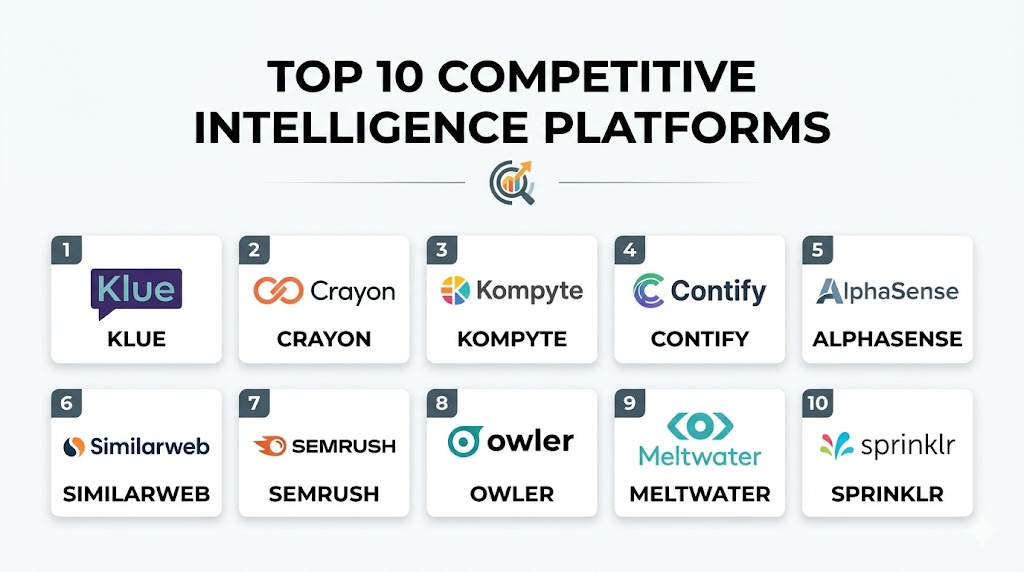
Top 10 Competitive Intelligence Platforms
#1 — Crayon
Short description: Crayon is one of the most recognized Competitive Intelligence Platforms for sales, marketing, and strategy teams. It helps organizations monitor competitor activity across websites, pricing pages, campaigns, product updates, and digital channels while supporting sales enablement and battlecard workflows. It is especially popular among SaaS and B2B organizations.
Key Features
- Competitor activity monitoring
- AI-powered insight summaries
- Sales battlecards
- Website and pricing change alerts
- Market intelligence dashboards
- CRM integrations
- Competitive content tracking
Pros
- Strong sales enablement workflows
- Excellent competitor monitoring automation
- Useful AI-driven insight generation
Cons
- Enterprise pricing may be high for smaller teams
- Setup quality affects monitoring depth
- Advanced workflows may require onboarding
Platforms / Deployment
- Web
- Cloud
Security & Compliance
- SSO/SAML support
- RBAC capabilities
- Audit logging
- GDPR support
Integrations & Ecosystem
Crayon integrates with sales, CRM, and collaboration ecosystems to connect competitive insights directly into revenue workflows.
- Salesforce
- HubSpot
- Slack
- Microsoft Teams
- CRM systems
- APIs
Support & Community
Strong onboarding support with active sales enablement and competitive intelligence communities. Documentation and customer success programs are well developed.
#2 — Klue
Short description: Klue is a competitive enablement platform designed for product marketing and sales organizations. It helps businesses collect competitor insights, build battlecards, and distribute intelligence to revenue teams in real time. It is widely used in SaaS, technology, and enterprise sales environments.
Key Features
- Competitive battlecards
- Competitor tracking
- Sales enablement workflows
- AI-powered summaries
- Collaboration tools
- Market insight dashboards
- CRM integrations
Pros
- Excellent battlecard management
- Strong fit for sales organizations
- Good collaborative intelligence workflows
Cons
- Best suited for structured sales teams
- Smaller businesses may not use full capabilities
- Advanced reporting may require configuration
Platforms / Deployment
- Web
- Cloud
Security & Compliance
- SSO support
- RBAC controls
- GDPR support
- Additional certifications not publicly stated
Integrations & Ecosystem
Klue integrates heavily into sales and enablement ecosystems to improve competitive response workflows.
- Salesforce
- Slack
- HubSpot
- Microsoft Teams
- Gong
- APIs
Support & Community
Klue offers strong onboarding, training programs, and enablement support for sales and product marketing organizations.
#3 — Similarweb
Short description: Similarweb is a digital intelligence platform that provides traffic analytics, competitor benchmarking, audience insights, and market intelligence across websites and digital channels. It is widely used by marketers, growth teams, agencies, and strategy leaders.
Key Features
- Website traffic analytics
- Competitor benchmarking
- Audience insights
- Search intelligence
- Market trend analysis
- Referral traffic tracking
- Digital performance monitoring
Pros
- Strong digital market visibility
- Useful traffic and audience insights
- Broad competitive benchmarking capabilities
Cons
- Not focused solely on sales enablement
- Data estimates may vary by market
- Premium features can become expensive
Platforms / Deployment
- Web
- Cloud
Security & Compliance
- SSO capabilities
- Access controls
- GDPR support
- Additional certifications not publicly stated
Integrations & Ecosystem
Similarweb integrates with analytics and business intelligence workflows for broader market analysis.
- Google Analytics
- APIs
- CRM systems
- Business intelligence tools
- Marketing analytics workflows
- Data export systems
Support & Community
Strong documentation and market analytics resources with wide adoption across marketing and growth teams.
#4 — Kompyte
Short description: Kompyte is a competitive intelligence automation platform focused on monitoring competitor websites, campaigns, products, and messaging. It helps sales and marketing teams stay updated on competitive movements through automated alerts and dashboards.
Key Features
- Automated competitor tracking
- Website monitoring
- Sales battlecards
- Marketing campaign monitoring
- AI-powered alerts
- Competitive dashboards
- CRM integrations
Pros
- Good automation workflows
- Useful for marketing and sales teams
- Real-time monitoring capabilities
Cons
- Enterprise customization varies
- Smaller teams may not need full workflows
- Reporting depth depends on setup quality
Platforms / Deployment
- Web
- Cloud
Security & Compliance
- GDPR support
- Access controls
- Additional certifications not publicly stated
Integrations & Ecosystem
Kompyte supports integrations with CRM, collaboration, and sales enablement systems.
- Salesforce
- Slack
- HubSpot
- CRM platforms
- APIs
- Collaboration tools
Support & Community
Good onboarding support with practical implementation guidance for competitive monitoring workflows.
#5 — Contify
Short description: Contify is a market and competitive intelligence platform focused on helping enterprises monitor competitors, customers, industries, and market developments. It is commonly used by strategy teams and market intelligence departments.
Key Features
- Market intelligence monitoring
- Competitor tracking
- Industry news aggregation
- AI-driven insight summaries
- Alerts and dashboards
- Custom intelligence workflows
- Research collaboration tools
Pros
- Strong enterprise intelligence capabilities
- Broad market monitoring support
- Useful strategic research workflows
Cons
- More enterprise-oriented than SMB-focused
- Implementation may require structured planning
- Smaller teams may find it complex
Platforms / Deployment
- Web
- Cloud
Security & Compliance
- RBAC controls
- GDPR support
- Additional certifications not publicly stated
Integrations & Ecosystem
Contify integrates with enterprise research, analytics, and collaboration workflows for centralized intelligence management.
- CRM systems
- APIs
- Collaboration platforms
- Business intelligence tools
- Email workflows
- Data export systems
Support & Community
Contify provides enterprise onboarding, implementation support, and ongoing customer success guidance.
#6 — SEMrush Traffic & Market Toolkit
Short description: SEMrush Traffic & Market Toolkit provides competitive market insights, traffic analysis, keyword intelligence, and audience benchmarking for marketers and growth teams. It is widely used for digital competitor analysis and online market visibility tracking.
Key Features
- Competitor traffic analysis
- Audience benchmarking
- Keyword intelligence
- Market trend analysis
- Search visibility monitoring
- Advertising insights
- Domain comparison tools
Pros
- Strong digital marketing intelligence
- Useful SEO and traffic visibility
- Good competitor benchmarking workflows
Cons
- Less focused on sales enablement
- Competitive intelligence is part of broader SEO suite
- Enterprise governance features are moderate
Platforms / Deployment
- Web
- Cloud
Security & Compliance
- MFA support
- Access controls
- Additional certifications not publicly stated
Integrations & Ecosystem
SEMrush connects competitive market insights with broader digital marketing and SEO workflows.
- Google Analytics
- Google Search Console
- APIs
- Reporting systems
- Marketing analytics workflows
- CRM integrations
Support & Community
Large user community with extensive educational content, onboarding resources, and marketing support documentation.
#7 — AlphaSense
Short description: AlphaSense is an AI-powered market intelligence and research platform used by enterprises, financial organizations, and strategy teams. It supports competitive intelligence, earnings analysis, industry research, and market monitoring using AI search and summarization capabilities.
Key Features
- AI-powered search and summaries
- Market intelligence monitoring
- Competitor research
- Earnings and transcript analysis
- Strategic reporting tools
- Alerts and dashboards
- Enterprise research workflows
Pros
- Powerful AI-driven research capabilities
- Strong enterprise intelligence workflows
- Useful for strategic decision-making
Cons
- Premium enterprise pricing
- More advanced than basic competitor monitoring tools
- Requires structured research workflows
Platforms / Deployment
- Web
- Cloud
Security & Compliance
- SSO/SAML support
- RBAC controls
- Audit logging
- GDPR support
Integrations & Ecosystem
AlphaSense integrates with enterprise research, analytics, and strategic planning environments.
- APIs
- Business intelligence tools
- CRM systems
- Enterprise research workflows
- Collaboration platforms
- Data export systems
Support & Community
Strong enterprise onboarding and customer support with extensive training and implementation guidance.
#8 — Owler
Short description: Owler is a business intelligence and competitive insights platform focused on company tracking, competitor updates, funding events, leadership changes, and market activity. It is commonly used by sales, strategy, and business development teams.
Key Features
- Company tracking
- Competitor alerts
- Funding and acquisition monitoring
- Leadership change tracking
- Market activity updates
- Sales intelligence support
- Competitive dashboards
Pros
- Easy-to-consume competitor updates
- Useful company intelligence workflows
- Good for sales and business development teams
Cons
- Less detailed than enterprise intelligence suites
- Advanced analytics are limited
- Market depth varies by company coverage
Platforms / Deployment
- Web
- Cloud
Security & Compliance
- Access controls
- GDPR support
- Additional certifications not publicly stated
Integrations & Ecosystem
Owler integrates with sales and business intelligence workflows to improve account and competitor visibility.
- Salesforce
- CRM systems
- APIs
- Email workflows
- Sales intelligence tools
- Collaboration systems
Support & Community
Simple onboarding experience with broad adoption among sales and business intelligence users.
#9 — Cipher
Short description: Cipher is a technology intelligence and competitive monitoring platform focused on innovation tracking, patents, market developments, and emerging technology analysis. It is commonly used by R&D, innovation, and corporate strategy teams.
Key Features
- Technology intelligence monitoring
- Patent analysis
- Competitor innovation tracking
- Strategic dashboards
- Market trend analysis
- AI-powered insight workflows
- Research collaboration tools
Pros
- Strong innovation intelligence workflows
- Useful for R&D and strategy teams
- Good technology monitoring support
Cons
- More specialized than general CI platforms
- Enterprise-oriented workflows
- Smaller teams may not require advanced research depth
Platforms / Deployment
- Web
- Cloud
Security & Compliance
- RBAC controls
- Access management capabilities
- Additional certifications not publicly stated
Integrations & Ecosystem
Cipher integrates with enterprise innovation and strategy environments for research-driven intelligence operations.
- APIs
- Research workflows
- Collaboration platforms
- Business intelligence tools
- Data export systems
- Innovation management tools
Support & Community
Cipher provides enterprise onboarding and support for research and innovation-focused teams.
#10 — Visualping
Short description: Visualping is a website change monitoring platform used by teams that need simple competitor monitoring, pricing change alerts, and webpage tracking. It is commonly used for lightweight competitive monitoring workflows and website intelligence.
Key Features
- Website change detection
- Competitor page monitoring
- Pricing page alerts
- Email notifications
- Visual change tracking
- Automation workflows
- Page comparison monitoring
Pros
- Very easy to use
- Fast setup process
- Useful lightweight monitoring solution
Cons
- Limited enterprise intelligence workflows
- Basic compared with full CI platforms
- Advanced collaboration features are limited
Platforms / Deployment
- Web
- Cloud
Security & Compliance
- MFA support
- Access control features
- Additional certifications not publicly stated
Integrations & Ecosystem
Visualping supports lightweight integrations and notification workflows for monitoring website changes and competitor activity.
- Slack
- APIs
- Email systems
- Collaboration tools
- Automation workflows
- Browser-based monitoring
Support & Community
Simple onboarding experience with practical setup guidance and broad adoption among lightweight monitoring users.
Comparison Table
| Tool Name | Best For | Platform(s) Supported | Deployment | Standout Feature | Public Rating |
|---|---|---|---|---|---|
| Crayon | Sales enablement teams | Web | Cloud | AI-driven competitive insights | N/A |
| Klue | Product marketing and sales | Web | Cloud | Battlecard management | N/A |
| Similarweb | Digital market analysis | Web | Cloud | Traffic and audience benchmarking | N/A |
| Kompyte | Automated competitor monitoring | Web | Cloud | Real-time competitor alerts | N/A |
| Contify | Enterprise market intelligence | Web | Cloud | Strategic intelligence workflows | N/A |
| SEMrush Traffic & Market Toolkit | Digital marketing teams | Web | Cloud | Search and traffic intelligence | N/A |
| AlphaSense | Enterprise research teams | Web | Cloud | AI-powered market research | N/A |
| Owler | Sales and business intelligence | Web | Cloud | Company and competitor updates | N/A |
| Cipher | Innovation and R&D intelligence | Web | Cloud | Technology and patent tracking | N/A |
| Visualping | Lightweight competitor monitoring | Web | Cloud | Website change detection | N/A |
Evaluation & Scoring of Competitive Intelligence Platforms
| Tool Name | Core 25% | Ease 15% | Integrations 15% | Security 10% | Performance 10% | Support 10% | Value 15% | Weighted Total |
|---|---|---|---|---|---|---|---|---|
| Crayon | 9.3 | 8.4 | 9.0 | 8.5 | 8.9 | 8.8 | 8.0 | 8.8 |
| Klue | 9.0 | 8.5 | 8.8 | 8.3 | 8.7 | 8.7 | 8.1 | 8.7 |
| Similarweb | 9.1 | 8.3 | 8.7 | 8.0 | 8.8 | 8.4 | 7.8 | 8.5 |
| Kompyte | 8.6 | 8.2 | 8.4 | 7.9 | 8.5 | 8.2 | 8.2 | 8.3 |
| Contify | 8.9 | 7.8 | 8.5 | 8.2 | 8.6 | 8.4 | 7.9 | 8.4 |
| SEMrush Traffic & Market Toolkit | 8.8 | 8.7 | 8.4 | 7.8 | 8.7 | 8.5 | 8.6 | 8.5 |
| AlphaSense | 9.4 | 7.5 | 8.8 | 8.8 | 9.1 | 8.8 | 7.4 | 8.7 |
| Owler | 8.0 | 9.0 | 7.9 | 7.5 | 8.1 | 8.0 | 8.9 | 8.2 |
| Cipher | 8.7 | 7.6 | 8.2 | 8.1 | 8.5 | 8.2 | 7.8 | 8.2 |
| Visualping | 7.8 | 9.2 | 7.5 | 7.3 | 7.9 | 8.0 | 9.1 | 8.1 |
These scores are comparative rather than absolute. Enterprise-focused platforms generally score higher in AI research, governance, integrations, and scalability, while lightweight monitoring tools perform better in simplicity and affordability. Businesses should prioritize the categories that best align with competitive complexity, intelligence workflows, and operational scale.
Which Competitive Intelligence Platforms Tool Is Right for You?
Solo / Freelancer
Individuals and small teams usually benefit most from lightweight tools like Visualping or Owler because they are easy to deploy and provide fast competitor visibility without requiring complex workflows.
SMB
SMBs often need a balance between usability, competitor tracking, and collaboration. Klue, Kompyte, and SEMrush Traffic & Market Toolkit provide strong monitoring and competitive visibility without enterprise-level operational overhead.
Mid-Market
Mid-market businesses typically need broader collaboration, reporting, and sales enablement capabilities. Crayon, Similarweb, and Contify offer stronger intelligence workflows and scalable competitor monitoring.
Enterprise
Large enterprises should evaluate Crayon, AlphaSense, Contify, and Cipher because of their AI-driven research capabilities, governance controls, and large-scale intelligence workflows.
Budget vs Premium
Budget-focused organizations may prefer Visualping or Owler because of lower complexity and faster onboarding. Premium platforms like AlphaSense and Crayon provide deeper AI research, strategic intelligence, and enterprise collaboration capabilities.
Feature Depth vs Ease of Use
Visualping and Owler prioritize simplicity and fast deployment, while AlphaSense, Crayon, and Contify provide broader strategic intelligence depth that may require more operational planning.
Integrations & Scalability
Organizations with CRM, BI, collaboration, and sales enablement requirements should prioritize Crayon, Klue, AlphaSense, or Similarweb because of their stronger ecosystem connectivity.
Security & Compliance Needs
Businesses with stricter governance requirements should prioritize platforms supporting SSO, RBAC, audit logs, and centralized user administration controls.
Frequently Asked Questions
1. What is a Competitive Intelligence Platform?
A Competitive Intelligence Platform helps businesses monitor competitors, track market activity, analyze strategic changes, and centralize intelligence workflows across sales, marketing, product, and strategy teams.
2. Why are Competitive Intelligence Platforms important?
Competitor activity changes rapidly across digital channels. These platforms help teams respond faster to pricing changes, product launches, marketing campaigns, and market shifts while improving strategic decision-making.
3. What kinds of competitor data can these platforms track?
Most platforms track websites, pricing pages, campaigns, social activity, product launches, market news, customer sentiment, search visibility, traffic trends, and company updates.
4. Are these platforms useful for sales teams?
Yes. Many platforms support battlecards, sales enablement workflows, objection handling, and CRM integrations that help sales teams respond more effectively during competitive deals.
5. How difficult is implementation?
Implementation depends on workflow complexity and monitoring scope. Lightweight monitoring tools can be deployed quickly, while enterprise intelligence platforms may require onboarding, integrations, and governance planning.
6. Do Competitive Intelligence Platforms use AI?
Many modern platforms now use AI for summarization, trend analysis, competitor alerts, research assistance, and workflow automation. AI helps reduce manual analysis workloads significantly.
7. Are these platforms secure?
Most enterprise-focused platforms support governance capabilities such as SSO, RBAC, audit logs, and administrative controls. Security depth varies depending on the platform and deployment size.
8. What are common mistakes when selecting a platform?
Common mistakes include focusing only on monitoring volume, ignoring collaboration workflows, underestimating integration requirements, and failing to define clear intelligence ownership across teams.
9. Can these platforms integrate with CRM systems?
Yes. Many Competitive Intelligence Platforms integrate with Salesforce, HubSpot, Slack, Microsoft Teams, and sales enablement workflows to distribute insights directly to operational teams.
10. What are alternatives to Competitive Intelligence Platforms?
Alternatives include manual competitor research, spreadsheets, Google Alerts, SEO tools, social monitoring tools, and internal research workflows. These approaches may work initially but often become difficult to scale.
Conclusion
Competitive Intelligence Platforms help businesses transform scattered competitor data into structured, actionable insights that support faster and more confident decision-making. The right platform depends on team size, competitive pressure, sales complexity, market dynamics, and operational maturity. Smaller teams may prefer lightweight monitoring solutions like Visualping or Owler, while growing organizations often benefit from Klue, Kompyte, or Similarweb for broader competitor visibility and collaboration. Enterprises with mature intelligence programs should evaluate Crayon, AlphaSense, Contify, or Cipher for deeper AI-driven research, governance, and strategic analysis capabilities. Rather than selecting a platform based only on feature volume, organizations should shortlist a few strong options, validate integrations, test monitoring accuracy, involve sales and strategy teams early, and run pilot workflows before making a long-term investment decision.