Introduction
Academic Writing Tools help students, researchers, professors, scholars, and academic teams plan, draft, edit, cite, organize, and check research-based writing. These tools support many academic tasks, including grammar correction, citation management, literature review organization, plagiarism checking, research note management, LaTeX writing, manuscript drafting, and thesis preparation.
Academic writing requires clarity, accuracy, structure, originality, proper citation, and strong evidence. A good academic writing tool helps users reduce errors, organize sources, improve readability, manage references, maintain formatting, and prepare polished work for submission. These tools are useful for essays, research papers, dissertations, journal manuscripts, conference papers, literature reviews, reports, and scholarly books.
Common use cases include:
- Research paper writing
- Thesis and dissertation drafting
- Citation and bibliography management
- Grammar and style improvement
- Literature review organization
- Plagiarism and originality checking
- LaTeX document preparation
- Academic note-taking and outlining
Buyers should evaluate:
- Grammar and academic style support
- Citation and reference management
- Plagiarism or originality checking
- Research organization features
- PDF annotation and note-taking
- Collaboration and review workflows
- Word processor or LaTeX support
- Export and formatting options
- Security and privacy controls
- Pricing and institutional availability
Best for: Academic Writing Tools are best for students, PhD researchers, professors, academic authors, research teams, librarians, journal contributors, and institutions that regularly create research-based writing. Not ideal for: users who only need casual writing help, teams that require full human academic editing, or writers expecting tools to replace research judgment, subject expertise, citation verification, or ethical authorship practices.
Key Trends in Academic Writing Tools
- AI-assisted writing support is expanding: Academic tools increasingly help with summaries, outlines, rewriting, grammar correction, and clarity improvement.
- Citation accuracy remains critical: Researchers still need reliable reference managers because incorrect citations can weaken academic credibility.
- Plagiarism and originality checks are more important: Institutions and authors need tools that help identify similarity, citation gaps, and originality risks before submission.
- LaTeX and structured writing remain essential: Technical, scientific, mathematical, and engineering researchers often need tools that support structured academic formatting.
- Research organization is becoming more integrated: Writers want citation libraries, PDF notes, outlines, drafts, and annotations connected in one workflow.
- Collaboration is now a major requirement: Research papers often involve multiple authors, supervisors, reviewers, and institutional collaborators.
- Privacy and academic integrity matter: Students and researchers must understand how tools process uploaded papers, drafts, citations, and unpublished research.
- Multilingual academic writing support is growing: Non-native English speakers increasingly use writing tools to improve clarity, grammar, and academic tone.
- Human review remains necessary: Writing tools can improve drafts, but they cannot verify research quality, argument strength, methodology, or factual accuracy.
- Institutional access affects tool choice: Universities and libraries often provide access to selected writing, citation, or plagiarism tools.
How We Selected These Tools Methodology
The tools below were selected to represent a practical mix of grammar tools, citation managers, research organization platforms, manuscript writing tools, LaTeX editors, originality checkers, and academic productivity tools.
Selection criteria included:
- Academic writing usefulness for essays, research papers, dissertations, manuscripts, and reports.
- Editing and style support, including grammar, clarity, readability, and academic tone.
- Citation and reference capabilities, including bibliography generation and source organization.
- Research workflow fit, including PDF management, note-taking, outlining, and literature review support.
- Collaboration support for co-authors, supervisors, reviewers, and research groups.
- Formatting and publishing support, including academic templates, LaTeX, and export options.
- Originality and plagiarism support, where relevant.
- Ease of use for students, researchers, teachers, and academic teams.
- Security and privacy posture, especially for unpublished papers and institutional work.
- Value for money, based on student, researcher, team, and institutional needs.
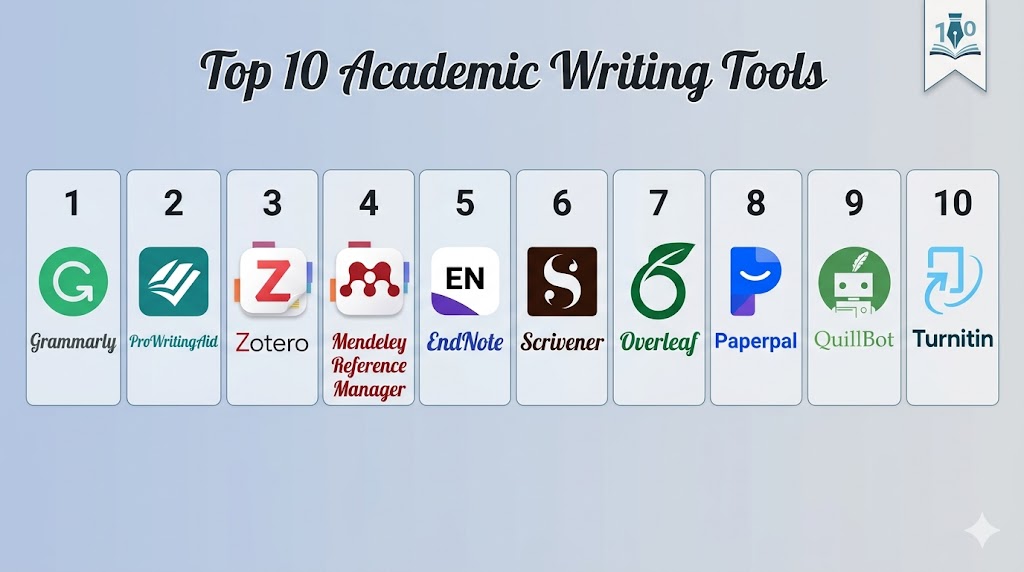
Top 10 Academic Writing Tools
#1 — Grammarly
Short description: Grammarly is a writing assistant that helps academic users improve grammar, spelling, punctuation, clarity, tone, and readability. It is useful for essays, research drafts, emails, reports, and academic communication. It is especially helpful for students and researchers who want real-time writing feedback across common writing environments.
Key Features
- Grammar, spelling, and punctuation correction.
- Clarity and conciseness suggestions.
- Tone and readability feedback.
- AI-assisted rewriting support.
- Browser, desktop, mobile, and document support.
- Plagiarism checking in selected plans.
- Team and style guide features in business plans.
Pros
- Easy to use for everyday academic writing.
- Strong grammar and clarity support.
- Works across many writing platforms.
Cons
- Suggestions may not always fit academic nuance.
- Advanced features may require paid plans.
- It does not replace expert editing or citation review.
Platforms / Deployment
Web / Windows / macOS / iOS / Android
Browser extensions / Cloud
Security & Compliance
Enterprise controls, SSO, and user management may be available depending on plan. Buyers should verify data handling, retention, and compliance documentation directly.
SOC 2, ISO 27001, HIPAA: Not publicly stated.
Integrations & Ecosystem
Grammarly works well across everyday academic writing workflows, including drafts, emails, notes, and documents.
- Browser writing support
- Desktop writing support
- Document editing workflows
- Email writing support
- Mobile writing support
- Team writing environments
Support & Community
Grammarly provides help resources, onboarding materials, and support options. It has strong recognition among students, writers, professionals, and academic users.
#2 — ProWritingAid
Short description: ProWritingAid is a writing improvement tool focused on grammar, style, readability, structure, repetition, and long-form editing. It is useful for academic essays, dissertations, manuscripts, and research reports that need deeper writing feedback. It is especially helpful for users who want detailed analysis rather than quick corrections only.
Key Features
- Grammar, spelling, and punctuation checks.
- Style and readability improvement.
- Detailed writing reports.
- Repetition and sentence variety analysis.
- Long-form writing support.
- Integrations with writing platforms.
- Plagiarism checking options may be available.
Pros
- Strong for long-form academic drafts.
- Detailed reports help improve writing habits.
- Useful for students, researchers, and academic authors.
Cons
- Reports may feel complex for beginners.
- Some advanced features require paid access.
- Creative and academic suggestions need human judgment.
Platforms / Deployment
Web / Windows / macOS
Browser extensions / Cloud / Desktop options may vary
Security & Compliance
Security and privacy features may vary by plan. Buyers should verify data processing, retention, and institutional requirements directly.
SOC 2, ISO 27001, HIPAA: Not publicly stated.
Integrations & Ecosystem
ProWritingAid works well for academic users who need structured editing feedback and long-form revision support.
- Browser extensions
- Web editor
- Desktop writing workflows
- Long-form writing platforms
- Document editing tools
- Manuscript revision workflows
Support & Community
ProWritingAid provides documentation, learning resources, and support materials. It is recognized among long-form writers, editors, students, and academic authors.
#3 — Zotero
Short description: Zotero is a reference manager that helps academic writers collect, organize, cite, annotate, and manage research sources. It supports web capture, PDF management, notes, citation styles, and bibliography generation. It is especially useful for students and researchers managing literature reviews and research papers.
Key Features
- Reference collection and library organization.
- Browser-based source capture.
- Citation and bibliography generation.
- PDF storage and annotation.
- Tags, collections, notes, and search.
- Group libraries for collaboration.
- Import and export support for citation formats.
Pros
- Strong free core functionality.
- Excellent for research organization and citation workflows.
- Useful for students, researchers, and academic teams.
Cons
- Large PDF libraries may require storage upgrades.
- Metadata imports need manual checking.
- Advanced organization features may require learning.
Platforms / Deployment
Web / Windows / macOS / Linux / iOS
Desktop / Cloud sync
Security & Compliance
Account-based sync and library sharing are available. Users should verify privacy, storage, and institutional requirements directly.
SOC 2, ISO 27001, HIPAA: Not publicly stated.
Integrations & Ecosystem
Zotero supports academic research workflows from source collection to bibliography creation.
- Browser connector
- Word processor citation plugins
- PDF annotation workflows
- Group library sharing
- BibTeX and RIS export
- Academic database capture
Support & Community
Zotero has strong documentation, community support, user forums, and academic recognition. It is widely used by researchers, students, and librarians.
#4 — Mendeley Reference Manager
Short description: Mendeley Reference Manager helps researchers manage PDFs, citations, references, and academic libraries. It supports citation generation, PDF organization, annotation, and cloud syncing. It is especially useful for researchers who need a structured library for academic papers and source management.
Key Features
- Reference library management.
- PDF storage and annotation.
- Citation and bibliography generation.
- Word processor citation support.
- Cloud syncing across devices.
- Search and organization tools.
- Import support for reference formats.
Pros
- Useful for PDF-heavy academic research.
- Cloud sync helps access libraries across devices.
- Practical for citation and bibliography workflows.
Cons
- Some users may prefer more open or locally controlled tools.
- Storage and account limits should be reviewed.
- Imported metadata still needs checking.
Platforms / Deployment
Web / Windows / macOS / Linux
Desktop / Cloud
Security & Compliance
Account-based cloud storage and syncing are available. Users should verify data handling, retention, and institutional requirements directly.
SOC 2, ISO 27001, HIPAA: Not publicly stated.
Integrations & Ecosystem
Mendeley supports academic research and writing workflows involving PDFs, citations, and document references.
- Word processor citation tools
- PDF reading and annotation
- Reference import workflows
- Cloud library sync
- Academic database exports
- Research writing workflows
Support & Community
Mendeley provides documentation and help resources. It is recognized among students, researchers, and academic institutions.
#5 — EndNote
Short description: EndNote is a mature reference management tool used by researchers, universities, institutions, and academic authors. It supports large reference libraries, citation generation, bibliography formatting, document integration, and collaboration. It is especially useful for advanced academic writing and institutional research workflows.
Key Features
- Advanced reference library management.
- Citation and bibliography generation.
- Large citation style support.
- Word processor integration.
- PDF organization.
- Library sharing and collaboration.
- Import and export support for research databases.
Pros
- Strong for advanced research and institutional use.
- Mature citation and bibliography workflows.
- Useful for large and complex research libraries.
Cons
- Can feel complex for beginners.
- Cost may be higher than lightweight tools.
- Requires learning for advanced workflows.
Platforms / Deployment
Web / Windows / macOS
Desktop / Cloud
Security & Compliance
Institutional and account-based access may be available depending on licensing. Buyers should verify security, privacy, and compliance requirements directly.
SOC 2, ISO 27001, HIPAA: Not publicly stated.
Integrations & Ecosystem
EndNote fits academic and institutional writing environments where citation control and long-term research libraries are important.
- Word processor citation integration
- Research database import workflows
- PDF management
- Library sharing
- Citation style management
- Institutional research workflows
Support & Community
EndNote has strong institutional recognition, documentation, training resources, and support options. It is widely used in universities and research organizations.
#6 — Scrivener
Short description: Scrivener is a long-form writing and organization tool used by authors, researchers, dissertation writers, and academic authors. It helps users structure chapters, notes, outlines, references, drafts, and research materials in one writing workspace. It is especially useful for dissertations, books, theses, and complex long-form projects.
Key Features
- Long-form writing workspace.
- Chapter and section organization.
- Research material storage.
- Outline and corkboard-style planning.
- Draft compilation and export.
- Notes and metadata support.
- Useful for complex writing projects.
Pros
- Excellent for organizing long academic projects.
- Helps manage drafts, notes, and structure.
- Useful for thesis, dissertation, and book writing.
Cons
- Not a citation manager by itself.
- Learning curve for new users.
- Collaboration features are limited compared with cloud tools.
Platforms / Deployment
Windows / macOS / iOS
Desktop
Security & Compliance
Local file control depends on user setup. Formal enterprise compliance claims are not publicly stated.
SOC 2, ISO 27001, HIPAA: Not publicly stated.
Integrations & Ecosystem
Scrivener works best as a structured writing environment, often used alongside citation managers and grammar tools.
- Long-form draft organization
- Research note storage
- Chapter planning
- Outline workflows
- Export and compilation workflows
- Academic manuscript drafting
Support & Community
Scrivener has documentation, tutorials, and a strong user community among authors, researchers, and long-form writers.
#7 — Overleaf
Short description: Overleaf is a collaborative online LaTeX editor used by researchers, students, scientists, engineers, and academic teams. It supports structured academic writing, mathematical formatting, templates, bibliography management, and real-time collaboration. It is especially useful for technical papers, theses, conference papers, and journal submissions.
Key Features
- Online LaTeX editing.
- Real-time collaboration.
- Academic templates.
- Bibliography and citation support.
- Mathematical and scientific formatting.
- Version history and project sharing.
- Export and submission-ready document workflows.
Pros
- Strong for technical and scientific writing.
- Excellent collaboration for LaTeX documents.
- Useful templates for academic manuscripts.
Cons
- Requires LaTeX knowledge for advanced use.
- Not ideal for users who prefer simple word processors.
- Complex projects may require careful file organization.
Platforms / Deployment
Web / Cloud
Security & Compliance
Project sharing and access controls may be available depending on plan. Buyers should verify data handling, retention, and institutional requirements directly.
SOC 2, ISO 27001, HIPAA: Not publicly stated.
Integrations & Ecosystem
Overleaf is designed for academic and technical writing workflows where LaTeX formatting and collaboration are important.
- LaTeX document editing
- Bibliography workflows
- Academic templates
- Real-time collaboration
- Journal and conference writing
- Research team document workflows
Support & Community
Overleaf has strong documentation, templates, academic community usage, and support resources. It is widely recognized in scientific and technical research communities.
#8 — Paperpal
Short description: Paperpal is an academic writing assistant focused on helping researchers improve manuscripts, grammar, clarity, academic tone, and submission readiness. It is designed for academic and scholarly writing rather than general business writing. It is especially useful for researchers preparing papers, journal manuscripts, and formal academic documents.
Key Features
- Academic grammar and language suggestions.
- Manuscript-focused writing improvements.
- Clarity and readability support.
- Academic tone guidance.
- Editing suggestions for research writing.
- Submission-oriented writing assistance.
- Support for non-native English academic writers.
Pros
- Focused specifically on academic writing.
- Useful for manuscript polishing.
- Helpful for researchers improving clarity and tone.
Cons
- Not a full citation manager.
- Output still needs subject-matter review.
- Advanced features and limits should be checked by plan.
Platforms / Deployment
Web / Cloud
Document workflow options may vary
Security & Compliance
Not publicly stated.
Integrations & Ecosystem
Paperpal fits academic writing workflows where users need manuscript-focused language support and clarity improvement.
- Manuscript editing workflows
- Academic writing support
- Research paper polishing
- Grammar and clarity review
- Non-native English writing support
- Journal submission preparation
Support & Community
Paperpal provides writing guidance and support resources for academic users. It is strongest for researchers and students working on scholarly manuscripts.
#9 — QuillBot
Short description: QuillBot is a writing assistance platform used for paraphrasing, grammar checking, summarization, and sentence improvement. It helps academic users rewrite text, simplify ideas, and improve fluency. It is especially useful for students and researchers who need support with rewriting and clarity, but users must apply it ethically and review originality carefully.
Key Features
- Paraphrasing and rewriting modes.
- Grammar and spelling checking.
- Summarization support.
- Citation-related tools may be available.
- Tone and fluency improvement.
- Web-based editor and browser support.
- Useful for academic drafting and revision.
Pros
- Strong for rewriting and sentence improvement.
- Easy to use for students and researchers.
- Helpful for simplifying complex wording.
Cons
- Rewriting must be used ethically.
- Output may change meaning if not reviewed.
- Enterprise academic governance is limited.
Platforms / Deployment
Web / Browser extensions may be available
Cloud
Security & Compliance
Not publicly stated.
Integrations & Ecosystem
QuillBot is useful as a supporting tool for revision, paraphrasing, grammar correction, and summarization.
- Web editor
- Browser writing workflows
- Paraphrasing workflows
- Grammar correction
- Summarization workflows
- Academic writing support
Support & Community
QuillBot has strong recognition among students, researchers, and content writers. Help resources and support materials are available.
#10 — Turnitin
Short description: Turnitin is an academic integrity and similarity checking platform used by educational institutions, instructors, and students. It helps detect text similarity, support originality review, and improve academic integrity workflows. It is especially useful for institutions that need structured originality checking and feedback processes.
Key Features
- Similarity checking for academic submissions.
- Originality review workflows.
- Instructor and student feedback support.
- Academic integrity reporting.
- Institutional submission workflows.
- Writing feedback features may vary by product.
- Learning management system integrations may be available.
Pros
- Strong fit for institutions and instructors.
- Useful for originality and similarity review.
- Supports academic integrity workflows.
Cons
- Usually institution-focused rather than individual-first.
- Similarity results require human interpretation.
- Not a complete writing or citation management tool.
Platforms / Deployment
Web / Cloud
Security & Compliance
Institutional controls and privacy features may be available depending on deployment and contract. Buyers should verify data handling, retention, access controls, and compliance documentation directly.
SOC 2, ISO 27001, HIPAA: Not publicly stated.
Integrations & Ecosystem
Turnitin is designed for academic institutions, instructors, and learning environments where originality review is part of the writing process.
- Learning management systems
- Assignment submission workflows
- Instructor feedback workflows
- Similarity reporting
- Academic integrity review
- Institutional writing assessment
Support & Community
Turnitin provides institutional support, documentation, and educator-focused resources. It is widely recognized in academic integrity and assessment workflows.
Comparison Table
| Tool Name | Best For | Platform Supported | Deployment | Standout Feature | Public Rating |
|---|---|---|---|---|---|
| Grammarly | Grammar, clarity, and everyday academic writing | Web, Windows, macOS, iOS, Android | Cloud | Real-time writing correction and clarity support | N/A |
| ProWritingAid | Long-form academic editing | Web, Windows, macOS | Cloud / Desktop varies | Detailed writing reports and style analysis | N/A |
| Zotero | Citation and research source management | Web, Windows, macOS, Linux, iOS | Desktop / Cloud sync | Strong web capture and reference management | N/A |
| Mendeley Reference Manager | PDF-heavy academic research | Web, Windows, macOS, Linux | Desktop / Cloud | PDF organization and citation workflows | N/A |
| EndNote | Advanced academic citation workflows | Web, Windows, macOS | Desktop / Cloud | Mature citation and bibliography management | N/A |
| Scrivener | Thesis, dissertation, and long-form writing | Windows, macOS, iOS | Desktop | Long-form writing organization | N/A |
| Overleaf | Technical and LaTeX-based academic writing | Web | Cloud | Collaborative LaTeX writing | N/A |
| Paperpal | Academic manuscript polishing | Web | Cloud | Research-focused language improvement | N/A |
| QuillBot | Paraphrasing and rewriting support | Web | Cloud | Sentence rewriting and summarization | N/A |
| Turnitin | Academic integrity and similarity checking | Web | Cloud | Similarity reporting and originality review | N/A |
Evaluation & Scoring of Academic Writing Tools
The scoring below is comparative and practical. It is not an official rating and should not be treated as a universal ranking. Scores are based on academic writing usefulness, ease of use, integrations, security posture, performance, support maturity, and buyer value.
| Tool Name | Core | Ease | Integrations | Security | Performance | Support | Value | Weighted Total |
|---|---|---|---|---|---|---|---|---|
| Grammarly | 8 | 9 | 9 | 8 | 9 | 8 | 8 | 8.40 |
| ProWritingAid | 8 | 8 | 8 | 7 | 8 | 8 | 8 | 7.95 |
| Zotero | 9 | 8 | 9 | 8 | 8 | 8 | 10 | 8.75 |
| Mendeley Reference Manager | 8 | 8 | 8 | 7 | 8 | 8 | 8 | 7.95 |
| EndNote | 10 | 7 | 9 | 8 | 8 | 9 | 7 | 8.45 |
| Scrivener | 8 | 7 | 6 | 8 | 8 | 7 | 8 | 7.45 |
| Overleaf | 9 | 7 | 8 | 8 | 8 | 8 | 8 | 8.05 |
| Paperpal | 8 | 8 | 7 | 6 | 8 | 7 | 8 | 7.50 |
| QuillBot | 7 | 9 | 7 | 6 | 8 | 7 | 9 | 7.70 |
| Turnitin | 9 | 7 | 8 | 8 | 8 | 8 | 7 | 8.00 |
These scores are intended to help users shortlist tools, not declare one universal winner. Zotero and EndNote are stronger for citation and research management, while Grammarly, ProWritingAid, and Paperpal are better for writing improvement. Overleaf is best for LaTeX-based academic work, Scrivener is strong for long-form writing organization, and Turnitin is valuable for originality review.
Which Academic Writing Tool Is Right for You?
Solo / Freelancer
Independent academic writers, freelance researchers, and solo students should prioritize affordability, ease of use, citation management, and writing improvement. A combination of tools often works better than relying on one platform.
Good options include Grammarly for grammar, Zotero for citations, ProWritingAid for long-form editing, QuillBot for rewriting support, and Scrivener for dissertation or book organization.
Solo users should choose based on writing stage. Planning requires organization tools, drafting needs writing tools, and final review needs grammar, citation, and originality checks.
SMB
Small education companies, research consultancies, training providers, and academic service teams need tools that support writing quality, source management, and collaboration. They may not need institution-level systems, but they do need reliable workflows.
Good options include Zotero, Grammarly, ProWritingAid, Mendeley Reference Manager, and Overleaf. These tools help small teams manage references, improve writing, and collaborate on academic or research documents.
SMBs should check collaboration features, document sharing, export options, and pricing before selecting tools.
Mid-Market
Mid-market research teams, academic departments, and content-heavy organizations often need better structure, collaboration, and review workflows. They may handle multiple authors, reviewers, references, drafts, and publication requirements.
Good options include EndNote, Zotero, Overleaf, Turnitin, Paperpal, and Mendeley Reference Manager. These tools can support citation management, collaborative writing, academic editing, and integrity review.
Mid-market buyers should validate integration with writing tools, learning platforms, citation styles, and institutional processes.
Enterprise
Universities, research institutions, publishers, and large academic organizations need security, administration, collaboration, training, access control, and long-term support. They often require institution-wide tools for writing, citation, and originality workflows.
Good options include EndNote, Turnitin, Zotero, Overleaf, Mendeley Reference Manager, and Paperpal depending on institutional needs. Enterprise buyers should review licensing, privacy, storage, admin controls, and support models.
Institutions should also provide training so students and researchers use tools correctly and ethically.
Budget vs Premium
Budget-focused users should evaluate Zotero, QuillBot, Grammarly, and open or free writing workflows. Zotero is especially valuable for citation management, while Grammarly and QuillBot can support writing improvement.
Premium buyers should evaluate EndNote, Turnitin, Paperpal, ProWritingAid, and advanced plans of major writing tools when they need deeper editing, institutional workflows, originality checks, or formal support.
The best value depends on academic stage. A student writing essays may need fewer features than a research team preparing journal manuscripts.
Feature Depth vs Ease of Use
If ease of use is the priority, Grammarly, QuillBot, Zotero, and Paperpal are practical starting points. They help users improve drafts, manage sources, and revise writing without too much setup.
If feature depth is more important, EndNote, Overleaf, Scrivener, ProWritingAid, and Turnitin may be stronger. These tools support complex research libraries, LaTeX writing, long-form organization, detailed editing, and academic integrity workflows.
The best academic writing setup often combines multiple tools instead of relying on one platform.
Integrations & Scalability
Academic writing tools are most useful when they connect with word processors, browsers, LaTeX editors, PDF workflows, citation databases, and learning platforms. Buyers should test integrations with the exact tools they use.
Strong integration-focused options include Zotero, EndNote, Mendeley Reference Manager, Overleaf, Grammarly, and Turnitin. These tools can support different parts of the research and writing lifecycle.
Scalability depends on library size, number of authors, collaboration needs, citation styles, document length, and institutional requirements.
Security & Compliance Needs
Security-sensitive users should review how tools handle drafts, references, uploaded PDFs, unpublished research, student submissions, and institutional data. Academic content may include confidential research, private notes, unpublished manuscripts, or student records.
Enterprise and institutional buyers should evaluate Turnitin, EndNote, Overleaf, Mendeley Reference Manager, Zotero, and Paperpal depending on privacy needs. Do not assume certifications unless the vendor confirms them directly.
For confidential research, legal academic work, healthcare studies, or unpublished manuscripts, always review data handling before uploading content.
Frequently Asked Questions FAQs
1. What are Academic Writing Tools?
Academic Writing Tools help students and researchers plan, draft, edit, cite, organize, and check scholarly writing.
They may include grammar checkers, citation managers, LaTeX editors, originality checkers, and research organizers.
These tools are useful for essays, theses, dissertations, journal papers, and literature reviews.
They improve workflow but do not replace research expertise or academic judgment.
2. Which tool is best for academic grammar checking?
Grammarly, ProWritingAid, and Paperpal are strong options for academic grammar and clarity improvement.
Grammarly is useful for everyday writing, while ProWritingAid provides deeper long-form feedback.
Paperpal is more focused on academic and manuscript-style writing.
Users should still review suggestions carefully to protect meaning and academic tone.
3. Which tool is best for citation management?
Zotero, Mendeley Reference Manager, and EndNote are strong citation management tools.
Zotero is flexible and widely used, while EndNote is strong for advanced and institutional workflows.
Mendeley is useful for PDF-heavy research libraries.
The best choice depends on citation style needs, writing platform, and research volume.
4. Which tool is best for thesis or dissertation writing?
Scrivener, Zotero, Grammarly, ProWritingAid, and EndNote are useful for thesis or dissertation writing.
Scrivener helps organize chapters, notes, and long drafts, while Zotero and EndNote manage citations.
Grammarly and ProWritingAid help improve language and readability.
A strong dissertation workflow often combines several tools.
5. Is Overleaf only for technical writing?
Overleaf is especially strong for technical, scientific, mathematical, and engineering writing because it supports LaTeX.
However, it can also be used for any academic document where structured formatting and collaboration matter.
Users who are not comfortable with LaTeX may need time to learn it.
It is best for teams that value precise formatting and collaborative editing.
6. Can academic writing tools prevent plagiarism?
Academic writing tools can help identify similarity, citation gaps, and originality risks, but they cannot guarantee plagiarism-free work.
Turnitin is commonly used for similarity checking and academic integrity workflows.
Writers must still cite properly, paraphrase ethically, and understand institutional rules.
Originality depends on responsible writing, not just software checks.
7. Are AI writing tools allowed in academic writing?
Rules vary by institution, course, journal, and publisher.
Some allow AI tools for grammar or clarity support, while others restrict AI-generated content or require disclosure.
Students and researchers should always follow academic integrity policies before using AI writing assistance.
When in doubt, ask the instructor, supervisor, or publisher.
8. What is the biggest mistake when using academic writing tools?
The biggest mistake is accepting suggestions without checking accuracy, meaning, citations, and academic integrity.
Tools can improve writing, but they may also introduce errors or change the intended argument.
Another mistake is trusting imported citation metadata without verification.
Human review is still required for serious academic work.
9. Do academic writing tools help non-native English writers?
Yes, tools like Grammarly, Paperpal, ProWritingAid, and QuillBot can help non-native English writers improve clarity and fluency.
They can identify grammar issues, awkward phrasing, wordiness, and sentence structure problems.
However, users should ensure that revisions do not change technical meaning.
For high-stakes work, human academic editing may still be useful.
10. How should I choose the right academic writing tool?
Start by identifying your main need: grammar improvement, citation management, long-form organization, LaTeX writing, or originality checking.
Then test two or three tools with real drafts, references, and document formats.
Check ease of use, integrations, export options, privacy, and pricing.
The best tool is the one that fits your academic workflow and improves quality without weakening integrity.
Conclusion
Academic Writing Tools help students, researchers, and institutions create clearer, better organized, and more credible scholarly work.
They support grammar correction, citation management, research organization, long-form drafting, LaTeX writing, and originality review.
Grammarly, ProWritingAid, and Paperpal are useful for improving academic language and readability.
Zotero, Mendeley Reference Manager, and EndNote are stronger for citation and research source management.
Scrivener supports long-form writing organization, while Overleaf is valuable for LaTeX-based academic collaboration.
QuillBot can help with rewriting and summarization, but it must be used ethically and carefully.
Turnitin supports academic integrity workflows, especially for institutions and instructors.
There is no single best tool because academic writing needs vary by discipline, writing stage, budget, and institutional rules.
Simple and clear comparison of academic tools that makes choosing the right one much easier.