Introduction
Drug Discovery Platforms are advanced software and computational systems designed to accelerate the identification of drug targets, design of molecules, and optimization of drug candidates using data science, AI, and computational chemistry. These platforms integrate biological, chemical, and clinical data to streamline early-stage research and reduce the time required to bring new therapies to market.
Modern drug discovery is no longer driven solely by lab experiments. Instead, it combines artificial intelligence, machine learning, molecular modeling, and big data analytics to predict how molecules behave, identify promising compounds, and minimize costly failures. AI-driven platforms can significantly reduce the time and cost of drug development by enabling faster target identification and molecule design.
Real-world use cases
- Identifying biological targets for diseases
- Designing and optimizing drug molecules
- Predicting drug safety and efficacy
- Accelerating preclinical research
- Supporting computational chemistry workflows
What buyers should evaluate
- AI and machine learning capabilities
- Molecular modeling and simulation features
- Data integration and analytics capabilities
- Collaboration and workflow management
- Integration with lab systems and databases
- Scalability for large datasets
- Security and compliance controls
- Ease of use for researchers
Best for: Pharmaceutical companies, biotech startups, research labs, computational chemists, and bioinformatics teams.
Not ideal for: Small labs without computational infrastructure or advanced research needs.
Key Trends in Drug Discovery Platforms
- AI-driven molecule design and generative chemistry
- Integration of multi-omics and biological datasets
- Cloud-based research environments
- Automation of target identification and validation
- Use of protein structure prediction technologies
- Real-time collaboration across research teams
- API-first ecosystems for integration
- Predictive analytics for drug safety and efficacy
- Adoption of digital twins for biological modeling
- Shift toward data-driven drug discovery workflows
AI platforms are transforming drug discovery by enabling rapid identification of targets and predicting molecular behavior with high accuracy, reducing traditional experimental timelines.
How We Selected These Tools
- Evaluated adoption across pharma and biotech industries
- Assessed AI, modeling, and simulation capabilities
- Considered integration with lab and data systems
- Reviewed scalability for large research datasets
- Analyzed usability for scientists and researchers
- Evaluated collaboration and workflow features
- Considered deployment flexibility
- Assessed overall value and innovation
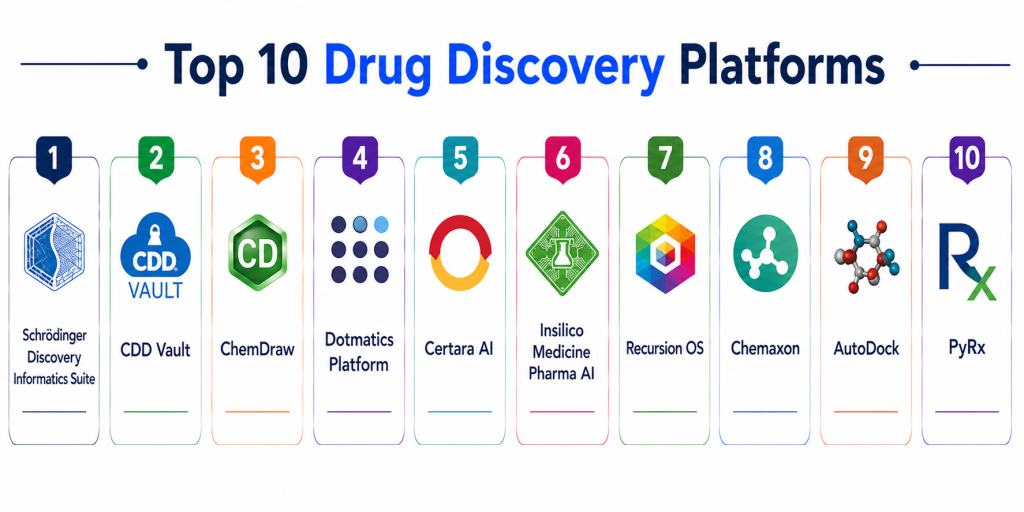
Top 10 Drug Discovery Platforms
#1 — Schrödinger Discovery Informatics Suite
Short description: A leading computational platform used for molecular modeling, simulation, and drug design across pharma and biotech.
Key Features
- Molecular modeling
- Simulation tools
- Drug design workflows
- Data analysis
- Visualization tools
Pros
- Industry-standard platform
- Highly accurate simulations
- Scalable
Cons
- Expensive
- Complex
- Requires expertise
Platforms / Deployment
- Web Windows Linux
- Cloud On premise
Security & Compliance
- Not publicly stated
Integrations & Ecosystem
Integrates with scientific tools and databases.
- APIs
- Lab systems
Support & Community
Enterprise support
#2 — CDD Vault
Short description: A collaborative data platform for managing and analyzing drug discovery data across research teams.
Key Features
- Data management
- Collaboration tools
- Reporting
- Integration
- Security
Pros
- Easy collaboration
- Secure data storage
- Scalable
Cons
- Limited modeling features
- Pricing
- Smaller ecosystem
Platforms / Deployment
- Web
- Cloud
Security & Compliance
- Access control and audit features
- Not publicly stated
Integrations & Ecosystem
Supports integration with research tools.
- APIs
- Data platforms
Support & Community
Enterprise support
#3 — ChemDraw
Short description: A widely used tool for chemical structure drawing and analysis in drug discovery workflows.
Key Features
- Chemical structure drawing
- Data visualization
- Reporting
- Integration
- Analysis tools
Pros
- Easy to use
- Widely adopted
- Reliable
Cons
- Limited advanced AI features
- Basic modeling capabilities
- Desktop-focused
Platforms / Deployment
- Windows macOS
- Desktop
Security & Compliance
- Not publicly stated
Integrations & Ecosystem
Supports integration with scientific tools.
- APIs
- Lab tools
Support & Community
Strong community
#4 — Dotmatics Platform
Short description: Dotmatics provides a unified data and analytics platform for scientific research and drug discovery.
Key Features
- Data integration
- Analytics
- Collaboration
- Workflow automation
- Reporting
Pros
- Unified platform
- Scalable
- Strong analytics
Cons
- Pricing
- Complex setup
- Learning curve
Platforms / Deployment
- Web
- Cloud
Security & Compliance
- Not publicly stated
Integrations & Ecosystem
Integrates with lab systems and data tools.
- APIs
- Data platforms
Support & Community
Enterprise support
#5 — Certara AI
Short description: Certara AI focuses on predictive modeling and simulation to optimize drug development.
Key Features
- Predictive modeling
- Simulation
- Data analytics
- Reporting
- Integration
Pros
- Strong predictive capabilities
- Scalable
- Reliable
Cons
- Complex
- Pricing
- Learning curve
Platforms / Deployment
- Web
- Cloud
Security & Compliance
- Not publicly stated
Integrations & Ecosystem
Supports integration with research tools.
- APIs
- Data systems
Support & Community
Enterprise support
#6 — Insilico Medicine Pharma AI
Short description: A cutting-edge AI-driven platform that supports end-to-end drug discovery using generative AI and multi-omics data.
Key Features
- AI molecule generation
- Target identification
- Data analytics
- Simulation
- Workflow automation
Pros
- Strong AI capabilities
- End-to-end platform
- Scalable
Cons
- Complex
- Expensive
- Learning curve
Platforms / Deployment
- Web
- Cloud
Security & Compliance
- Not publicly stated
Integrations & Ecosystem
Integrates with research and clinical tools.
- APIs
- Data platforms
Support & Community
Enterprise support
#7 — Recursion OS
Short description: Recursion OS combines AI, automation, and experimental biology to accelerate drug discovery.
Key Features
- AI analysis
- Data integration
- Automation
- Reporting
- Collaboration
Pros
- Innovative platform
- Strong AI integration
- Scalable
Cons
- Complex
- Pricing
- Limited accessibility
Platforms / Deployment
- Web
- Cloud
Security & Compliance
- Not publicly stated
Integrations & Ecosystem
Supports integration with research tools.
- APIs
- Data systems
Support & Community
Enterprise support
#8 — Chemaxon
Short description: Chemaxon provides chemical informatics tools for molecular modeling and drug design.
Key Features
- Chemical modeling
- Data analysis
- Visualization
- Integration
- Reporting
Pros
- Strong chemical tools
- Scalable
- Reliable
Cons
- Complex
- Pricing
- Learning curve
Platforms / Deployment
- Web Desktop
- Cloud
Security & Compliance
- Not publicly stated
Integrations & Ecosystem
Supports integration with scientific tools.
- APIs
- Data tools
Support & Community
Enterprise support
#9 — AutoDock
Short description: AutoDock is an open-source tool for molecular docking and simulation.
Key Features
- Molecular docking
- Simulation
- Visualization
- Data analysis
- Integration
Pros
- Free and open-source
- Widely used
- Flexible
Cons
- Requires expertise
- Limited UI
- Smaller ecosystem
Platforms / Deployment
- Windows Linux macOS
- Self-hosted
Security & Compliance
- Not publicly stated
Integrations & Ecosystem
Supports integration with research tools.
- APIs
- Plugins
Support & Community
Open-source community
#10 — PyRx
Short description: PyRx is an open-source virtual screening tool for drug discovery research.
Key Features
- Virtual screening
- Molecular docking
- Data analysis
- Visualization
- Integration
Pros
- Free
- Easy to use
- Flexible
Cons
- Limited advanced features
- Smaller ecosystem
- Performance limitations
Platforms / Deployment
- Windows Linux macOS
- Self-hosted
Security & Compliance
- Not publicly stated
Integrations & Ecosystem
Supports integration with research tools.
- APIs
- Plugins
Support & Community
Open-source support
Comparison Table Top 10
| Tool Name | Best For | Platform Supported | Deployment | Standout Feature | Public Rating |
|---|---|---|---|---|---|
| Schrödinger | Enterprise | Web Windows Linux | Cloud On premise | Molecular modeling | N/A |
| CDD Vault | Collaboration | Web | Cloud | Data management | N/A |
| ChemDraw | Chemists | Windows macOS | Desktop | Structure drawing | N/A |
| Dotmatics | Data analytics | Web | Cloud | Unified data platform | N/A |
| Certara AI | Simulation | Web | Cloud | Predictive modeling | N/A |
| Insilico Medicine | AI discovery | Web | Cloud | Generative AI | N/A |
| Recursion OS | AI workflows | Web | Cloud | Automation | N/A |
| Chemaxon | Informatics | Web Desktop | Cloud | Chemical modeling | N/A |
| AutoDock | Research | Windows Linux macOS | Self-hosted | Docking simulation | N/A |
| PyRx | Screening | Windows Linux macOS | Self-hosted | Virtual screening | N/A |
Evaluation & Scoring of Drug Discovery Platforms
| Tool Name | Core | Ease | Integrations | Security | Performance | Support | Value | Weighted Total |
|---|---|---|---|---|---|---|---|---|
| Schrödinger | 10 | 6 | 9 | 8 | 9 | 9 | 6 | 8.5 |
| CDD Vault | 8 | 8 | 8 | 8 | 8 | 8 | 7 | 8.0 |
| ChemDraw | 7 | 9 | 6 | 7 | 7 | 8 | 9 | 7.8 |
| Dotmatics | 9 | 7 | 9 | 8 | 8 | 8 | 7 | 8.2 |
| Certara AI | 9 | 6 | 8 | 8 | 9 | 8 | 7 | 8.1 |
| Insilico Medicine | 9 | 7 | 9 | 8 | 9 | 8 | 6 | 8.2 |
| Recursion OS | 9 | 6 | 8 | 8 | 9 | 8 | 6 | 8.0 |
| Chemaxon | 8 | 7 | 8 | 7 | 8 | 7 | 7 | 7.7 |
| AutoDock | 7 | 6 | 7 | 7 | 7 | 7 | 10 | 7.5 |
| PyRx | 7 | 7 | 6 | 7 | 7 | 6 | 9 | 7.4 |
Scores are comparative and reflect capabilities in modeling, AI integration, and scalability. Choose based on research complexity and computational needs.
Which Drug Discovery Platform Is Right for You
Solo Researchers
AutoDock and PyRx are affordable and flexible.
SMB Biotech
ChemDraw and CDD Vault offer ease of use.
Mid-Market
Dotmatics and Chemaxon provide balanced features.
Enterprise Pharma
Schrödinger and Insilico Medicine are ideal.
Budget vs Premium
Open-source tools are budget-friendly, Schrödinger is premium.
Feature Depth vs Ease of Use
Schrödinger for depth, ChemDraw for simplicity.
Integrations & Scalability
Dotmatics and Insilico are strong options.
Security & Compliance Needs
Enterprise tools provide stronger controls.
Frequently Asked Questions
1. What are drug discovery platforms
These platforms help researchers identify drug targets and design molecules using computational tools. They accelerate research and reduce costs.
2. How do drug discovery platforms work
They analyze biological and chemical data to predict how molecules interact with targets. This improves efficiency and accuracy.
3. Why are they important
They reduce time and cost in drug development. They also improve success rates in clinical trials.
4. Are AI platforms better than traditional methods
AI platforms are faster and more scalable. However, experimental validation is still required.
5. Who uses these platforms
Pharma companies, biotech firms, and research institutions use them extensively.
6. How much do these platforms cost
Costs vary widely. Open-source tools are free, while enterprise platforms are expensive.
7. Do they integrate with lab systems
Yes, most platforms integrate with LIMS and research tools. This improves workflows.
8. How long does implementation take
Implementation can take days to weeks depending on complexity.
9. Are these platforms secure
Most platforms provide secure data handling. Security features vary by vendor.
10. Are there alternatives
Traditional lab-based research methods are alternatives. However, they are slower and less efficient.
Conclusion
Drug discovery platforms are transforming how new medicines are developed by combining computational power, artificial intelligence, and biological insights into a unified research workflow. These tools enable faster target identification, molecule design, and optimization, significantly reducing the time and cost of bringing new therapies to market. From open-source tools like AutoDock to enterprise-grade platforms like Schrödinger and Insilico Medicine, each solution offers unique strengths depending on research scale and complexity. The best choice depends on your organization’s needs, including data integration, AI capabilities, and computational resources, rather than a one-size-fits-all solution. Organizations should prioritize scalability, accuracy, and integration when selecting a platform. A practical next step is to shortlist a few tools, run pilot studies, and evaluate how well they align with your research workflows and innovation goals.
Great overview. These platforms are really helping researchers reduce time and cost in early-stage drug development.