Introduction
Experiment tracking tools are essential components of modern machine learning workflows. They help teams log, organize, compare, and reproduce experiments by capturing parameters, metrics, datasets, and model artifacts. In machine learning development, experimentation is iterative and complex, making it critical to track changes and results systematically.
Without proper experiment tracking, teams struggle with reproducibility, collaboration, and model optimization. These tools provide a centralized system to manage experiments, enabling faster development cycles and better decision-making.
Real-world use cases include:
- Tracking hyperparameter tuning experiments
- Comparing model performance across iterations
- Managing datasets and feature versions
- Collaborating across data science teams
- Reproducing experiments for compliance and audits
Key evaluation criteria for buyers:
- Experiment logging and metadata tracking
- Visualization of metrics and comparisons
- Integration with ML frameworks and pipelines
- Versioning of models, datasets, and code
- Collaboration and team workflows
- Scalability for large experiments
- Security and governance features
- Deployment flexibility (cloud/on-prem/hybrid)
- Ease of use and developer experience
- Cost and operational overhead
Best for:
Experiment tracking tools are ideal for data scientists, ML engineers, and AI teams working on iterative model development and experimentation.
Not ideal for:
Teams with minimal experimentation or simple analytics workflows may not need dedicated tracking tools.
Key Trends in Experiment Tracking Tools
- Integration with MLOps platforms for end-to-end ML lifecycle
- Real-time experiment logging and visualization
- Collaboration features for distributed teams
- Cloud-native tracking tools with scalable storage
- Automated experiment comparison and analysis
- Support for multiple ML frameworks and languages
- Versioning for datasets, models, and pipelines
- Integration with CI/CD pipelines
- Enhanced visualization dashboards
- Security and compliance for enterprise workflows
How We Selected These Tools (Methodology)
- Evaluated experiment tracking and logging capabilities
- Assessed visualization and comparison features
- Reviewed integration with ML frameworks (TensorFlow, PyTorch, etc.)
- Checked scalability for large-scale experiments
- Considered collaboration and workflow features
- Examined security, governance, and compliance features
- Evaluated ease of use and developer experience
- Reviewed community support and documentation
- Considered open-source vs enterprise solutions
- Ensured applicability across SMB, mid-market, and enterprise use cases
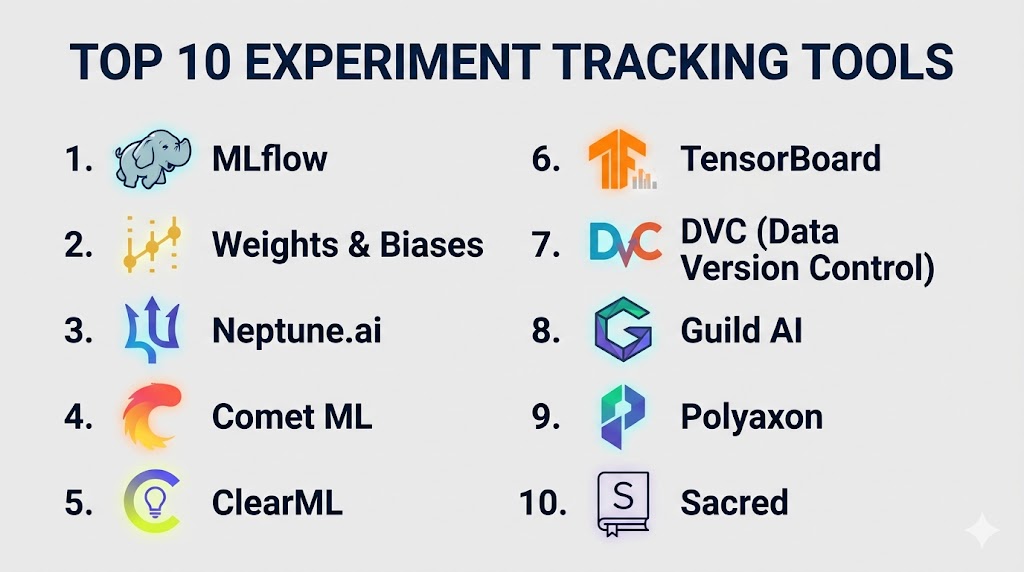
Top 10 Experiment Tracking Tools
#1 — MLflow
Short description (3-4 lines): MLflow is an open-source platform for managing the ML lifecycle, including experiment tracking, model packaging, and deployment.
Key Features
- Experiment logging and tracking
- Model registry and versioning
- REST API deployment support
- Integration with multiple ML frameworks
- Parameter and metric tracking
- Artifact storage
Pros
- Open-source and flexible
- Strong ecosystem support
Cons
- Requires setup and infrastructure
- Limited built-in visualization
Platforms / Deployment
- Linux / Windows / macOS
- Cloud / On-prem / Hybrid
Security & Compliance
- Depends on deployment
- Supports authentication and access control
Integrations & Ecosystem
- TensorFlow, PyTorch, Scikit-learn, cloud platforms
Support & Community
- Large open-source community
#2 — Weights & Biases
Short description: Weights & Biases is a popular experiment tracking platform with powerful visualization and collaboration tools.
Key Features
- Real-time experiment tracking
- Hyperparameter tuning visualization
- Model comparison dashboards
- Artifact versioning
- Collaboration tools
Pros
- Excellent UI and visualization
- Easy to use
Cons
- Paid for advanced features
- Cloud-first platform
Platforms / Deployment
- Cloud / On-prem (limited)
Security & Compliance
- Encryption, RBAC
Integrations & Ecosystem
- TensorFlow, PyTorch, Keras, Hugging Face
Support & Community
- Active community
- Enterprise support
#3 — Neptune.ai
Short description: Neptune.ai is an experiment tracking tool focused on metadata logging and model monitoring.
Key Features
- Experiment metadata tracking
- Model monitoring integration
- Visualization dashboards
- Version control for experiments
- API-based logging
Pros
- Flexible logging system
- Strong integrations
Cons
- Requires setup for advanced workflows
- UI less intuitive than competitors
Platforms / Deployment
- Cloud / On-prem
Security & Compliance
- RBAC, encryption
Integrations & Ecosystem
- TensorFlow, PyTorch, MLflow
Support & Community
- Active community
#4 — Comet ML
Short description: Comet ML is a cloud-based experiment tracking platform offering model monitoring and collaboration.
Key Features
- Experiment tracking and logging
- Model comparison dashboards
- Hyperparameter optimization
- Collaboration features
- Model registry
Pros
- Strong visualization tools
- Easy integration
Cons
- Paid plans required
- Cloud dependency
Platforms / Deployment
- Cloud / Hybrid
Security & Compliance
- Encryption, RBAC
Integrations & Ecosystem
- ML frameworks, cloud services
Support & Community
- Enterprise support
#5 — ClearML
Short description: ClearML is an open-source MLOps platform that includes experiment tracking and pipeline orchestration.
Key Features
- Experiment tracking
- Pipeline automation
- Model versioning
- Dataset management
- Remote execution
Pros
- Open-source and feature-rich
- End-to-end ML workflow support
Cons
- Requires setup
- UI complexity
Platforms / Deployment
- Cloud / On-prem / Hybrid
Security & Compliance
- RBAC, encryption
Integrations & Ecosystem
- TensorFlow, PyTorch, pipelines
Support & Community
- Open-source community
#6 — TensorBoard
Short description: TensorBoard is a visualization tool for TensorFlow experiments and metrics tracking.
Key Features
- Visualization of training metrics
- Graph visualization
- Model performance tracking
- Integration with TensorFlow
- Logging support
Pros
- Free and widely used
- Simple visualization
Cons
- Limited to TensorFlow ecosystem
- Not a full tracking platform
Platforms / Deployment
- Local / Cloud
Security & Compliance
- Depends on deployment
Integrations & Ecosystem
- TensorFlow ecosystem
Support & Community
- Strong community
#7 — DVC (Data Version Control)
Short description: DVC is a data and experiment versioning tool for managing datasets and ML pipelines.
Key Features
- Data versioning
- Pipeline tracking
- Integration with Git
- Experiment comparison
- Reproducibility support
Pros
- Strong version control
- Works with existing Git workflows
Cons
- Limited visualization
- CLI-heavy
Platforms / Deployment
- Linux / Windows / macOS
- Cloud / On-prem
Security & Compliance
- Depends on Git and storage
Integrations & Ecosystem
- Git, cloud storage, ML pipelines
Support & Community
- Active community
#8 — Guild AI
Short description: Guild AI is an experiment tracking tool focused on reproducibility and experiment management.
Key Features
- Experiment tracking
- Configuration management
- Reproducibility tools
- CLI-based workflows
- Integration with ML frameworks
Pros
- Lightweight
- Easy reproducibility
Cons
- Limited UI
- Smaller community
Platforms / Deployment
- Linux / Windows / macOS
Security & Compliance
- Depends on deployment
Integrations & Ecosystem
- Python ML ecosystem
Support & Community
- Community support
#9 — Polyaxon
Short description: Polyaxon is an MLOps platform with experiment tracking, orchestration, and deployment features.
Key Features
- Experiment tracking
- Pipeline orchestration
- Model deployment
- Monitoring tools
- Kubernetes-native
Pros
- End-to-end MLOps
- Scalable
Cons
- Complex setup
- Requires Kubernetes knowledge
Platforms / Deployment
- Cloud / On-prem / Hybrid
Security & Compliance
- RBAC, encryption
Integrations & Ecosystem
- Kubernetes, ML frameworks
Support & Community
- Enterprise support
#10 — Sacred
Short description: Sacred is a lightweight experiment tracking tool for managing configurations and results.
Key Features
- Experiment configuration tracking
- Logging and reproducibility
- Lightweight Python integration
- Flexible experiment setup
- Metadata tracking
Pros
- Simple and lightweight
- Easy integration
Cons
- Limited features
- Smaller ecosystem
Platforms / Deployment
- Linux / Windows / macOS
Security & Compliance
- Depends on deployment
Integrations & Ecosystem
- Python ecosystem
Support & Community
- Small community
Comparison Table
| Tool | Best For | Platform | Deployment | Standout Feature | Rating |
|---|---|---|---|---|---|
| MLflow | Open-source ML | Multi | Hybrid | Model lifecycle | N/A |
| W&B | Visualization | Cloud | Cloud | Dashboards | N/A |
| Neptune | Metadata tracking | Multi | Hybrid | Flexible logging | N/A |
| Comet | Collaboration | Cloud | Cloud | Model comparison | N/A |
| ClearML | Full pipeline | Multi | Hybrid | End-to-end ML | N/A |
| TensorBoard | TensorFlow | Multi | Local/Cloud | Visualization | N/A |
| DVC | Version control | Multi | Hybrid | Git integration | N/A |
| Guild AI | Lightweight | Multi | Local | Reproducibility | N/A |
| Polyaxon | MLOps | Multi | Hybrid | Kubernetes-native | N/A |
| Sacred | Simple tracking | Multi | Local | Lightweight setup | N/A |
Evaluation & Scoring
| Tool | Core | Ease | Integration | Security | Performance | Support | Value | Total |
|---|---|---|---|---|---|---|---|---|
| MLflow | 9 | 7 | 8 | 7 | 8 | 8 | 8 | 8.0 |
| W&B | 9 | 9 | 8 | 8 | 8 | 8 | 7 | 8.4 |
| Neptune | 8 | 8 | 8 | 7 | 8 | 7 | 7 | 7.7 |
| Comet | 8 | 8 | 8 | 7 | 8 | 7 | 7 | 7.7 |
| ClearML | 8 | 7 | 8 | 7 | 8 | 7 | 8 | 7.9 |
| TensorBoard | 7 | 8 | 6 | 6 | 7 | 7 | 8 | 7.1 |
| DVC | 8 | 6 | 8 | 7 | 7 | 7 | 8 | 7.6 |
| Guild AI | 7 | 7 | 6 | 6 | 7 | 6 | 7 | 6.9 |
| Polyaxon | 8 | 6 | 8 | 8 | 8 | 7 | 7 | 7.6 |
| Sacred | 7 | 7 | 6 | 6 | 7 | 6 | 7 | 6.9 |
Which Experiment Tracking Tool Is Right for You?
Solo / Freelancer
MLflow or Sacred is best for simple tracking and flexibility.
SMB
Weights & Biases or Neptune provides strong visualization and collaboration.
Mid-Market
ClearML or Comet ML supports team workflows and scaling.
Enterprise
Polyaxon or MLflow (with infra) provides full lifecycle tracking and scalability.
Frequently Asked Questions (FAQs)
What is an experiment tracking tool?
A tool that logs parameters, metrics, and outputs of ML experiments.
Why is experiment tracking important?
It ensures reproducibility and helps compare model performance.
Are these tools free?
Some are open-source; others offer paid enterprise plans.
Do they integrate with ML frameworks?
Yes, most support TensorFlow, PyTorch, and others.
Can they track datasets?
Some tools support dataset versioning and tracking.
Are they scalable?
Yes, especially cloud-based platforms.
Can teams collaborate?
Yes, most tools support team collaboration.
Do they support visualization?
Yes, many tools provide dashboards and graphs.
Are they secure?
Enterprise tools offer RBAC and encryption.
How to choose one?
Based on scale, budget, integrations, and team needs.
Conclusion
Experiment tracking tools are a foundational component of modern machine learning workflows, enabling teams to systematically manage, compare, and reproduce experiments. Open-source solutions like MLflow and ClearML provide flexibility and control, making them ideal for teams with strong engineering capabilities. Platforms such as Weights & Biases, Comet ML, and Neptune.ai offer powerful visualization and collaboration features, making them suitable for growing teams and organizations focused on productivity. For enterprises, tools like Polyaxon deliver scalable, production-ready capabilities integrated with broader MLOps ecosystems. Choosing the right tool depends on your workflow complexity, team size, infrastructure preferences, and budget. A practical approach is to test a few tools with real experiments, evaluate usability and integration, and then standardize across teams for consistency and efficiency in ML development.