Introduction
Pharmacovigilance Software refers to specialized platforms used to monitor, detect, assess, and prevent adverse effects or safety issues related to pharmaceutical products and medical devices. These systems help organizations collect and analyze safety data from clinical trials, post-marketing surveillance, literature, and real-world evidence.
In today’s highly regulated healthcare environment, ensuring patient safety is critical. With massive volumes of safety data being generated globally, manual tracking is no longer feasible. Pharmacovigilance platforms provide automated adverse event reporting, signal detection, regulatory compliance workflows, and audit-ready documentation, making them essential for pharma companies and CROs.
Real-world use cases
- Monitoring adverse drug reactions and safety signals
- Managing case intake and regulatory submissions
- Performing risk-benefit analysis
- Ensuring compliance with global regulations
- Supporting post-marketing surveillance
What buyers should evaluate
- Adverse event reporting and case management
- Signal detection and risk analysis capabilities
- Compliance with global regulations
- Integration with EDC, CTMS, and safety databases
- Workflow automation and scalability
- Reporting and audit trails
- Data security and privacy controls
- Deployment flexibility
Best for: Pharmaceutical companies, CROs, biotech firms, regulatory bodies, and healthcare organizations managing drug safety.
Not ideal for: Small healthcare setups without structured pharmacovigilance requirements.
Key Trends in Pharmacovigilance Software
- AI-driven signal detection and predictive safety analytics
- Automation of adverse event reporting workflows
- Integration with real-world data and social media monitoring
- Cloud-based pharmacovigilance platforms
- Regulatory-ready systems with global compliance frameworks
- Natural language processing for case intake
- Real-time safety monitoring dashboards
- API-first architecture for interoperability
- Increased focus on audit readiness and traceability
- Shift from reactive to proactive safety monitoring
How We Selected These Tools
- Evaluated global adoption in pharma and CRO industries
- Assessed end-to-end pharmacovigilance lifecycle coverage
- Considered signal detection and reporting capabilities
- Reviewed integration with clinical systems
- Analyzed scalability for global safety operations
- Evaluated compliance readiness and audit capabilities
- Considered usability and workflow automation
- Assessed overall flexibility and value
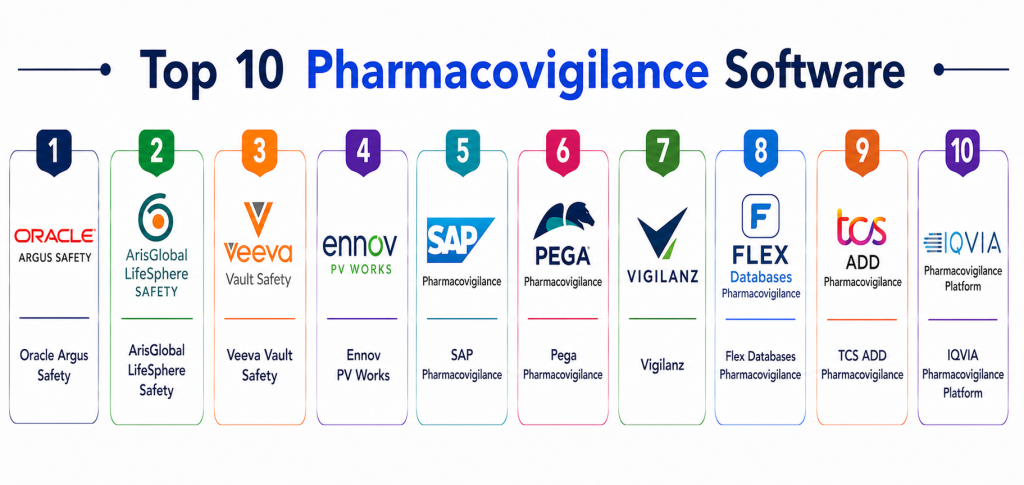
Top 10 Pharmacovigilance Software
#1 — Oracle Argus Safety
Short description: Oracle Argus Safety is an industry-leading pharmacovigilance platform designed for managing global drug safety data and regulatory compliance.
Key Features
- Case processing and reporting
- Signal detection
- Risk management
- Compliance workflows
- Global submission support
Pros
- Industry standard
- Highly scalable
- Strong compliance features
Cons
- Expensive
- Complex setup
- Steep learning curve
Platforms / Deployment
- Web
- Cloud On premise
Security & Compliance
- Audit trails, access control
- Not publicly stated
Integrations & Ecosystem
Integrates with Oracle clinical ecosystem and safety databases.
- APIs
- EDC systems
- Regulatory systems
Support & Community
Enterprise-grade support
#2 — ArisGlobal LifeSphere Safety
Short description: LifeSphere Safety provides end-to-end pharmacovigilance capabilities with advanced automation and analytics.
Key Features
- Case intake and processing
- Signal detection
- Risk management
- Regulatory reporting
- Analytics
Pros
- Strong automation
- Scalable
- Advanced analytics
Cons
- Complex
- Pricing
- Learning curve
Platforms / Deployment
- Web
- Cloud
Security & Compliance
- Not publicly stated
Integrations & Ecosystem
Supports integration with clinical systems.
- APIs
- Data tools
Support & Community
Enterprise support
#3 — Veeva Vault Safety
Short description: Veeva Vault Safety is a cloud-based pharmacovigilance platform offering unified safety data management and compliance tracking.
Key Features
- Case management
- Workflow automation
- Reporting
- Compliance tracking
- Integration
Pros
- Cloud-native
- Strong compliance
- Scalable
Cons
- Expensive
- Learning curve
- Setup effort
Platforms / Deployment
- Web
- Cloud
Security & Compliance
- Compliance-focused controls
- Not publicly stated
Integrations & Ecosystem
Integrates with Veeva ecosystem and clinical tools.
- APIs
- Clinical systems
Support & Community
Enterprise support
#4 — Ennov PV Works
Short description: Ennov PV Works is a pharmacovigilance solution focused on safety data management and compliance.
Key Features
- Case processing
- Signal detection
- Reporting
- Workflow automation
- Compliance
Pros
- Flexible
- Scalable
- Strong compliance
Cons
- Smaller ecosystem
- Pricing
- Setup effort
Platforms / Deployment
- Web
- Cloud
Security & Compliance
- Not publicly stated
Integrations & Ecosystem
Supports integrations with enterprise tools.
- APIs
- Data systems
Support & Community
Good support
#5 — SAP Pharmacovigilance
Short description: SAP Pharmacovigilance integrates safety data management with enterprise resource planning systems.
Key Features
- Safety data tracking
- Integration with ERP
- Reporting
- Compliance
- Analytics
Pros
- Enterprise integration
- Scalable
- Reliable
Cons
- Complex
- Expensive
- Requires SAP ecosystem
Platforms / Deployment
- Web
- Cloud On premise
Security & Compliance
- Not publicly stated
Integrations & Ecosystem
Integrates with SAP systems.
- APIs
- ERP
Support & Community
Enterprise support
#6 — Pega Pharmacovigilance
Short description: Pega offers pharmacovigilance solutions with strong workflow automation and case management capabilities.
Key Features
- Case management
- Workflow automation
- Reporting
- Analytics
- Compliance
Pros
- Strong automation
- Scalable
- Flexible
Cons
- Complex
- Pricing
- Learning curve
Platforms / Deployment
- Web
- Cloud
Security & Compliance
- Not publicly stated
Integrations & Ecosystem
Supports integration with enterprise systems.
- APIs
- Data tools
Support & Community
Enterprise support
#7 — VigiLanz
Short description: VigiLanz is a pharmacovigilance platform focused on real-time monitoring and clinical surveillance.
Key Features
- Real-time monitoring
- Data integration
- Reporting
- Alerts
- Analytics
Pros
- Real-time insights
- Easy to use
- Strong analytics
Cons
- Limited enterprise features
- Smaller ecosystem
- Pricing
Platforms / Deployment
- Web
- Cloud
Security & Compliance
- Not publicly stated
Integrations & Ecosystem
Supports integration with healthcare systems.
- APIs
- Data tools
Support & Community
Good support
#8 — Flex Databases PV
Short description: Flex Databases provides pharmacovigilance solutions with customizable workflows and reporting.
Key Features
- Case processing
- Reporting
- Workflow automation
- Compliance
- Integration
Pros
- Flexible
- Customizable
- Scalable
Cons
- Smaller ecosystem
- Limited documentation
- Pricing
Platforms / Deployment
- Web
- Cloud
Security & Compliance
- Not publicly stated
Integrations & Ecosystem
Supports integration via APIs.
- APIs
- Data tools
Support & Community
Growing support
#9 — TCS ADD Pharmacovigilance
Short description: TCS ADD provides pharmacovigilance solutions for managing safety data and compliance.
Key Features
- Case management
- Reporting
- Analytics
- Compliance
- Integration
Pros
- Enterprise-ready
- Scalable
- Reliable
Cons
- Complex
- Pricing
- Learning curve
Platforms / Deployment
- Web
- Cloud
Security & Compliance
- Not publicly stated
Integrations & Ecosystem
Supports enterprise integrations.
- APIs
- Systems
Support & Community
Enterprise support
#10 — IQVIA Pharmacovigilance Platform
Short description: IQVIA provides comprehensive pharmacovigilance solutions with strong analytics and global data integration.
Key Features
- Case processing
- Data analytics
- Reporting
- Compliance
- Integration
Pros
- Strong analytics
- Global reach
- Scalable
Cons
- Expensive
- Complex
- Learning curve
Platforms / Deployment
- Web
- Cloud
Security & Compliance
- Not publicly stated
Integrations & Ecosystem
Integrates with global healthcare systems.
- APIs
- Data platforms
Support & Community
Enterprise support
Comparison Table Top 10
| Tool Name | Best For | Platform Supported | Deployment | Standout Feature | Public Rating |
|---|---|---|---|---|---|
| Oracle Argus | Enterprise | Web | Cloud On premise | Industry standard | N/A |
| ArisGlobal | Automation | Web | Cloud | Signal detection | N/A |
| Veeva Vault | Compliance | Web | Cloud | Workflow automation | N/A |
| Ennov PV | Mid-market | Web | Cloud | Flexibility | N/A |
| SAP PV | Enterprise | Web | Cloud On premise | ERP integration | N/A |
| Pega PV | Automation | Web | Cloud | Workflow engine | N/A |
| VigiLanz | Monitoring | Web | Cloud | Real-time insights | N/A |
| Flex Databases | Custom workflows | Web | Cloud | Customization | N/A |
| TCS ADD | Enterprise | Web | Cloud | Scalability | N/A |
| IQVIA | Global trials | Web | Cloud | Data analytics | N/A |
Evaluation & Scoring of Pharmacovigilance Software
| Tool Name | Core | Ease | Integrations | Security | Performance | Support | Value | Weighted Total |
|---|---|---|---|---|---|---|---|---|
| Oracle Argus | 10 | 6 | 9 | 9 | 9 | 9 | 6 | 8.7 |
| ArisGlobal | 9 | 7 | 9 | 9 | 9 | 8 | 6 | 8.4 |
| Veeva Vault | 9 | 7 | 9 | 9 | 9 | 8 | 6 | 8.4 |
| Ennov PV | 8 | 7 | 8 | 8 | 8 | 7 | 7 | 7.9 |
| SAP PV | 9 | 6 | 9 | 9 | 9 | 8 | 6 | 8.3 |
| Pega PV | 8 | 7 | 8 | 8 | 8 | 7 | 7 | 7.8 |
| VigiLanz | 8 | 8 | 7 | 7 | 8 | 7 | 8 | 7.9 |
| Flex Databases | 7 | 8 | 7 | 7 | 7 | 7 | 8 | 7.5 |
| TCS ADD | 8 | 6 | 8 | 8 | 8 | 7 | 7 | 7.7 |
| IQVIA | 9 | 6 | 9 | 9 | 9 | 8 | 6 | 8.3 |
Scores are comparative and reflect capabilities in safety monitoring, compliance, and scalability.
Which Pharmacovigilance Software Is Right for You
Small Teams
Flex Databases or VigiLanz are simpler and affordable.
SMB
Ennov PV Works and Pega offer balanced features.
Mid-Market
ArisGlobal and IQVIA provide scalability.
Enterprise
Oracle Argus, SAP, and Veeva Vault are ideal.
Budget vs Premium
Flex Databases is budget-friendly, Oracle Argus is premium.
Feature Depth vs Ease of Use
Oracle for depth, VigiLanz for simplicity.
Integrations & Scalability
SAP and Veeva are strong options.
Security & Compliance Needs
Enterprise tools provide strongest compliance capabilities.
Frequently Asked Questions
1. What is pharmacovigilance software
It is software used to monitor and manage drug safety data. It helps detect adverse effects and ensure patient safety.
2. Why is pharmacovigilance important
It ensures drugs are safe for public use. It helps identify risks and prevent harmful effects.
3. How does pharmacovigilance software work
It collects safety data, analyzes it, and generates reports. It also detects signals and supports regulatory submissions.
4. Who uses pharmacovigilance software
Pharma companies, CROs, and regulatory agencies use it. It is also used in clinical research and healthcare.
5. What features are most important
Key features include adverse event reporting, signal detection, and compliance workflows. These ensure safety monitoring.
6. Is pharmacovigilance software expensive
Enterprise tools are expensive, while smaller solutions are more affordable. Pricing depends on scale and features.
7. Does it integrate with clinical systems
Yes, most tools integrate with EDC, CTMS, and regulatory systems. This improves workflow efficiency.
8. How long does implementation take
Implementation can take weeks to months depending on complexity.
9. Are these systems secure
Most systems provide audit trails and access control. Compliance varies by provider.
10. Are there alternatives
Manual systems or spreadsheets exist, but they lack scalability and compliance features.
Conclusion
Pharmacovigilance software plays a critical role in ensuring drug safety, regulatory compliance, and patient protection across the pharmaceutical lifecycle. These platforms enable organizations to efficiently manage adverse event data, detect safety signals, and respond proactively to potential risks. From flexible solutions like VigiLanz and Flex Databases to enterprise-grade platforms like Oracle Argus and Veeva Vault Safety, each tool offers unique capabilities depending on scale and complexity. The best choice depends on factors such as regulatory requirements, integration needs, and operational scale rather than a one-size-fits-all solution. Organizations should prioritize compliance, automation, and analytics when selecting a platform. A practical next step is to shortlist a few tools, conduct pilot implementations, and evaluate how well they align with your pharmacovigilance workflows and long-term safety objectives.
Great content. These tools clearly show how technology is improving compliance, monitoring, and healthcare outcomes 👍