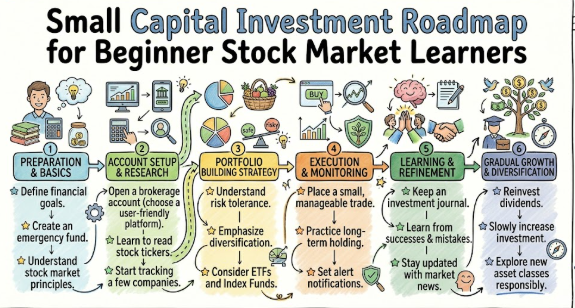
Introduction
Stepping into the world of shares, stock exchanges, and market charts can feel incredibly overwhelming for a beginner. If you are a salaried professional looking to build long-term wealth, a student eager to learn financial basics, or a first-time investor trying to understand how money grows, you have likely faced conflicting advice. You might hear stories of individuals making massive returns alongside warnings of sudden market drops. This mixed messaging creates confusion, leaving many beginners wondering whether equity investment in India is a reliable wealth-building tool or a high-risk gamble.
The truth lies in understanding that stock market investing in India is a systematic process rooted in business growth, research, and discipline rather than luck. Over the long term, investing in equity can be suitable for long-term goals like buying a home, funding higher education, or building a retirement corpus. However, navigating this space successfully requires a solid foundation.
This comprehensive guide is designed to break down complex financial concepts into simple language. By reading this Beginner’s Guide to Stock Market Investing in India, you will learn how the Indian stock market functions, how to set up your investment infrastructure safely, how to evaluate companies responsibly, and how to manage risks effectively.
1. What Is Stock Market Investing?
In simple words, stock market investing is the process of buying fractional ownership in a publicly listed company. When a business wants to expand, develop new products, or clear existing debts, it may raise capital from the general public by listing its shares on a stock exchange.
When you purchase a share, you become a part-owner of that company. If the company performs well, expands its operations, and increases its profitability over time, the market value of your shares may rise. Furthermore, some profitable companies choose to distribute a portion of their earnings back to shareholders in the form of dividends.
However, it is crucial for a beginner to understand that investing is completely distinct from gambling. Gambling relies entirely on chance, with an immediate, binary outcome where one party wins and another loses. On the other hand, stock market investing in India focuses on supporting actual businesses that produce goods, provide services, employ people, and generate revenue. Because businesses experience operational cycles, investing requires deep research, consistent monitoring, and long-term patience. Stock prices fluctuate daily based on various factors, meaning returns are not guaranteed and capital loss is possible if decisions are rushed or unresearched.
2. How the Stock Market Works in India
The Indian financial system is highly structured and regulated to protect the interests of retail investors. To grasp the stock market for beginners, you must understand the key entities that make transactions possible.
- Stock Exchanges: India has two primary stock exchanges where shares are actively bought and sold: the National Stock Exchange (NSE) and the Bombay Stock Exchange (BSE). These exchanges act as organized marketplaces that bring buyers and sellers together.
- Listed Companies: These are corporations that have met the strict regulatory requirements to make their shares available for public trading.
- The Role of Brokers: Individual investors cannot interact directly with stock exchanges. Therefore, you must use an intermediary known as a stockbroker. Brokers offer online platforms to execute buy and sell orders.
- Demat and Trading Accounts: When you purchase shares, they must be stored in a digital safehouse called a Demat account. The actual process of placing a buy or sell order occurs through your Trading account.
- Demand and Supply Dynamics: The market price of a stock moves based on basic economics. If a company announces excellent earnings, more investors will want to buy the stock (high demand), causing the price to rise. Conversely, if a sector faces regulatory hurdles, more investors might want to sell (high supply), causing the price to fall.
- Market Regulator: The entire ecosystem is strictly monitored by the Securities and Exchange Board of India (SEBI). SEBI establishes rules to prevent fraudulent practices, ensure market transparency, and safeguard the capital of ordinary investors.
3. Basic Stock Market Terms Beginners Should Know
Before deploying your hard-earned money, it helps to understand the fundamental language used by market participants. Below is a foundational breakdown of key Indian stock market basics.
| Term | Simple Meaning | Why It Matters for Beginners |
| Share | Small ownership unit in a company | Helps you understand what you are buying |
| Demat Account | Account that holds shares digitally | Needed to store shares electronically |
| Trading Account | Account used to buy and sell shares | Helps place stock market orders |
| Brokerage | Fee charged by broker | Affects investment cost |
| Portfolio | Collection of investments | Helps track overall investments |
| Risk | Possibility of loss or uncertainty | Important before investing money |
| Diversification | Spreading money across investments | Helps reduce concentration risk |
4. Difference Between Investing and Trading
One of the most vital concepts in a beginner stock market guide is differentiating between long-term investing and short-term trading. Mixing up these two approaches often leads to severe financial frustration.
Long-Term Investing
Investing is a marathon focused on the long-term fundamentals of a business. An investor looks at a company’s financial health, product demand, and competitive advantages, intending to hold the shares for multiple years. This approach relies on compounding and business growth. Because it focuses on underlying economic performance rather than daily price noise, long-term investing in stocks can be suitable for long-term goals and is generally less stress-inducing for beginners.
Short-Term Trading
Trading is a sprint that focuses primarily on short-term price movements, technical charts, and market sentiment. Traders buy and sell stocks within days, hours, or even minutes to capture small, quick price differences. Trading requires continuous market tracking, technical analysis expertise, and an incredibly high risk tolerance.
For the vast majority of beginners, focusing on fundamental investing is a safer path to learning market mechanics, as trading without deep technical knowledge can lead to swift capital loss.
5. Why Beginners Should Learn Before Investing
Many people enter the stock market hoping to generate immediate profits, often influenced by selective success stories on social media. However, jumping in without education is highly risky.
- Avoiding Emotional Pitfalls: When the market drops, untrained investors often panic and sell their shares at a loss. Learning how market cycles operate helps you maintain discipline during sudden corrections.
- Filtering Out Noise: The financial world is full of unverified “hot stock tips” on messaging apps and social media. Educational grounding allows you to evaluate companies objectively instead of following the crowd blindly.
- Understanding Risk vs. Reward: Every investment carries some level of risk. By educating yourself, you learn to identify whether a potential investment fits your specific risk tolerance and financial capacity.
- Interpreting Basic Financials: You do not need a degree in finance, but knowing how to read a basic profit-and-loss statement ensures you buy shares in sustainable, cash-generating businesses rather than speculative shell companies.
6. Requirements to Start Stock Market Investing in India
Setting up your investment infrastructure in India is highly streamlined and completely digital. To open your trading credentials, you need to gather specific documents and understand how to invest in stocks in India securely.
- Permanent Account Number (PAN) Card: This is mandatory for all financial transactions in India, ensuring your capital gains and investments are tracked accurately for taxation purposes.
- Aadhaar Card or Valid ID Proof: Your Aadhaar card, voter ID, or passport is required to complete the digital Know Your Customer (KYC) identity verification process.
- Active Bank Account: You must link a regular savings or current bank account to transfer funds into your trading account to buy shares.
- Demat and Trading Account for Beginners: You will need to select a SEBI-registered broker to open a combined Demat and Trading account. Ensure you compare account maintenance charges and brokerage fees before selecting a partner.
- Linked Mobile Number and Email: Access to the phone number linked with your Aadhaar card is critical to sign application forms digitally via secure One-Time Passwords (OTPs).
- Clear Financial Goal and Risk Awareness: Beyond physical documents, you must entry the market with a defined time horizon, clear goals, and an absolute acceptance that equity markets carry inherent volatility.
7. Step-by-Step Process to Start Investing in Stocks
Once your documents are ready, follow this sequential roadmap to make your very first investment responsibly.
- Learn Basic Stock Market Concepts: Dedicate time to understanding stock market terminology, sector categories, and general economic indicators.
- Define Your Financial Goal: Clearly outline what you are investing for—whether it is a long-term corpus for higher education, a down payment for property, or retirement planning.
- Understand Your Risk Tolerance: Evaluate how much market volatility you can comfortably handle without panicking or experiencing emotional distress.
- Open a Demat and Trading Account: Choose a reputable broker, submit your KYC documents online, and verify your bank account details.
- Start with a Small Amount: Never invest a massive lump sum initially. Begin with a nominal amount that you can comfortably afford to lose while you learn the user interface of your platform.
- Research Companies Before Investing: Look into stable, well-known sectors and analyze individual business revenues, product utility, and market reputation.
- Avoid Tips and Rumors: Treat anonymous recommendations with extreme skepticism. Rely purely on verifiable financial data and personal research.
- Diversify Your Investments: Avoid allocating all your capital into a single stock or sector. Spread your money across distinct industries to buffer against unexpected downturns.
- Track Your Portfolio Regularly: Set up a monthly or quarterly schedule to review how your companies are performing financially. Avoid checking stock charts multiple times a day.
- Stay Invested with Patience: Wealth building takes time. Give your chosen companies room to grow through changing economic environments.
- Review Your Goals Periodically: Ensure your investment strategy remains aligned with your changing life stages, income adjustments, and overall liabilities.
- Take Expert Guidance if Needed: If managing individual stock portfolios feels too complex, seek counsel from a registered financial advisor or consider professional equity mutual funds.
8. How to Choose Stocks as a Beginner
Selecting your initial stocks requires an objective, analytical approach rather than guesswork. Focus heavily on fundamental stability.
Analyze the Underlying Business
Invest only in businesses whose products or services you personally understand. For example, if you see a company dominating the consumer goods, automobile, or banking sector with high public utility, it serves as a practical starting point for fundamental research.
Check Revenue and Profit Trends
Look at the company’s historical financial performance over the past 3 to 5 years. A healthy, growing company will demonstrate a stable or upward trend in both total revenues and net profits. Avoid companies showing erratic, unexplained losses.
Examine Debt Levels
High debt can cripple a business during economic downturns because interest obligations must be paid regardless of profit margins. Look for companies with manageable debt-to-equity ratios. Companies with zero or very low debt generally provide a safer cushion for beginner portfolios.
Study Management Quality and Industry Position
Ensure the company is run by a reputable management team with no history of corporate governance issues or legal fraud. Moreover, check if the business possesses a competitive advantage, often called an economic “moat,” which allows it to maintain profitability ahead of its competitors. Avoid buying a stock simply because its share price is low; focus strictly on long-term business fundamentals.
9. How Much Money Is Needed to Start Investing?
A common myth among first-time investors is that you need a fortune to participate in equity investment in India. In reality, you can start with a very small amount. Because fractional shares do not exist in India, the minimum investment is simply the market price of a single share of your chosen company. This means you can begin your journey with as little as 100 to 500 Rupees.
The exact amount you should invest depends entirely on your disposable income, monthly expenses, near-term goals, and personal risk appetite. However, a golden rule of personal finance is to never invest your emergency fund in the stock market. Equity markets can be volatile in the short term, and if you face a medical or professional emergency during a market correction, you might be forced to liquidate your shares at a loss.
Furthermore, you must completely avoid borrowing money, taking personal loans, or using credit card funds to invest. Start small, understand how the system works, and gradually scale your monthly allocations as your confidence and knowledge expand.
10. Real-Life Example: First-Time Investor in India
Let us look at a realistic scenario to understand how a beginner can plan their investment journey systematically.
Scenario Profile
Consider Rohan, a 26-year-old salaried software professional living in Bengaluru. Rohan earns a net monthly salary of 60,000 Rupees. After calculating his mandatory expenses—such as house rent, utilities, groceries, and insurance premiums—he spends roughly 40,000 Rupees each month. This leaves him with a disposable surplus of 20,000 Rupees.
Step-by-Step Capital Allocation
- Emergency Fund Setup: Before putting a single rupee into equity shares, Rohan builds a liquid emergency fund equal to six months of his living expenses (2,40,000 Rupees) and stores it safely in a high-yield savings account or a liquid fixed deposit.
- Determining the Investment Budget: Out of his remaining 20,000 Rupees monthly surplus, Rohan decides that he can comfortably allocate 5,000 Rupees toward long-term stock market investing without impacting his daily life.
- Portfolio Diversification Strategy: Instead of buying shares of just one company, Rohan decides to split his 5,000 Rupees allocation evenly across three distinct sectors:
- Consumer Goods Sector: 1,500 Rupees in an established FMCG brand.
- Banking Sector: 1,500 Rupees in a leading private sector bank.
- Technology Sector: 2,000 Rupees in a stable IT services provider.
11. Risks of Stock Market Investing
A responsible stock investing tips for beginners guide must shed light on the potential downsides of equity investing. Being aware of risks prevents panicked decisions.
- Market Risk: This refers to the general volatility of the entire financial system. Economic recessions, geopolitical tensions, or changes in global interest rates can cause the entire stock market to decline, impacting even highly stable companies.
- Company-Specific Risk: If a company faces a product recall, internal management fraud, or poor quarterly earnings, its individual stock price can plummet independently of the broader market index.
- Sector Risk: This occurs when an entire industry faces structural headwinds. For example, sudden changes in government export policies can hurt all automobile or pharmaceutical companies simultaneously.
- Liquidity Risk: Some smaller, low-volume companies (often called penny stocks) suffer from poor liquidity. This means that if you want to sell your shares quickly, you might not find a buyer at your desired price.
- Emotional Risk and Capital Loss: The psychological urge to overreact to daily price movements can cause investors to buy at market peaks due to greed (FOMO) or sell at market bottoms due to fear. Always remember that stock prices fluctuate, returns are never guaranteed, and loss of initial capital is an inherent reality of the market.
12. Beginner Stock Investing Checklist
Before deploying capital into any public enterprise, run your investment plan through this structured checklist to ensure you are entering the market with maximum preparedness.
| Checklist Point | Status |
| Investment goal defined | Yes/No |
| Emergency fund kept separate | Yes/No |
| Demat and trading account opened | Yes/No |
| Risk tolerance understood | Yes/No |
| Company research done | Yes/No |
| Portfolio diversified | Yes/No |
| Investment amount affordable | Yes/No |
| Long-term plan reviewed | Yes/No |
13. Common Mistakes Beginners Make in Stock Market Investing
Learning from the errors of past investors can save you from significant financial setbacks. Here are twelve widespread mistakes to avoid actively:
- Investing Without Learning Basics: Allocating funds without understanding terms like market cap, P/E ratio, or dividend yield.
- Following Random Tips: Acting on unverified advice from friends, relatives, or sensational social media channels.
- Buying Stocks Only Because They Are Cheap: Purchasing penny stocks priced at 2 Rupees, assuming they will easily grow to 200 Rupees, without evaluating underlying business value.
- Investing Emergency Money: Deploying funds needed for monthly survival, rent, or medical emergencies into volatile stock accounts.
- Expecting Quick Profits: Treating the stock market as a get-rich-quick scheme rather than a long-term compounder.
- Panic Selling During Market Corrections: Liquidating high-quality stocks during temporary economic downturns when prices drop red across the board.
- Not Diversifying: Allocating 100 percent of your capital into a single stock or one thematic industry sector.
- Ignoring Company Fundamentals: Buying shares of businesses that show consecutive financial losses and rising debt burdens.
- Trading Without Risk Management: Attempting intraday trading or derivatives trading without strict stop-loss protocols or formal training.
- Borrowing Money to Invest: Taking high-interest personal loans to trade or buy stocks, risking compound debt.
- Not Reviewing the Portfolio: Leaving your investments completely unmonitored for years without checking structural shifts in business models.
- Investing Based on Pure Emotions: Letting greed drive purchases at market peaks and fear drive sales during market corrections.
14. Practical Tips for Beginner Investors
To cultivate a resilient, sustainable wealth-building journey, embed these everyday principles into your operational strategy:
- Start Small and Scale Gradually: Begin with minimal capital to get comfortable with digital platforms, order executions, and price fluctuations before raising your stakes.
- Prioritize Learning Over Earning Initially: Spend your first few months focusing on understanding business models, annual reports, and macroeconomics.
- Embrace a Long-Term Horizon: Give your equity portfolio a minimum time frame of 5 to 7 years, allowing compounding interest to work effectively.
- Automate Your Investments: Consider setting up systematic monthly allocations to invest a fixed amount regularly, which helps average out your purchase costs over time.
- Keep Asset Allocations Balanced: Ensure your overall net worth is balanced across diversified baskets like fixed deposits, gold, mutual funds, and individual equities based on your life goals.
15. When Should Beginners Take Professional Help?
While managing your own investments can be incredibly educational, there are specific situations where seeking qualified financial help is the most responsible course of action.
- You Struggle to Understand Risk: If the thought of price fluctuations causes you deep emotional stress or insomnia, a certified financial planner can guide you toward safer, more suitable asset classes.
- You Plan to Deploy a Large Lump Sum: If you receive a large inheritance, a corporate bonus, or retirement gratuity funds, professional assistance helps protect against costly entry errors.
- You Face Complex Financial Goals: When trying to manage multiple high-priority goals simultaneously—such as funding a child’s international education, clearing an active home loan, and building a retirement nest egg.
- You Face Severe Time Constraints: If your professional career or business leaves you with absolutely zero hours to read company annual reports, track balance sheets, or monitor macroeconomic changes, relying on professionally managed Mutual Funds, ETFs, or SEBI-registered Investment Advisers ensures your money is handled with proper oversight.
16. Frequently Asked Questions
1. What is stock market investing for beginners in India?
Answer. It is the structured process where first-time retail investors buy partial ownership shares of publicly listed companies through registered stock exchanges to build long-term wealth as the underlying businesses grow.
2. How can a beginner start investing in stocks in India?
Answer. A beginner can start by choosing a SEBI-registered broker, opening a combined Demat and Trading account online with valid KYC documents (PAN and Aadhaar), linking a bank account, and purchasing shares of fundamentally strong businesses.
3. What is the minimum amount needed to start stock market investing in India?
Answer. There is no official legal minimum limit. You can start investing with the price of a single share of any listed company, which means you can begin your investing journey with as little as 100 to 500 Rupees.
4. Is stock market investing safe for beginners, or can I lose money?
Answer. Stock investments carry inherent market risks, and returns are never guaranteed. While investing in fundamentally strong companies over the long term can mitigate volatility, short-term price drops can lead to capital loss if choices are unresearched.
5. What is the difference between a Demat account and a Trading account?
Answer. A Trading account is used as the transactional platform to execute buy and sell orders on the exchange, whereas a Demat account acts as a secure digital vault that holds your purchased shares electronically.
6. How do I choose the best stocks to buy as a beginner?
Answer. Focus on well-established, highly transparent companies whose businesses you easily understand. Look for consistent profit growth over 5 years, low debt-to-equity levels, strong management reputations, and stable competitive market advantages.
7. Why is long-term investing in stocks recommended over short-term trading?
Answer. Long-term investing relies on the actual profit growth of businesses and benefits from compounding, making it less risky and less stressful for beginners compared to short-term trading, which requires complex technical analysis and high speed.
8. What is diversification, and why is it important for beginner stock market guides?
Answer. Diversification means spreading your investment capital across multiple distinct sectors and companies rather than just one. This ensures that if one specific sector faces an economic downturn, the stability of your other holdings can help buffer the impact.
9. Can I withdraw my invested money from the Indian stock market at any time?
Answer. Yes, under normal trading days and market hours, you can sell your listed shares instantly. Once the transaction settles, which usually takes one to two business days, the funds can be transferred directly to your linked savings bank account.
10. What is the single biggest mistake first-time investors should avoid?
Answer. The biggest mistake is investing hard-earned capital based on unverified “hot tips” or viral social media rumors without performing personal research, which often leads to emotional panic selling during temporary market corrections.
17. Conclusion
Mastering the fundamentals outlined in this Beginner’s Guide to Stock Market Investing in India can help turn what seems like a confusing market into a practical framework for building long-term wealth. While equity investments carry inherent market risks and capital returns can never be fully guaranteed, approaching the market with a long-term mindset, regular research, and strong diversification can help you stay resilient through market cycles.
Always remember that successful investing is a continuous process of learning and staying disciplined. Avoid the traps of short-term greed, keep your emergency funds completely separate, and base your choices on real business numbers rather than hype.
think beginner roadmaps should discuss portfolio tracking habits more deeply. Maintaining a simple investment journal helps small investors learn faster than constantly switching strategies.
One thing I noticed is brokerage charges can impact small investments. It would be useful to explain cost optimization.