Introduction
Data Masking and Tokenization Tools help organizations protect sensitive data by replacing real values with safe, hidden, encrypted, randomized, anonymized, or tokenized alternatives. These tools are commonly used to protect personal data, financial data, health data, customer records, employee data, payment information, production databases, analytics datasets, and AI training data.
Data masking keeps data usable while hiding sensitive values. Tokenization replaces sensitive values with tokens that can be mapped back only through controlled systems. Together, these methods help teams reduce privacy risk, protect production data, secure test environments, enable safer analytics, and support compliance needs.
Real-world use cases include:
- Masking production data before using it in development and testing
- Tokenizing payment and customer identifiers
- Protecting PII in analytics and AI pipelines
- Sharing datasets safely with partners or vendors
- Reducing exposure in databases, warehouses, and cloud platforms
Buyers evaluating Data Masking and Tokenization Tools should consider:
- Static and dynamic masking support
- Tokenization and encryption options
- Structured and unstructured data coverage
- Referential integrity preservation
- Cloud data warehouse compatibility
- DevOps and test data management support
- Policy-based access controls
- Audit logs and compliance reporting
- API and automation support
- Performance at enterprise scale
Best for: Security teams, privacy teams, compliance teams, DevOps teams, data engineering teams, database administrators, AI teams, financial services, healthcare organizations, SaaS companies, and enterprises handling sensitive production data.
Not ideal for: Very small teams with limited sensitive data, projects that only require manual redaction, or organizations without formal data governance, test data, privacy, or compliance workflows.
Key Trends in Data Masking and Tokenization Tools
- AI and analytics teams increasingly need privacy-safe datasets for model training, testing, and experimentation.
- Dynamic masking is becoming more important because users need different views of the same dataset based on role and policy.
- Tokenization is gaining importance for protecting customer, payment, and regulated data while preserving business utility.
- Cloud-native masking is becoming essential for warehouses such as Snowflake, BigQuery, Redshift, and Databricks.
- Synthetic data generation is becoming closely connected with data masking for safer development and AI workflows.
- Enterprises are prioritizing referential integrity so masked datasets still behave like production data.
- Data protection is shifting from one-time masking jobs toward policy-driven controls across production, non-production, analytics, and AI systems.
- Unstructured data masking is growing because sensitive data often lives in files, PDFs, documents, logs, and support tickets.
- Privacy engineering teams are combining masking, tokenization, anonymization, encryption, and access control into unified data protection programs.
- Auditability is becoming critical so teams can prove how sensitive data was protected, who accessed it, and where it was shared.
How We Selected These Tools
The tools in this list were selected based on masking depth, tokenization support, enterprise adoption, cloud compatibility, privacy workflow coverage, security controls, and practical usefulness across development, analytics, compliance, and AI workflows.
Selection criteria included:
- Static and dynamic data masking capabilities
- Tokenization and encryption support
- Database, warehouse, and application coverage
- Ability to preserve data relationships
- Test data management and DevOps integration
- Cloud and hybrid deployment flexibility
- Security, access control, and audit features
- Support for PII, PCI, PHI, and sensitive enterprise data
- Automation, APIs, and workflow integration
- Practical fit for enterprises, SaaS teams, and regulated industries
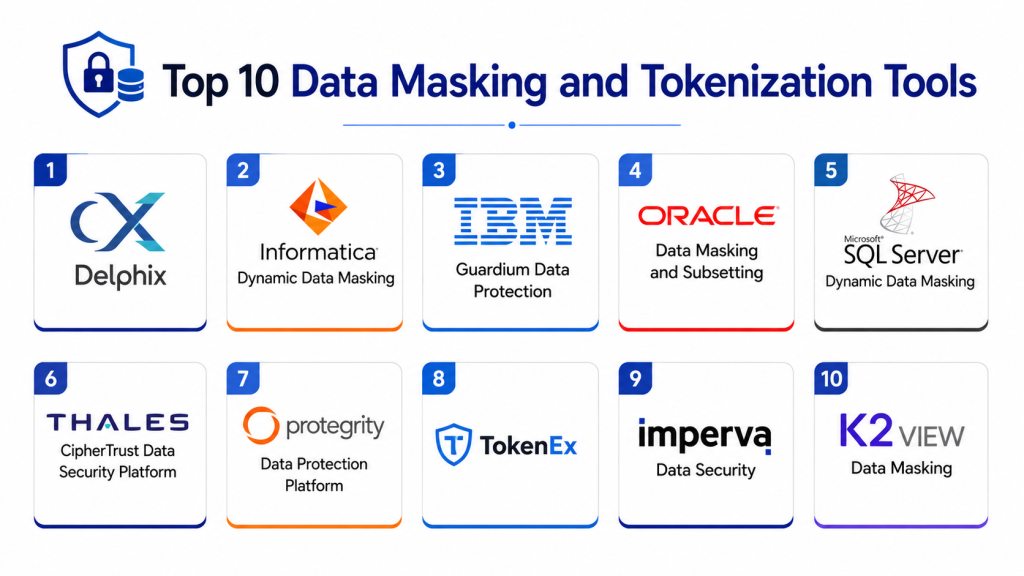
Top 10 Data Masking and Tokenization Tools
1- Protegrity
Short description: Protegrity is an enterprise data protection platform focused on tokenization, encryption, masking, anonymization, and policy-based data protection across cloud, analytics, AI, and enterprise data environments. Its platform emphasizes data-level protection that can follow sensitive data across different systems and workflows. Protegrity states that its protection service supports tokenization, encryption, masking, anonymization, and role-based masking for sensitive fields.
Key Features
- Data tokenization
- Field-level masking
- Encryption and de-identification
- Role-based data protection
- Policy-based enforcement
- Cloud data platform support
- AI and analytics data protection workflows
Pros
- Strong enterprise-grade data protection coverage
- Useful for tokenization-heavy security programs
- Good fit for analytics, AI, and regulated data workflows
Cons
- Enterprise implementation can require planning
- May be more than smaller teams need
- Advanced policy design requires data governance maturity
Platforms / Deployment
- Enterprise data platforms / Cloud warehouses / APIs
- Cloud / Self-hosted / Hybrid options vary
Security & Compliance
- Tokenization
- Encryption
- Masking
- Role-based protection
- Policy enforcement
- Audit and governance capabilities vary by deployment
Integrations & Ecosystem
Protegrity is designed to protect data across enterprise data stacks, analytics environments, and AI workflows. It is a strong option when organizations need consistent protection across many systems rather than only test data masking.
- Cloud data warehouses
- Analytics platforms
- AI pipelines
- Enterprise databases
- Data governance workflows
- API-based data protection
Support & Community
Enterprise support, implementation resources, documentation, and data protection guidance are available through Protegrity and its partner ecosystem.
2- Delphix
Short description: Delphix is a data masking and test data management platform used by enterprises to protect production data before it is used in development, testing, analytics, and DevOps workflows. It is well suited for organizations that need realistic masked datasets while reducing risk in non-production environments.
Key Features
- Static data masking
- Test data management
- Data virtualization support
- DevOps workflow integration
- Sensitive data protection
- Database masking automation
- Non-production data security
Pros
- Strong fit for DevOps and test data workflows
- Useful for protecting production copies
- Good for regulated enterprises with many application environments
Cons
- Primarily strongest in non-production data workflows
- Enterprise setup can be complex
- Advanced use cases may require governance planning
Platforms / Deployment
- Enterprise databases / DevOps environments
- Cloud / Self-hosted / Hybrid options vary
Security & Compliance
- Data masking
- Access controls
- Audit workflows
- Encryption support varies by deployment
- Compliance support varies by environment
Integrations & Ecosystem
Delphix is commonly used with enterprise databases, application testing environments, and DevOps release workflows.
- Oracle
- SQL Server
- PostgreSQL
- DevOps pipelines
- Test environments
- Enterprise applications
Support & Community
Enterprise support, implementation services, documentation, and partner resources are available.
3- Informatica Data Masking
Short description: Informatica Data Masking helps organizations protect sensitive data by applying masking policies across databases, applications, and enterprise data environments. It is often used by large organizations with broader Informatica data management, governance, and integration programs.
Key Features
- Static data masking
- Persistent masking
- Sensitive data discovery support
- Rule-based masking
- Data privacy workflows
- Enterprise data integration
- Policy-based controls
Pros
- Strong enterprise data management ecosystem
- Good fit for large data governance programs
- Useful for regulated and complex data environments
Cons
- Enterprise licensing and setup can be complex
- Smaller teams may find it heavy
- Advanced configuration requires technical expertise
Platforms / Deployment
- Enterprise databases / Cloud data environments
- Cloud / Self-hosted / Hybrid options vary
Security & Compliance
- RBAC
- Encryption support
- Audit logging
- Data privacy controls
- Governance features vary by deployment
Integrations & Ecosystem
Informatica integrates well with broader data integration, metadata, and governance workflows.
- Databases
- Data warehouses
- Cloud platforms
- Data governance tools
- ETL and integration pipelines
- Enterprise applications
Support & Community
Strong enterprise support ecosystem, implementation partners, documentation, and professional services are available.
4- IBM InfoSphere Optim Data Privacy
Short description: IBM InfoSphere Optim Data Privacy is an enterprise data masking solution used to protect sensitive information in non-production and test environments. K2View’s overview identifies IBM Optim as a tool for realistic data masking in development and testing environments, especially for regulated industries.
Key Features
- Data masking for test environments
- Sensitive data protection
- Data subsetting support
- Enterprise database coverage
- Rule-based masking
- Test data privacy workflows
- IBM ecosystem alignment
Pros
- Strong fit for large enterprise environments
- Useful for legacy and regulated systems
- Good for test data privacy programs
Cons
- Interface and workflows may feel older than newer tools
- Best suited for organizations with IBM ecosystem experience
- Modern cloud-native workflows may require planning
Platforms / Deployment
- Enterprise databases / Mainframe and distributed environments
- Self-hosted / Hybrid options vary
Security & Compliance
- Masking controls
- Access governance
- Audit support
- Enterprise security features vary by deployment
Integrations & Ecosystem
IBM Optim fits organizations with traditional enterprise systems, complex databases, and regulated data privacy needs.
- IBM data platforms
- Enterprise databases
- Test environments
- Compliance workflows
- Application development systems
- Legacy data environments
Support & Community
IBM provides enterprise support, documentation, consulting resources, and partner implementation services.
5- Tonic.ai
Short description: Tonic.ai provides data de-identification, synthetic data generation, and test data tools that help developers and data teams create realistic, privacy-safe datasets. Its Textual product is positioned for de-identifying unstructured enterprise data such as documents, spreadsheets, text files, images, and related formats.
Key Features
- Data de-identification
- Synthetic data generation
- Test data creation
- Structured and unstructured data support
- Subsetting workflows
- Developer-friendly interface
- Cloud and self-hosted options
Pros
- Strong developer experience
- Useful for realistic test data generation
- Good fit for modern engineering and AI teams
Cons
- Broader enterprise governance may require integrations
- Complex enterprise datasets require configuration
- Tokenization-focused requirements may need careful review
Platforms / Deployment
- Web / Databases / Cloud storage / Developer workflows
- Cloud / Self-hosted / Hybrid options vary
Security & Compliance
- Access controls
- De-identification
- Data masking
- Deployment controls vary
- Audit features vary by plan
Integrations & Ecosystem
Tonic.ai fits teams that need to create realistic but safe development, testing, and AI datasets.
- Databases
- Snowflake
- Databricks
- Cloud storage
- Developer workflows
- AI data preparation pipelines
Support & Community
Tonic.ai provides documentation, support resources, onboarding, and developer-focused guidance.
6- K2View Data Masking
Short description: K2View Data Masking is an enterprise data masking solution focused on protecting data across complex enterprise systems while preserving business entity relationships. K2View describes its approach as entity-based masking with capabilities such as PII discovery and synthetic data generation.
Key Features
- Entity-based data masking
- PII discovery support
- Synthetic data generation
- Referential integrity preservation
- Enterprise data source coverage
- Test data management support
- High-scale masking workflows
Pros
- Strong fit for complex enterprise data relationships
- Useful for preserving business context
- Good option for large distributed data environments
Cons
- Setup can require careful data modeling
- Less simple for small teams
- Advanced configuration may require expert support
Platforms / Deployment
- Enterprise databases / Cloud and hybrid data systems
- Cloud / Self-hosted / Hybrid options vary
Security & Compliance
- Data masking
- PII discovery
- Access controls
- Audit and governance capabilities vary by deployment
Integrations & Ecosystem
K2View is designed for enterprise data architectures where customer, account, or business entity relationships must remain consistent after masking.
- Enterprise databases
- CRM systems
- Data warehouses
- Test environments
- Data governance workflows
- Application development pipelines
Support & Community
Enterprise support, implementation assistance, documentation, and consulting resources are available.
7- Broadcom Test Data Manager
Short description: Broadcom Test Data Manager helps organizations create, mask, subset, and manage test data for application development and quality assurance workflows. It is useful for enterprises that need compliant test data across complex application environments.
Key Features
- Test data masking
- Data subsetting
- Synthetic test data generation
- Test data provisioning
- Mainframe and enterprise system support
- DevOps integration
- Data privacy controls
Pros
- Strong test data management focus
- Useful for enterprise QA and DevOps teams
- Good fit for complex legacy environments
Cons
- Enterprise setup may be complex
- Less focused on modern AI-specific workflows
- Best value comes with large test data programs
Platforms / Deployment
- Enterprise databases / Mainframe / Test environments
- Cloud / Self-hosted / Hybrid options vary
Security & Compliance
- Masking controls
- Access control support
- Audit workflows
- Compliance features vary by deployment
Integrations & Ecosystem
Broadcom Test Data Manager fits enterprises with mature testing, QA, and software delivery pipelines.
- Mainframe systems
- Databases
- DevOps tools
- QA platforms
- Enterprise applications
- Test environments
Support & Community
Broadcom provides enterprise support, documentation, professional services, and partner resources.
8- Oracle Data Masking and Subsetting
Short description: Oracle Data Masking and Subsetting helps organizations protect sensitive data inside Oracle database environments by masking production data before it is shared with development, testing, or partner teams. It is best suited for Oracle-heavy enterprises.
Key Features
- Oracle database masking
- Data subsetting
- Sensitive data protection
- Application testing support
- Referential integrity preservation
- Policy-driven masking
- Oracle ecosystem integration
Pros
- Strong fit for Oracle database environments
- Useful for development and testing workflows
- Good data subsetting support
Cons
- Best suited for Oracle-centric environments
- Limited flexibility outside Oracle ecosystems
- Requires database administration expertise
Platforms / Deployment
- Oracle Database / Enterprise database environments
- Cloud / Self-hosted / Hybrid options vary
Security & Compliance
- Database access controls
- Masking policies
- Audit support through Oracle ecosystem
- Encryption and security depend on Oracle configuration
Integrations & Ecosystem
Oracle Data Masking and Subsetting integrates naturally with Oracle database administration, development, and testing workflows.
- Oracle Database
- Oracle Enterprise Manager
- Test environments
- Application development workflows
- Data governance processes
- Enterprise systems
Support & Community
Oracle provides enterprise support, documentation, consulting services, and partner implementation resources.
9- Thales CipherTrust Data Security Platform
Short description: Thales CipherTrust Data Security Platform provides encryption, key management, tokenization, and data protection controls for enterprise environments. It is useful for organizations that need strong cryptographic controls and centralized protection for sensitive data.
Key Features
- Data tokenization
- Encryption
- Key management
- Access policy controls
- Sensitive data protection
- Cloud and enterprise data security
- Centralized security management
Pros
- Strong encryption and tokenization focus
- Good fit for regulated industries
- Useful for centralized enterprise data security
Cons
- Requires security architecture expertise
- May be more infrastructure-focused than test data-focused
- Advanced deployments need planning
Platforms / Deployment
- Enterprise infrastructure / Cloud data environments
- Cloud / Self-hosted / Hybrid options vary
Security & Compliance
- Tokenization
- Encryption
- Key management
- Access controls
- Audit logging
- Compliance support varies by deployment
Integrations & Ecosystem
Thales CipherTrust fits organizations that need strong cryptographic protection for sensitive enterprise data.
- Databases
- Cloud platforms
- Storage systems
- Key management workflows
- Security operations
- Compliance programs
Support & Community
Thales provides enterprise support, implementation guidance, security documentation, and partner services.
10- Immuta
Short description: Immuta is a data access governance platform that helps organizations enforce policies such as masking, row-level controls, purpose-based access, and privacy-aware data usage across cloud data platforms. It is useful when masking must be tied to access governance rather than only static data transformation.
Key Features
- Dynamic data masking
- Attribute-based access control
- Policy-based data governance
- Row-level and column-level controls
- Cloud data platform integration
- Audit and monitoring
- Data usage governance
Pros
- Strong dynamic policy enforcement
- Good fit for cloud analytics environments
- Useful for role-based and purpose-based masking
Cons
- Not a traditional static masking-only tool
- Requires mature data governance policies
- Best suited for modern cloud data platforms
Platforms / Deployment
- Cloud data platforms / Analytics environments
- Cloud / Hybrid options vary
Security & Compliance
- RBAC
- Attribute-based access controls
- Dynamic masking
- Audit logging
- Policy enforcement
- Compliance workflow support varies by deployment
Integrations & Ecosystem
Immuta integrates with cloud data platforms where teams need governed analytics access and dynamic protection.
- Snowflake
- Databricks
- Cloud warehouses
- Data lakes
- Analytics platforms
- Data governance workflows
Support & Community
Immuta provides enterprise support, documentation, onboarding, and data governance expertise.
Comparison Table
| Tool Name | Best For | Platforms Supported | Deployment | Standout Feature | Public Rating |
|---|---|---|---|---|---|
| Protegrity | Enterprise tokenization and data protection | Cloud data platforms / Enterprise systems | Cloud / Self-hosted / Hybrid options vary | Field-level tokenization and masking | N/A |
| Delphix | DevOps and test data masking | Databases / Test environments | Cloud / Self-hosted / Hybrid options vary | Test data masking and virtualization | N/A |
| Informatica Data Masking | Enterprise data governance programs | Databases / Cloud data environments | Cloud / Self-hosted / Hybrid options vary | Persistent enterprise masking | N/A |
| IBM InfoSphere Optim Data Privacy | Regulated enterprise test data | Enterprise databases / Legacy systems | Self-hosted / Hybrid options vary | Test data privacy for enterprise systems | N/A |
| Tonic.ai | Developer test data and de-identification | Databases / Cloud storage / Web | Cloud / Self-hosted / Hybrid options vary | Realistic de-identified test data | N/A |
| K2View Data Masking | Complex entity-based masking | Enterprise data sources | Cloud / Self-hosted / Hybrid options vary | Entity-based masking | N/A |
| Broadcom Test Data Manager | Enterprise QA and test data | Mainframe / Databases / DevOps | Cloud / Self-hosted / Hybrid options vary | Test data provisioning and masking | N/A |
| Oracle Data Masking and Subsetting | Oracle database environments | Oracle Database | Cloud / Self-hosted / Hybrid options vary | Oracle-native masking and subsetting | N/A |
| Thales CipherTrust Data Security Platform | Encryption and tokenization | Enterprise infrastructure / Cloud systems | Cloud / Self-hosted / Hybrid options vary | Tokenization and key management | N/A |
| Immuta | Dynamic cloud data masking | Cloud data platforms | Cloud / Hybrid options vary | Policy-based dynamic masking | N/A |
Evaluation and Scoring of Data Masking and Tokenization Tools
| Tool Name | Core 25% | Ease 15% | Integrations 15% | Security 10% | Performance 10% | Support 10% | Value 15% | Weighted Total |
|---|---|---|---|---|---|---|---|---|
| Protegrity | 9.3 | 7.8 | 9.0 | 9.4 | 8.9 | 8.8 | 8.0 | 8.78 |
| Delphix | 8.9 | 8.0 | 8.8 | 9.0 | 8.8 | 8.7 | 8.0 | 8.60 |
| Informatica Data Masking | 9.0 | 7.7 | 9.0 | 9.1 | 8.7 | 8.8 | 7.9 | 8.61 |
| IBM InfoSphere Optim Data Privacy | 8.6 | 7.4 | 8.5 | 8.9 | 8.5 | 8.7 | 7.8 | 8.33 |
| Tonic.ai | 8.8 | 8.6 | 8.7 | 8.7 | 8.7 | 8.5 | 8.6 | 8.67 |
| K2View Data Masking | 8.9 | 7.8 | 8.8 | 8.9 | 8.8 | 8.5 | 8.2 | 8.55 |
| Broadcom Test Data Manager | 8.6 | 7.6 | 8.6 | 8.8 | 8.5 | 8.6 | 7.9 | 8.35 |
| Oracle Data Masking and Subsetting | 8.5 | 7.8 | 8.6 | 8.9 | 8.6 | 8.7 | 8.0 | 8.43 |
| Thales CipherTrust Data Security Platform | 9.0 | 7.5 | 8.8 | 9.5 | 8.8 | 8.8 | 7.9 | 8.64 |
| Immuta | 8.7 | 8.2 | 9.0 | 9.2 | 8.8 | 8.6 | 8.1 | 8.66 |
These scores are comparative and intended to help buyers evaluate practical fit rather than identify one universal winner. Tokenization-focused platforms are strongest for sensitive production data protection, while test data tools are better for development and QA environments. Dynamic masking platforms are best when access policies need to change based on user role, purpose, or context.
Which Data Masking and Tokenization Tool Is Right for You?
Solo / Freelancer
Solo developers and small consultants usually do not need a full enterprise data masking suite. A lightweight developer-focused tool or database-native masking method may be enough for small demos, prototypes, or limited testing environments.
SMB
SMBs should prioritize ease of use, test data protection, and simple cloud integration. Tonic.ai, Delphix, Immuta, and cloud-native masking features can be practical depending on whether the main need is test data, analytics access control, or privacy-safe AI data.
Mid-Market
Mid-sized organizations often need stronger automation, data relationship preservation, DevOps integration, and audit workflows. Delphix, Tonic.ai, K2View, Informatica, and Immuta are strong choices for growing engineering and data teams.
Enterprise
Large enterprises usually need tokenization, encryption, static masking, dynamic masking, data discovery, audit trails, policy enforcement, and cross-platform integration. Protegrity, Informatica, IBM Optim, Thales CipherTrust, Oracle, Delphix, and Immuta are strong enterprise-focused options.
Budget vs Premium
Budget-conscious teams may prefer developer-focused tools or native database masking features. Premium enterprise tools provide stronger policy management, automation, support, referential integrity, auditability, and compliance coverage.
Feature Depth vs Ease of Use
Tonic.ai is strong for developer-friendly test data and de-identification workflows. Protegrity and Thales are stronger for tokenization and cryptographic data protection. Immuta is stronger for dynamic access-based masking. Informatica, IBM Optim, Oracle, and Broadcom are better suited for complex enterprise environments.
Integrations and Scalability
Organizations should prioritize tools that integrate with their main databases, data warehouses, DevOps tools, cloud platforms, AI pipelines, and governance systems. Integration matters because masking only works well when it fits into the real flow of data.
Security and Compliance Needs
Security-focused organizations should prioritize tokenization, encryption, dynamic masking, audit logs, RBAC, policy enforcement, data lineage, and proof of protection. Regulated industries should also validate masking consistency, reversibility rules, and evidence collection.
Frequently Asked Questions
1. What is a Data Masking and Tokenization Tool?
A Data Masking and Tokenization Tool protects sensitive information by replacing real values with safe alternatives. Masking hides or transforms data, while tokenization replaces sensitive values with controlled tokens.
2. What is the difference between masking and tokenization?
Masking changes data so it can be safely used in non-production or analytics workflows. Tokenization replaces sensitive values with tokens that can only be mapped back through a secure token system.
3. What is static data masking?
Static data masking creates a protected copy of data where sensitive values are permanently transformed. It is commonly used for development, testing, training, and analytics environments.
4. What is dynamic data masking?
Dynamic data masking hides sensitive values at query time based on user role, policy, or context. The original data remains unchanged, but users only see what they are allowed to see.
5. Why is tokenization important?
Tokenization is useful when organizations need to preserve workflows while removing direct exposure to sensitive values. It is common in payment, customer data, healthcare, and regulated data environments.
6. What are common implementation mistakes?
Common mistakes include breaking referential integrity, masking only obvious fields, ignoring test environments, failing to protect logs, using weak policies, and not validating masked data quality.
7. Can masking tools support AI workflows?
Yes. Masking, tokenization, anonymization, and synthetic data can help teams prepare safer datasets for AI training, model testing, analytics, and LLM workflows.
8. What integrations are most important?
Important integrations include databases, data warehouses, cloud storage, DevOps tools, CI/CD pipelines, data catalogs, identity providers, SIEM platforms, and AI data workflows.
9. Should teams choose static masking or dynamic masking?
Static masking is better for creating safe copies of production data. Dynamic masking is better when users need controlled access to live or shared data based on roles and policies.
10. What should buyers evaluate before choosing a tool?
Buyers should evaluate masking accuracy, tokenization support, data source coverage, referential integrity, automation, performance, security controls, audit logs, cloud compatibility, and total operating cost.
Conclusion
Data Masking and Tokenization Tools are essential for protecting sensitive data while keeping it useful for development, testing, analytics, AI, and enterprise operations. The right tool can reduce privacy risk, prevent unnecessary exposure, support compliance, improve DevOps safety, and enable teams to work with realistic but protected datasets. Protegrity and Thales are strong choices for tokenization and enterprise data protection, while Delphix, Informatica, IBM Optim, Oracle, and Broadcom are strong for test data and enterprise masking workflows. Tonic.ai is a strong fit for developer-friendly de-identification and synthetic data, while K2View is useful for entity-based masking across complex data relationships. Immuta is a strong option when dynamic masking and access governance are the main priorities. The best choice depends on data sources, security goals, cloud strategy, compliance needs, development workflows, and whether the organization needs static masking, dynamic masking, tokenization, encryption, or a combined data protection approach. Shortlist two or three tools, test them with real sensitive datasets, validate referential integrity and performance, review audit logs, and confirm that the chosen platform fits your long-term privacy and data security strategy.