Introduction
Kubernetes Policy Enforcement Tools help organizations enforce security, compliance, and operational policies across Kubernetes clusters. These tools ensure that workloads, configurations, and resources comply with internal standards, regulatory requirements, and best practices. By automating policy enforcement, organizations can reduce misconfigurations, prevent vulnerabilities, and maintain governance at scale across multiple clusters and cloud environments.
With the increasing adoption of Kubernetes for cloud-native applications, maintaining consistent policy compliance is critical for enterprises. Modern tools provide declarative policy management, admission control, real-time enforcement, audit reporting, and CI/CD integration. These capabilities allow DevSecOps teams, platform engineers, and security teams to automatically enforce policies, prevent unauthorized changes, and maintain compliance without slowing down development.
Real-world use cases include:
- Enforcing security and network policies in Kubernetes clusters
- Blocking deployment of misconfigured or non-compliant resources
- Managing compliance for regulatory requirements like HIPAA, PCI, or SOC 2
- Automating policy checks in CI/CD pipelines
- Auditing Kubernetes cluster resources and configurations
Evaluation Criteria for Buyers
Organizations evaluating Kubernetes Policy Enforcement Tools should consider:
- Native Kubernetes integration
- Declarative policy management
- Admission control enforcement
- Compliance reporting and auditing
- CI/CD pipeline integration
- Multi-cluster support
- Real-time monitoring and alerting
- Remediation guidance and automated enforcement
- Developer-friendly workflows
- Open-source vs commercial support
Best for: DevSecOps teams, Kubernetes platform engineers, security teams, enterprises running multi-cluster environments, cloud-native organizations, fintech, healthcare, and SaaS providers.
Not ideal for: Organizations not using Kubernetes or managing only a few small clusters. Lightweight enforcement may still be beneficial for smaller teams.
Key Trends in Kubernetes Policy Enforcement Tools
- Kubernetes-native enforcement is expanding for multi-cluster and hybrid deployments
- Declarative policies are increasingly used via GitOps and Infrastructure as Code workflows
- Admission control and webhook integrations are standard for real-time enforcement
- Policy as Code frameworks like OPA and Kyverno are widely adopted
- Compliance automation for regulatory and internal standards is becoming essential
- Runtime enforcement and drift detection are gaining importance
- Integration with CI/CD pipelines allows shift-left policy checks
- Policy visualization dashboards are improving operational transparency
- Automated remediation workflows are reducing manual interventions
- Developer-centric workflows help ensure compliance without blocking productivity
How We Selected These Tools
The following Kubernetes Policy Enforcement Tools were selected based on adoption, Kubernetes-native support, enforcement capabilities, and usability across enterprise and SMB environments:
- Strong Kubernetes integration and API support
- Declarative and GitOps-friendly policy enforcement
- Multi-cluster policy management
- CI/CD integration and shift-left enforcement
- Compliance and audit reporting
- Runtime monitoring and drift detection
- Developer-friendly workflows and automation
- Open-source vs commercial options
- Governance and RBAC support
- Scalability across cloud-native environments
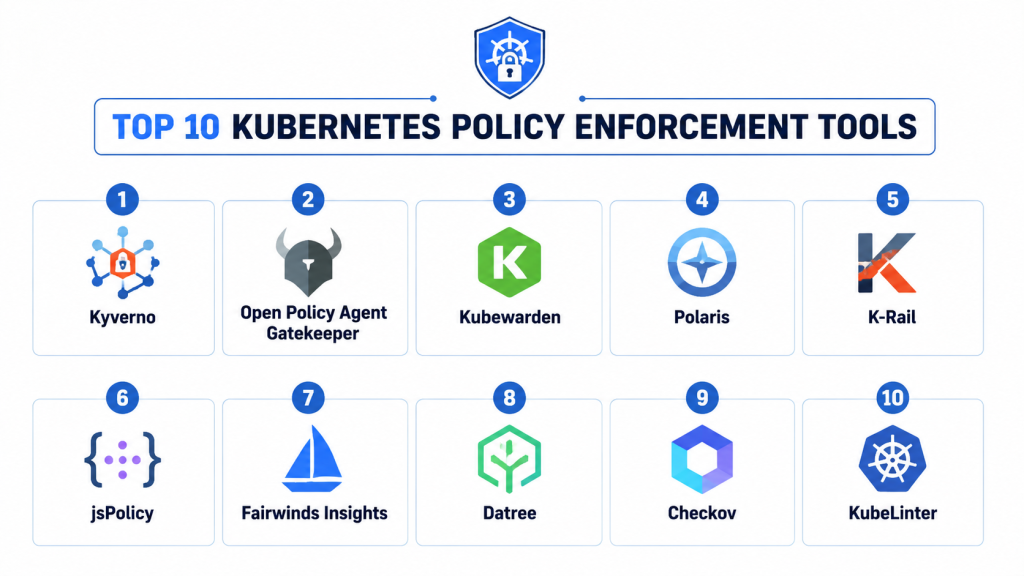
Top 10 Kubernetes Policy Enforcement Tools
1- Open Policy Agent (OPA) Gatekeeper
Short description: OPA Gatekeeper is an open-source framework for Kubernetes that enforces policies and validates configurations using declarative Rego rules. It integrates with Kubernetes Admission Controller to enforce compliance in real-time.
Key Features
- Declarative policy enforcement
- Kubernetes-native integration
- Admission controller enforcement
- Multi-cluster support
- Audit reporting
- GitOps integration
- Custom Rego policy rules
Pros
- Strong open-source community
- Flexible and highly customizable policies
- Real-time enforcement in Kubernetes clusters
Cons
- Rego language learning curve
- Enterprise-scale governance requires careful configuration
- Complex policies may impact performance
Platforms / Deployment
- Kubernetes / Cloud / Self-hosted
Security & Compliance
Supports RBAC, audit logs, and policy enforcement.
Integrations & Ecosystem
- Kubernetes clusters
- GitOps workflows
- CI/CD pipelines
- Policy-as-Code frameworks
Support & Community
Active open-source community and extensive documentation.
2- Kyverno
Short description: Kyverno is a Kubernetes-native policy engine that enforces security and operational policies using YAML-based declarative policies.
Key Features
- Kubernetes-native admission controller
- Declarative YAML policies
- Resource validation and mutation
- Policy enforcement at runtime
- Multi-cluster support
- Audit reporting
- Integration with GitOps workflows
Pros
- Easier policy creation with YAML
- Strong Kubernetes integration
- Open-source and actively maintained
Cons
- Limited enterprise governance features compared to commercial tools
- Policy debugging can require Kubernetes expertise
- Multi-cloud enforcement may require configuration
Platforms / Deployment
- Kubernetes / Cloud / Self-hosted
Security & Compliance
Supports policy enforcement, audit visibility, and RBAC.
Integrations & Ecosystem
- GitOps platforms
- CI/CD pipelines
- Helm charts
- Kubernetes controllers
Support & Community
Active open-source community with developer-friendly resources.
3- Prisma Cloud (Compute)
Short description: Prisma Cloud provides enterprise Kubernetes security with policy enforcement, compliance monitoring, and runtime threat detection.
Key Features
- Policy enforcement and compliance
- Runtime monitoring
- Admission controller integration
- Multi-cluster Kubernetes support
- Vulnerability and configuration scanning
- Audit reporting
- Automated remediation
Pros
- Enterprise-grade Kubernetes governance
- Strong runtime and compliance capabilities
- Centralized dashboard and reporting
Cons
- Premium pricing
- Enterprise deployment requires planning
- Learning curve for complex policies
Platforms / Deployment
- Cloud / Kubernetes / Hybrid
Security & Compliance
Supports RBAC, audit logs, compliance policies, and governance workflows.
Integrations & Ecosystem
- Kubernetes clusters
- CI/CD pipelines
- Cloud registries
- Helm and GitOps workflows
Support & Community
Enterprise support with onboarding and professional services.
4- StackRox (Red Hat Advanced Cluster Security)
Short description: StackRox, now part of Red Hat Advanced Cluster Security, provides Kubernetes security, policy enforcement, and compliance at scale.
Key Features
- Kubernetes admission control
- Policy-as-Code enforcement
- Multi-cluster visibility
- Compliance reporting and audit
- Runtime monitoring
- Integration with CI/CD pipelines
- Vulnerability scanning
Pros
- Enterprise Kubernetes security
- Centralized policy management
- Multi-cluster and multi-cloud support
Cons
- Premium enterprise pricing
- Setup complexity for large clusters
- Best suited for Red Hat OpenShift environments
Platforms / Deployment
- Cloud / Kubernetes / Hybrid
Security & Compliance
Supports RBAC, audit reporting, policy enforcement, and compliance automation.
Integrations & Ecosystem
- OpenShift and Kubernetes
- CI/CD pipelines
- Security dashboards
- Admission controllers
Support & Community
Red Hat enterprise support with professional services.
5- Kyverno Enterprise (Cloud Native Security Platform)
Short description: Enterprise editions of Kyverno add governance dashboards, multi-cluster policy management, and extended compliance capabilities.
Key Features
- Centralized governance
- Multi-cluster policy management
- Compliance dashboards
- Enhanced audit reporting
- Policy lifecycle management
- CI/CD enforcement
Pros
- Enterprise-grade monitoring
- Multi-cluster enforcement
- Enhanced compliance reporting
Cons
- Premium licensing
- Requires Kubernetes expertise
- Advanced dashboards may require training
Platforms / Deployment
- Kubernetes / Cloud / Self-hosted
Security & Compliance
Supports RBAC, policy audit, and governance reporting.
Integrations & Ecosystem
- GitOps pipelines
- CI/CD integrations
- Kubernetes clusters
- Helm charts
Support & Community
Enterprise support with documentation and professional onboarding.
6- K-Rail
Short description: K-Rail is a lightweight Kubernetes admission controller that enforces policies to block unsafe deployments and misconfigurations.
Key Features
- Admission controller enforcement
- Declarative policy management
- Blocking unsafe resources
- Lightweight Kubernetes integration
- Configurable rules
- Audit logging
Pros
- Simple and lightweight
- Fast enforcement
- Open-source and easy to deploy
Cons
- Limited enterprise reporting
- No multi-cluster management
- Requires manual policy tuning for complex setups
Platforms / Deployment
- Kubernetes / Cloud / Self-hosted
Security & Compliance
Supports policy enforcement and audit logging.
Integrations & Ecosystem
- Kubernetes clusters
- CI/CD pipelines
- GitOps workflows
Support & Community
Open-source community support.
7- Kyverno Policy Controller (Standalone Enterprise)
Short description: Standalone enterprise controllers provide centralized Kubernetes policy management across multiple clusters with enhanced audit and reporting.
Key Features
- Multi-cluster policy enforcement
- Centralized dashboards
- Compliance reporting
- Admission controller enforcement
- CI/CD integration
- Runtime monitoring
Pros
- Enterprise governance at scale
- Multi-cluster visibility
- Compliance tracking
Cons
- Enterprise pricing
- Complex setup
- Requires Kubernetes expertise
Platforms / Deployment
- Kubernetes / Cloud / Hybrid
Security & Compliance
RBAC, audit reporting, and governance workflows included.
Integrations & Ecosystem
- CI/CD pipelines
- GitOps workflows
- Multi-cluster Kubernetes
- Helm charts
Support & Community
Enterprise support available.
8- Kyverno Policy-as-Code SaaS
Short description: Cloud-based policy enforcement as a service for Kubernetes, providing dashboards, monitoring, and centralized governance.
Key Features
- Policy-as-Code enforcement
- Multi-cluster monitoring
- Compliance dashboards
- CI/CD integration
- Runtime alerting
- Audit reporting
Pros
- SaaS simplicity
- Centralized policy management
- Real-time compliance monitoring
Cons
- Enterprise pricing
- Limited offline cluster support
- Subscription-based licensing
Platforms / Deployment
- Cloud / Kubernetes
Security & Compliance
Supports RBAC, audit logs, and compliance monitoring.
Integrations & Ecosystem
- GitOps pipelines
- CI/CD systems
- Kubernetes clusters
- Helm charts
Support & Community
Enterprise-level SaaS support.
9- OpenShift Compliance Operator
Short description: The OpenShift Compliance Operator helps enforce policies and validate cluster configurations for compliance with internal and regulatory requirements.
Key Features
- Compliance checks
- Policy enforcement
- Cluster validation
- Audit reporting
- Multi-cluster support
- CVE and benchmark integration
Pros
- Red Hat OpenShift integration
- Built-in compliance reporting
- Policy enforcement
Cons
- OpenShift-specific
- Limited cross-platform support
- Advanced configurations require expertise
Platforms / Deployment
- Kubernetes / OpenShift / Cloud
Security & Compliance
Supports audit reporting, policy enforcement, and RBAC.
Integrations & Ecosystem
- OpenShift clusters
- GitOps pipelines
- CI/CD workflows
Support & Community
Red Hat enterprise support.
10- Kyverno Cloud Native Security (Enterprise SaaS)
Short description: Kyverno Enterprise SaaS edition provides policy enforcement and compliance monitoring with real-time reporting across multiple clusters.
Key Features
- Policy enforcement as a service
- Multi-cluster monitoring
- Audit and compliance reporting
- Admission controller integration
- CI/CD integration
- Developer workflows
Pros
- SaaS ease of deployment
- Multi-cluster visibility
- Compliance dashboards
Cons
- Subscription-based pricing
- Enterprise setup complexity
- Kubernetes expertise required
Platforms / Deployment
- Cloud / Kubernetes
Security & Compliance
Supports RBAC, policy enforcement, audit visibility, and governance workflows.
Integrations & Ecosystem
- CI/CD pipelines
- GitOps workflows
- Kubernetes clusters
- Helm charts
Support & Community
Enterprise SaaS support.
Comparison Table
| Tool Name | Best For | Platform Supported | Deployment | Standout Feature | Public Rating |
|---|---|---|---|---|---|
| OPA Gatekeeper | Open-source policy enforcement | Kubernetes | Hybrid | Rego-based policy enforcement | N/A |
| Kyverno | YAML-native policy enforcement | Kubernetes | Cloud / Self-hosted | Declarative policies | N/A |
| Prisma Cloud Compute | Enterprise runtime enforcement | Kubernetes / Cloud | Hybrid | Compliance dashboards and runtime scanning | N/A |
| StackRox | Enterprise governance | Kubernetes | Cloud / Hybrid | Multi-cluster policy enforcement | N/A |
| Kyverno Enterprise | Enterprise governance | Kubernetes | Cloud / Self-hosted | Centralized dashboards | N/A |
| K-Rail | Lightweight admission control | Kubernetes | Cloud / Self-hosted | Fast policy enforcement | N/A |
| Kyverno Policy Controller | Multi-cluster enforcement | Kubernetes | Cloud / Hybrid | Centralized compliance | N/A |
| Kyverno SaaS | Cloud-based policy enforcement | Kubernetes | Cloud | SaaS dashboard monitoring | N/A |
| OpenShift Compliance Operator | OpenShift compliance | OpenShift / Kubernetes | Cloud | Compliance benchmark enforcement | N/A |
| Kyverno Cloud Native Security | Enterprise SaaS | Kubernetes / Cloud | Cloud | Multi-cluster compliance monitoring | N/A |
Evaluation & Scoring of Kubernetes Policy Enforcement Tools
| Tool Name | Core 25% | Ease 15% | Integrations 15% | Security 10% | Performance 10% | Support 10% | Value 15% | Weighted Total |
|---|---|---|---|---|---|---|---|---|
| OPA Gatekeeper | 10 | 7 | 9 | 9 | 8 | 8 | 9 | 8.7 |
| Kyverno | 9 | 8 | 8 | 8 | 8 | 8 | 9 | 8.3 |
| Prisma Cloud Compute | 9 | 7 | 8 | 9 | 8 | 8 | 7 | 8.0 |
| StackRox | 9 | 7 | 8 | 9 | 8 | 8 | 7 | 8.0 |
| Kyverno Enterprise | 9 | 7 | 8 | 9 | 8 | 8 | 7 | 8.0 |
| K-Rail | 8 | 8 | 7 | 8 | 8 | 7 | 8 | 7.8 |
| Kyverno Policy Controller | 9 | 7 | 8 | 9 | 8 | 8 | 7 | 8.0 |
| Kyverno SaaS | 9 | 8 | 8 | 9 | 8 | 8 | 7 | 8.1 |
| OpenShift Compliance Operator | 8 | 7 | 7 | 8 | 8 | 7 | 7 | 7.5 |
| Kyverno Cloud Native Security | 9 | 8 | 8 | 9 | 8 | 8 | 7 | 8.1 |
Which Kubernetes Policy Enforcement Tool Is Right for You?
Solo / Freelancer
OPA Gatekeeper or Kyverno are excellent for small clusters or open-source projects.
SMB
Kyverno, K-Rail, or Kyverno SaaS provide easy enforcement with CI/CD integration.
Mid-Market
Prisma Cloud Compute, StackRox, or Kyverno Enterprise for multi-cluster and compliance monitoring.
Enterprise
Prisma Cloud Compute, StackRox, Kyverno Enterprise/SaaS, OpenShift Compliance Operator for enterprise-grade governance and multi-cluster compliance.
Budget vs Premium
Open-source tools like Kyverno and OPA Gatekeeper reduce cost. Premium tools provide dashboards, runtime scanning, multi-cluster management, and enterprise support.
Feature Depth vs Ease of Use
Lightweight scanners offer simple enforcement; enterprise tools provide centralized dashboards, reporting, and automated remediation.
Integrations & Scalability
Scanners should integrate with CI/CD, GitOps pipelines, Helm, registries, and multi-cluster Kubernetes environments.
Security & Compliance Needs
Focus on RBAC, audit logging, policy enforcement, automated compliance, and cluster-wide visibility.
Frequently Asked Questions FAQs
1- What are Kubernetes Policy Enforcement Tools?
They automate compliance, security, and governance policies in Kubernetes clusters.
2- Why are these tools important?
They prevent misconfigurations, enforce standards, and maintain cluster compliance at scale.
3- Can they block unsafe deployments?
Yes. Admission controllers enforce policies in real-time.
4- Do they integrate with CI/CD pipelines?
Yes. Most tools integrate to enforce policies before code reaches clusters.
5- Can they handle multi-cluster environments?
Enterprise editions provide multi-cluster visibility and centralized enforcement.
6- Are open-source options available?
Yes. OPA Gatekeeper, Kyverno, and K-Rail are widely used open-source tools.
7- Do these tools provide audit reports?
Yes. Many provide compliance dashboards, reporting, and policy violation logs.
8- What is policy-as-code in Kubernetes?
Declarative policies stored in code that are automatically enforced via controllers and CI/CD pipelines.
9- Can they detect runtime drift?
Some enterprise tools provide runtime monitoring to detect policy violations after deployment.
10- Which tool is best for enterprise?
Prisma Cloud Compute, StackRox, Kyverno Enterprise/SaaS, and OpenShift Compliance Operator depending on governance requirements.
Conclusion
Kubernetes Policy Enforcement Tools are essential for maintaining security, compliance, and operational standards across modern containerized workloads. Open-source tools like OPA Gatekeeper, Kyverno, and K-Rail provide flexible policy enforcement and easy integration, while enterprise platforms such as Prisma Cloud Compute, StackRox, and Kyverno Enterprise/SaaS offer centralized dashboards, multi-cluster visibility, automated remediation, and compliance reporting. Selecting the right tool depends on cluster size, compliance needs, cloud-native architecture, and developer workflows. Organizations should test two or three tools, validate policy enforcement, ensure CI/CD integration, and confirm reporting and multi-cluster capabilities before standardizing on a solution.
Do you want me to give 5 hashtags for this blog next?
It would be helpful to include how these tools handle policy enforcement without impacting cluster performance in high scale environments.