Introduction
Digital Forensics & Incident Response DFIR Suites help organizations investigate cyberattacks, collect digital evidence, contain threats, analyze compromised systems, and recover from security incidents. These platforms combine forensic investigation capabilities with incident response workflows, enabling security teams to identify attack vectors, reconstruct timelines, preserve evidence, and accelerate remediation efforts.
Modern cyber threats are increasingly sophisticated, involving ransomware, fileless malware, insider threats, cloud compromise, identity attacks, and supply chain intrusions. Traditional standalone security tools often lack the visibility and forensic depth needed for rapid investigations. DFIR suites centralize telemetry, endpoint data, threat intelligence, memory analysis, log analytics, and incident workflows into unified operational environments.
Common real-world use cases include:
- Ransomware investigation and containment
- Endpoint and memory forensics
- Insider threat investigations
- Cloud breach analysis
- Threat hunting and evidence preservation
Buyers evaluating DFIR suites should focus on:
- Endpoint forensic capabilities
- Incident response automation
- Memory and disk analysis support
- Threat intelligence integrations
- Cloud and hybrid infrastructure visibility
- Chain-of-custody support
- Scalability and performance
- Reporting and timeline reconstruction
- AI-assisted investigation capabilities
- Ease of deployment and analyst usability
Best for: SOC teams, DFIR analysts, MSSPs, enterprise security operations, government agencies, financial institutions, healthcare organizations, and cloud-native enterprises.
Not ideal for: Very small businesses with minimal cybersecurity maturity or organizations requiring only basic antivirus and monitoring functionality.
Key Trends in Digital Forensics & Incident Response DFIR Suites
- AI-assisted forensic investigations are improving incident triage and anomaly detection.
- Memory forensics is becoming increasingly important for detecting fileless malware.
- Cloud-native DFIR workflows are replacing traditional endpoint-only investigations.
- Automated incident timeline reconstruction is becoming more advanced.
- Unified XDR and DFIR capabilities are converging rapidly.
- OpenTelemetry and standardized telemetry pipelines are improving evidence collection.
- Threat intelligence enrichment is becoming deeply integrated into forensic workflows.
- Generative AI-assisted investigation analysis is emerging in modern DFIR environments.
- Remote forensic acquisition is becoming critical for hybrid workforces.
- Incident response orchestration and automated remediation are expanding rapidly.
How We Selected These Tools Methodology
The tools in this list were selected based on forensic depth, incident response maturity, and enterprise operational relevance.
- Evaluated forensic investigation capabilities
- Assessed incident response automation features
- Reviewed endpoint and memory analysis support
- Considered cloud and hybrid infrastructure visibility
- Evaluated integration ecosystem breadth
- Reviewed AI-assisted investigation workflows
- Assessed scalability and operational performance
- Considered reporting and evidence preservation capabilities
- Evaluated usability and analyst workflows
- Reviewed enterprise adoption and ecosystem maturity
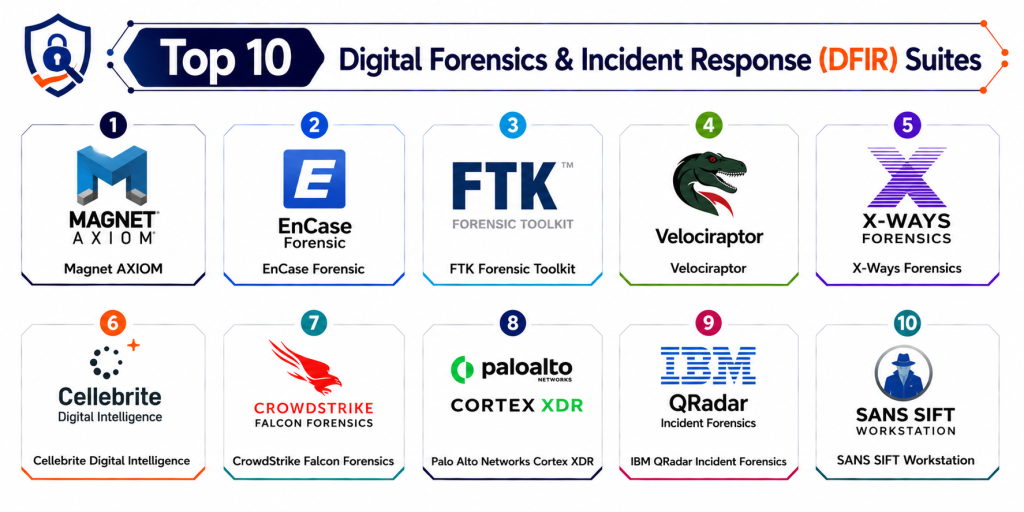
Top 10 Digital Forensics & Incident Response DFIR Suites
1- CrowdStrike Falcon Forensics
Short description: CrowdStrike Falcon Forensics is a cloud-native DFIR platform focused on endpoint investigations, incident response, threat hunting, and real-time attack visibility for enterprise environments.
Key Features
- Endpoint forensics
- Real-time incident response
- Threat hunting workflows
- Memory analysis support
- Cloud-native telemetry
- AI-assisted threat detection
- Remote forensic acquisition
Pros
- Strong cloud-native architecture
- Excellent endpoint visibility
- Fast incident response workflows
Cons
- Premium enterprise pricing
- Advanced tuning may require expertise
- Large deployments require operational maturity
Platforms / Deployment
- Windows / Linux / macOS
- Cloud
Security & Compliance
- SSO/SAML
- RBAC
- Audit logging
- Encryption support
Integrations & Ecosystem
CrowdStrike integrates broadly with enterprise security and observability ecosystems.
- AWS
- Azure
- SIEM platforms
- Threat intelligence tools
- APIs
- XDR platforms
Support & Community
Strong enterprise DFIR ecosystem with mature operational support resources.
2- Microsoft Defender XDR
Short description: Microsoft Defender XDR combines endpoint detection, forensic investigation, identity analytics, and incident response workflows across Microsoft enterprise environments.
Key Features
- Endpoint forensic visibility
- Incident investigation timelines
- Threat analytics
- Cloud attack visibility
- Identity-based investigations
- Automated remediation
- AI-assisted correlation
Pros
- Deep Microsoft ecosystem integration
- Strong hybrid infrastructure visibility
- Broad security analytics capabilities
Cons
- Best suited for Microsoft-centric environments
- Advanced workflows may be complex
- Premium features require higher licensing tiers
Platforms / Deployment
- Windows / Linux / macOS
- Cloud / Hybrid
Security & Compliance
- SSO/SAML
- MFA
- RBAC
- Audit logging
- Encryption support
Integrations & Ecosystem
Microsoft Defender integrates tightly with enterprise security and cloud ecosystems.
- Azure
- Microsoft Sentinel
- Microsoft 365
- APIs
- SIEM platforms
- Threat intelligence feeds
Support & Community
Extensive enterprise support with strong documentation ecosystem.
3- Palo Alto Networks Cortex XDR
Short description: Cortex XDR combines forensic analytics, endpoint telemetry, network visibility, and incident response automation for enterprise security operations.
Key Features
- Cross-domain forensic analytics
- Threat correlation
- Endpoint investigation workflows
- Network telemetry analysis
- Incident automation
- Threat intelligence enrichment
- Root-cause analytics
Pros
- Strong XDR integration
- Broad telemetry visibility
- Effective incident correlation
Cons
- Enterprise deployment complexity
- Premium licensing structure
- Operational expertise recommended
Platforms / Deployment
- Windows / Linux / macOS
- Cloud / Hybrid
Security & Compliance
- SSO/SAML
- RBAC
- Audit logs
- Encryption support
Integrations & Ecosystem
Cortex XDR integrates with enterprise security ecosystems and cloud platforms.
- AWS
- Azure
- SIEM platforms
- Threat intelligence feeds
- APIs
- Network security tools
Support & Community
Strong enterprise security ecosystem with mature DFIR documentation.
4- Magnet AXIOM
Short description: Magnet AXIOM is a specialized digital forensics platform focused on computer, mobile, cloud, and memory forensic investigations.
Key Features
- Disk and memory forensics
- Mobile device analysis
- Timeline reconstruction
- Evidence correlation
- Cloud artifact collection
- Deleted file recovery
- Advanced reporting
Pros
- Excellent forensic investigation depth
- Strong evidence analysis workflows
- Broad device support
Cons
- Less focused on live incident response
- Requires forensic expertise
- Enterprise automation capabilities are limited
Platforms / Deployment
- Windows
- Self-hosted
Security & Compliance
- Audit logging
- Encryption support
- Evidence preservation workflows
Integrations & Ecosystem
Magnet AXIOM integrates with forensic workflows and evidence management systems.
- Cellebrite
- Cloud evidence tools
- APIs
- SIEM exports
- Forensic toolkits
Support & Community
Strong DFIR training ecosystem with active forensic analyst community.
5- OpenText EnCase Forensic
Short description: EnCase Forensic is one of the most established enterprise digital forensics platforms for evidence collection, disk analysis, and forensic investigations.
Key Features
- Disk imaging and analysis
- Endpoint evidence collection
- Deleted file recovery
- Timeline analysis
- Email and artifact analysis
- Chain-of-custody support
- Reporting workflows
Pros
- Mature forensic investigation capabilities
- Strong legal evidence workflows
- Broad enterprise adoption
Cons
- Complex interface
- Expensive licensing
- Slower cloud-native evolution
Platforms / Deployment
- Windows
- Self-hosted
Security & Compliance
- Audit trails
- Encryption support
- Evidence preservation controls
Integrations & Ecosystem
EnCase integrates with forensic investigation and legal evidence ecosystems.
- SIEM exports
- Evidence repositories
- APIs
- Forensic toolkits
Support & Community
Long-established DFIR ecosystem with extensive training resources.
6- IBM QRadar Incident Forensics
Short description: IBM QRadar Incident Forensics provides network forensic visibility and incident investigation workflows integrated into enterprise SIEM environments.
Key Features
- Network forensics
- Packet capture analytics
- Incident reconstruction
- Threat intelligence integration
- Timeline analytics
- Security event correlation
- Investigative dashboards
Pros
- Strong network forensic capabilities
- Good SIEM integration
- Broad enterprise visibility
Cons
- Enterprise deployment complexity
- Premium pricing model
- Advanced tuning requires expertise
Platforms / Deployment
- Linux
- Cloud / Hybrid
Security & Compliance
- RBAC
- Audit logs
- Encryption support
Integrations & Ecosystem
QRadar integrates deeply with enterprise SOC ecosystems.
- IBM QRadar
- Threat intelligence feeds
- SIEM platforms
- APIs
- Network sensors
Support & Community
Strong enterprise SOC and DFIR support ecosystem.
7- Cellebrite Digital Intelligence Platform
Short description: Cellebrite provides advanced mobile and digital forensics capabilities designed for law enforcement, enterprise investigations, and incident response teams.
Key Features
- Mobile device forensics
- Evidence extraction
- Timeline analysis
- Cloud artifact collection
- Data recovery
- Evidence management
- Reporting and analytics
Pros
- Excellent mobile forensic capabilities
- Broad device support
- Mature investigative workflows
Cons
- Specialized mobile focus
- Premium licensing structure
- Enterprise IR automation is limited
Platforms / Deployment
- Windows
- Self-hosted
Security & Compliance
- Audit logging
- Encryption support
- ISO 27001
- SOC 2 Type II support
Integrations & Ecosystem
Cellebrite integrates with mobile forensic and investigative ecosystems.
- UFED
- Physical Analyzer
- Evidence systems
- APIs
- Investigation workflows
Support & Community
Strong global forensic training and enterprise support infrastructure.
8- Cyber Triage
Short description: Cyber Triage is a DFIR investigation platform focused on rapid endpoint triage, incident investigations, and threat hunting workflows.
Key Features
- Endpoint triage analysis
- Rapid evidence collection
- Incident investigation workflows
- Threat hunting support
- Malware investigation
- Automated prioritization
- Timeline analysis
Pros
- Fast investigation workflows
- Good analyst usability
- Efficient endpoint triage capabilities
Cons
- Smaller ecosystem than enterprise XDR vendors
- Limited cloud-native capabilities
- Enterprise scalability varies
Platforms / Deployment
- Windows
- Self-hosted / Hybrid
Security & Compliance
- RBAC
- Audit logging
- Encryption support
Integrations & Ecosystem
Cyber Triage integrates with forensic workflows and investigation ecosystems.
- SIEM platforms
- APIs
- Endpoint tools
- Investigation systems
Support & Community
Strong DFIR-focused operational documentation and analyst support.
9- SANS SIFT Workstation
Short description: SIFT Workstation is an open-source DFIR toolkit containing a broad collection of forensic and incident response tools for advanced investigations.
Key Features
- Open-source DFIR toolkit
- Memory and disk forensics
- Timeline analysis
- Malware investigation
- Log analysis
- Evidence collection
- Linux forensic environment
Pros
- Free and open-source
- Extensive DFIR tool coverage
- Strong training ecosystem
Cons
- Requires technical expertise
- No centralized enterprise management
- Manual workflows can be complex
Platforms / Deployment
- Linux
- Self-hosted
Security & Compliance
- Encryption support
- Evidence preservation workflows
Integrations & Ecosystem
SIFT integrates with open-source forensic ecosystems and investigative workflows.
- Volatility
- Autopsy
- Sleuth Kit
- APIs
- Open-source DFIR tools
Support & Community
Large DFIR training and open-source investigation community.
10- Autopsy Digital Forensics Platform
Short description: Autopsy is an open-source digital forensics platform designed for disk analysis, evidence recovery, timeline investigations, and forensic workflows.
Key Features
- Disk forensics
- Timeline analysis
- Deleted file recovery
- Keyword investigations
- Artifact extraction
- Evidence indexing
- Open-source extensibility
Pros
- Free and open-source
- Good forensic analysis depth
- Broad community adoption
Cons
- Limited enterprise automation
- Requires technical expertise
- Less suited for live enterprise incident response
Platforms / Deployment
- Windows / Linux
- Self-hosted
Security & Compliance
- Evidence preservation workflows
- Audit support varies
Integrations & Ecosystem
Autopsy integrates with open-source DFIR and forensic ecosystems.
- Sleuth Kit
- Volatility
- APIs
- Open-source plugins
Support & Community
Large global forensic analyst and training community.
Comparison Table
| Tool Name | Best For | Platform(s) Supported | Deployment | Standout Feature | Public Rating |
|---|---|---|---|---|---|
| CrowdStrike Falcon Forensics | Cloud-native DFIR | Windows, Linux, macOS | Cloud | Real-time endpoint forensics | N/A |
| Microsoft Defender XDR | Microsoft enterprise security | Hybrid environments | Cloud, Hybrid | Identity-driven investigations | N/A |
| Cortex XDR | Cross-domain analytics | Multi-platform | Cloud, Hybrid | Threat correlation analytics | N/A |
| Magnet AXIOM | Advanced forensic investigations | Windows | Self-hosted | Timeline reconstruction | N/A |
| OpenText EnCase Forensic | Legal-grade digital forensics | Windows | Self-hosted | Evidence preservation | N/A |
| IBM QRadar Incident Forensics | Network forensic analysis | Linux | Cloud, Hybrid | Packet-level investigations | N/A |
| Cellebrite Digital Intelligence Platform | Mobile forensics | Windows | Self-hosted | Mobile evidence extraction | N/A |
| Cyber Triage | Rapid endpoint investigations | Windows | Hybrid | Fast endpoint triage | N/A |
| SANS SIFT Workstation | Open-source DFIR | Linux | Self-hosted | Comprehensive DFIR toolkit | N/A |
| Autopsy Digital Forensics Platform | Open-source forensic analysis | Windows, Linux | Self-hosted | Disk and artifact analysis | N/A |
Evaluation & Scoring of Digital Forensics & Incident Response DFIR Suites
| Tool Name | Core 25% | Ease 15% | Integrations 15% | Security 10% | Performance 10% | Support 10% | Value 15% | Weighted Total |
|---|---|---|---|---|---|---|---|---|
| CrowdStrike Falcon Forensics | 9 | 8 | 9 | 9 | 9 | 8 | 6 | 8.25 |
| Microsoft Defender XDR | 9 | 7 | 9 | 9 | 8 | 9 | 7 | 8.30 |
| Cortex XDR | 9 | 7 | 8 | 9 | 8 | 8 | 6 | 7.90 |
| Magnet AXIOM | 8 | 7 | 7 | 8 | 8 | 8 | 7 | 7.60 |
| OpenText EnCase Forensic | 8 | 6 | 7 | 9 | 8 | 8 | 6 | 7.35 |
| IBM QRadar Incident Forensics | 8 | 6 | 8 | 8 | 8 | 8 | 6 | 7.40 |
| Cellebrite Digital Intelligence Platform | 8 | 7 | 7 | 9 | 8 | 8 | 6 | 7.45 |
| Cyber Triage | 7 | 8 | 6 | 7 | 8 | 7 | 8 | 7.30 |
| SANS SIFT Workstation | 7 | 5 | 7 | 7 | 8 | 8 | 10 | 7.35 |
| Autopsy Digital Forensics Platform | 7 | 6 | 6 | 7 | 7 | 7 | 10 | 7.10 |
These scores are comparative rather than absolute. Higher scores generally indicate broader forensic visibility, stronger automation, and mature enterprise investigation workflows. Open-source platforms may still provide excellent value for technically skilled DFIR teams requiring customization and flexibility.
Which Digital Forensics & Incident Response DFIR Suite Is Right for You?
Solo / Freelancer
Independent security researchers and small investigation teams often benefit from open-source platforms such as SIFT Workstation and Autopsy because of their flexibility and lower operational cost.
SMB
Small and medium businesses should prioritize deployment simplicity, endpoint visibility, and manageable operational overhead. Cyber Triage and Microsoft Defender XDR provide practical investigation capabilities with simpler workflows.
Mid-Market
Mid-market organizations often require stronger automation, cloud visibility, and incident analytics. CrowdStrike Falcon Forensics and Cortex XDR provide scalable DFIR capabilities with strong operational visibility.
Enterprise
Large enterprises typically need centralized forensic analytics, hybrid cloud visibility, advanced threat intelligence, and workflow orchestration. Splunk-integrated ecosystems, Microsoft Defender XDR, and CrowdStrike are strong enterprise-focused choices.
Budget vs Premium
Open-source DFIR platforms generally provide lower licensing costs and greater customization flexibility. Enterprise-grade DFIR suites offer broader telemetry visibility, AI-assisted analytics, and automation but usually require larger budgets.
Feature Depth vs Ease of Use
Platforms such as EnCase and Magnet AXIOM provide deep forensic capabilities but may require highly skilled investigators. CrowdStrike and Microsoft Defender emphasize operational simplicity and cloud-native workflows.
Integrations & Scalability
Organizations with mature security operations should prioritize integrations with SIEM platforms, XDR ecosystems, threat intelligence feeds, APIs, cloud providers, and observability tools.
Security & Compliance Needs
Regulated industries should focus on evidence preservation, audit logging, chain-of-custody support, encryption, role-based access controls, and compliance reporting capabilities.
Frequently Asked Questions FAQs
1. What are DFIR suites?
DFIR suites are cybersecurity platforms that combine digital forensics and incident response capabilities to investigate, analyze, contain, and remediate cyber incidents.
2. Why are DFIR platforms important?
They help organizations reduce incident response time, preserve evidence, investigate attacks, improve threat visibility, and strengthen operational resilience.
3. What types of evidence do DFIR tools analyze?
DFIR platforms analyze endpoint telemetry, memory dumps, logs, disk artifacts, network traffic, cloud activity, and mobile device evidence.
4. What is memory forensics?
Memory forensics involves analyzing volatile system memory to detect malware, fileless attacks, credential theft, and suspicious runtime activity.
5. Are DFIR platforms suitable for cloud-native environments?
Yes. Many modern DFIR suites now support cloud infrastructure, containers, Kubernetes, and hybrid cloud telemetry workflows.
6. What integrations are most important?
Important integrations include SIEM platforms, XDR ecosystems, threat intelligence feeds, cloud providers, APIs, and observability tools.
7. Which industries benefit most from DFIR suites?
Financial services, healthcare, telecom, government agencies, SaaS providers, legal organizations, and enterprise SOC environments commonly benefit from DFIR capabilities.
8. What are common DFIR deployment mistakes?
Common mistakes include incomplete telemetry collection, weak evidence preservation procedures, poor alert prioritization, fragmented integrations, and insufficient analyst training.
9. Are open-source DFIR tools reliable?
Yes. Open-source tools such as SIFT and Autopsy are widely used by DFIR professionals and training organizations when properly managed.
10. Is AI changing digital forensics and incident response?
Yes. AI and machine learning are improving anomaly detection, timeline analysis, alert prioritization, and investigation automation across modern DFIR workflows.
Conclusion
Digital Forensics & Incident Response DFIR Suites have become essential cybersecurity platforms for organizations defending increasingly complex hybrid cloud, cloud-native, and distributed enterprise environments. These platforms help SOC teams, DFIR analysts, and security operations teams accelerate investigations, preserve evidence, automate incident response, and improve operational resilience through centralized forensic analytics and incident workflows. Enterprise buyers should carefully evaluate forensic depth, incident response automation, cloud-native visibility, integration flexibility, scalability, and analyst usability before selecting a platform. CrowdStrike Falcon Forensics, Microsoft Defender XDR, and Cortex XDR provide strong enterprise-grade DFIR and XDR capabilities, while Magnet AXIOM and EnCase remain highly valuable for deep forensic investigations and evidence analysis. Open-source platforms such as SIFT Workstation and Autopsy continue offering flexible and cost-effective investigation environments for technically skilled DFIR teams. The best solution ultimately depends on infrastructure complexity, cloud maturity, security operations scale, compliance requirements, and budget priorities. Shortlist a few platforms, run pilot investigations across your infrastructure environment, validate integrations with your SIEM and cloud ecosystems, and evaluate analyst workflows before making a long-term DFIR platform investment decision.
Clear and informative article about DFIR suites. I especially liked the simple explanation of investigation and incident response processes.
The article compares tooling well, but long-term operational readiness matters too. Many teams buy DFIR platforms without investing enough in investigator training, playbook testing, and cross-team response coordination.