Introduction
Entering the world of stock investment for beginners is incredibly exciting. With a smartphone and a demat account, you can buy shares of India’s top companies in seconds. For many first-time investors, students, and salaried professionals across India, the stock market feels like the ultimate gateway to wealth creation. However, the initial rush of excitement can turn into confusion if your first few trades end up in the red.
It is completely natural for new investors to make mistakes when starting out. The stock market is a dynamic, fast-moving system governed by complex economic data and human psychology. Because most of us are never taught personal finance or portfolio management tips in school, we learn by doing. Unfortunately, learning by doing in the stock market can sometimes lead to costly investing errors to avoid.
The good news is that you do not have to lose your hard-earned money to learn these lessons. By understanding the common stock market pitfalls that others have faced, you can fast-track your journey toward becoming a smart, disciplined investor.
In this comprehensive beginner investor guide, we will break down the exact common stock market mistakes beginners should avoid. You will discover why these blunders happen, how they impact your hard-earned savings, and practical, actionable strategies to protect your capital. Whether you want to build a long-term retirement fund or simply grow your savings, mastering market risk management early will keep you far ahead of the crowd.
Why Beginners Make Stock Market Mistakes
Before exploring specific trading mistakes, it is vital to understand why new investors fall into these traps. Stock investing is not just a game of numbers; it is heavily rooted in human psychology. When real money is on the line, our brains naturally experience intense emotions that can cloud logic and rational judgment.
For a salaried professional or student in India, the stock market often feels like a golden ticket to beat inflation. However, without a foundational roadmap, beginners frequently fall prey to systemic behavioral errors. Let’s look at the primary reasons why these initial missteps occur:
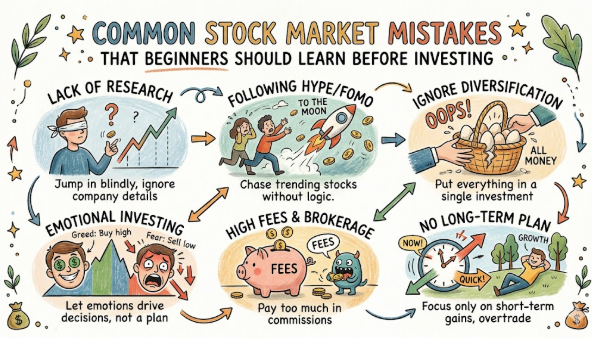
- Lack of Fundamental Knowledge: Many individuals open a trading account without understanding the absolute basics of a balance sheet, price-to-earnings (P/E) ratios, or corporate governance. Buying a stock without knowing how the underlying company makes money is equivalent to driving a car blindfolded.
- Emotional Decisions (Fear and Greed): The market swings between periods of intense optimism (bull markets) and deep pessimism (bear markets). Greed drives beginners to buy at all-time highs because they fear missing out (FOMO). Conversely, fear causes them to panic-sell great companies at a loss during a temporary market correction.
- The Overconfidence Trap: When the broader Indian market is surging, almost every stock goes up. This can lead new investors to mistake a roaring bull market for personal financial genius. This overconfidence often results in taking on excessive risk right before a market downturn.
- Chasing Hype and Trends: Whether it is a viral video on social media, a trending thread on forums, or “free premium tips” on WhatsApp channels, beginners love shortcuts. They buy heavily into speculative penny stocks or overnight sensations without verifying the underlying business stability.
- Inadequate Research and Due Diligence: Relying on second-hand information is one of the biggest common investment traps. Beginners often spend days researching a new smartphone purchase, but will invest thousands of rupees into a stock based entirely on a casual recommendation from a friend.
Most Common Stock Market Mistakes
| Mistake | Why It Happens | How to Avoid |
| Chasing hot stocks | Following hype, social media trends, or sensationalized financial news. | Focus on business fundamentals, revenue growth, and independent research. |
| Ignoring risk management | Overlooking stop-loss orders, asset allocation, and position sizing. | Diversify across asset classes and set strict risk limits per trade. |
| Emotional trading | Allowing fear, greed, and panic to dictate day-to-day decisions. | Stick to a pre-written investment plan and avoid making impulsive moves. |
| Lack of research | Blindly buying stocks based on tips, rumors, or unverified advice. | Analyze company financial statements, balance sheets, and sector health. |
| Overtrading | Trying to make quick profits by constantly buying and selling. | Limit your total number of trades and focus heavily on a long-term strategy. |
| Ignoring fees/charges | Forgetting how small transaction costs rapidly reduce overall returns. | Factor in brokerage charges, STT (Security Transaction Tax), and GST. |
| Not having a plan | Investing without defining clear financial goals or time horizons. | Define explicit financial goals and design an aligned asset allocation strategy. |
The Deep Impact of These Mistakes on Your Wealth
Making a few mistakes might feel harmless initially, but over time, these investing errors to avoid compound into significant financial and psychological damage. The stock market is highly unforgiving to unplanned actions. Understanding the true cost of these errors is the first major step toward building long-term financial discipline.
When beginners get caught in these common investment traps, the negative outcomes extend far beyond a shrinking bank balance:
- Severely Reduced Portfolio Returns: The most direct consequence of poor choices is capital erosion. Consistently buying overvalued stocks and selling them in a panic prevents your capital from experiencing the magic of compounding interest over the long haul.
- Intense Financial and Mental Stress: Watching your hard-earned savings evaporate due to impulsive trading decisions causes sleepless nights and immense anxiety. This stress frequently bleeds into your professional career and personal life, creating a toxic relationship with money management.
- Missed Opportunity Costs: Every rupee locked up in a fundamentally weak, declining penny stock is a rupee that could have been growing steadily in a high-quality index fund, a blue-chip company, or a diversified mutual fund.
- Severe Portfolio Imbalance: Failing to monitor your allocations can leave you overly exposed to a single high-risk sector (like tech or infrastructure). If that specific industry faces regulatory hurdles or economic downturns, your entire financial foundation could take a severe hit.
- Loss of Confidence in Wealth Creation: This is perhaps the saddest outcome of all. After losing money due to avoidable mistakes, many beginners conclude that “the stock market is just gambling.” They exit the market permanently, missing out on India’s long-term economic growth story.
Step-by-Step Guide to Avoiding Mistakes
Here is your comprehensive, step-by-step roadmap to navigate market risk management and protect your capital from day one:
- Educate Yourself Continually: Before risking your capital, invest time in learning how the market works. Understand basic terms like market capitalization, dividend yield, and return on equity (ROE). Treat financial literacy as an ongoing asset.
- Set Clear Financial Goals: Define exactly why you are investing. Are you building an emergency fund, saving for a down payment on a home, or planning for retirement twenty years from now? Your specific goal dictates your investment horizon and overall risk tolerance.
- Diversify Your Holdings Intelligently: Never put all your eggs in one basket. Spread your capital across different sectors (such as Banking, FMCG, IT, and Pharmaceuticals) and different asset classes. If one sector underperforms, the others act as a financial safety net.
- Incorporate Strict Risk Limits: If you participate in short-term trading, always utilize a stop-loss order to automatically cap your losses if a trade goes against you. For long-term investors, limit any single stock from occupying more than 5% to 10% of your total portfolio.
- Control Your Emotional Impulses: Create a set of personal investing rules and write them down. For example, promise yourself that you will never buy a stock on the same day you hear about it. Give yourself a 48-hour cooling-off period to research the company calmly.
- Track and Minimize Your Transaction Expenses: Be highly mindful of the costs associated with trading. Frequent churning of your portfolio generates hefty brokerage fees, depository participant (DP) charges, and taxes that quietly eat away at your net profits.
- Review Performance with Objectivity: Periodically check your portfolio (quarterly or bi-annually) to see if your initial investment theses still hold true. If a company’s fundamentals have fundamentally permanently deteriorated, accept the loss gracefully and reallocate those funds into a healthier asset.
Stock Market Beginner Checklist
| Checklist Point | Investor Action Item |
| Investment goals defined | Clearly state if this capital is for short-term gains or long-term growth. |
| Risk tolerance assessed | Ensure you are financially and emotionally comfortable with daily volatility. |
| Diversification plan in place | Check that your capital is safely spread across multiple unique companies and sectors. |
| Research completed before buying | Verify that you have read the company’s latest quarterly earnings or annual report. |
| Stop-loss or risk control set | Establish an exact exit price point if the trade or investment loses value. |
| Brokerage and fees considered | Factor all transaction taxes into your net profit and loss calculations. |
| Portfolio monitored regularly | Schedule specific dates to review your assets without over-checking them daily. |
| Emotional decisions avoided | Confirm this buy/sell order is based on data rather than FOMO or market panic. |
| Investment horizon considered | Align your choice with how long you can comfortably leave this money untouched. |
| Learning from mistakes | Document past errors in an investment journal to avoid repeating them. |
A Real-Life Example: Rahul’s Hard-Earned Lesson
To see these principles in action, let’s look at the story of Rahul, a 26-year-old software engineer working in Bengaluru. In early 2024, amidst a roaring market rally, Rahul decided to jump into stock market investing.
Eager to double his savings quickly, Rahul joined several trending social media channels. He noticed everyone talking about a speculative renewable energy penny stock trading at just ₹15 per share. Without checking the company’s financial records, debt levels, or earnings history, Rahul invested ₹1,000,000—nearly his entire emergency savings fund—into this single stock.
Within three weeks, regulatory changes caused the stock to hit consecutive lower circuits, meaning there were no buyers available, and the stock price crashed by 45%. Terrified of losing everything, Rahul panicked and sold his entire position at a massive loss, losing ₹45,000 in a matter of days. Frustrated and stressed, he initially blamed the market, calling it “rigged.”
However, instead of quitting, Rahul took a step back to figure out where he went wrong. He realized he had committed multiple beginner investing mistakes simultaneously: chasing hype, ignoring portfolio management tips, failing to diversify, and letting raw fear dictate his actions.
Rahul decided to change his approach completely. He kept a small portion of capital to start small, focusing exclusively on high-quality blue-chip companies and low-cost index funds. He built a balanced asset allocation strategy, ensuring no single stock made up more than 5% of his investments. By shifting his mindset to long-term compounding and tuning out daily social media noise, Rahul slowly rebuilt his portfolio, steadily growing his wealth with peace of mind.
Practical Tips for Beginners to Stay Profitable
Succeeding in the stock market is less about timing the exact bottom or top of a chart, and more about managing your behavior over time. Here are highly actionable, grounded tips to keep you on the profitable side of the wealth-creation equation:
- Start Small and Scale Slowly: When you are new, start with an amount of money that won’t impact your daily lifestyle if you lose a portion of it. Treat your initial capital as “tuition fee” for your real-world market education.
- Commit to a Long-Term Investment Horizon: True wealth is built over years, not days. Give your companies time to scale their business operations, expand margins, and compound your capital organically.
- Automate via Systematic Investment Plans (SIPs): If you are a salaried professional, set up an automated monthly investment into index funds or solid mutual funds. This enforces financial discipline and averages out your purchasing costs across market highs and lows.
- Keep an Investment Journal: Document every single stock purchase you make. Write down exactly why you bought it, what your target expectations are, and what would make you sell it. This keeps you completely accountable and prevents emotional drifting.
- Avoid Unverified Market Rumors and WhatsApp Tips: If an investment tip sounds too good to be true, it almost certainly is. Legitimate wealth generation requires patience and due diligence; shortcuts typically lead straight to capital destruction.
Frequently Asked Questions (FAQs)
1. What is the most common beginner mistake?
The most common mistake is chasing overvalued stocks based entirely on social media hype or unverified tips without checking underlying business fundamentals. This greed-driven behavior regularly leads to buying at market peaks right before a sharp correction occurs.
2. How to control emotional trading?
You can control emotional trading by building a highly structured, written investment plan before spending any money. Establishing automated rules, utilizing stop-loss orders, and stepping away from tracking stock charts all day can prevent panic-driven mistakes.
3. Should I follow stock tips from social media?
No, you should never blindly follow stock recommendations from social media or messaging platforms. Many of these channels are unregulated and may be attempting to artificially inflate low-volume penny stocks to benefit themselves at your direct expense.
4. How important is diversification?
Diversification is the single most important tool for effective risk management. By spreading your capital across unrelated sectors and asset classes, you ensure that a sudden downturn in one industry will not completely ruin your entire portfolio.
5. How often should I monitor my portfolio?
For long-term investors, reviewing your stock portfolio once every quarter or every six months is more than enough. Checking your account balance multiple times a day often creates unnecessary psychological anxiety, which leads to impulsive overtrading.
6. Is overtrading harmful?
Yes, overtrading is highly destructive to your long-term financial health. Constantly buying and selling stocks accumulates massive transaction costs, brokerage fees, and short-term capital gains taxes that quietly drain your overall profitability over time.
7. How do brokerage fees affect returns?
Every buy and sell transaction incurs brokerage fees, exchange turnover charges, and government taxes. If you trade too frequently with small capital amounts, these fixed and percentage-based costs can easily wipe out a massive portion of your returns.
8. Can I avoid mistakes completely?
No, it is practically impossible to avoid mistakes entirely because the market involves inherent uncertainties. However, by practicing disciplined portfolio management and risk limits, you can ensure that your inevitable small mistakes never become financially catastrophic.
9. What mistakes reduce long-term returns?
Failing to let your winners run, panic-selling high-quality companies during brief market corrections, and holding onto permanently failing businesses hoping to break even are the primary errors that kill long-term portfolio growth.
10. How to learn from past investment errors?
The absolute best way to learn is by maintaining a dedicated investment log. Document exactly what went wrong with a losing position, analyze whether it was an error in logic or execution, and update your personal rules to ensure you don’t repeat it.
Conclusion
Building wealth through stock investment for beginners is a highly rewarding marathon, not an overnight sprint. It is vital to remember that investment mistakes vary depending on investment style, risk tolerance, and experience. A mistake for a short-term day trader might be perfectly acceptable behavior for a long-term value investor.
The secret to ultimate survival in the market is minimizing catastrophic errors. By avoiding speculative hype, implementing strict market risk management, and committing to deep company research, you protect your financial future. Do not let the fear of making mistakes keep you on the sidelines. Every legendary investor started exactly where you are standing today.
The article is helpful, but position sizing is another common mistake. Investing too much in a single stock can increase risk even if the idea looks strong.