Introduction
Adversarial Robustness Testing Tools help AI and machine learning teams test how models behave when exposed to intentionally modified, noisy, misleading, or malicious inputs. These tools are used to evaluate whether models can resist adversarial attacks, prompt manipulation, data perturbations, evasion attempts, poisoning risks, jailbreaks, and unexpected edge cases.
As organizations deploy AI in cybersecurity, finance, healthcare, autonomous systems, fraud detection, identity verification, content moderation, and generative AI applications, robustness testing has become a core part of responsible AI and AI security. A model may perform well on normal test data but fail when attackers slightly alter inputs or exploit hidden weaknesses.
Real-world use cases include:
- Testing image classifiers against adversarial perturbations
- Evaluating NLP models against misleading or manipulated text
- Stress-testing fraud detection models against evasion attacks
- Testing LLM applications against jailbreaks and prompt injection
- Measuring model stability under noisy, corrupted, or shifted data
Buyers evaluating Adversarial Robustness Testing Tools should consider:
- Support for adversarial attack simulations
- Defense and mitigation testing
- Model type compatibility
- LLM and generative AI security testing
- Image, text, tabular, and multimodal support
- Integration with ML and MLOps workflows
- Reporting and benchmark capabilities
- Automation and CI/CD compatibility
- Security and governance controls
- Ease of use for AI, security, and risk teams
Best for: AI security teams, data scientists, machine learning engineers, MLOps teams, red teams, model risk teams, cybersecurity teams, AI governance teams, and enterprises deploying AI in sensitive or high-impact environments.
Not ideal for: Very small experimental projects, simple internal prototypes, or teams that do not yet have a formal model validation, security testing, or AI risk review process.
Key Trends in Adversarial Robustness Testing Tools
- Adversarial testing is becoming part of AI security and model risk management workflows.
- LLM jailbreak testing and prompt injection testing are becoming major enterprise priorities.
- Robustness testing is expanding from computer vision into NLP, tabular ML, and generative AI.
- AI red teaming is becoming more structured and repeatable.
- Model monitoring platforms are adding robustness and drift-related evaluation capabilities.
- Open-source robustness libraries remain popular for research and technical experimentation.
- Enterprises are combining robustness testing with bias, explainability, and governance reviews.
- CI/CD integration is becoming important so robustness checks can run before model release.
- Safety benchmarks are becoming more practical for production AI systems.
- Human-in-the-loop review is becoming important for interpreting adversarial test results.
How We Selected These Tools
The tools in this list were selected based on adversarial testing depth, model coverage, research adoption, enterprise usability, LLM security support, integration flexibility, and practical relevance for AI teams.
Selection criteria included:
- Adversarial attack and defense coverage
- Support for computer vision, NLP, tabular, and LLM workflows
- Robustness benchmarking capabilities
- Ease of integration with ML pipelines
- Automation and repeatable testing support
- Open-source and enterprise ecosystem maturity
- Security and governance alignment
- Reporting and evaluation depth
- Developer experience and documentation quality
- Practical fit for AI safety, AI security, and model validation teams
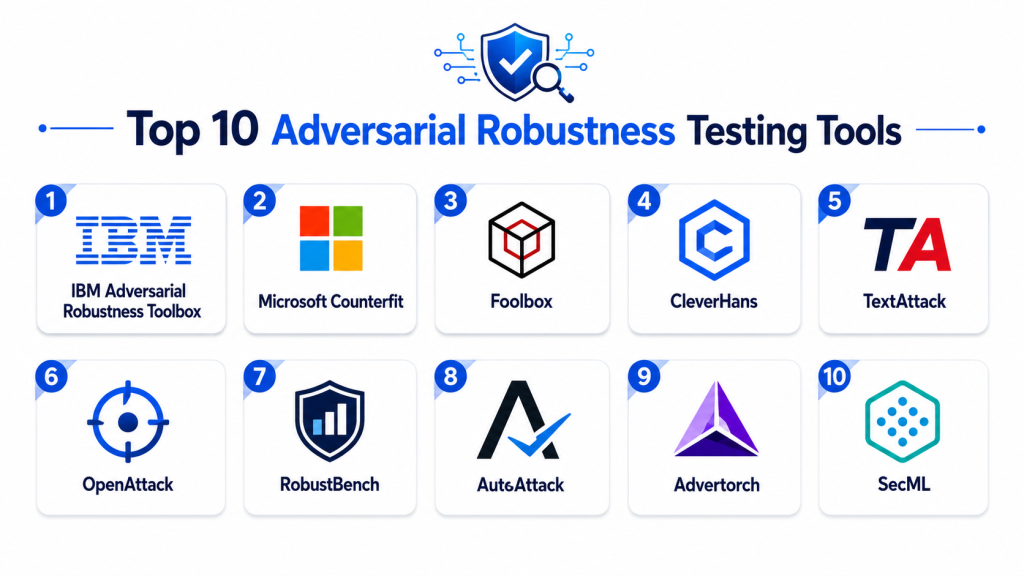
Top 10 Adversarial Robustness Testing Tools
1- IBM Adversarial Robustness Toolbox
Short description: IBM Adversarial Robustness Toolbox is one of the most widely used open-source libraries for testing and improving the robustness of machine learning models. It supports adversarial attacks, defenses, metrics, and evaluations across multiple data types and model frameworks.
Key Features
- Adversarial attack simulations
- Defense method support
- Robustness metrics
- Support for image, tabular, audio, and text workflows
- Integration with common ML frameworks
- Model-agnostic testing patterns
- Open-source experimentation support
Pros
- Strong attack and defense coverage
- Widely adopted in AI security research
- Useful for technical robustness validation
Cons
- Requires ML security expertise
- Business-friendly reporting must be built separately
- Production governance requires additional tooling
Platforms / Deployment
- Python / Linux / macOS / Windows
- Self-hosted / Hybrid
Security & Compliance
- Not publicly stated
- Security depends on deployment environment, data handling, and internal controls
Integrations & Ecosystem
IBM Adversarial Robustness Toolbox integrates with common machine learning frameworks and testing workflows.
- TensorFlow
- PyTorch
- scikit-learn
- Keras
- Jupyter notebooks
- Custom ML pipelines
Support & Community
Strong open-source community, research adoption, documentation, and practical usage among AI security and robustness practitioners.
2- CleverHans
Short description: CleverHans is an open-source library focused on adversarial machine learning research and robustness testing. It is commonly used by researchers and technical teams to experiment with adversarial examples and evaluate model vulnerabilities.
Key Features
- Adversarial example generation
- Attack method implementations
- Model robustness experiments
- Research-oriented workflows
- Deep learning model testing
- Python-based usage
- Benchmarking support patterns
Pros
- Strong research credibility
- Useful for adversarial ML experimentation
- Good for technical robustness studies
Cons
- More research-focused than enterprise-focused
- Requires technical expertise
- Limited governance and reporting features
Platforms / Deployment
- Python / Linux / macOS / Windows
- Self-hosted / Hybrid
Security & Compliance
- Not publicly stated
- Security depends on local deployment and data handling practices
Integrations & Ecosystem
CleverHans fits into adversarial ML research and technical validation workflows.
- TensorFlow workflows
- PyTorch patterns
- Python notebooks
- Deep learning experiments
- Research benchmarks
- Custom model testing
Support & Community
CleverHans has strong academic visibility, open-source support, and adoption in adversarial machine learning research.
3- Foolbox
Short description: Foolbox is an open-source Python toolbox for creating adversarial examples and evaluating robustness of machine learning models. It is useful for testing image classifiers and other ML models against common adversarial attack methods.
Key Features
- Adversarial example generation
- Multiple attack algorithms
- Robustness benchmarking
- Model framework compatibility
- Python-based workflows
- Attack comparison support
- Research and experimentation use
Pros
- Practical adversarial testing library
- Good for comparing attacks
- Useful for research and technical validation
Cons
- Primarily technical and developer-focused
- Requires knowledge of adversarial ML
- Enterprise reporting must be built separately
Platforms / Deployment
- Python / Linux / macOS / Windows
- Self-hosted / Hybrid
Security & Compliance
- Not publicly stated
- Security depends on deployment and data handling setup
Integrations & Ecosystem
Foolbox integrates with deep learning and Python ML workflows.
- PyTorch
- TensorFlow
- JAX patterns
- Python notebooks
- Image models
- Custom ML pipelines
Support & Community
Active open-source usage in adversarial ML experimentation, research projects, and model robustness testing.
4- TextAttack
Short description: TextAttack is an open-source framework for adversarial attacks, data augmentation, and robustness evaluation for natural language processing models. It is especially useful for teams testing text classifiers, transformers, and NLP pipelines.
Key Features
- NLP adversarial attacks
- Text perturbation strategies
- Data augmentation workflows
- Model robustness evaluation
- Attack recipes
- Transformer model support
- Benchmarking for NLP models
Pros
- Strong NLP adversarial testing focus
- Useful for text model robustness validation
- Good for testing language model vulnerabilities
Cons
- Focused mostly on NLP use cases
- Requires technical setup
- Enterprise governance features are limited
Platforms / Deployment
- Python / Linux / macOS / Windows
- Self-hosted / Hybrid
Security & Compliance
- Not publicly stated
- Security depends on deployment and data governance setup
Integrations & Ecosystem
TextAttack works well with modern NLP and transformer-based workflows.
- Hugging Face Transformers
- PyTorch
- TensorFlow patterns
- NLP classifiers
- Python notebooks
- Custom text pipelines
Support & Community
Strong open-source community in NLP robustness research, with documentation and practical examples for adversarial text testing.
5- OpenAI Evals
Short description: OpenAI Evals is an evaluation framework used to test AI model behavior, benchmark outputs, and create repeatable evaluation workflows for language model applications. It can support adversarial-style tests for prompts, outputs, and model behavior.
Key Features
- LLM evaluation workflows
- Custom test creation
- Prompt and output evaluation
- Regression testing patterns
- Benchmark-style evaluation
- Automated scoring workflows
- Language model behavior testing
Pros
- Useful for LLM evaluation and regression testing
- Flexible for custom adversarial test cases
- Good for prompt and output behavior analysis
Cons
- Not a traditional adversarial ML library
- Requires careful test design
- Security and governance depend on implementation
Platforms / Deployment
- Python / Developer environments
- Self-hosted / Hybrid
Security & Compliance
- Not publicly stated
- Security depends on deployment, model provider, and test data handling
Integrations & Ecosystem
OpenAI Evals fits into LLM application testing and model behavior evaluation workflows.
- LLM applications
- Prompt testing workflows
- Custom benchmarks
- Python pipelines
- CI/CD patterns
- Evaluation datasets
Support & Community
Open-source evaluation ecosystem with active use among AI developers building model tests and benchmark workflows.
6- Garak
Short description: Garak is an open-source LLM vulnerability scanner designed to test language models and applications for weaknesses such as jailbreaks, prompt injection patterns, data leakage, toxicity, hallucination risks, and unsafe behaviors.
Key Features
- LLM vulnerability scanning
- Jailbreak testing
- Prompt injection testing
- Data leakage checks
- Unsafe output testing
- Plugin-based probes
- Automated red-team style testing
Pros
- Strong focus on LLM security testing
- Useful for AI red teams and security teams
- Open-source and practical for generative AI workflows
Cons
- Primarily focused on LLM systems
- Test results require expert interpretation
- Enterprise reporting may require customization
Platforms / Deployment
- Python / CLI / Developer environments
- Self-hosted / Hybrid
Security & Compliance
- Not publicly stated
- Security depends on deployment, test data, and model access configuration
Integrations & Ecosystem
Garak integrates with language model testing and AI security workflows.
- LLM APIs
- Local models
- Prompt testing systems
- AI red team workflows
- Security validation pipelines
- Custom probes
Support & Community
Growing open-source community focused on LLM security, AI red teaming, and practical adversarial testing for generative AI.
7- Promptfoo
Short description: Promptfoo is an open-source evaluation and testing framework for prompts, LLM outputs, and AI workflows. It helps teams build adversarial test cases, compare models, run regression tests, and evaluate prompt robustness.
Key Features
- Prompt testing
- LLM output comparison
- Custom assertions
- Adversarial test cases
- Regression testing
- CI/CD integration
- Multi-provider model testing
Pros
- Practical for LLM application testing
- Good CI/CD compatibility
- Flexible custom evaluation logic
Cons
- Not a full adversarial ML library
- Requires carefully designed test cases
- Complex risk scoring may need custom evaluators
Platforms / Deployment
- Node.js / CLI / Developer environments
- Self-hosted / Hybrid
Security & Compliance
- Not publicly stated
- Security depends on deployment, model provider, and data handling process
Integrations & Ecosystem
Promptfoo integrates with prompt workflows, LLM providers, and developer pipelines.
- OpenAI-compatible providers
- Local models
- CI/CD pipelines
- Custom APIs
- Prompt workflows
- RAG systems
Support & Community
Growing open-source adoption, practical documentation, and strong usefulness for AI regression and prompt robustness testing.
8- Giskard
Short description: Giskard is an AI testing platform that helps teams evaluate ML and LLM applications for robustness, bias, hallucination risk, security issues, performance weaknesses, and data quality problems.
Key Features
- Robustness testing
- Bias and fairness checks
- LLM evaluation
- Hallucination detection
- Automated test generation
- Model quality dashboards
- AI risk testing workflows
Pros
- Broad AI quality and risk testing
- Useful for both ML and LLM systems
- Good automated test generation support
Cons
- Less specialized than dedicated adversarial ML libraries
- Enterprise governance depends on deployment
- Test design still needs expert review
Platforms / Deployment
- Python / Web / Enterprise infrastructure
- Cloud / Self-hosted / Hybrid options vary
Security & Compliance
- Access controls vary by deployment
- Governance and audit features vary by plan
- Security depends on hosting and implementation model
Integrations & Ecosystem
Giskard integrates with ML and LLM development workflows.
- Python ML workflows
- LLM applications
- RAG systems
- Evaluation datasets
- MLOps platforms
- Custom models
Support & Community
Growing adoption in AI testing, open-source resources, enterprise AI governance use cases, and responsible AI workflows.
9- Microsoft Counterfit
Short description: Microsoft Counterfit is an open-source automation tool for security testing of AI systems. It helps red teams and ML security practitioners test AI models against adversarial attacks and evaluate security weaknesses.
Key Features
- AI security testing
- Adversarial attack automation
- Red-team style workflows
- Model attack orchestration
- Security assessment support
- Python-based extensibility
- Integration with adversarial libraries
Pros
- Strong AI security orientation
- Useful for red teams and security practitioners
- Helps structure adversarial testing workflows
Cons
- Requires security and ML expertise
- Less suited for non-technical users
- Enterprise reporting requires additional tooling
Platforms / Deployment
- Python / CLI / Developer environments
- Self-hosted / Hybrid
Security & Compliance
- Not publicly stated
- Security depends on deployment, model access controls, and testing environment
Integrations & Ecosystem
Counterfit can work with adversarial ML testing workflows and security validation pipelines.
- Python ML systems
- Adversarial testing libraries
- Red team workflows
- Model APIs
- Security assessment pipelines
- Custom ML environments
Support & Community
Open-source support, technical documentation, and usage among AI security practitioners and red-team communities.
10- RobustBench
Short description: RobustBench is a benchmark platform for evaluating adversarial robustness of machine learning models, especially in computer vision. It provides standardized robustness benchmarks and model comparisons for researchers and technical teams.
Key Features
- Robustness benchmarks
- Standardized evaluation datasets
- Model comparison support
- Adversarial robustness leaderboards
- Computer vision robustness focus
- Reproducible testing patterns
- Research-oriented evaluation
Pros
- Strong benchmarking value
- Useful for comparing robustness methods
- Good research and validation support
Cons
- More benchmark-focused than full testing platform
- Primarily computer vision oriented
- Requires technical interpretation
Platforms / Deployment
- Python / Research environments
- Self-hosted / Hybrid
Security & Compliance
- Not publicly stated
- Security depends on local evaluation environment and data handling
Integrations & Ecosystem
RobustBench fits into robustness research and model comparison workflows.
- PyTorch workflows
- Computer vision models
- Research benchmarks
- Adversarial evaluation scripts
- Academic robustness testing
- Custom experiments
Support & Community
Strong research community visibility, reproducible benchmark focus, and use among adversarial robustness researchers.
Comparison Table
| Tool Name | Best For | Platforms Supported | Deployment | Standout Feature | Public Rating |
|---|---|---|---|---|---|
| IBM Adversarial Robustness Toolbox | Broad adversarial ML testing | Python environments | Self-hosted / Hybrid | Attack and defense coverage | N/A |
| CleverHans | Adversarial ML research | Python environments | Self-hosted / Hybrid | Research-grade adversarial examples | N/A |
| Foolbox | Robustness benchmarking | Python environments | Self-hosted / Hybrid | Attack comparison workflows | N/A |
| TextAttack | NLP adversarial testing | Python environments | Self-hosted / Hybrid | Text perturbation attacks | N/A |
| OpenAI Evals | LLM behavior testing | Python environments | Self-hosted / Hybrid | Custom LLM evaluations | N/A |
| Garak | LLM vulnerability scanning | Python / CLI | Self-hosted / Hybrid | Jailbreak and prompt injection testing | N/A |
| Promptfoo | Prompt robustness testing | Node.js / CLI | Self-hosted / Hybrid | CI/CD prompt regression tests | N/A |
| Giskard | AI robustness and risk testing | Python / Web | Cloud / Self-hosted / Hybrid options vary | Automated AI quality tests | N/A |
| Microsoft Counterfit | AI red-team security testing | Python / CLI | Self-hosted / Hybrid | Security-oriented attack automation | N/A |
| RobustBench | Robustness benchmarking | Python environments | Self-hosted / Hybrid | Standardized robustness benchmarks | N/A |
Evaluation & Scoring of Adversarial Robustness Testing Tools
| Tool Name | Core 25% | Ease 15% | Integrations 15% | Security 10% | Performance 10% | Support 10% | Value 15% | Weighted Total |
|---|---|---|---|---|---|---|---|---|
| IBM Adversarial Robustness Toolbox | 9.5 | 7.3 | 9.0 | 7.8 | 8.8 | 8.7 | 9.4 | 8.67 |
| CleverHans | 8.7 | 7.0 | 8.3 | 7.5 | 8.5 | 8.2 | 9.2 | 8.23 |
| Foolbox | 8.8 | 7.4 | 8.4 | 7.5 | 8.7 | 8.3 | 9.1 | 8.33 |
| TextAttack | 8.7 | 7.8 | 8.6 | 7.5 | 8.5 | 8.4 | 9.1 | 8.40 |
| OpenAI Evals | 8.4 | 8.0 | 8.7 | 7.7 | 8.4 | 8.5 | 8.9 | 8.39 |
| Garak | 8.9 | 7.8 | 8.5 | 7.7 | 8.6 | 8.3 | 9.1 | 8.48 |
| Promptfoo | 8.3 | 8.7 | 8.5 | 7.6 | 8.4 | 8.2 | 9.2 | 8.48 |
| Giskard | 8.8 | 8.0 | 8.4 | 8.2 | 8.5 | 8.4 | 8.6 | 8.52 |
| Microsoft Counterfit | 8.6 | 7.2 | 8.3 | 7.8 | 8.4 | 8.1 | 9.0 | 8.24 |
| RobustBench | 8.2 | 7.1 | 8.0 | 7.4 | 8.6 | 8.0 | 9.0 | 8.06 |
These scores are comparative and intended to help buyers evaluate practical fit rather than identify one universal winner. Traditional adversarial ML libraries are strongest for technical robustness research, while LLM-focused tools are better for prompt injection, jailbreak, and generative AI testing. Enterprise teams should combine automated tests, human review, security validation, and governance reporting for reliable AI risk management.
Which Adversarial Robustness Testing Tool Is Right for You?
Solo / Freelancer
Solo AI builders and independent researchers usually need open-source tools that are flexible and affordable. Foolbox, CleverHans, TextAttack, Promptfoo, Garak, and RobustBench are practical choices depending on whether the work involves image models, NLP models, or LLM applications.
SMB
SMBs usually need practical robustness testing without heavy platform investment. IBM Adversarial Robustness Toolbox, TextAttack, Promptfoo, Garak, and Giskard can help teams test model weaknesses, prompt robustness, and AI application risks.
Mid-Market
Mid-sized organizations often need more repeatable testing, CI/CD integration, model evaluation, and AI risk workflows. Giskard, Garak, Promptfoo, OpenAI Evals, and IBM Adversarial Robustness Toolbox are strong choices for building structured AI robustness testing programs.
Enterprise
Large enterprises usually require AI red teaming, governance evidence, risk documentation, security testing, auditability, and repeatable evaluation workflows. IBM Adversarial Robustness Toolbox, Microsoft Counterfit, Garak, Giskard, Promptfoo, and OpenAI Evals are strong options when integrated into internal security and MLOps processes.
Budget vs Premium
Open-source tools provide strong value for technical teams, especially when internal AI security expertise is available. Enterprise-grade workflows may require combining these tools with governance platforms, monitoring tools, documentation systems, and human review processes.
Feature Depth vs Ease of Use
IBM Adversarial Robustness Toolbox provides broad ML attack and defense coverage but requires expertise. Promptfoo is easier for LLM prompt testing. Garak is strong for LLM vulnerability scanning. TextAttack is strong for NLP robustness, while Foolbox and CleverHans are strong for traditional adversarial ML experimentation.
Integrations & Scalability
Teams working with image models should prioritize IBM Adversarial Robustness Toolbox, Foolbox, CleverHans, and RobustBench. Teams working with NLP should evaluate TextAttack. Teams building LLM applications should prioritize Garak, Promptfoo, OpenAI Evals, and Giskard.
Security & Compliance Needs
Security-focused teams should prioritize isolated test environments, access controls, logging, repeatable test evidence, model inventory alignment, red-team workflows, and safe handling of sensitive test prompts or datasets. Robustness testing should be part of release gates, not only a one-time review.
Frequently Asked Questions
1. What is an Adversarial Robustness Testing Tool?
An Adversarial Robustness Testing Tool helps teams evaluate how AI models behave when exposed to manipulated, noisy, malicious, or unexpected inputs. It tests whether models are stable and secure under stress.
2. Why is adversarial robustness important?
Robustness matters because models can fail when attackers slightly alter inputs or exploit weaknesses. These failures can cause wrong predictions, security gaps, unsafe outputs, or unreliable user experiences.
3. What is an adversarial example?
An adversarial example is an input intentionally modified to fool a model while appearing normal or only slightly changed to humans. These examples are common in computer vision, NLP, and AI security research.
4. What is prompt injection testing?
Prompt injection testing evaluates whether an LLM application can be manipulated through malicious instructions, hidden prompts, user text, documents, or retrieved content that attempts to override system behavior.
5. What is jailbreak testing?
Jailbreak testing checks whether users can bypass safety rules or intended restrictions in a generative AI system. It is commonly used in AI red teaming and LLM security validation.
6. What are common robustness testing mistakes?
Common mistakes include testing only normal validation data, ignoring LLM-specific attacks, using unrealistic adversarial inputs, skipping human review, failing to retest after model changes, and not documenting results.
7. Can adversarial testing improve model security?
Yes. It can reveal weaknesses before deployment, guide model hardening, improve prompts and guardrails, validate defenses, and help teams design safer AI systems.
8. Are these tools only for deep learning models?
No. Many tools focus on deep learning, but robustness testing can also apply to NLP systems, tabular models, fraud systems, recommender systems, search systems, and LLM applications.
9. What integrations are most important?
Important integrations include ML frameworks, LLM providers, CI/CD pipelines, MLOps platforms, model registries, evaluation datasets, monitoring systems, red-team workflows, and governance platforms.
10. What should buyers evaluate before choosing a tool?
Buyers should evaluate supported model types, attack coverage, LLM security support, automation, reporting, integration options, ease of use, security controls, scalability, and alignment with internal AI risk processes.
Conclusion
Adversarial Robustness Testing Tools are essential for organizations that want to deploy AI systems safely, securely, and reliably in real-world environments. The right tool can help teams uncover hidden vulnerabilities, test model stability, evaluate prompt injection risks, reduce jailbreak exposure, validate defenses, and create stronger evidence for AI governance reviews. IBM Adversarial Robustness Toolbox is a strong broad-spectrum option for traditional adversarial ML testing, while CleverHans, Foolbox, and RobustBench are valuable for technical robustness research. TextAttack is especially useful for NLP robustness, while Garak, Promptfoo, OpenAI Evals, and Giskard are strong choices for LLM and generative AI testing workflows. Microsoft Counterfit is useful for AI red-team security testing and structured adversarial assessments. The best choice depends on model type, threat model, technical maturity, security requirements, and governance expectations. Shortlist two or three tools, test them against realistic adversarial scenarios, validate findings with human review, integrate checks into release workflows, and make robustness testing a continuous part of the AI lifecycle.