Introduction
Secure Data Enclaves are protected computing environments where sensitive data can be processed, analyzed, shared, or used for AI workloads without exposing the raw data to unauthorized users, infrastructure operators, or external collaborators. These environments commonly use controls such as trusted execution environments, confidential computing, encryption, access policies, audit logs, privacy-preserving computation, and controlled data collaboration workflows.
They matter because organizations now need to collaborate on sensitive datasets, run analytics on regulated information, and use AI models without unnecessarily exposing confidential data. Secure enclaves can help protect data while it is actively being processed, which is often harder than protecting data at rest or in transit. Trusted execution environments isolate workloads while they run, and attestation can help verify that approved code is running in a protected environment.
Real-world use cases include:
- Secure analytics on regulated healthcare or financial data
- Privacy-preserving collaboration between companies
- Confidential AI inference and model evaluation
- Secure data clean rooms for advertising and customer analytics
- Protected research environments for sensitive datasets
Buyers evaluating Secure Data Enclaves should consider:
- Confidential computing and TEE support
- Data clean room and collaboration features
- Access control and identity integration
- Data residency and sovereignty controls
- Audit logs and attestation evidence
- Support for analytics, AI, and data science workflows
- Integration with cloud warehouses and data lakes
- Privacy-preserving computation methods
- Deployment flexibility across cloud, hybrid, and self-hosted environments
- Governance, compliance, and operational maturity
Best for: Security teams, privacy teams, data governance teams, AI teams, analytics teams, healthcare organizations, financial institutions, research groups, government agencies, advertising teams, and enterprises collaborating on sensitive data.
Not ideal for: Small teams with low-risk datasets, simple internal dashboards, or organizations that do not need confidential computation, external collaboration, audit evidence, or strong data isolation.
Key Trends in Secure Data Enclaves
- Confidential computing is becoming more important as enterprises look for stronger protection for data while it is actively processed.
- AI workloads are increasing demand for secure inference, private retrieval, confidential prompts, protected model weights, and auditable execution.
- Data clean rooms are expanding as organizations need privacy-safe collaboration without exposing raw customer or partner data.
- Cryptographic attestation is becoming important because security and audit teams need proof that workloads ran inside approved protected environments.
- Cloud providers are expanding confidential computing options across virtual machines, containers, Kubernetes, and AI infrastructure.
- Privacy-enhancing technologies such as secure multiparty computation and differential privacy are becoming more connected with secure enclave workflows.
- Data sovereignty requirements are increasing demand for architectures that limit infrastructure provider visibility.
- Secure analytics environments are becoming important for research, healthcare, public sector, and financial services.
- Enterprises are moving from policy-only data sharing to technically enforced collaboration controls.
- Developer-friendly enclave platforms are emerging to reduce the complexity of deploying applications into trusted execution environments.
How We Selected These Tools
The tools in this list were selected based on secure data collaboration depth, confidential computing support, enterprise adoption, governance features, privacy controls, analytics compatibility, and practical fit for sensitive data environments.
Selection criteria included:
- Secure enclave or confidential computing capabilities
- Data clean room and privacy-preserving collaboration support
- Access control, audit logs, and governance workflows
- Cloud, hybrid, and self-hosted deployment flexibility
- Support for analytics, AI, and data science workflows
- Integration with data warehouses, lakes, and cloud platforms
- Attestation, encryption, and isolation capabilities
- Enterprise security and compliance readiness
- Developer and data team usability
- Practical fit for regulated and privacy-sensitive use cases
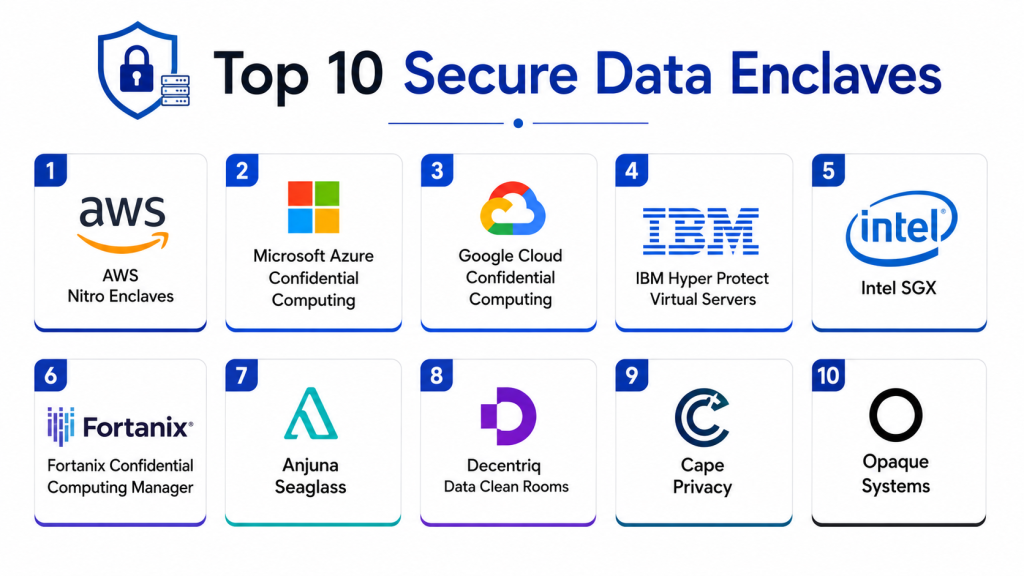
Top 10 Secure Data Enclaves
1- AWS Clean Rooms
Short description: AWS Clean Rooms helps organizations collaborate on datasets without directly sharing raw underlying data. It is useful for privacy-safe analytics, partner collaboration, advertising measurement, customer insights, and controlled multi-party data analysis inside the AWS ecosystem.
Key Features
- Privacy-preserving data collaboration
- Configurable analysis rules
- Multi-party collaboration workflows
- Query controls
- AWS ecosystem integration
- Clean room analytics support
- Access and permission management
Pros
- Strong fit for AWS-based organizations
- Useful for partner and customer analytics collaboration
- Reduces need to move or expose raw data
Cons
- Best suited for AWS environments
- Advanced collaboration design requires planning
- Not a general-purpose confidential computing platform
Platforms / Deployment
- AWS Cloud / Data collaboration environments
- Cloud
Security & Compliance
- IAM integration
- Encryption
- Audit logging through AWS services
- Access controls
- Query and collaboration controls
- Compliance support depends on AWS configuration
Integrations & Ecosystem
AWS Clean Rooms fits organizations already using AWS data, analytics, and security services. It is most valuable when collaborators need controlled analytics without direct raw data exchange.
- Amazon S3
- AWS Glue
- AWS Identity and Access Management
- AWS analytics workflows
- Advertising and marketing analytics
- Partner data collaboration
Support & Community
AWS provides documentation, enterprise support plans, cloud architecture guidance, and a broad security and analytics partner ecosystem.
2- Snowflake Data Clean Rooms
Short description: Snowflake Data Clean Rooms enables organizations to collaborate with partners using governed datasets inside the Snowflake ecosystem. It is useful for privacy-safe analytics, data collaboration, marketing measurement, and secure business intelligence workflows.
Key Features
- Governed data collaboration
- Clean room analytics
- Controlled query workflows
- Data sharing controls
- Role-based governance
- Snowflake-native integration
- Privacy-safe partner collaboration
Pros
- Strong fit for Snowflake customers
- Good governed data sharing experience
- Useful for analytics and marketing collaboration
Cons
- Best suited for Snowflake-centered data stacks
- Requires clean room design and governance planning
- Not focused on general TEE-based workload isolation
Platforms / Deployment
- Snowflake Cloud Data Platform
- Cloud
Security & Compliance
- RBAC
- Encryption
- Access controls
- Audit logging
- Data governance controls
- Compliance support depends on Snowflake configuration
Integrations & Ecosystem
Snowflake Data Clean Rooms works well when organizations already use Snowflake for data warehousing, analytics, and partner data sharing.
- Snowflake data sharing
- BI tools
- Marketing analytics workflows
- Partner datasets
- Data governance processes
- Enterprise analytics teams
Support & Community
Snowflake provides documentation, enterprise support, partner resources, and a strong data collaboration ecosystem.
3- Databricks Clean Rooms
Short description: Databricks Clean Rooms helps organizations collaborate on data and AI workloads without exposing raw data unnecessarily. It is useful for teams that need privacy-preserving analytics, ML collaboration, and governed sharing across lakehouse environments.
Key Features
- Privacy-safe data collaboration
- Lakehouse integration
- Analytics and AI workflow support
- Controlled access policies
- Collaborative query workflows
- Governance through Unity Catalog
- Partner data sharing support
Pros
- Strong fit for lakehouse and AI teams
- Useful for analytics and machine learning collaboration
- Good governance alignment for Databricks users
Cons
- Best suited for Databricks environments
- Requires governance setup
- May be more complex than simple data sharing
Platforms / Deployment
- Databricks Lakehouse environments
- Cloud
Security & Compliance
- RBAC
- Unity Catalog governance
- Encryption
- Audit logging
- Access controls
- Compliance depends on deployment configuration
Integrations & Ecosystem
Databricks Clean Rooms fits organizations that need secure collaboration across analytics, AI, and data science workflows.
- Databricks Lakehouse
- Unity Catalog
- ML workflows
- Partner analytics
- Data sharing workflows
- BI and analytics platforms
Support & Community
Databricks provides enterprise support, documentation, training resources, and a strong data engineering and AI ecosystem.
4- Microsoft Azure Confidential Computing
Short description: Microsoft Azure Confidential Computing provides infrastructure and services for running workloads in hardware-backed trusted execution environments. It is useful for organizations that need stronger protection for data in use, confidential AI, secure analytics, and regulated workloads.
Key Features
- Confidential virtual machines
- Trusted execution environment support
- Secure enclave workloads
- Attestation support
- Kubernetes and container patterns
- Confidential AI workload support
- Azure security ecosystem integration
Pros
- Strong fit for Microsoft and Azure environments
- Good infrastructure-level confidential computing support
- Useful for regulated and high-security workloads
Cons
- Requires cloud architecture expertise
- Application compatibility must be validated
- Not a clean room solution by itself
Platforms / Deployment
- Azure Cloud / Confidential VMs / Kubernetes patterns
- Cloud / Hybrid options vary
Security & Compliance
- Microsoft Entra ID integration
- RBAC
- Encryption
- Audit logging
- Attestation support
- Azure compliance controls
Integrations & Ecosystem
Azure Confidential Computing integrates with Microsoft cloud, identity, security, and AI workflows.
- Azure Kubernetes Service
- Azure Machine Learning
- Azure confidential virtual machines
- Microsoft security tools
- Enterprise identity systems
- Confidential AI applications
Support & Community
Microsoft provides enterprise support, documentation, architecture guidance, partner resources, and security engineering support.
5- Google Cloud Confidential Space
Short description: Google Cloud Confidential Space helps organizations run workloads in a protected environment where data can be processed with stronger isolation and reduced exposure. It is useful for secure collaboration, privacy-preserving analytics, and confidential computing use cases on Google Cloud.
Key Features
- Confidential workload execution
- Data collaboration support patterns
- Attestation workflows
- Google Cloud integration
- Protected processing environments
- Policy-based access patterns
- Secure analytics use cases
Pros
- Strong Google Cloud confidential computing fit
- Useful for secure multi-party data processing
- Good fit for privacy-sensitive analytics workflows
Cons
- Best suited for Google Cloud environments
- Requires architecture and policy planning
- Advanced use cases need technical expertise
Platforms / Deployment
- Google Cloud confidential computing environments
- Cloud
Security & Compliance
- IAM integration
- Encryption
- Audit logging
- Attestation support
- Cloud access controls
- Compliance support depends on configuration
Integrations & Ecosystem
Google Cloud Confidential Space fits secure data collaboration and confidential workload scenarios within Google Cloud.
- Google Cloud Storage
- BigQuery workflows
- Vertex AI patterns
- Confidential VMs
- Cloud IAM
- Secure data collaboration workflows
Support & Community
Google Cloud provides documentation, enterprise support, security architecture resources, and cloud engineering guidance.
6- Opaque Systems
Short description: Opaque Systems provides a confidential computing platform for secure data analytics and AI workloads. It is designed to help organizations run collaborative analytics on sensitive data while keeping data protected through confidential computing technologies.
Key Features
- Confidential analytics
- Secure data collaboration
- Trusted execution environment support
- Privacy-preserving data processing
- AI and ML workflow support
- Data protection during processing
- Enterprise deployment options
Pros
- Strong focus on confidential analytics
- Useful for regulated and collaborative data workloads
- Good fit for privacy-sensitive AI and analytics teams
Cons
- Requires confidential computing architecture planning
- May be more specialized than general analytics platforms
- Enterprise integration needs careful evaluation
Platforms / Deployment
- Cloud / Kubernetes / Enterprise data environments
- Cloud / Self-hosted / Hybrid options vary
Security & Compliance
- Confidential computing
- Encryption
- Access controls
- Attestation support varies by architecture
- Governance capabilities vary by deployment
Integrations & Ecosystem
Opaque Systems is useful when teams need secure data analytics over sensitive datasets without unnecessary exposure.
- Data lakes
- Analytics workflows
- AI and ML pipelines
- Cloud infrastructure
- Kubernetes environments
- Secure collaboration workflows
Support & Community
Enterprise support, documentation, and confidential computing expertise are available through Opaque Systems.
7- Decentriq
Short description: Decentriq provides data clean room and confidential computing solutions for privacy-preserving collaboration. It is useful for organizations that need to collaborate on sensitive datasets while maintaining strong controls over raw data exposure.
Key Features
- Data clean rooms
- Confidential computing support
- Privacy-preserving analytics
- Partner collaboration workflows
- Controlled data access
- Secure computation patterns
- Audit and governance support
Pros
- Strong focus on secure data collaboration
- Useful for analytics and partner data sharing
- Good fit for privacy-sensitive industries
Cons
- Specialized platform category
- Collaboration model requires planning
- May need integration with existing data platforms
Platforms / Deployment
- Web / Data collaboration environments
- Cloud / Hybrid options vary
Security & Compliance
- Access controls
- Encryption
- Confidential computing support
- Audit workflows
- Governance controls vary by deployment
Integrations & Ecosystem
Decentriq fits privacy-preserving collaboration scenarios across enterprise, public sector, healthcare, financial, and advertising analytics workflows.
- Partner analytics
- Data clean rooms
- Data collaboration workflows
- Cloud data platforms
- Governance systems
- Secure analytics processes
Support & Community
Decentriq provides documentation, enterprise support, and privacy-preserving collaboration guidance.
8- Anjuna
Short description: Anjuna provides confidential computing software that helps organizations run applications in secure enclaves without extensive application rewrites. It is useful for teams that want to protect sensitive workloads in cloud, container, and enterprise environments.
Key Features
- Confidential computing software
- Secure enclave workload support
- Application shielding
- Cloud workload protection
- Container and Kubernetes patterns
- Data-in-use protection
- Enterprise deployment support
Pros
- Strong focus on workload protection
- Useful for cloud and Kubernetes security
- Helps reduce application rewrite burden
Cons
- Requires confidential computing infrastructure
- Best suited for technical teams
- Integration planning is important
Platforms / Deployment
- Cloud infrastructure / Kubernetes / Enterprise workloads
- Cloud / Self-hosted / Hybrid options vary
Security & Compliance
- Confidential computing
- Encryption
- Access controls
- Attestation support depends on architecture
- Enterprise security controls vary by deployment
Integrations & Ecosystem
Anjuna fits organizations that want to run existing workloads inside confidential computing environments.
- Cloud platforms
- Kubernetes
- Enterprise applications
- Secure analytics workflows
- AI workloads
- Confidential computing infrastructure
Support & Community
Enterprise support, technical implementation guidance, documentation, and confidential computing expertise are available.
9- Fortanix Confidential Computing Manager
Short description: Fortanix Confidential Computing Manager helps organizations manage applications running inside trusted execution environments. It is useful for enterprises that need secure workload deployment, attestation, key management, and confidential computing operations.
Key Features
- Confidential computing management
- Trusted execution environment orchestration
- Application attestation
- Key management integration
- Secure workload deployment
- Policy and access controls
- Enterprise security workflows
Pros
- Strong confidential computing operations focus
- Useful for attestation and workload management
- Good fit for regulated workloads
Cons
- Requires technical security expertise
- Best suited for teams already adopting confidential computing
- Broader data collaboration workflows may need additional tools
Platforms / Deployment
- Enterprise workloads / Cloud confidential computing environments
- Cloud / Self-hosted / Hybrid options vary
Security & Compliance
- Attestation support
- Encryption
- Access controls
- Key management
- Audit logging
- Governance controls vary by deployment
Integrations & Ecosystem
Fortanix fits confidential computing programs where secure workload lifecycle management and attestation are important.
- Cloud confidential computing
- Key management systems
- Enterprise applications
- Secure AI workflows
- Regulated workloads
- Data protection programs
Support & Community
Fortanix provides enterprise support, technical documentation, implementation guidance, and security expertise.
10- Duality Technologies
Short description: Duality Technologies focuses on privacy-enhancing technologies that help organizations collaborate and compute on sensitive data while reducing raw data exposure. It is useful for secure analytics, regulated collaboration, and privacy-preserving data science workflows.
Key Features
- Privacy-preserving computation
- Secure collaboration workflows
- Sensitive data analytics
- Data sharing controls
- Privacy-enhancing technology support
- Analytics and research workflows
- Enterprise deployment options
Pros
- Strong focus on privacy-preserving collaboration
- Useful for regulated and multi-party analytics
- Good fit for research and sensitive data environments
Cons
- Specialized use cases require planning
- May be less familiar to general analytics teams
- Integration complexity depends on data environment
Platforms / Deployment
- Enterprise data collaboration environments
- Cloud / Hybrid options vary
Security & Compliance
- Privacy-preserving computation
- Access controls
- Encryption support
- Audit and governance features vary by deployment
Integrations & Ecosystem
Duality Technologies fits organizations that need secure analytics and collaboration without exposing sensitive raw datasets.
- Data collaboration workflows
- Secure analytics environments
- Research partnerships
- Financial data analysis
- Healthcare analytics
- Privacy engineering workflows
Support & Community
Enterprise support, privacy technology expertise, implementation guidance, and customer success resources are available.
Comparison Table
| Tool Name | Best For | Platforms Supported | Deployment | Standout Feature | Public Rating |
|---|---|---|---|---|---|
| AWS Clean Rooms | AWS data collaboration | AWS Cloud / Data collaboration workflows | Cloud | Privacy-safe partner analytics | N/A |
| Snowflake Data Clean Rooms | Snowflake data sharing | Snowflake Cloud Data Platform | Cloud | Governed clean room analytics | N/A |
| Databricks Clean Rooms | Lakehouse AI and analytics collaboration | Databricks Lakehouse | Cloud | Clean rooms with AI and lakehouse workflows | N/A |
| Azure Confidential Computing | Confidential cloud workloads | Azure Cloud / Kubernetes patterns | Cloud / Hybrid options vary | Trusted execution environments | N/A |
| Google Cloud Confidential Space | Secure cloud collaboration | Google Cloud confidential environments | Cloud | Attested confidential workload execution | N/A |
| Opaque Systems | Confidential analytics | Cloud / Kubernetes / Data environments | Cloud / Self-hosted / Hybrid options vary | TEE-based secure analytics | N/A |
| Decentriq | Privacy-preserving clean rooms | Web / Data collaboration environments | Cloud / Hybrid options vary | Confidential data collaboration | N/A |
| Anjuna | Secure enclave workload protection | Cloud / Kubernetes / Enterprise workloads | Cloud / Self-hosted / Hybrid options vary | Application shielding in enclaves | N/A |
| Fortanix Confidential Computing Manager | Enclave workload lifecycle management | Cloud confidential computing environments | Cloud / Self-hosted / Hybrid options vary | Attestation and enclave management | N/A |
| Duality Technologies | Privacy-enhancing collaboration | Enterprise collaboration environments | Cloud / Hybrid options vary | Privacy-preserving computation | N/A |
Evaluation and Scoring of Secure Data Enclaves
| Tool Name | Core 25% | Ease 15% | Integrations 15% | Security 10% | Performance 10% | Support 10% | Value 15% | Weighted Total |
|---|---|---|---|---|---|---|---|---|
| AWS Clean Rooms | 8.8 | 8.3 | 9.0 | 9.0 | 8.6 | 8.8 | 8.3 | 8.68 |
| Snowflake Data Clean Rooms | 8.9 | 8.4 | 9.1 | 9.0 | 8.7 | 8.8 | 8.2 | 8.72 |
| Databricks Clean Rooms | 8.8 | 8.1 | 9.0 | 9.0 | 8.8 | 8.7 | 8.2 | 8.66 |
| Azure Confidential Computing | 9.2 | 7.8 | 9.0 | 9.3 | 8.8 | 8.9 | 8.1 | 8.78 |
| Google Cloud Confidential Space | 9.0 | 7.9 | 8.8 | 9.2 | 8.7 | 8.7 | 8.1 | 8.65 |
| Opaque Systems | 8.9 | 7.7 | 8.5 | 9.2 | 8.6 | 8.4 | 8.0 | 8.50 |
| Decentriq | 8.8 | 8.0 | 8.5 | 9.0 | 8.5 | 8.4 | 8.1 | 8.50 |
| Anjuna | 8.7 | 7.6 | 8.6 | 9.1 | 8.6 | 8.5 | 8.0 | 8.45 |
| Fortanix Confidential Computing Manager | 8.8 | 7.5 | 8.6 | 9.3 | 8.6 | 8.6 | 7.9 | 8.50 |
| Duality Technologies | 8.6 | 7.8 | 8.3 | 9.0 | 8.4 | 8.3 | 8.0 | 8.35 |
These scores are comparative and intended to help buyers evaluate practical fit rather than identify one universal winner. Data clean room platforms are strongest for controlled analytics collaboration, while confidential computing platforms are stronger for protecting workloads and data in use. Privacy-enhancing technology platforms are best when organizations need advanced multi-party computation or collaboration patterns beyond standard data sharing.
Which Secure Data Enclave Tool Is Right for You?
Solo / Freelancer
Solo consultants and small technical teams usually do not need a full enterprise secure data enclave unless they handle sensitive client data or regulated analytics. For lightweight use cases, cloud-native confidential computing or tightly controlled clean room features may be enough.
SMB
SMBs should prioritize ease of deployment and compatibility with their existing cloud or warehouse. AWS Clean Rooms, Snowflake Data Clean Rooms, Databricks Clean Rooms, or cloud-native confidential computing can be practical depending on whether the main need is partner analytics or secure workload processing.
Mid-Market
Mid-sized organizations often need controlled collaboration, audit logs, role-based access, and secure analytics. Snowflake, Databricks, AWS Clean Rooms, Azure Confidential Computing, Decentriq, and Opaque Systems are strong options depending on architecture and privacy requirements.
Enterprise
Large enterprises usually need data sovereignty, governance, attestation, compliance evidence, confidential workloads, secure AI, and partner collaboration controls. Azure Confidential Computing, Google Cloud Confidential Space, Fortanix, Anjuna, Opaque Systems, AWS Clean Rooms, Snowflake, and Databricks are strong enterprise-focused options.
Budget vs Premium
Cloud-native clean rooms may be cost-effective when teams already use the same cloud or warehouse ecosystem. Specialized confidential computing and privacy-enhancing platforms may require more budget and expertise but provide deeper security controls for high-risk workloads.
Feature Depth vs Ease of Use
Data clean rooms are easier for analytics collaboration. Confidential computing platforms provide deeper workload isolation but require more engineering. Privacy-enhancing technology platforms provide stronger collaboration privacy for complex use cases but need careful data and workflow design.
Integrations and Scalability
Organizations should prioritize integration with existing cloud platforms, data warehouses, identity providers, BI tools, AI platforms, data catalogs, governance systems, and audit workflows. Secure enclaves are most effective when embedded into normal analytics and AI workflows rather than treated as isolated projects.
Security and Compliance Needs
Security-focused organizations should prioritize encryption, RBAC, attestation, audit logs, policy enforcement, data residency, least-privilege access, workload isolation, and evidence collection. Regulated teams should validate whether enclave controls can produce audit-ready proof of how data was accessed, processed, and protected.
Frequently Asked Questions
1. What is a Secure Data Enclave?
A Secure Data Enclave is a controlled environment where sensitive data can be processed, analyzed, or shared with stronger security and governance controls. It helps limit raw data exposure while supporting analytics, AI, or collaboration.
2. How is a secure enclave different from a data clean room?
A secure enclave often refers to protected computation or workload isolation, while a data clean room usually focuses on controlled data collaboration and analytics between parties. Many modern solutions combine elements of both.
3. What is confidential computing?
Confidential computing protects data while it is actively being processed by running workloads inside hardware-isolated environments. This helps reduce exposure to infrastructure, administrators, and surrounding systems.
4. What is a trusted execution environment?
A trusted execution environment is an isolated area where code and data can run with stronger protection from the rest of the system. It is commonly used to protect sensitive workloads and data in use.
5. What is attestation?
Attestation is a verification process that helps prove a workload is running in an approved trusted environment with expected code and configuration. It gives security and audit teams stronger evidence than policy statements alone.
6. What are common secure enclave use cases?
Common use cases include healthcare research, financial risk modeling, secure AI inference, privacy-safe marketing analytics, public sector data collaboration, fraud detection, and sensitive partner analytics.
7. Can secure data enclaves support AI workloads?
Yes. Secure data enclaves can support confidential AI workflows such as private inference, protected prompts, secure retrieval, model evaluation, and sensitive data processing with reduced exposure.
8. What are common implementation mistakes?
Common mistakes include choosing a tool before defining data access policies, ignoring attestation requirements, underestimating performance testing, weak identity controls, unclear partner permissions, and poor audit evidence collection.
9. What integrations are most important?
Important integrations include cloud platforms, data warehouses, data lakes, identity providers, BI tools, AI platforms, data catalogs, key management systems, SIEM platforms, and governance workflows.
10. What should buyers evaluate before choosing a platform?
Buyers should evaluate enclave isolation, clean room controls, attestation, performance, integration depth, data residency, audit logs, privacy controls, deployment flexibility, support quality, and total operating cost.
Conclusion
Secure Data Enclaves are becoming essential for organizations that need to analyze, collaborate on, or use sensitive data without unnecessary exposure. The right platform can help protect data during processing, support privacy-safe collaboration, improve audit readiness, enable confidential AI workflows, and reduce risk when working with regulated or partner datasets. AWS Clean Rooms, Snowflake Data Clean Rooms, and Databricks Clean Rooms are strong choices for governed analytics collaboration, while Azure Confidential Computing and Google Cloud Confidential Space are better suited for confidential workload execution. Opaque Systems, Decentriq, Anjuna, Fortanix, and Duality Technologies provide specialized options for confidential analytics, enclave management, and privacy-preserving computation. The best choice depends on whether the organization needs clean room collaboration, trusted execution environments, confidential AI, secure analytics, or privacy-enhancing computation. Shortlist two or three platforms, test them with real sensitive data workflows, validate identity and access policies, measure performance, review attestation and audit evidence, and ensure the selected solution fits your long-term data privacy, security, and AI governance strategy.