Introduction
Imagine you are walking through a massive, busy marketplace. With thousands of shops, it is nearly impossible to know if the entire market is having a “good day” or a “bad day” just by looking at one or two stalls. You need a summary—a single indicator that tells you how the market as a whole is performing.
In the Indian stock market, that indicator is the Nifty. For beginners, the stock market can feel like a labyrinth of numbers, charts, and complex jargon. However, understanding the Nifty is your first step toward decoding this complexity. Whether you are a student, a new investor, or a curious professional, grasping the basics of Nifty helps you move from “guessing” to “analyzing.” This blog explains what is Nifty and how does it work, ensuring you have the foundational knowledge to navigate your investment journey with confidence.
What Is Nifty?
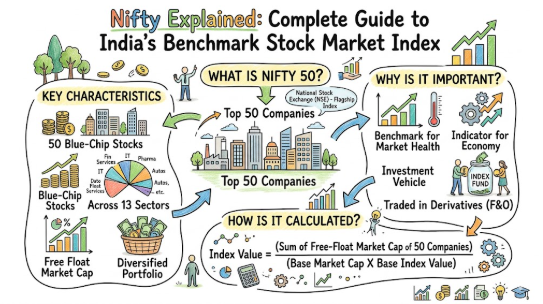
The term Nifty (short for National Stock Exchange Fifty) refers to the flagship index of the National Stock Exchange (NSE) in India. Specifically known as the Nifty 50, it tracks the performance of 50 of the largest, most liquid, and well-established companies listed on the NSE.
Think of it as a “representative sample” of the Indian economy. Instead of tracking thousands of individual stocks, you look at the Nifty 50 to get an instant snapshot of how the market is trending. If the Nifty is up, it generally means the majority of the top-performing companies in India are seeing positive investor sentiment.
Why This Matters
Understanding the Nifty is crucial because it serves as the benchmark for the entire Indian stock market.
- Performance Gauge: It tells you if your own investments are performing better or worse than the broader market.
- Economic Pulse: It reflects investor confidence in major sectors like banking, IT, and energy.
- Decision Making: It helps in timing investments and setting expectations for long-term growth.
Example: If you hold a mutual fund, its performance is often compared against the Nifty. If the Nifty gives a 12% return and your fund gives 8%, you know your fund is underperforming.
Detailed Breakdown of the Topic
Stock Basics and Indices
An index is a statistical measure of changes in a portfolio of stocks. The Nifty 50 acts as an index that provides a balanced view of the market. It covers diverse sectors, ensuring that a slump in one industry (like IT) can be offset by a rise in another (like banking).
The “Free-Float” Methodology
The Nifty 50 uses a Free-Float Market Capitalization method. This means it only considers shares that are available for the public to trade. It excludes shares held by company promoters or governments. This makes the index more realistic because it reflects only the shares that actually move the market.
Step-by-Step Guide to Understanding Nifty
- Monitor the Index Daily: Start by checking the Nifty 50 value on a reliable finance portal.
- Understand Sector Weights: Realize that companies like HDFC Bank or Reliance Industries have a higher impact because of their size.
- Compare Benchmarks: Always compare your portfolio returns against the Nifty to see if you are truly beating the market.
- Analyze News Impact: Notice how major political or economic announcements cause the Nifty to fluctuate.
- Use Index Funds: If you are a beginner, consider investing in Nifty 50 Index funds, which mirror the index’s performance.
- Maintain Long-Term View: Don’t react to daily dips; look at the trend over months or years.
Practical Real-Life Examples
- Situation: A investor panics because the market dropped 1%. Mistake: Selling everything. Action: Checking Nifty components; if the drop is broad-based, they stay calm and hold for the long term.
- Situation: Choosing a stock to buy. Mistake: Picking a random small company. Action: Looking at the Nifty 50 list to find established, reliable businesses.
- Situation: Measuring success. Mistake: Thinking 10% returns are great. Action: Comparing it to Nifty; if Nifty did 15%, the investor realizes they need to improve their strategy.
- Situation: Diversifying. Mistake: Buying only bank stocks. Action: Investing in an Nifty ETF to get exposure to 13 different sectors.
- Situation: Handling volatility. Mistake: Trying to time the market. Action: Investing fixed amounts regularly (SIP) regardless of Nifty’s daily level.
Common Problems Readers Face
- Information Overload: Being overwhelmed by daily market news.
- Emotional Decision Making: Buying high and selling low out of fear.
- Unrealistic Expectations: Expecting the Nifty to go up every single day.
- Ignoring Transaction Costs: Failing to account for brokerage and taxes.
Mistakes to Avoid
- Trading on “Tips”: Following social media influencers blindly instead of researching index components.
- Over-leveraging: Borrowing money to invest in the market.
- Ignoring Diversification: Putting all your money into one sector.
- Panic Selling: Exiting your positions during temporary market corrections.
“Don’t Do This” Checklist:
- Don’t invest based on rumors.
- Don’t use money needed for emergencies.
- Don’t ignore the long-term historical data of the Nifty 50.
Comparison and Strategy Tables
Table 1: Investing vs. Trading via Nifty
| Feature | Investing in Nifty (Index Fund) | Trading Nifty (Derivatives) |
| Goal | Long-term wealth creation | Short-term profit from volatility |
| Risk | Moderate | Very High |
| Time Commitment | Minimal | High |
| Strategy | Buy and hold (SIP) | Technical analysis and market timing |
Table 2: Beginner Mistake vs. Correct Approach
| Situation | Beginner Mistake | Correct Approach |
| Market Volatility | Panic sell and exit | Stay invested and review the long-term trend |
| Asset Choice | Choosing obscure, volatile stocks | Investing in top 50 blue-chip companies |
| Research | Relying on social media tips | Analyzing sectoral weights in the Nifty |
Tools and Methods
- SIP Calculator: To plan your long-term wealth using Nifty index funds.
- Stock Watchlist: Keep a list of all 50 Nifty constituents.
- Financial News Apps: For tracking real-time market movements.
Expert Tips
- Keep your portfolio simple; you don’t need hundreds of stocks.
- The Nifty 50 is a great start, but keep learning about Nifty Next 50 for more growth.
- Always check the “Expense Ratio” when picking an Nifty Index Fund.
- Automation is key—set up auto-debit for your investments.
- Read the “Rebalancing” reports to understand which stocks are added or removed.
Case Studies
- Rahul (The Consistent Saver): Started a SIP in a Nifty index fund during his early 20s. Despite market crashes in 2020, he didn’t stop. After 10 years, he built a solid corpus without needing to track daily charts.
- Anita (The Overconfident Trader): Tried trading Nifty options with borrowed money. A sudden market swing wiped out her capital in two days. Lesson: High risk requires capital you can afford to lose.
- Vikram (The Learner): Studied the sectoral weightage of Nifty. He realized banking sectors were over-represented and diversified his portfolio with other Nifty variants, leading to more stable returns.
Risk Awareness Section
Investing in the market involves Market Risk. The Nifty 50 is not immune to global crises, geopolitical tensions, or economic slowdowns. Never treat index investing as a “guaranteed” way to make money. Always consult a certified financial planner before making significant decisions.
Checklist Before Taking Action
- Establishment of an emergency fund separate from all investment capital to ensure financial stability during unforeseen personal circumstances.
- Thorough research into the underlying mechanics and risk profiles associated with index-based investing.
- Direct comparison of multiple index funds to identify options with the lowest expense ratios and best tracking accuracy.
- Definition of clear, long-term financial goals spanning five years or more to align with the nature of equity market growth.
- Creation of a realistic monthly investment budget to prevent personal financial stress or over-extension.
- Implementation of robust security protocols for all personal data, trading accounts, and digital login credentials.
- Verification of repayment capacity if considering any form of financial commitment or leverage, ensuring no dependency on borrowed funds for market activities.
- Formulation of a written investment plan that outlines specific objectives, duration, and exit strategies to minimize emotional decision-making.
Key Terms Explained
- Blue-chip: Large, well-established, and financially sound companies.
- Liquidity: The ease with which a stock can be bought or sold without affecting its price.
- Market Cap: The total value of a company’s outstanding shares.
- Volatility: The speed and scale of price changes in the market.
- Sectoral Weight: The percentage of influence a specific sector has on the index.
- SIP: A method of investing a fixed amount at regular intervals.
- Expense Ratio: The fee charged by mutual funds to manage your money.
- Base Year: The starting point used to calculate the index value.
- Benchmark: A standard against which the performance of an investment is measured.
- Free-Float: Shares that are available for the public to trade.
Who Should Read This Blog
- Beginners entering the stock market.
- Students interested in finance.
- Salaried employees looking to start their wealth-building journey.
- Investors tired of picking individual stocks and seeking stability.
Frequently Asked Questions
- What is Nifty and how does it work for a common person?
Nifty 50 acts as a barometer for the Indian market, tracking the top 50 companies. For a common person, it provides a simple way to invest in India’s growth by buying an index fund. - Is Nifty a stock that I can buy?
You cannot buy the Nifty index directly like a single stock, but you can buy Nifty 50 ETFs or Index Mutual Funds that replicate the index’s performance. - How often is the Nifty 50 index updated?
The Nifty 50 index is rebalanced semi-annually, usually in January and July, to ensure it represents the most active and relevant companies. - Does a high Nifty value mean the economy is doing well?
Generally, yes, but it specifically reflects the sentiment and growth of the top 50 companies, not necessarily the entire informal economy. - Can I lose money by investing in Nifty?
Yes, because Nifty tracks equity markets, which are subject to market risks. Values can go down in the short term, which is why a long-term approach is recommended. - What is the difference between Nifty and Sensex?
Nifty tracks the top 50 companies on the NSE, while Sensex tracks the top 30 companies on the BSE. Both are benchmark indices for India. - Is Nifty 50 the same as the entire stock market?
No, it only represents the top 50 largest companies by free-float market cap; there are thousands of other smaller companies not in the Nifty. - How is Nifty calculated?
It is calculated using the free-float market capitalization method, which gives higher weightage to larger, more liquid companies. - Who manages the Nifty 50 index?
The Nifty 50 is managed by NSE Indices Limited, a subsidiary of the National Stock Exchange of India. - Why should beginners start with Nifty?
It offers automatic diversification and lower risk compared to picking individual stocks, making it an ideal starting point. - Do I need a demat account to track Nifty?
You can track Nifty values for free on news websites, but you need a demat account if you intend to invest in Nifty-based instruments. - Is there a minimum amount to invest in Nifty?
Through mutual fund SIPs, you can start investing in Nifty index funds with as little as ₹100–₹500 per month.
Conclusion and Next Steps
The Nifty is more than just a ticker symbol; it is the heartbeat of India’s corporate sector. Understanding what is Nifty and how does it work gives you the clarity to look past the noise of daily market fluctuations. By focusing on the top 50 companies, you gain exposure to the most robust parts of the Indian economy.
As a next step, I encourage you to look up the current list of Nifty 50 companies. Read about their businesses and understand why they are considered industry leaders. Start small, maintain a long-term perspective, and always keep your financial goals aligned with your risk appetite. The goal is not to “beat” the market every single day but to grow your wealth steadily by riding the long-term growth of the Indian economy. Stay curious, keep learning, and remember that consistent, informed action is the key to financial success.
I’ve noticed that beginners often treat the Nifty as a prediction tool, whereas its real value is as a benchmark for measuring portfolio performance.