Introduction
Stream processing frameworks are software platforms that allow organizations to process and analyze continuous flows of data in real time. Unlike batch processing, stream processing frameworks enable low-latency analytics, event-driven decision-making, and real-time monitoring. They are essential for modern applications that rely on immediate insights, including fraud detection, IoT analytics, financial monitoring, and live operational dashboards.
With the rise of big data, event-driven architectures, and AI applications, stream processing frameworks help organizations handle high-volume data streams efficiently while providing scalability, reliability, and fault tolerance.
Real-world use cases include:
- Detecting anomalies in financial transactions in real time.
- Monitoring IoT sensor data for predictive maintenance.
- Providing live analytics for marketing campaigns.
- Real-time log monitoring and operational intelligence.
- Enabling event-driven architectures for microservices.
Key evaluation criteria for buyers:
- Low latency and high throughput
- Stateful and stateless stream processing
- Scalability and fault tolerance
- Integration with data sources, storage, and BI platforms
- Support for event time and windowing
- Developer tooling and APIs
- Operational monitoring and observability
- Security and compliance features
- Ease of deployment and cloud/on-prem options
- Cost-effectiveness and licensing
Best for:
Stream processing frameworks are ideal for data engineers, DevOps teams, and analytics teams in organizations with high-volume, time-sensitive data pipelines.
Not ideal for:
Small organizations with minimal data volume or no real-time processing needs may not require dedicated stream processing frameworks; simpler event or batch processing may suffice.
Key Trends in Stream Processing Frameworks
- Unified batch and stream processing for flexibility and analytics convergence.
- AI and ML integration for real-time predictive analytics.
- Cloud-native deployments to reduce operational overhead and scale elastically.
- Edge processing and IoT analytics to handle data close to the source.
- Support for event-driven architectures in microservices and serverless environments.
- Low-code and high-level APIs for faster development.
- Advanced windowing and stateful computation for complex event processing.
- Observability and monitoring tools for real-time pipeline health.
- Open-source frameworks gaining enterprise adoption with managed options.
- Security, governance, and compliance integrated in stream pipelines.
How We Selected These Tools (Methodology)
- Reviewed latency, throughput, and scalability under high data volumes.
- Evaluated stateful and stateless processing capabilities.
- Assessed integration with data sources, storage, and analytics.
- Checked deployment flexibility (cloud, on-prem, hybrid).
- Examined monitoring, observability, and alerting features.
- Considered developer APIs, SDKs, and learning curve.
- Evaluated fault tolerance and reliability for production workloads.
- Reviewed security, compliance, and governance features.
- Factored support, community, and documentation quality.
- Ensured relevance across SMB, mid-market, and enterprise organizations.
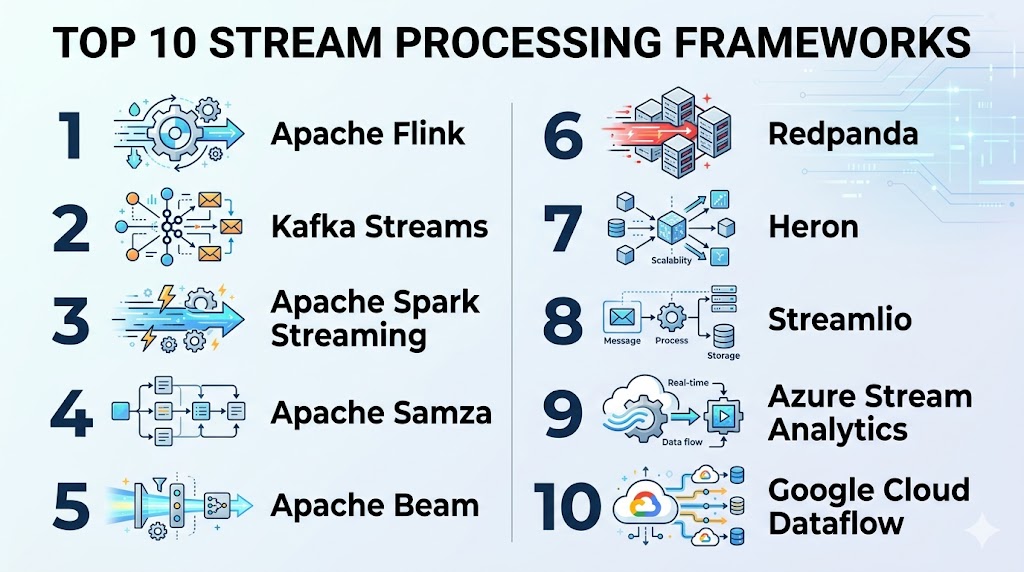
Top 10 Stream Processing Frameworks
#1 — Apache Flink
Short description: Apache Flink is an open-source stream processing framework designed for stateful computations over unbounded and bounded data streams.
Key Features
- Stateful and stateless stream processing
- Event-time processing and windowing
- Fault-tolerant and distributed architecture
- Scalable for high throughput
- Integration with Kafka, Pulsar, and storage systems
- Support for batch processing (unified model)
- APIs for Java, Scala, and Python
Pros
- Highly scalable and reliable
- Supports complex event processing
Cons
- Requires operational expertise
- Steep learning curve
Platforms / Deployment
- Linux / Cloud / On-prem / Hybrid
Security & Compliance
- Depends on deployment
- Supports SSL/TLS and ACL integration
Integrations & Ecosystem
- Kafka, Pulsar, Spark, BI tools, cloud storage
Support & Community
- Large open-source community
- Vendor support via managed offerings
#2 — Apache Kafka Streams
Short description: Kafka Streams is a lightweight stream processing library that allows applications to process data directly from Kafka topics.
Key Features
- Library integrated with Apache Kafka
- Stateless and stateful processing
- Low-latency stream analytics
- Windowing and aggregation
- Scalable and fault-tolerant
Pros
- Lightweight and simple to embed in applications
- Tight Kafka integration
Cons
- Requires Kafka infrastructure
- Limited to Kafka streams only
Platforms / Deployment
- Java / Cloud / On-prem
Security & Compliance
- Encryption, ACLs, SSO via Kafka
Integrations & Ecosystem
- Kafka ecosystem, connectors, BI tools
Support & Community
- Open-source community
- Vendor support via Confluent
#3 — Apache Spark Streaming
Short description: Spark Streaming extends Apache Spark to handle real-time data streams with micro-batching.
Key Features
- Micro-batch processing model
- High throughput and fault tolerance
- Integration with Spark SQL and MLlib
- Connectors for Kafka, Kinesis, and HDFS
- APIs in Java, Scala, and Python
Pros
- Unified batch and stream processing
- Supports advanced analytics
Cons
- Micro-batch latency may be higher than true streaming
- Requires cluster management
Platforms / Deployment
- Linux / Cloud / On-prem / Hybrid
Security & Compliance
- Encryption, ACLs, RBAC
- Compliance depends on environment
Integrations & Ecosystem
- Kafka, Kinesis, HDFS, BI tools
Support & Community
- Large community
- Managed offerings via Databricks
#4 — Apache Samza
Short description: Apache Samza is a distributed stream processing framework that integrates with messaging systems like Kafka for real-time analytics.
Key Features
- Stateful stream processing
- Fault-tolerant and scalable
- Integration with Kafka and YARN
- Simple API for developers
Pros
- Works seamlessly with Kafka
- Supports stateful processing
Cons
- Smaller ecosystem than Flink or Spark
- Operational setup required
Platforms / Deployment
- Linux / Cloud / On-prem
Security & Compliance
- Depends on deployment
- Integrates with Kafka security
Integrations & Ecosystem
- Kafka, YARN, storage, BI connectors
Support & Community
- Open-source community
- Documentation available
#5 — Apache Beam
Short description: Apache Beam provides a unified programming model for both batch and stream processing across multiple execution engines.
Key Features
- Unified batch and stream APIs
- Supports multiple runners (Flink, Spark, Dataflow)
- Event-time processing and windowing
- Language support: Java, Python, Go
Pros
- Flexibility to run on different engines
- Simplifies cross-platform stream processing
Cons
- Dependency on runners for execution
- Steeper learning curve for beginners
Platforms / Deployment
- Linux / Cloud / On-prem / Hybrid
Security & Compliance
- Depends on execution engine
- Supports encryption and access control
Integrations & Ecosystem
- Kafka, Pulsar, cloud platforms, storage systems
Support & Community
- Open-source community
- Documentation and examples
#6 — Redpanda
Short description: Redpanda is a Kafka-compatible streaming platform optimized for performance, suitable for stream processing applications.
Key Features
- Kafka API compatible
- Low-latency stream processing
- Simplified deployment (single binary)
- High throughput
Pros
- Easy to operate
- High performance and low latency
Cons
- Smaller ecosystem
- Less mature tooling than Kafka
Platforms / Deployment
- Cloud / On-prem
Security & Compliance
- Encryption, RBAC
- Compliance depends on deployment
Integrations & Ecosystem
- Kafka connectors, BI tools, cloud storage
Support & Community
- Commercial support
- Growing community
#7 — Heron (by Twitter)
Short description: Heron is a real-time stream processing engine designed to replace Apache Storm with better performance and scalability.
Key Features
- Low-latency real-time processing
- Fault-tolerant and distributed
- Scalable deployment
- Compatible with existing Storm topologies
Pros
- Optimized for low-latency processing
- Handles large-scale deployments
Cons
- Limited community compared to Flink/Spark
- Requires expertise to operate
Platforms / Deployment
- Linux / Cloud / On-prem
Security & Compliance
- Deployment-dependent
- Supports encryption and ACLs
Integrations & Ecosystem
- Kafka, storage, BI, monitoring tools
Support & Community
- Open-source support
- Twitter engineering resources
#8 — Streamlio
Short description: Streamlio combines Pulsar, Heron, and BookKeeper to provide a full-featured stream processing framework.
Key Features
- Distributed, low-latency streaming
- Fault-tolerant and scalable
- Multi-tenant architecture
- Event analytics-ready pipelines
Pros
- High-performance, end-to-end streaming
- Suitable for complex deployments
Cons
- Complex operational setup
- Engineering expertise required
Platforms / Deployment
- Cloud / On-prem
Security & Compliance
- RBAC, encryption
- Deployment-dependent compliance
Integrations & Ecosystem
- Kafka, Pulsar, BI tools, storage
Support & Community
- Open-source community
- Managed offerings
#9 — Azure Stream Analytics
Short description: Azure Stream Analytics is a fully managed cloud service for real-time analytics on event streams.
Key Features
- Managed, serverless streaming
- Real-time analytics and windowing
- Integration with Azure ecosystem
- SQL-like query language for streams
Pros
- Easy to deploy and manage
- Cloud-native scaling
Cons
- Cloud-only
- Vendor lock-in with Azure
Platforms / Deployment
- Cloud
Security & Compliance
- Encryption, RBAC
- SOC 2, compliance via Azure
Integrations & Ecosystem
- Azure Event Hubs, IoT Hub, Data Lake, Power BI
Support & Community
- Microsoft support
- Large Azure community
#10 — Google Cloud Dataflow
Short description: Dataflow is a fully managed stream and batch processing service using the Apache Beam programming model.
Key Features
- Unified batch and stream processing
- Auto-scaling compute resources
- Event-time processing
- Serverless execution
Pros
- Simplifies stream processing deployment
- Serverless and fully managed
Cons
- Cloud-only solution
- Learning curve for Beam API
Platforms / Deployment
- Cloud
Security & Compliance
- Encryption, IAM controls
- Cloud compliance features
Integrations & Ecosystem
- Pub/Sub, BigQuery, storage systems
Support & Community
- Google Cloud support
- Growing user community
Comparison Table (Top 10)
| Tool Name | Best For | Platform(s) Supported | Deployment | Standout Feature | Public Rating |
|---|---|---|---|---|---|
| Apache Flink | Stateful stream processing | Linux | Cloud / On-prem / Hybrid | Event-time processing | N/A |
| Kafka Streams | Lightweight Kafka integration | Java | Cloud / On-prem | Low-latency streaming | N/A |
| Spark Streaming | Unified batch/stream | Linux | Cloud / On-prem | Micro-batch processing | N/A |
| Apache Samza | Kafka integration | Linux | Cloud / On-prem | Stateful streaming | N/A |
| Apache Beam | Cross-platform streams | Linux | Cloud / On-prem / Hybrid | Unified APIs | N/A |
| Redpanda | Kafka-compatible | Cloud / On-prem | Low-latency | N/A | |
| Heron | Twitter-scale streaming | Linux | Cloud / On-prem | Low latency | N/A |
| Streamlio | Full-featured stream | Cloud / On-prem | Multi-tenant | N/A | |
| Azure Stream Analytics | Managed cloud | Cloud | Cloud | Serverless streaming | N/A |
| Google Cloud Dataflow | Managed batch/stream | Cloud | Cloud | Serverless Beam | N/A |
Evaluation & Scoring of Stream Processing Frameworks
| Tool Name | Core (25%) | Ease (15%) | Integrations (15%) | Security (10%) | Performance (10%) | Support (10%) | Value (15%) | Weighted Total (0–10) |
|---|---|---|---|---|---|---|---|---|
| Apache Flink | 9 | 6 | 8 | 7 | 9 | 7 | 6 | 7.8 |
| Kafka Streams | 8 | 7 | 8 | 7 | 8 | 7 | 7 | 7.5 |
| Spark Streaming | 8 | 6 | 8 | 7 | 8 | 7 | 6 | 7.3 |
| Apache Samza | 8 | 6 | 7 | 7 | 8 | 6 | 6 | 7.0 |
| Apache Beam | 8 | 7 | 8 | 7 | 8 | 7 | 6 | 7.3 |
| Redpanda | 7 | 8 | 7 | 7 | 8 | 6 | 7 | 7.2 |
| Heron | 8 | 6 | 7 | 7 | 9 | 6 | 6 | 7.1 |
| Streamlio | 8 | 6 | 7 | 7 | 8 | 6 | 6 | 7.0 |
| Azure Stream Analytics | 7 | 8 | 7 | 8 | 7 | 7 | 7 | 7.3 |
| Google Cloud Dataflow | 8 | 7 | 8 | 8 | 8 | 7 | 7 | 7.6 |
Which Stream Processing Framework Is Right for You?
Solo / Freelancer
Redpanda or Kafka Streams provides lightweight, low-latency streaming for small projects.
SMB
Managed cloud services like Azure Stream Analytics or Google Dataflow simplify deployment and scaling.
Mid-Market
Apache Flink or Spark Streaming provides more control, high throughput, and analytics integration.
Enterprise
Confluent Kafka, Apache Flink, and Streamlio offer full-featured, fault-tolerant, large-scale stream processing.
Budget vs Premium
Open-source frameworks reduce licensing costs but may increase operational overhead; managed cloud options reduce maintenance but can be costlier at scale.
Feature Depth vs Ease of Use
Frameworks like Flink and Beam provide rich functionality, whereas cloud-managed options simplify setup.
Integrations & Scalability
Ensure your framework integrates with data sources, analytics pipelines, and BI tools for end-to-end streaming workflows.
Security & Compliance Needs
Select frameworks supporting encryption, RBAC, SSO, and audit logging for secure data streaming.
Frequently Asked Questions (FAQs)
What is a stream processing framework?
A framework that processes continuous data flows in real-time, enabling analytics and event-driven responses.
How is it different from event streaming?
Event streaming focuses on moving messages; stream processing analyzes and transforms them in real-time.
Are these frameworks secure?
Most enterprise frameworks support encryption, role-based access, and integration with security policies.
Can small teams use them?
Yes, lightweight frameworks like Kafka Streams or Redpanda are suitable for smaller deployments.
Do these frameworks support analytics?
Yes, most integrate with BI tools or provide APIs for analytics.
What are common integrations?
Connectors to Kafka, Pulsar, storage systems, cloud services, and BI platforms.
How fast are these frameworks?
Latency varies; low-latency engines like Redpanda and Heron support millisecond processing.
Are cloud-managed options better for operations?
Yes, managed services reduce infrastructure management and scale automatically.
Can stream processing replace batch processing?
They complement batch systems; real-time insights and batch analytics can coexist.
How long does deployment take?
Managed cloud frameworks can deploy within hours; open-source self-hosted frameworks may take days.
Conclusion
Stream processing frameworks are critical for real-time analytics, event-driven architectures, and instantaneous business insights. Small teams can benefit from lightweight frameworks like Redpanda or Kafka Streams, while SMBs may leverage cloud-managed services like Azure Stream Analytics or Google Dataflow. Mid-market organizations requiring high throughput and analytics integration should consider Apache Flink or Spark Streaming, whereas enterprises with complex, large-scale pipelines benefit from Streamlio, Apache Flink, or Confluent Kafka. When choosing a framework, consider latency, scalability, operational complexity, integrations, and security. Pilots and testing with your critical streams can validate performance and ease of adoption. Properly implemented, stream processing frameworks empower organizations to react instantly to events, drive operational efficiency, and gain competitive advantage through real-time insights.