Introduction
Website builders are tools that allow users to create, design, and launch websites without coding skills. They typically include drag-and-drop editors, templates, hosting, and built-in features for SEO, e-commerce, and analytics. These platforms make it possible for individuals and businesses to build professional websites quickly and cost-effectively.
Modern website builders go beyond simple page creation—they now include AI-powered design, automation, and integrations, making them powerful tools for businesses of all sizes.
Common Use Cases
- Business websites and portfolios
- E-commerce stores
- Blogs and content sites
- Landing pages and marketing funnels
- Agency and client websites
What Buyers Should Evaluate
- Ease of use and learning curve
- Design flexibility and templates
- SEO and performance features
- E-commerce capabilities
- Integration ecosystem
- Scalability
- Hosting and security
- Pricing and value
Best for: Small businesses, freelancers, startups, agencies, and anyone needing a fast, no-code website solution.
Not ideal for: Highly custom applications requiring deep backend development or complex engineering.
Key Trends in Website Builders
- AI-powered website generation and design
- No-code and low-code development
- Mobile-first and responsive design
- Built-in SEO and marketing tools
- Integration with CRM and analytics platforms
- Expansion of e-commerce capabilities
- Real-time collaboration features
- API-first ecosystems
- Automation of content and design
- Personalization and dynamic content
How We Selected These Tools (Methodology)
- Market popularity and adoption
- Feature completeness (design, hosting, SEO, e-commerce)
- Ease of use for beginners and professionals
- Performance and reliability
- Integration ecosystem
- Scalability across business sizes
- Security considerations
- Support and documentation
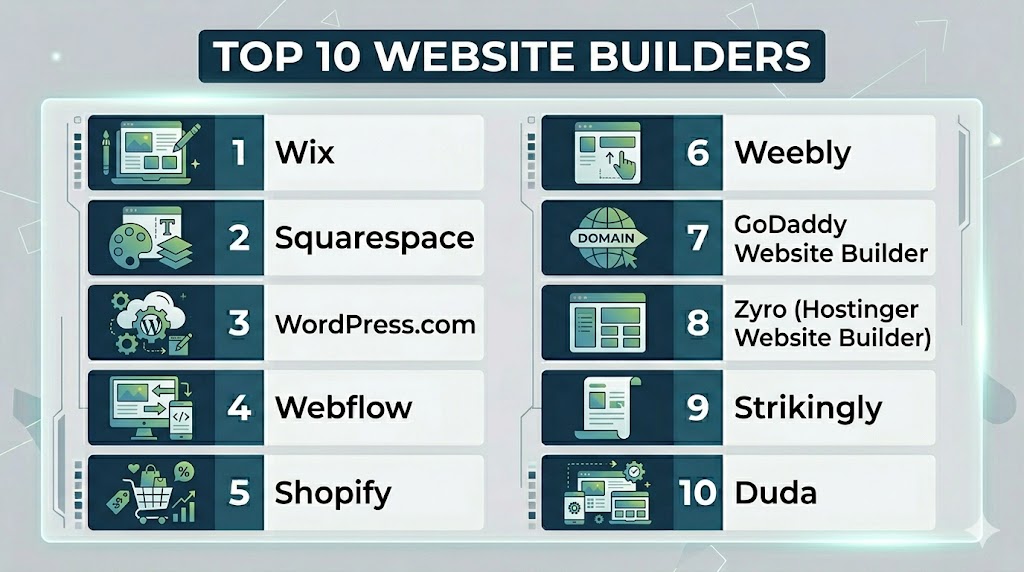
Top 10 Website Builders
#1 — Wix
Short description: A widely used website builder known for its flexibility, templates, and ease of use.
Key Features
- Drag-and-drop editor
- Large template library
- AI website builder
- SEO and marketing tools
- App marketplace
- E-commerce support
Pros
- Beginner-friendly
- Highly customizable
Cons
- Limited scalability for complex sites
- Ads on free plan
Platforms / Deployment
- Web
- Cloud
Security & Compliance
- Encryption, access control
- Other: Not publicly stated
Integrations & Ecosystem
Offers a large app marketplace and integrations.
- CRM tools
- Marketing tools
- APIs
Support & Community
Strong documentation and large user community.
#2 — Squarespace
Short description: A design-focused website builder known for high-quality templates and ease of use.
Key Features
- Professional templates
- Drag-and-drop editor
- Built-in SEO tools
- E-commerce features
- Analytics dashboards
Pros
- Beautiful designs
- Easy setup
Cons
- Limited customization flexibility
- Higher pricing
Platforms / Deployment
- Web
- Cloud
Security & Compliance
- SSL encryption
- Other: Not publicly stated
Integrations & Ecosystem
- Marketing tools
- APIs
Support & Community
Strong support and onboarding.
#3 — WordPress.com
Short description: A powerful platform offering flexibility and scalability with themes and plugins.
Key Features
- Thousands of themes
- Plugin ecosystem
- Blogging tools
- SEO features
- Customization options
Pros
- Highly flexible
- Large ecosystem
Cons
- Learning curve
- Requires setup
Platforms / Deployment
- Web
- Cloud
Security & Compliance
- Not publicly stated
Integrations & Ecosystem
- Plugins
- APIs
- CMS integrations
Support & Community
Very large global community.
#4 — Webflow
Short description: A professional-grade builder combining design flexibility with CMS capabilities.
Key Features
- Visual design editor
- CMS integration
- Animations and interactions
- Responsive design
- Hosting
Pros
- Advanced design control
- Developer-friendly
Cons
- Steep learning curve
- Higher complexity
Platforms / Deployment
- Web
- Cloud
Security & Compliance
- Not publicly stated
Integrations & Ecosystem
- APIs
- CMS tools
Support & Community
Strong community and tutorials.
#5 — Shopify
Short description: A leading platform for building and managing e-commerce websites.
Key Features
- Online store builder
- Payment processing
- Inventory management
- App marketplace
- Analytics
Pros
- Strong e-commerce tools
- Scalable
Cons
- Transaction fees
- Limited design flexibility
Platforms / Deployment
- Web
- Cloud
Security & Compliance
- Not publicly stated
Integrations & Ecosystem
- E-commerce apps
- APIs
Support & Community
Strong support and ecosystem.
#6 — Weebly
Short description: A beginner-friendly builder with simple tools for small websites and stores.
Key Features
- Drag-and-drop editor
- Templates
- E-commerce features
- SEO tools
- Hosting
Pros
- Easy to use
- Affordable
Cons
- Limited customization
- Fewer advanced features
Platforms / Deployment
- Web
- Cloud
Security & Compliance
- Not publicly stated
Integrations & Ecosystem
- APIs
- Basic integrations
Support & Community
Good support for beginners.
#7 — GoDaddy Website Builder
Short description: A simple builder designed for quick website creation with minimal setup.
Key Features
- Drag-and-drop editor
- Templates
- Marketing tools
- SEO features
- Hosting
Pros
- Fast setup
- Beginner-friendly
Cons
- Limited flexibility
- Basic features
Platforms / Deployment
- Web
- Cloud
Security & Compliance
- Not publicly stated
Integrations & Ecosystem
- Marketing tools
- APIs
Support & Community
Good onboarding support.
#8 — Zyro (Hostinger Website Builder)
Short description: An affordable builder with AI tools for fast website creation.
Key Features
- AI content generation
- Templates
- Drag-and-drop editor
- E-commerce features
- Analytics
Pros
- Affordable
- Fast setup
Cons
- Limited advanced features
- Smaller ecosystem
Platforms / Deployment
- Web
- Cloud
Security & Compliance
- Not publicly stated
Integrations & Ecosystem
- APIs
- Basic tools
Support & Community
Moderate support.
#9 — Strikingly
Short description: A builder focused on simple one-page websites and quick launches.
Key Features
- One-page design
- Templates
- Drag-and-drop editor
- Analytics
- Hosting
Pros
- Very easy to use
- Fast deployment
Cons
- Limited scalability
- Basic features
Platforms / Deployment
- Web
- Cloud
Security & Compliance
- Not publicly stated
Integrations & Ecosystem
- APIs
- Basic integrations
Support & Community
Good support for beginners.
#10 — Duda
Short description: A website builder designed for agencies and professionals managing multiple sites.
Key Features
- Drag-and-drop builder
- Team collaboration
- White-label options
- Templates
- Analytics
Pros
- Agency-focused
- Collaboration tools
Cons
- Expensive
- Less suitable for beginners
Platforms / Deployment
- Web
- Cloud
Security & Compliance
- Not publicly stated
Integrations & Ecosystem
- APIs
- Marketing tools
Support & Community
Strong support for agencies.
Comparison Table (Top 10)
| Tool Name | Best For | Platform(s) Supported | Deployment | Standout Feature | Public Rating |
|---|---|---|---|---|---|
| Wix | Beginners | Web | Cloud | Drag-and-drop flexibility | N/A |
| Squarespace | Design | Web | Cloud | High-quality templates | N/A |
| WordPress | Flexibility | Web | Cloud | Plugin ecosystem | N/A |
| Webflow | Designers | Web | Cloud | Advanced design control | N/A |
| Shopify | E-commerce | Web | Cloud | Online store tools | N/A |
| Weebly | Small sites | Web | Cloud | Simplicity | N/A |
| GoDaddy | Quick setup | Web | Cloud | Fast deployment | N/A |
| Zyro | Budget | Web | Cloud | AI tools | N/A |
| Strikingly | One-page sites | Web | Cloud | One-page builder | N/A |
| Duda | Agencies | Web | Cloud | Collaboration tools | N/A |
Evaluation & Scoring of Website Builders
| Tool Name | Core | Ease | Integrations | Security | Performance | Support | Value | Weighted Total |
|---|---|---|---|---|---|---|---|---|
| Wix | 9 | 9 | 8 | 7 | 8 | 8 | 8 | 8.3 |
| Squarespace | 8 | 9 | 7 | 7 | 8 | 8 | 7 | 7.9 |
| WordPress | 9 | 6 | 9 | 7 | 9 | 8 | 8 | 8.3 |
| Webflow | 9 | 6 | 8 | 7 | 9 | 7 | 7 | 7.9 |
| Shopify | 9 | 7 | 9 | 7 | 9 | 8 | 7 | 8.1 |
| Weebly | 7 | 9 | 6 | 6 | 7 | 7 | 8 | 7.4 |
| GoDaddy | 7 | 9 | 6 | 6 | 7 | 7 | 8 | 7.4 |
| Zyro | 7 | 8 | 6 | 6 | 7 | 6 | 9 | 7.3 |
| Strikingly | 6 | 9 | 5 | 6 | 6 | 7 | 8 | 6.9 |
| Duda | 8 | 7 | 8 | 7 | 8 | 8 | 7 | 7.8 |
How to interpret scores:
- Scores are comparative benchmarks
- Higher scores indicate stronger overall performance
- Beginner tools prioritize ease of use
- Advanced tools offer flexibility and scalability
- Choose based on your specific needs
Which Website Builder Is Right for You?
Solo / Freelancer
Use Wix or Strikingly for simplicity and fast setup.
SMB
Squarespace or Weebly provide a good balance of design and usability.
Mid-Market
Webflow or Shopify offer better scalability and features.
Enterprise
WordPress and Duda are ideal for flexibility and large-scale projects.
Budget vs Premium
- Budget: Zyro, Weebly
- Premium: Webflow, Shopify
Feature Depth vs Ease of Use
- Deep features: WordPress, Webflow
- Easy to use: Wix, GoDaddy
Integrations & Scalability
- Strong integrations: WordPress, Shopify
- Moderate: Wix, Squarespace
Security & Compliance Needs
Choose platforms with strong hosting security and access control.
Frequently Asked Questions (FAQs)
What are website builders?
They are tools that allow users to create websites without coding.
Do I need coding skills?
No, most builders use drag-and-drop interfaces.
Are website builders free?
Some offer free plans, but advanced features require payment.
Can I build an online store?
Yes, many builders support e-commerce features.
Are they SEO-friendly?
Most modern builders include SEO tools.
Can I switch platforms later?
Yes, but migration may require effort.
Are they secure?
Security varies by platform.
Do they support integrations?
Yes, most offer APIs and integrations.
Are they scalable?
Some are more scalable than others.
Which is best for beginners?
Wix and Squarespace are popular beginner choices.
Conclusion
Website builders make it easy to create professional websites without coding. The right platform depends on your goals, budget, and technical skills. Advanced tools offer flexibility and scalability, while simpler builders focus on ease of use. It’s important to evaluate design options, integrations, and performance. No single platform fits all needs, so choose based on your workflow. Start by testing a few builders and select the one that best supports your online presence.