Introduction
Model Explainability Tools help AI and machine learning teams understand why a model made a prediction, classification, recommendation, ranking, or decision. These tools make model behavior more transparent by showing important features, prediction drivers, decision patterns, confidence signals, model weaknesses, and possible bias risks.
As organizations deploy AI in finance, healthcare, insurance, hiring, cybersecurity, customer service, fraud detection, marketing, and operations, explainability becomes essential for trust, debugging, governance, compliance, and business adoption. A model may perform well on accuracy metrics, but teams still need to know why it behaves a certain way before using it in high-impact workflows.
Real-world use cases include:
- Explaining credit risk or fraud detection predictions
- Understanding why a model classified a document or image
- Identifying feature importance in customer churn models
- Debugging model errors before production deployment
- Supporting AI governance and audit review workflows
Buyers evaluating Model Explainability Tools should consider:
- Local and global explanation support
- Feature importance and attribution methods
- Support for tabular, text, image, and time-series models
- Bias and fairness analysis capabilities
- Integration with ML and MLOps platforms
- Model monitoring and drift explainability
- Visualization and reporting quality
- Security and access controls
- Support for black-box and white-box models
- Ease of use for both technical and business teams
Best for: Data scientists, machine learning engineers, MLOps teams, AI governance teams, model risk teams, compliance teams, product teams, enterprise architects, and organizations deploying AI in regulated or high-impact environments.
Not ideal for: Very simple rule-based automation, small experimental models with no production use, or teams that do not yet have a structured model development and validation process.
Key Trends in Model Explainability Tools
- Explainability is becoming a core requirement for enterprise AI governance and model risk management.
- Generative AI systems are increasing demand for transparency around retrieval, prompts, outputs, and model behavior.
- Model explainability is moving from offline notebooks into production monitoring workflows.
- Business-friendly dashboards are becoming more important for non-technical stakeholders.
- Explainability is increasingly combined with fairness, drift, and performance monitoring.
- Open-source explainability libraries remain popular for technical experimentation and research.
- Enterprise platforms are adding explainability reports, audit trails, and governance workflows.
- Teams are using explainability to identify data leakage, weak features, and model shortcuts.
- Feature attribution techniques are being combined with human review for high-impact decisions.
- Explainability is becoming important for AI procurement, vendor risk review, and compliance documentation.
How We Selected These Tools
The tools in this list were selected based on explainability depth, model coverage, enterprise readiness, open-source adoption, visualization quality, governance support, and integration with machine learning workflows.
Selection criteria included:
- Local and global model explanation capabilities
- Support for different model types and data formats
- Feature importance and attribution techniques
- Bias, fairness, and model risk analysis
- Integration with MLOps and model monitoring tools
- Usability for data science and governance teams
- Visualization and reporting quality
- Security and deployment flexibility
- Community and enterprise adoption
- Practical fit for production AI workflows
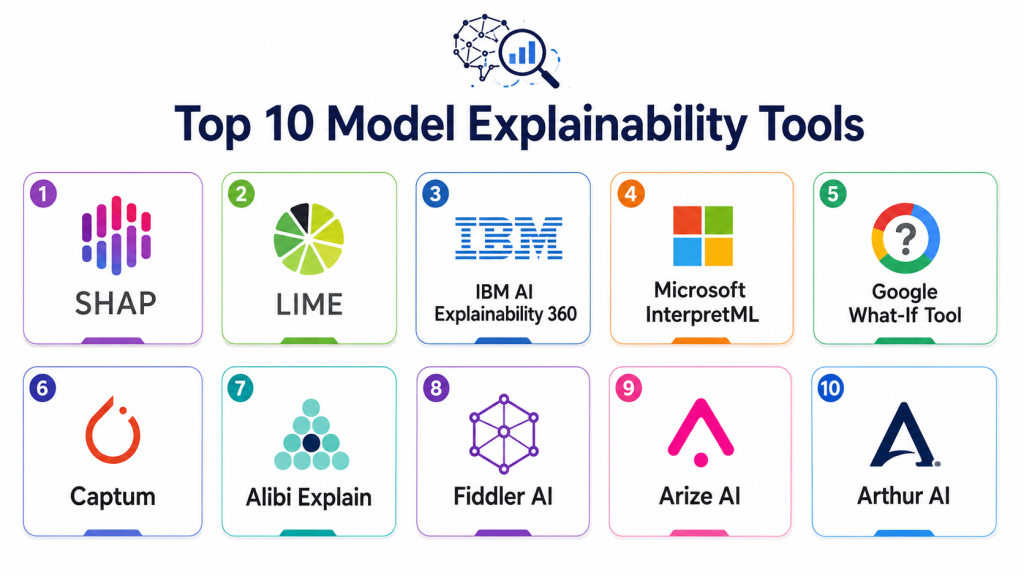
Top 10 Model Explainability Tools
1- SHAP
Short description: SHAP is one of the most widely used open-source model explainability libraries. It helps data scientists explain individual predictions and overall model behavior using feature attribution values based on game-theoretic concepts.
Key Features
- Local prediction explanations
- Global feature importance
- Support for tree-based models
- Support for deep learning and general models
- Rich visualization options
- Python-based workflows
- Integration with common ML libraries
Pros
- Strong explainability depth
- Widely adopted by data science teams
- Useful for both debugging and model validation
Cons
- Can be computationally expensive
- Requires technical expertise
- Business-friendly reporting must often be built separately
Platforms / Deployment
- Python / Linux / macOS / Windows
- Self-hosted / Hybrid
Security & Compliance
- Not publicly stated
- Security depends on deployment environment and data handling practices
Integrations & Ecosystem
SHAP fits naturally into Python-based machine learning workflows and model validation processes.
- scikit-learn
- XGBoost
- LightGBM
- TensorFlow
- PyTorch
- Jupyter notebooks
Support & Community
SHAP has a large open-source community, broad documentation, and strong adoption among machine learning practitioners.
2- LIME
Short description: LIME is an open-source explainability library that explains individual predictions by approximating model behavior around a specific instance. It is useful for understanding black-box model outputs in tabular, text, and image use cases.
Key Features
- Local model explanations
- Black-box model support
- Tabular explanation support
- Text explanation support
- Image explanation support
- Python-based implementation
- Model-agnostic approach
Pros
- Easy to understand conceptually
- Useful for black-box model debugging
- Works across multiple data types
Cons
- Explanations can vary depending on sampling
- Less comprehensive than some newer approaches
- Requires careful interpretation
Platforms / Deployment
- Python / Linux / macOS / Windows
- Self-hosted / Hybrid
Security & Compliance
- Not publicly stated
- Security depends on deployment and data handling setup
Integrations & Ecosystem
LIME integrates with common Python ML workflows and black-box model evaluation pipelines.
- scikit-learn
- Text classifiers
- Image classifiers
- Python notebooks
- Custom ML models
- Data science workflows
Support & Community
LIME has strong academic and practitioner adoption, open-source availability, and practical examples for explainability experimentation.
3- Microsoft InterpretML
Short description: Microsoft InterpretML is an open-source toolkit for training interpretable models and explaining black-box models. It is useful for teams that want both inherently interpretable models and post-hoc explanations.
Key Features
- Glassbox model support
- Black-box explanations
- Explainable boosting machines
- Feature importance analysis
- Interactive visualizations
- Python-based workflows
- Model debugging support
Pros
- Good balance of interpretable models and explanation tools
- Useful visualizations
- Strong fit for technical ML teams
Cons
- Requires data science expertise
- Enterprise governance workflows need additional tooling
- Some use cases need custom reporting
Platforms / Deployment
- Python / Linux / macOS / Windows
- Self-hosted / Hybrid
Security & Compliance
- Not publicly stated
- Security depends on deployment model and data handling practices
Integrations & Ecosystem
InterpretML integrates with Python ML environments and model validation workflows.
- scikit-learn
- Python notebooks
- Azure ML workflows
- Tabular models
- Model validation pipelines
- Data science environments
Support & Community
InterpretML has open-source adoption, Microsoft ecosystem visibility, and practical documentation for explainable machine learning workflows.
4- IBM AI Explainability 360
Short description: IBM AI Explainability 360 is an open-source toolkit that provides algorithms, metrics, and visualizations for explaining machine learning models. It is designed to support transparent AI development and responsible AI workflows.
Key Features
- Multiple explainability algorithms
- Local and global explanations
- Support for different model types
- Fairness and responsible AI ecosystem alignment
- Visual explanation utilities
- Research-backed methods
- Python-based workflows
Pros
- Strong responsible AI orientation
- Broad explanation method coverage
- Useful for research and enterprise experimentation
Cons
- Requires technical expertise
- Production deployment needs additional engineering
- Business-facing workflow support is limited without customization
Platforms / Deployment
- Python / Linux / macOS / Windows
- Self-hosted / Hybrid
Security & Compliance
- Not publicly stated
- Security depends on deployment and data governance setup
Integrations & Ecosystem
AI Explainability 360 integrates with responsible AI and machine learning workflows.
- Python ML stacks
- Jupyter notebooks
- Model validation workflows
- IBM AI ecosystem
- Fairness analysis tools
- Custom ML pipelines
Support & Community
The toolkit has open-source community support, research visibility, and adoption among responsible AI practitioners.
5- Google Explainable AI
Short description: Google Explainable AI provides tools for understanding feature importance and model behavior within Google Cloud AI workflows. It is useful for teams building and deploying models in Google Cloud environments.
Key Features
- Feature attribution
- Model explanation support
- Integration with managed AI services
- Visualization workflows
- Prediction explanation support
- Cloud-native model development
- Monitoring integration patterns
Pros
- Strong Google Cloud integration
- Useful for managed ML workflows
- Good fit for cloud-native AI teams
Cons
- Best suited for Google Cloud environments
- Less flexible outside Google ecosystem
- Requires cloud architecture knowledge
Platforms / Deployment
- Google Cloud / Web / APIs
- Cloud
Security & Compliance
- IAM integration
- Encryption
- Audit logging
- Access controls
- Cloud governance controls
- Compliance support depends on configuration
Integrations & Ecosystem
Google Explainable AI integrates with Google Cloud data, AI, and model deployment workflows.
- Vertex AI
- BigQuery
- Cloud Storage
- Model monitoring tools
- AI pipelines
- Enterprise cloud systems
Support & Community
Google Cloud provides documentation, enterprise support, training, and cloud AI engineering resources.
6- AWS SageMaker Clarify
Short description: AWS SageMaker Clarify helps machine learning teams detect bias and explain model predictions inside AWS SageMaker workflows. It is useful for AWS-based organizations that need explainability during model development and evaluation.
Key Features
- Feature attribution
- Bias detection
- Pre-training analysis
- Post-training analysis
- Model explainability reports
- SageMaker integration
- Monitoring workflow support
Pros
- Strong AWS integration
- Useful for model bias and explainability checks
- Good fit for SageMaker users
Cons
- Best suited for AWS environments
- Less complete as standalone governance tooling
- Requires ML expertise to interpret results
Platforms / Deployment
- AWS Cloud / SageMaker environments
- Cloud
Security & Compliance
- IAM integration
- Encryption
- Audit logging through AWS services
- Access controls
- Compliance support depends on AWS configuration
Integrations & Ecosystem
SageMaker Clarify integrates with AWS machine learning and cloud data workflows.
- Amazon SageMaker
- Amazon S3
- AWS IAM
- CloudWatch
- ML pipelines
- AWS data services
Support & Community
AWS provides documentation, training resources, enterprise support plans, and a large ML developer ecosystem.
7- Fiddler AI
Short description: Fiddler AI is an AI observability and explainability platform focused on monitoring, explaining, and improving model behavior in production. It helps teams understand prediction drivers, drift, bias, and performance changes.
Key Features
- Production model explainability
- Model monitoring
- Drift detection
- Bias and fairness insights
- Performance analytics
- AI observability dashboards
- LLM monitoring support
Pros
- Strong production explainability capabilities
- Good monitoring and observability workflows
- Useful for enterprise model risk management
Cons
- Requires integration with production systems
- Pricing may not fit small teams
- Best value comes with mature MLOps processes
Platforms / Deployment
- Web / APIs / Enterprise AI environments
- Cloud / Hybrid options vary
Security & Compliance
- RBAC
- Encryption
- SSO support
- Audit logging
- Enterprise security controls
- Compliance details vary by plan
Integrations & Ecosystem
Fiddler AI integrates with model serving, monitoring, and MLOps environments.
- ML platforms
- Cloud data platforms
- Model serving systems
- LLM applications
- MLOps pipelines
- Enterprise dashboards
Support & Community
Fiddler provides enterprise support, onboarding assistance, documentation, and AI observability expertise.
8- Arthur AI
Short description: Arthur AI is a model monitoring and explainability platform that helps teams track model behavior, detect bias, monitor drift, and evaluate deployed AI systems. It supports production-focused explainability and responsible AI workflows.
Key Features
- Model explainability
- Bias detection
- Drift monitoring
- Performance tracking
- Production dashboards
- LLM evaluation support
- Alerting and reporting
Pros
- Good production model visibility
- Useful for responsible AI monitoring
- Supports traditional ML and generative AI workflows
Cons
- Requires production integration
- Governance depth depends on implementation
- Smaller teams may not need the full platform
Platforms / Deployment
- Web / APIs / AI infrastructure
- Cloud / Hybrid options vary
Security & Compliance
- RBAC
- Encryption
- Audit logging
- Access controls
- Enterprise security features vary by plan
Integrations & Ecosystem
Arthur AI integrates with production AI and model operations environments.
- Model serving systems
- Cloud AI platforms
- MLOps pipelines
- Monitoring workflows
- LLM applications
- Enterprise AI dashboards
Support & Community
Arthur provides documentation, onboarding, enterprise support, and guidance for AI monitoring and explainability workflows.
9- Arize AI
Short description: Arize AI is an AI observability platform that helps teams monitor model performance, drift, data quality, and explainability signals across production AI systems. It is useful for teams that need visibility into how models behave after deployment.
Key Features
- Model observability
- Drift detection
- Performance monitoring
- Explainability workflows
- Data quality tracking
- LLM observability support
- Production debugging
Pros
- Strong production AI monitoring capabilities
- Good model debugging workflows
- Useful for enterprise MLOps teams
Cons
- Requires integration and instrumentation
- Not primarily a standalone notebook explainability library
- Best value comes with production AI scale
Platforms / Deployment
- Web / APIs / AI infrastructure
- Cloud / Hybrid options vary
Security & Compliance
- RBAC
- Encryption
- SSO support
- Audit logging
- Enterprise security controls
- Compliance details vary by plan
Integrations & Ecosystem
Arize AI integrates with model serving systems, data pipelines, and observability workflows.
- ML platforms
- Model serving tools
- Cloud data platforms
- LLM applications
- MLOps pipelines
- AI monitoring systems
Support & Community
Arize provides enterprise support, technical documentation, onboarding resources, and AI observability expertise.
10- Alibi Explain
Short description: Alibi Explain is an open-source Python library for machine learning model inspection and interpretation. It provides methods for black-box and white-box explanations across tabular, image, and text models.
Key Features
- Black-box explanations
- White-box explanation support
- Counterfactual explanations
- Anchor explanations
- Feature attribution
- Tabular, image, and text support
- Python-based workflows
Pros
- Strong open-source flexibility
- Useful counterfactual explanation methods
- Good fit for technical ML teams
Cons
- Requires data science expertise
- Production workflows need additional tooling
- Enterprise governance support is limited by default
Platforms / Deployment
- Python / Linux / macOS / Windows
- Self-hosted / Hybrid
Security & Compliance
- Not publicly stated
- Security depends on deployment and data handling practices
Integrations & Ecosystem
Alibi Explain integrates with Python ML workflows and model validation pipelines.
- scikit-learn
- TensorFlow
- PyTorch
- Python notebooks
- ML pipelines
- Model evaluation workflows
Support & Community
Alibi Explain has open-source community support, practical documentation, and adoption among explainable AI practitioners.
Comparison Table
| Tool Name | Best For | Platforms Supported | Deployment | Standout Feature | Public Rating |
|---|---|---|---|---|---|
| SHAP | Feature attribution and model debugging | Python environments | Self-hosted / Hybrid | Shapley-based explanations | N/A |
| LIME | Local black-box explanations | Python environments | Self-hosted / Hybrid | Instance-level explanations | N/A |
| Microsoft InterpretML | Interpretable models and explanations | Python environments | Self-hosted / Hybrid | Explainable boosting machines | N/A |
| IBM AI Explainability 360 | Responsible AI explainability research | Python environments | Self-hosted / Hybrid | Multiple explainability algorithms | N/A |
| Google Explainable AI | Google Cloud model explanation | Google Cloud / APIs | Cloud | Cloud-native feature attribution | N/A |
| AWS SageMaker Clarify | AWS bias and explainability workflows | AWS Cloud / SageMaker | Cloud | Bias and explainability in SageMaker | N/A |
| Fiddler AI | Production AI explainability | Web / APIs | Cloud / Hybrid options vary | Model observability and explanations | N/A |
| Arthur AI | Production monitoring and explainability | Web / APIs | Cloud / Hybrid options vary | Bias and drift visibility | N/A |
| Arize AI | AI observability and debugging | Web / APIs | Cloud / Hybrid options vary | Production model behavior tracking | N/A |
| Alibi Explain | Open-source explainability methods | Python environments | Self-hosted / Hybrid | Counterfactual and anchor explanations | N/A |
Evaluation & Scoring of Model Explainability Tools
| Tool Name | Core 25% | Ease 15% | Integrations 15% | Security 10% | Performance 10% | Support 10% | Value 15% | Weighted Total |
|---|---|---|---|---|---|---|---|---|
| SHAP | 9.5 | 7.6 | 9.0 | 7.5 | 8.6 | 8.8 | 9.5 | 8.76 |
| LIME | 8.5 | 8.1 | 8.5 | 7.4 | 8.0 | 8.3 | 9.3 | 8.33 |
| Microsoft InterpretML | 8.8 | 8.0 | 8.6 | 7.8 | 8.3 | 8.5 | 9.0 | 8.49 |
| IBM AI Explainability 360 | 8.9 | 7.6 | 8.5 | 7.8 | 8.3 | 8.4 | 8.9 | 8.39 |
| Google Explainable AI | 8.6 | 8.0 | 8.8 | 9.0 | 8.6 | 8.7 | 8.1 | 8.56 |
| AWS SageMaker Clarify | 8.7 | 8.0 | 9.0 | 9.1 | 8.6 | 8.8 | 8.2 | 8.61 |
| Fiddler AI | 9.1 | 8.1 | 8.8 | 8.9 | 8.8 | 8.8 | 7.9 | 8.68 |
| Arthur AI | 8.8 | 8.0 | 8.6 | 8.7 | 8.7 | 8.6 | 8.0 | 8.48 |
| Arize AI | 8.7 | 8.1 | 8.8 | 8.8 | 8.8 | 8.7 | 8.0 | 8.56 |
| Alibi Explain | 8.5 | 7.5 | 8.3 | 7.5 | 8.1 | 8.0 | 9.1 | 8.19 |
These scores are comparative and intended to help buyers evaluate practical fit rather than identify one universal winner. Open-source libraries are excellent for experimentation, debugging, and model validation, while enterprise observability platforms are stronger for production monitoring, governance, and cross-team reporting. The best fit depends on model type, deployment environment, explainability depth, business reporting needs, and AI governance maturity.
Which Model Explainability Tool Is Right for You?
Solo / Freelancer
Solo data scientists and independent ML builders usually need flexible, low-cost explainability tools for experimentation. SHAP, LIME, Alibi Explain, and InterpretML are strong choices because they work well in Python notebooks and custom ML workflows.
SMB
SMBs usually need explainability without heavy governance overhead. SHAP, InterpretML, AWS SageMaker Clarify, and Google Explainable AI are practical options depending on whether the team uses open-source workflows or cloud ML platforms.
Mid-Market
Mid-sized organizations often require explainability plus model monitoring, drift detection, and stakeholder reporting. Fiddler AI, Arize AI, Arthur AI, SageMaker Clarify, and cloud-native explainability tools are strong options for growing AI operations.
Enterprise
Large enterprises typically require explainability, governance, audit trails, production monitoring, fairness analysis, and cross-functional review workflows. Fiddler AI, Arize AI, Arthur AI, AWS SageMaker Clarify, Google Explainable AI, and IBM AI Explainability 360 are strong enterprise-friendly options depending on architecture.
Budget vs Premium
Open-source tools like SHAP, LIME, InterpretML, AI Explainability 360, and Alibi Explain are useful for budget-conscious technical teams. Premium platforms provide stronger monitoring, dashboards, governance workflows, access controls, and enterprise support.
Feature Depth vs Ease of Use
SHAP provides deep attribution analysis but can require expertise. LIME is easier to understand but may be less stable in some contexts. Enterprise platforms are easier for ongoing monitoring and stakeholder reporting but may provide less low-level flexibility than code-first libraries.
Integrations & Scalability
Teams using AWS should evaluate SageMaker Clarify. Teams using Google Cloud should evaluate Google Explainable AI. Teams using custom Python workflows should start with SHAP, LIME, InterpretML, or Alibi Explain. Teams managing production model portfolios should evaluate Fiddler AI, Arthur AI, or Arize AI.
Security & Compliance Needs
Security-focused organizations should prioritize RBAC, SSO, encryption, audit logs, data retention controls, private deployment options, and model inventory integration. Regulated teams should also validate whether explanation reports are reproducible, understandable, and suitable for audit review.
Frequently Asked Questions
1. What is a Model Explainability Tool?
A Model Explainability Tool helps teams understand why an AI or machine learning model produced a specific prediction or decision. It can show feature importance, attribution values, examples, counterfactuals, and model behavior patterns.
2. Why is model explainability important?
Explainability improves trust, debugging, governance, and business adoption. It helps teams identify model errors, data leakage, bias risks, unstable features, and unexpected decision patterns before or after deployment.
3. What is the difference between local and global explanations?
Local explanations explain one specific prediction, while global explanations describe overall model behavior across many predictions. Most teams need both to understand model decisions properly.
4. What is feature importance?
Feature importance shows which inputs have the strongest influence on a model’s predictions. It helps teams understand model drivers, validate assumptions, and detect unexpected dependencies.
5. What are SHAP values?
SHAP values estimate how much each feature contributes to a model prediction. They are widely used because they provide both local and global views of model behavior.
6. What is a counterfactual explanation?
A counterfactual explanation shows what would need to change for a model to produce a different outcome. For example, it can show which input changes might shift a decision from rejected to approved.
7. Can explainability tools detect bias?
Some explainability tools can help reveal biased patterns, but fairness testing usually requires additional metrics and group-level analysis. Explainability and fairness should be used together for responsible AI workflows.
8. Are explainability tools useful for deep learning models?
Yes. Many tools support deep learning, but explanations can be harder to interpret compared with simpler tabular models. Teams should validate explanation quality carefully for complex neural networks.
9. What integrations are most important?
Important integrations include ML frameworks, model registries, cloud ML platforms, MLOps tools, notebooks, monitoring systems, data pipelines, and governance platforms.
10. What should buyers evaluate before choosing a tool?
Buyers should evaluate supported model types, local and global explanations, visualization quality, production monitoring, security, governance support, integration options, scalability, and ease of interpretation for business users.
Conclusion
Model Explainability Tools are essential for organizations that want to build AI systems users can trust, audit, improve, and operate responsibly. The right tool can help teams understand prediction drivers, debug model behavior, detect unexpected patterns, support governance workflows, and communicate model decisions to business stakeholders. SHAP is one of the strongest open-source options for feature attribution, while LIME remains useful for local black-box explanations. Microsoft InterpretML, IBM AI Explainability 360, and Alibi Explain provide practical open-source explainability methods for technical teams. AWS SageMaker Clarify and Google Explainable AI are strong choices for cloud-native ML workflows, while Fiddler AI, Arthur AI, and Arize AI provide stronger production monitoring and explainability for deployed models. The best choice depends on model type, infrastructure, governance maturity, security requirements, and whether explainability is needed during development, validation, production, or all stages. Shortlist two or three tools, test them on real models and datasets, compare explanation quality with domain experts, validate security controls, and make explainability part of the full AI lifecycle rather than a one-time review.