Introduction
Feature flag management tools (also called feature toggles) allow teams to enable, disable, or gradually roll out features without deploying new code. This means developers can ship code continuously while controlling feature visibility in real time.
In modern software development, feature flags are essential for continuous delivery, experimentation, and risk mitigation. Teams can release features to small user segments, run A/B tests, and instantly roll back changes if something breaks—without downtime.
Common Use Cases
- Gradual feature rollouts (canary releases)
- A/B testing and experimentation
- Kill switches for instant rollback
- Beta feature access control
- Continuous delivery and DevOps workflows
What Buyers Should Evaluate
- Ease of implementation (SDKs, APIs)
- Rollout strategies (percentage, user targeting)
- Real-time updates and performance
- Experimentation and analytics capabilities
- Integration with CI/CD and DevOps tools
- Governance (RBAC, audit logs)
- Deployment model (cloud vs self-hosted)
- Scalability and latency
- Pricing and usage model
Best for: Engineering teams, DevOps teams, SaaS companies, and product-led organizations practicing continuous delivery.
Not ideal for: Small projects or static apps where feature rollout control is unnecessary.
Key Trends in Feature Flag Management Tools
- Feature flags + experimentation convergence (one platform for both)
- AI-assisted rollout optimization and targeting
- Edge-based flag evaluation for ultra-low latency
- Git-based and developer-first workflows
- Open-source alternatives gaining adoption
- Real-time configuration (remote config) without redeployments
- Integration with CI/CD pipelines and DevOps tooling
- Data warehouse-native experimentation models
- Security and governance becoming critical (RBAC, audit logs)
- Multi-environment and multi-region flag management
How We Selected These Tools (Methodology)
The tools were selected based on:
- Market adoption and developer mindshare
- Feature completeness (flags, rollouts, experimentation)
- Performance and latency (edge vs server evaluation)
- Security and governance capabilities
- Integration ecosystem (CI/CD, cloud, APIs)
- Deployment flexibility (cloud, hybrid, self-hosted)
- Ease of onboarding and developer experience
- Community and open-source support
- Suitability for startups to enterprise
- Innovation in experimentation and AI
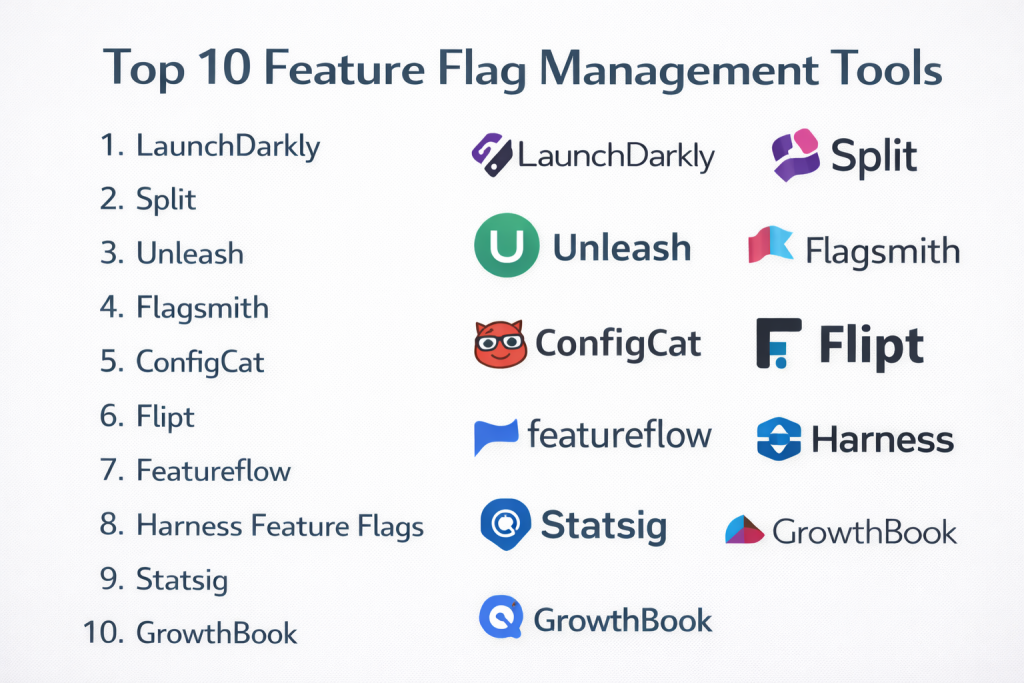
Top 10 Feature Flag Management Tools
#1 — LaunchDarkly
Short description: A leading enterprise-grade feature management platform with advanced experimentation and real-time control.
Key Features
- Feature flags with real-time updates
- Advanced targeting and segmentation
- Experimentation and analytics
- Feature rollouts and kill switches
- SDKs for multiple platforms
- Governance and audit logs
Pros
- Industry leader with mature platform
- Strong experimentation capabilities
Cons
- Expensive for smaller teams
- Requires onboarding time
Platforms / Deployment
Web / Mobile
Cloud
Security & Compliance
- SSO, RBAC, audit logs
- Additional certifications: Not publicly stated
Integrations & Ecosystem
Extensive enterprise integrations.
- CI/CD tools
- Cloud platforms
- APIs
- DevOps tools
Support & Community
Strong enterprise support and large developer community.
#2 — Split
Short description: A feature flag and experimentation platform combining product analytics with feature delivery.
Key Features
- Feature flags and experimentation
- Real-time metrics
- Traffic splitting
- User targeting
- Data-driven rollouts
- SDK support
Pros
- Strong analytics integration
- Good for product teams
Cons
- Pricing can scale
- Learning curve
Platforms / Deployment
Web
Cloud
Security & Compliance
Not publicly stated
Integrations & Ecosystem
Strong data integrations.
- Data warehouses
- APIs
- Analytics tools
Support & Community
Enterprise support available.
#3 — Unleash
Short description: A popular open-source feature flag platform with enterprise-grade capabilities.
Key Features
- Open-source core
- Gradual rollouts
- Edge evaluation
- RBAC and governance
- Multi-environment support
- A/B testing support
Pros
- Self-hosted flexibility
- Strong scalability
Cons
- Requires setup
- UI less polished
Platforms / Deployment
Web
Cloud / Self-hosted
Security & Compliance
- SSO, RBAC
- SOC2, ISO27001 (enterprise)
Integrations & Ecosystem
Developer-focused ecosystem.
- APIs
- CI/CD tools
- Cloud platforms
Support & Community
Strong open-source community and enterprise support.
#4 — Flagsmith
Short description: An open-source feature flag and remote configuration platform for developers.
Key Features
- Feature flags + remote config
- User segmentation
- A/B testing
- Multi-platform SDKs
- Real-time updates
- Environment management
Pros
- Open-source option
- Flexible deployment
Cons
- Requires setup for self-hosting
- Smaller ecosystem
Platforms / Deployment
Web
Cloud / Self-hosted
Security & Compliance
Not publicly stated
Integrations & Ecosystem
Flexible integrations.
- APIs
- Analytics tools
- DevOps tools
Support & Community
Growing open-source community.
#5 — ConfigCat
Short description: A developer-friendly feature flag service focused on simplicity and performance.
Key Features
- Feature flags with targeting
- Percentage rollouts
- SDKs for multiple languages
- Audit logs
- Real-time updates
- Dashboard UI
Pros
- Easy to use
- Affordable pricing
Cons
- Limited enterprise features
- Smaller ecosystem
Platforms / Deployment
Web
Cloud
Security & Compliance
Not publicly stated
Integrations & Ecosystem
Supports integrations via APIs.
- CI/CD tools
- APIs
Support & Community
Good documentation and onboarding.
#6 — Flipt
Short description: A Git-native, self-hosted feature flag platform designed for developer workflows.
Key Features
- Git-based configuration
- Self-hosted deployment
- SDK support
- Fast setup
- Version control integration
- Simple UI
Pros
- Developer-friendly
- Full control
Cons
- Limited enterprise features
- Requires DevOps setup
Platforms / Deployment
Web
Self-hosted
Security & Compliance
Not publicly stated
Integrations & Ecosystem
Git-centric integrations.
- GitHub
- GitLab
- APIs
Support & Community
Growing open-source community.
#7 — Featureflow
Short description: A feature management platform focused on progressive delivery and fast deployment.
Key Features
- Feature flags
- Progressive rollouts
- Targeting rules
- CI/CD integration
- Real-time control
- API access
Pros
- Easy onboarding
- Strong rollout control
Cons
- Smaller ecosystem
- Limited advanced analytics
Platforms / Deployment
Web
Cloud
Security & Compliance
Not publicly stated
Integrations & Ecosystem
Strong DevOps integrations.
- Slack
- Jira
- CI/CD tools
- APIs
Support & Community
Moderate support and documentation.
#8 — Harness Feature Flags
Short description: A feature flag platform integrated into a broader DevOps and CI/CD ecosystem.
Key Features
- Feature flags
- Progressive delivery
- CI/CD integration
- Governance tools
- Targeting and rollouts
- Audit logs
Pros
- Strong DevOps integration
- Enterprise-ready
Cons
- Requires ecosystem adoption
- Complex setup
Platforms / Deployment
Web
Cloud
Security & Compliance
Not publicly stated
Integrations & Ecosystem
Deep DevOps integrations.
- CI/CD pipelines
- APIs
Support & Community
Enterprise-level support.
#9 — Statsig
Short description: A modern experimentation and feature flag platform focused on product analytics.
Key Features
- Feature flags
- Experimentation
- Real-time analytics
- User targeting
- SDKs
- Monitoring
Pros
- Strong analytics focus
- Modern architecture
Cons
- Smaller ecosystem
- Developer-focused
Platforms / Deployment
Web
Cloud
Security & Compliance
Not publicly stated
Integrations & Ecosystem
Developer-centric integrations.
- APIs
- Data tools
Support & Community
Growing community.
#10 — GrowthBook
Short description: An open-source experimentation and feature flag platform for data-driven teams.
Key Features
- Feature flags
- A/B testing
- Data warehouse integration
- Open-source
- Experiment analysis
- Targeting
Pros
- Open-source flexibility
- Strong experimentation
Cons
- Requires setup
- Smaller ecosystem
Platforms / Deployment
Web
Cloud / Self-hosted
Security & Compliance
Not publicly stated
Integrations & Ecosystem
Strong data integrations.
- Data warehouses
- APIs
Support & Community
Active open-source community.
Comparison Table (Top 10)
| Tool Name | Best For | Platform(s) Supported | Deployment | Standout Feature | Public Rating |
|---|---|---|---|---|---|
| LaunchDarkly | Enterprise teams | Web, Mobile | Cloud | Real-time feature control | N/A |
| Split | Product analytics + flags | Web | Cloud | Experimentation + flags | N/A |
| Unleash | Open-source enterprise | Web | Hybrid | Self-hosted scalability | N/A |
| Flagsmith | Remote config + flags | Web | Hybrid | Feature flags + config | N/A |
| ConfigCat | SMB developers | Web | Cloud | Easy setup | N/A |
| Flipt | DevOps teams | Web | Self-hosted | Git-based flags | N/A |
| Featureflow | Progressive delivery | Web | Cloud | CI/CD integration | N/A |
| Harness | DevOps pipelines | Web | Cloud | CI/CD integration | N/A |
| Statsig | Product teams | Web | Cloud | Analytics-driven flags | N/A |
| GrowthBook | Data teams | Web | Hybrid | Open-source experimentation | N/A |
Evaluation & Scoring of Feature Flag Management Tools
| Tool Name | Core (25%) | Ease (15%) | Integrations (15%) | Security (10%) | Performance (10%) | Support (10%) | Value (15%) | Weighted Total |
|---|---|---|---|---|---|---|---|---|
| LaunchDarkly | 10 | 7 | 10 | 9 | 9 | 9 | 6 | 8.8 |
| Split | 9 | 7 | 9 | 8 | 9 | 8 | 7 | 8.3 |
| Unleash | 9 | 6 | 8 | 9 | 9 | 8 | 9 | 8.5 |
| Flagsmith | 8 | 7 | 7 | 7 | 8 | 7 | 9 | 7.9 |
| ConfigCat | 7 | 9 | 7 | 7 | 8 | 7 | 9 | 7.9 |
| Flipt | 7 | 7 | 7 | 7 | 8 | 7 | 9 | 7.7 |
| Featureflow | 7 | 8 | 8 | 7 | 8 | 7 | 8 | 7.8 |
| Harness | 8 | 6 | 9 | 8 | 9 | 8 | 7 | 8.0 |
| Statsig | 8 | 7 | 8 | 7 | 8 | 7 | 8 | 7.8 |
| GrowthBook | 8 | 6 | 8 | 7 | 8 | 7 | 9 | 7.9 |
How to interpret scores:
- Higher scores indicate stronger overall feature management capability
- Enterprise tools excel in security and scalability
- Open-source tools score higher in value and flexibility
- Developer-first tools may require more setup but offer greater control
- Choose based on team size, infrastructure, and experimentation needs
Which Feature Flag Tool Is Right for You?
Solo / Freelancer
- Best options: ConfigCat, Flagsmith
- Focus on simplicity and low cost
SMB
- Best options: ConfigCat, Featureflow
- Balance ease of use and rollout control
Mid-Market
- Best options: Split, Statsig, GrowthBook
- Focus on experimentation and scalability
Enterprise
- Best options: LaunchDarkly, Unleash, Harness
- Focus on governance, security, and scale
Budget vs Premium
- Budget: Flagsmith, GrowthBook, Flipt
- Premium: LaunchDarkly, Split
Feature Depth vs Ease of Use
- Advanced: LaunchDarkly, Harness
- Easy: ConfigCat, Featureflow
Integrations & Scalability
- Strong integrations: LaunchDarkly, Harness
- Lightweight: ConfigCat
Security & Compliance Needs
- High compliance: Unleash, LaunchDarkly
- Basic needs: Flagsmith
Frequently Asked Questions (FAQs)
What is a feature flag?
A feature flag allows you to enable or disable features without redeploying code.
Why use feature flag tools?
They reduce risk by allowing gradual rollouts and instant rollbacks.
Are feature flags only for developers?
Primarily yes, but product teams also use them for experimentation.
Can feature flags be used for A/B testing?
Yes, many tools support experimentation and traffic splitting.
Are these tools expensive?
Pricing ranges from free open-source to enterprise-level pricing.
Do feature flags affect performance?
Modern tools use edge evaluation to minimize latency.
Can I self-host feature flag tools?
Yes, tools like Unleash and Flagsmith support self-hosting.
What are common mistakes?
Leaving old flags in code and poor governance.
How long does implementation take?
From a few hours to several weeks depending on complexity.
Which tool is best overall?
LaunchDarkly is often considered the most complete, but alternatives may fit better based on budget and needs.
Conclusion
Feature flag management tools are critical for modern DevOps, continuous delivery, and experimentation-driven development.