Introduction
Relevance Evaluation Toolkits help teams measure how well search systems, recommendation engines, AI assistants, retrieval augmented generation workflows, and knowledge discovery platforms return useful results. These tools evaluate whether retrieved documents, passages, answers, or ranked results actually match the user’s query, intent, and context.
As organizations build AI search, semantic search, enterprise knowledge assistants, and RAG applications, relevance evaluation has become essential. A system may generate fluent answers, but if the retrieved context is weak, outdated, incomplete, or irrelevant, the final user experience suffers. Relevance evaluation toolkits help teams test retrieval quality, compare model outputs, monitor regressions, score relevance, detect hallucination risks, and improve ranking pipelines.
Real-world use cases include:
- Evaluating RAG retrieval quality
- Testing semantic search relevance
- Comparing embedding models and retrievers
- Monitoring AI assistant answer quality
- Measuring ranking changes before deployment
Buyers evaluating Relevance Evaluation Toolkits should consider:
- Retrieval relevance metrics
- RAG evaluation support
- LLM-as-judge capabilities
- Human evaluation workflows
- Dataset and benchmark management
- Observability and regression testing
- Integration with vector databases and search engines
- Prompt and model comparison support
- Security and access controls
- Developer experience and automation support
Best for: AI engineers, search engineers, MLOps teams, data scientists, product teams, enterprise search teams, RAG developers, QA teams, and organizations building AI-powered search or knowledge systems.
Not ideal for: Small teams with very basic keyword search, organizations without AI or retrieval workflows, or projects where manual review is enough and no recurring evaluation process is required.
Key Trends in Relevance Evaluation Toolkits
- RAG evaluation is becoming a core requirement for enterprise AI applications.
- LLM-as-judge methods are being used to score relevance, faithfulness, context quality, and answer usefulness.
- Retrieval evaluation is expanding beyond precision and recall into context relevance, groundedness, and answer correctness.
- Human-in-the-loop evaluation is becoming important for high-stakes AI systems.
- Regression testing is now essential when changing prompts, embeddings, retrievers, or ranking logic.
- Synthetic test dataset generation is helping teams evaluate systems faster.
- Vector search evaluation is becoming more important as semantic retrieval grows.
- Observability platforms are adding relevance scoring and quality monitoring.
- CI/CD integration is becoming important for AI application release workflows.
- Enterprises are prioritizing evaluation governance, auditability, and repeatable scoring methods.
How We Selected These Tools
The tools in this list were selected based on evaluation depth, RAG support, search relevance capabilities, developer adoption, integrations, flexibility, and production readiness.
Selection criteria included:
- Relevance and retrieval evaluation capabilities
- RAG-specific evaluation metrics
- Human and automated evaluation support
- Integration with LLM frameworks and vector databases
- Experiment tracking and regression testing
- Ease of use for AI and search teams
- Observability and monitoring support
- Open-source and enterprise adoption
- Security and governance capabilities
- Practical fit for AI search, RAG, and semantic retrieval workflows
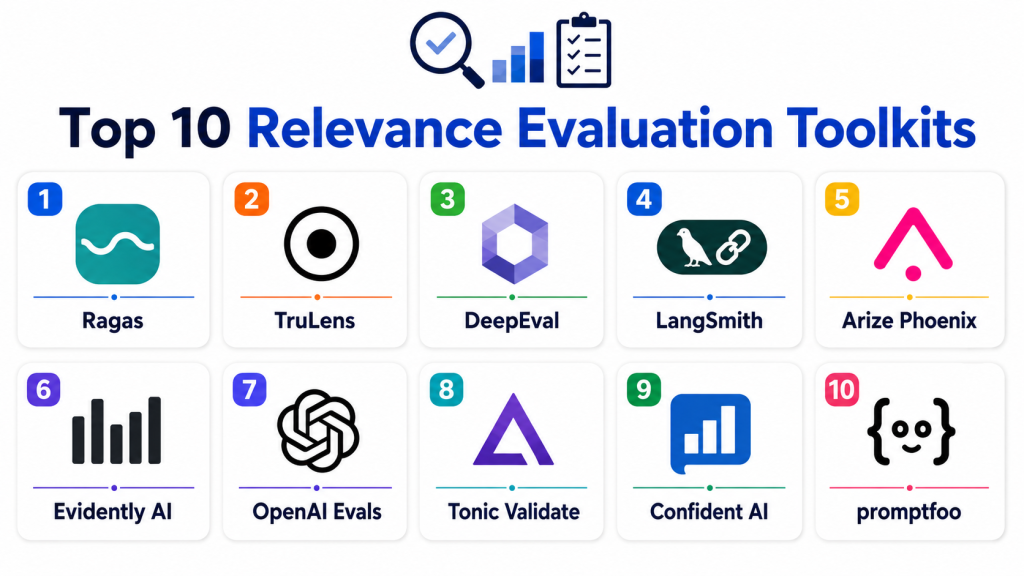
Top 10 Relevance Evaluation Toolkits
1- Ragas
Short description: Ragas is an open-source evaluation toolkit focused on RAG applications. It helps teams evaluate retrieval quality, answer relevance, faithfulness, context precision, context recall, and overall response quality using automated metrics.
Key Features
- RAG evaluation metrics
- Context relevance scoring
- Faithfulness evaluation
- Answer relevance checks
- Synthetic test generation support
- LLM-based evaluation workflows
- Integration with AI development frameworks
Pros
- Strong focus on RAG quality evaluation
- Open-source and developer-friendly
- Useful for testing retrieval and answer quality together
Cons
- Requires careful metric interpretation
- LLM-based scoring can vary by model
- Enterprise governance requires additional tooling
Platforms / Deployment
- Python / Linux / macOS / Windows
- Self-hosted / Hybrid
Security & Compliance
- Not publicly stated
- Security depends on deployment, model provider, and data handling configuration
Integrations & Ecosystem
Ragas works well with common AI and RAG development ecosystems.
- LangChain
- LlamaIndex
- Vector databases
- Python workflows
- Evaluation datasets
- LLM providers
Support & Community
Ragas has strong open-source adoption among RAG developers, active community support, and practical documentation for AI evaluation workflows.
2- DeepEval
Short description: DeepEval is an open-source LLM evaluation framework used to test relevance, faithfulness, hallucination risk, answer correctness, bias, toxicity, and other quality dimensions in AI applications.
Key Features
- LLM evaluation metrics
- RAG relevance testing
- Hallucination detection
- Unit-test style evaluation
- Regression testing workflows
- Custom evaluation metrics
- CI/CD-friendly testing
Pros
- Developer-friendly testing approach
- Strong fit for automated AI regression testing
- Useful custom metric flexibility
Cons
- Requires evaluation dataset design
- LLM judge outputs require validation
- Less focused on traditional search ranking than AI outputs
Platforms / Deployment
- Python / Developer environments
- Self-hosted / Hybrid
Security & Compliance
- Not publicly stated
- Security depends on deployment model, LLM provider, and test data handling
Integrations & Ecosystem
DeepEval integrates with AI engineering and software testing workflows.
- Pytest-style workflows
- LangChain
- LlamaIndex
- LLM applications
- CI/CD pipelines
- Custom AI systems
Support & Community
DeepEval has growing developer adoption, open-source documentation, and a strong fit for engineering-led AI quality testing.
3- TruLens
Short description: TruLens is an evaluation and observability toolkit for LLM and RAG applications. It helps teams evaluate groundedness, relevance, context quality, feedback functions, and application behavior during development and monitoring.
Key Features
- RAG evaluation workflows
- Feedback functions
- Groundedness scoring
- Context relevance checks
- Application tracing
- Experiment comparison
- Observability support
Pros
- Good evaluation and tracing combination
- Strong for RAG application debugging
- Useful feedback function flexibility
Cons
- Requires AI evaluation expertise
- Production governance depends on deployment
- Some workflows may need customization
Platforms / Deployment
- Python / Developer environments
- Self-hosted / Hybrid
Security & Compliance
- Not publicly stated
- Security depends on deployment, telemetry storage, and model provider configuration
Integrations & Ecosystem
TruLens integrates with popular LLM and RAG application frameworks.
- LangChain
- LlamaIndex
- Vector databases
- LLM applications
- Python workflows
- Observability pipelines
Support & Community
TruLens has strong open-source visibility in LLM evaluation, documentation, and developer community support.
4- Arize Phoenix
Short description: Arize Phoenix is an open-source AI observability and evaluation platform used to inspect embeddings, evaluate RAG workflows, analyze retrieval quality, and debug model behavior.
Key Features
- RAG evaluation
- Embedding visualization
- Retrieval debugging
- LLM tracing
- Dataset comparison
- Evaluation experiments
- Observability dashboards
Pros
- Strong observability and debugging experience
- Useful for embedding and retrieval analysis
- Good open-source AI monitoring support
Cons
- Requires observability setup
- Some enterprise workflows may need additional governance
- Evaluation quality depends on dataset design
Platforms / Deployment
- Python / Web / Cloud infrastructure
- Cloud / Self-hosted / Hybrid
Security & Compliance
- Access controls vary by deployment
- Encryption and governance depend on hosting model
- Enterprise controls vary by plan and configuration
Integrations & Ecosystem
Phoenix integrates well with LLM applications, tracing systems, and AI evaluation workflows.
- OpenTelemetry-style traces
- LangChain
- LlamaIndex
- Vector databases
- Embedding models
- AI application pipelines
Support & Community
Phoenix has active open-source adoption, strong AI observability documentation, and commercial ecosystem support.
5- LangSmith
Short description: LangSmith is an LLM application development, tracing, evaluation, and monitoring platform. It helps teams evaluate prompts, chains, agents, retrieval workflows, and AI application behavior using datasets and scoring workflows.
Key Features
- LLM application tracing
- Dataset-based evaluation
- Prompt and chain testing
- RAG workflow analysis
- Human feedback support
- Regression testing
- Monitoring and debugging
Pros
- Strong fit for LangChain-based applications
- Good tracing and evaluation workflow
- Useful for prompt and retrieval experiments
Cons
- Best value inside LangChain ecosystem
- Enterprise controls depend on plan
- Requires structured datasets for strong evaluation
Platforms / Deployment
- Web / APIs / Python environments
- Cloud / Hybrid options vary
Security & Compliance
- SSO and RBAC vary by plan
- Encryption support
- Audit and governance features vary by plan
Integrations & Ecosystem
LangSmith integrates deeply with LLM application development workflows.
- LangChain
- Python applications
- RAG pipelines
- LLM providers
- Evaluation datasets
- Application monitoring
Support & Community
LangSmith benefits from strong LangChain ecosystem adoption, documentation, and developer community support.
6- LlamaIndex Evaluation
Short description: LlamaIndex Evaluation provides evaluation utilities for RAG systems, retrieval quality, response quality, faithfulness, and query engine performance within LlamaIndex-based applications.
Key Features
- Retrieval evaluation
- Response evaluation
- Faithfulness checks
- Query engine testing
- Dataset generation support
- RAG quality analysis
- Integration with LlamaIndex workflows
Pros
- Strong fit for LlamaIndex applications
- Useful retrieval and response evaluation
- Developer-friendly for RAG experiments
Cons
- Best suited for LlamaIndex ecosystem
- Enterprise monitoring needs additional tooling
- LLM-based evaluations require validation
Platforms / Deployment
- Python / Developer environments
- Self-hosted / Hybrid
Security & Compliance
- Not publicly stated
- Security depends on model provider, deployment, and data handling setup
Integrations & Ecosystem
LlamaIndex Evaluation integrates directly with LlamaIndex RAG workflows.
- LlamaIndex
- Vector databases
- LLM providers
- Document loaders
- Query engines
- Python pipelines
Support & Community
LlamaIndex has a strong AI developer community, documentation, and growing adoption among RAG application builders.
7- Haystack Evaluation
Short description: Haystack provides evaluation utilities for search, question answering, retrieval, and RAG workflows. It helps teams assess retrievers, readers, pipelines, ranking quality, and answer performance.
Key Features
- Retriever evaluation
- Reader evaluation
- Pipeline evaluation
- Search relevance metrics
- RAG workflow support
- Dataset-based testing
- Modular evaluation components
Pros
- Strong search and retrieval foundation
- Good fit for question answering systems
- Useful for both traditional and semantic retrieval workflows
Cons
- Requires pipeline design expertise
- Evaluation setup depends on dataset quality
- Enterprise governance requires additional tooling
Platforms / Deployment
- Python / Docker / Linux
- Cloud / Self-hosted / Hybrid
Security & Compliance
- Security depends on deployment model
- Access controls and governance require surrounding infrastructure
- Enterprise security varies by implementation
Integrations & Ecosystem
Haystack integrates with search engines, vector stores, and AI pipelines.
- Elasticsearch
- OpenSearch
- Weaviate
- Pinecone
- Hugging Face
- LLM providers
Support & Community
Haystack has an active open-source AI search community, documentation, and practical adoption in semantic search and RAG projects.
8- Promptfoo
Short description: Promptfoo is an open-source evaluation and testing framework for prompts, LLM applications, and AI workflows. It helps teams compare model responses, evaluate relevance, test regressions, and automate quality checks.
Key Features
- Prompt evaluation
- LLM output comparison
- Custom scoring assertions
- Regression testing
- RAG evaluation patterns
- CI/CD integration
- Multi-model testing
Pros
- Practical for prompt and model comparison
- Good CI/CD testing support
- Flexible custom assertions
Cons
- Not a full search evaluation platform by itself
- Requires careful test case design
- Complex relevance scoring may need custom evaluators
Platforms / Deployment
- Node.js / CLI / Developer environments
- Self-hosted / Hybrid
Security & Compliance
- Not publicly stated
- Security depends on deployment, model provider, and test data handling
Integrations & Ecosystem
Promptfoo integrates with developer workflows and LLM providers.
- OpenAI-compatible providers
- Local models
- CI/CD pipelines
- Custom APIs
- Prompt workflows
- RAG systems
Support & Community
Promptfoo has growing open-source adoption, practical developer documentation, and strong usefulness for AI regression testing.
9- Giskard
Short description: Giskard is an AI testing and evaluation platform designed to evaluate ML and LLM applications for quality, robustness, bias, hallucination, security risks, and relevance issues.
Key Features
- LLM evaluation
- RAG testing support
- Bias and robustness checks
- Hallucination detection
- Automated test generation
- Model quality dashboards
- AI risk evaluation
Pros
- Strong AI quality and risk testing
- Useful for enterprise AI validation
- Good automated testing workflows
Cons
- Broader AI testing focus, not only relevance
- Requires governance planning for enterprise use
- Evaluation design still needs human review
Platforms / Deployment
- Python / Web / Enterprise infrastructure
- Cloud / Self-hosted / Hybrid options vary
Security & Compliance
- Access controls vary by deployment
- Governance and audit features vary by plan
- Security depends on implementation and hosting model
Integrations & Ecosystem
Giskard integrates with ML and LLM development workflows.
- Python ML workflows
- LLM applications
- RAG systems
- Evaluation datasets
- MLOps platforms
- Custom models
Support & Community
Giskard has growing adoption in AI testing, open-source resources, and enterprise AI governance use cases.
10- Evidently AI
Short description: Evidently AI is an open-source evaluation and monitoring platform for machine learning and AI systems. It helps teams monitor data quality, model quality, drift, and some LLM-related quality metrics in production workflows.
Key Features
- Model monitoring
- Data drift detection
- Quality evaluation reports
- Dataset comparison
- Monitoring dashboards
- AI application evaluation support
- Production monitoring workflows
Pros
- Strong monitoring and evaluation foundation
- Useful for model quality tracking
- Good open-source ecosystem
Cons
- Less specialized for search relevance than RAG-focused tools
- LLM evaluation workflows may need customization
- Enterprise observability requires planning
Platforms / Deployment
- Python / Web / Cloud infrastructure
- Cloud / Self-hosted / Hybrid
Security & Compliance
- Security depends on deployment
- Authentication and access controls vary by setup
- Enterprise controls vary by plan
Integrations & Ecosystem
Evidently AI integrates with ML workflows and monitoring pipelines.
- Python ML stacks
- Data pipelines
- Model monitoring systems
- Dashboards
- MLOps platforms
- Evaluation reports
Support & Community
Evidently AI has strong open-source adoption, documentation, and growing AI monitoring community support.
Comparison Table
| Tool Name | Best For | Platforms Supported | Deployment | Standout Feature | Public Rating |
|---|---|---|---|---|---|
| Ragas | RAG relevance evaluation | Python / Developer environments | Self-hosted / Hybrid | RAG-specific metrics | N/A |
| DeepEval | LLM regression testing | Python / Developer environments | Self-hosted / Hybrid | Unit-test style AI evaluation | N/A |
| TruLens | RAG tracing and feedback | Python / Developer environments | Self-hosted / Hybrid | Feedback function evaluation | N/A |
| Arize Phoenix | AI observability and retrieval debugging | Python / Web | Cloud / Self-hosted / Hybrid | Embedding and retrieval analysis | N/A |
| LangSmith | LLM app tracing and evaluation | Web / APIs / Python | Cloud / Hybrid options vary | Dataset-based chain evaluation | N/A |
| LlamaIndex Evaluation | LlamaIndex RAG testing | Python / Developer environments | Self-hosted / Hybrid | Query engine evaluation | N/A |
| Haystack Evaluation | Search and QA pipeline evaluation | Python / Docker / Linux | Cloud / Self-hosted / Hybrid | Retriever and reader evaluation | N/A |
| Promptfoo | Prompt and model testing | Node.js / CLI | Self-hosted / Hybrid | CI/CD prompt regression testing | N/A |
| Giskard | AI quality and risk testing | Python / Web | Cloud / Self-hosted / Hybrid options vary | Automated AI risk tests | N/A |
| Evidently AI | Model and data quality monitoring | Python / Web | Cloud / Self-hosted / Hybrid | Drift and quality monitoring | N/A |
Evaluation & Scoring of Relevance Evaluation Toolkits
| Tool Name | Core 25% | Ease 15% | Integrations 15% | Security 10% | Performance 10% | Support 10% | Value 15% | Weighted Total |
|---|---|---|---|---|---|---|---|---|
| Ragas | 9.3 | 8.0 | 8.8 | 7.8 | 8.6 | 8.3 | 9.2 | 8.69 |
| DeepEval | 9.0 | 8.5 | 8.6 | 7.8 | 8.6 | 8.2 | 9.1 | 8.62 |
| TruLens | 8.8 | 7.9 | 8.7 | 7.8 | 8.5 | 8.2 | 8.8 | 8.45 |
| Arize Phoenix | 9.0 | 8.1 | 8.9 | 8.3 | 8.7 | 8.5 | 8.8 | 8.69 |
| LangSmith | 9.1 | 8.5 | 9.0 | 8.5 | 8.8 | 8.8 | 8.1 | 8.72 |
| LlamaIndex Evaluation | 8.7 | 8.2 | 8.7 | 7.7 | 8.4 | 8.4 | 9.0 | 8.49 |
| Haystack Evaluation | 8.6 | 8.0 | 8.7 | 7.7 | 8.5 | 8.3 | 8.9 | 8.43 |
| Promptfoo | 8.5 | 8.8 | 8.5 | 7.6 | 8.5 | 8.2 | 9.2 | 8.56 |
| Giskard | 8.8 | 8.0 | 8.4 | 8.2 | 8.5 | 8.3 | 8.6 | 8.51 |
| Evidently AI | 8.2 | 8.1 | 8.4 | 8.0 | 8.5 | 8.4 | 8.9 | 8.36 |
These scores are comparative and intended to help teams evaluate practical fit rather than identify one universal winner. RAG-focused tools are strongest for retrieval and answer relevance, while observability platforms are better for tracing and monitoring production behavior. Testing frameworks are especially useful when teams want repeatable CI/CD checks before releasing changes to prompts, retrievers, embeddings, or ranking logic.
Which Relevance Evaluation Toolkit Is Right for You?
Solo / Freelancer
Solo AI developers and small teams often need lightweight, open-source, easy-to-run evaluation workflows. Ragas, DeepEval, Promptfoo, and LlamaIndex Evaluation are practical options for testing RAG prototypes and small AI assistants.
SMB
SMBs usually need repeatable evaluations without heavy governance overhead. Ragas, DeepEval, TruLens, Phoenix, and Promptfoo can help teams evaluate relevance, hallucination risk, retrieval quality, and regression behavior before production releases.
Mid-Market
Mid-sized organizations often need evaluation plus observability, dataset management, and regression tracking. LangSmith, Arize Phoenix, TruLens, Giskard, and Haystack Evaluation are strong options depending on whether the team is focused on RAG apps, enterprise search, or AI risk testing.
Enterprise
Large enterprises typically require evaluation governance, traceability, access controls, human feedback workflows, production monitoring, and repeatable scoring pipelines. LangSmith, Arize Phoenix, Giskard, TruLens, and Evidently AI are strong enterprise-friendly options when combined with internal security and review processes.
Budget vs Premium
Open-source tools like Ragas, DeepEval, TruLens, Haystack Evaluation, Promptfoo, and Evidently AI reduce licensing costs but may require internal engineering effort. Managed platforms and enterprise offerings can simplify collaboration, monitoring, dashboards, and governance.
Feature Depth vs Ease of Use
Ragas provides strong RAG-specific metrics, while DeepEval and Promptfoo are easier for test-driven workflows. Phoenix and LangSmith provide richer tracing and observability. Giskard and Evidently AI are broader AI quality platforms rather than purely relevance-focused tools.
Integrations & Scalability
Teams using LangChain may prefer LangSmith or DeepEval. Teams using LlamaIndex may prefer LlamaIndex Evaluation. Teams building search and question-answering systems may prefer Haystack Evaluation. Teams needing broader observability may prefer Phoenix, TruLens, or Evidently AI.
Security & Compliance Needs
Security-focused teams should evaluate data handling, model provider exposure, telemetry storage, role-based access, audit logs, private deployment options, and whether sensitive prompts or documents leave controlled environments. For enterprise RAG systems, permission-aware evaluation datasets are especially important.
Frequently Asked Questions
1. What is a Relevance Evaluation Toolkit?
A Relevance Evaluation Toolkit helps measure whether search results, retrieved documents, AI responses, or RAG contexts match the user’s query and intent. It supports quality testing for search and AI retrieval systems.
2. Why is relevance evaluation important?
Relevance evaluation helps teams identify weak retrieval, poor ranking, hallucination risks, missing context, and regression problems. Without evaluation, AI and search systems may appear functional but return unreliable results.
3. What is RAG evaluation?
RAG evaluation measures how well a system retrieves context and generates grounded answers from that context. It often checks context relevance, faithfulness, answer relevance, and correctness.
4. What is LLM-as-judge evaluation?
LLM-as-judge evaluation uses a language model to score outputs against criteria such as relevance, helpfulness, faithfulness, or correctness. It is useful but should be validated with human review for important workflows.
5. What are common relevance metrics?
Common metrics include precision, recall, mean reciprocal rank, normalized discounted cumulative gain, context precision, context recall, answer relevance, groundedness, and faithfulness.
6. What are common implementation mistakes?
Common mistakes include using weak test datasets, relying only on automated scoring, ignoring user intent, skipping regression tests, failing to evaluate retrieval separately, and not reviewing edge cases manually.
7. Can relevance evaluation reduce hallucinations?
Yes. Relevance evaluation can reduce hallucination risk by checking whether retrieved context supports the generated answer. However, it should be combined with grounding checks, prompt controls, and human review for critical use cases.
8. What integrations are most important?
Important integrations include vector databases, search engines, LLM frameworks, tracing systems, CI/CD tools, annotation workflows, prompt management systems, and production monitoring platforms.
9. Should teams use human evaluation or automated evaluation?
Both are useful. Automated evaluation is faster and repeatable, while human evaluation provides deeper judgment for nuanced relevance, domain-specific correctness, and high-impact decisions.
10. What should buyers evaluate before choosing a toolkit?
Buyers should evaluate metric quality, RAG support, human review workflows, CI/CD compatibility, observability, model provider flexibility, security controls, integration ecosystem, and reporting depth.
Conclusion
Relevance Evaluation Toolkits are becoming essential for teams building semantic search, AI assistants, RAG systems, enterprise knowledge search, and intelligent retrieval workflows. The right toolkit can help teams measure retrieval quality, compare ranking changes, reduce hallucination risks, test prompts, monitor regressions, and improve user trust in AI-powered experiences. Ragas is a strong choice for RAG-specific metrics, while DeepEval and Promptfoo support test-driven evaluation and regression workflows. TruLens and Arize Phoenix are useful for tracing, feedback functions, and retrieval debugging, while LangSmith provides strong evaluation and monitoring for LangChain-based applications. LlamaIndex Evaluation and Haystack Evaluation fit teams already using those ecosystems, while Giskard and Evidently AI support broader AI quality, risk, and monitoring workflows. The best choice depends on your application architecture, evaluation maturity, security needs, dataset quality, and production monitoring requirements. Shortlist two or three tools, build a representative test dataset, compare retrieval quality across real queries, validate automated scores with human review, and add regression checks before every major change to prompts, embeddings, retrievers, or ranking logic.