Introduction
Search Indexing Pipelines help organizations collect, crawl, parse, transform, enrich, and send content into search engines so users can find the right information quickly. These pipelines sit between content sources and search platforms, handling documents, websites, databases, APIs, file systems, knowledge bases, product catalogs, logs, and enterprise repositories before they become searchable.
Modern search indexing is no longer only about keywords. Teams now need pipelines that support full-text indexing, metadata extraction, document parsing, permissions, vector embeddings, semantic enrichment, multilingual content, near real-time updates, and retrieval workflows for AI applications. Search indexing pipelines are especially important for enterprise search, e-commerce search, support portals, developer documentation, compliance discovery, and RAG systems.
Real-world use cases include:
- Crawling websites and indexing pages into search engines
- Extracting text and metadata from PDFs, Word files, and spreadsheets
- Indexing enterprise repositories with access permissions
- Building search pipelines for product catalogs and content platforms
- Preparing documents for semantic search and AI retrieval
Buyers evaluating Search Indexing Pipelines should consider:
- Source connectors and crawler support
- Document parsing and metadata extraction
- Indexing speed and scalability
- Search engine compatibility
- Incremental indexing support
- Permission-aware indexing
- Data transformation and enrichment
- Monitoring and failure handling
- Hybrid keyword and vector search support
- Deployment flexibility and operational complexity
Best for: Search engineers, data engineers, enterprise IT teams, AI engineers, knowledge management teams, e-commerce teams, documentation teams, and organizations building large-scale search or AI retrieval systems.
Not ideal for: Very small websites or applications that only need basic built-in search without custom crawling, parsing, enrichment, or indexing workflows.
Key Trends in Search Indexing Pipelines
- Hybrid search indexing is becoming important because organizations need both keyword search and vector-based semantic retrieval.
- AI retrieval workflows are pushing indexing pipelines to support embeddings, chunking, metadata tagging, and document enrichment.
- Permission-aware indexing is now essential for enterprise search and workplace AI systems.
- Real-time and near real-time indexing is becoming more important for dynamic websites, product catalogs, and support content.
- Document parsing pipelines are increasingly handling PDFs, spreadsheets, presentations, emails, and scanned documents.
- Open-source search engines and indexing tools remain popular for teams that want deployment control and lower platform dependency.
- Search observability is becoming important for tracking failed crawls, stale documents, indexing latency, and relevance quality.
- Cloud-native indexing pipelines are becoming more common through containers, Kubernetes, queues, and event-driven architectures.
- Multilingual indexing and language-aware analysis are now important for global search experiences.
- Search indexing pipelines are increasingly connected with RAG, knowledge graphs, data catalogs, and enterprise content systems.
How We Selected These Tools
The tools in this list were selected based on indexing pipeline depth, search ecosystem adoption, source connectivity, scalability, parsing capabilities, deployment flexibility, and practical production fit.
Selection criteria included:
- Crawling, ingestion, and indexing capabilities
- Compatibility with major search engines
- Document extraction and metadata handling
- Scalability for enterprise and web-scale content
- Incremental indexing and refresh workflows
- Security and permission handling
- Open-source and enterprise ecosystem maturity
- Developer experience and API flexibility
- Monitoring and operational reliability
- Suitability for traditional search, semantic search, and AI retrieval
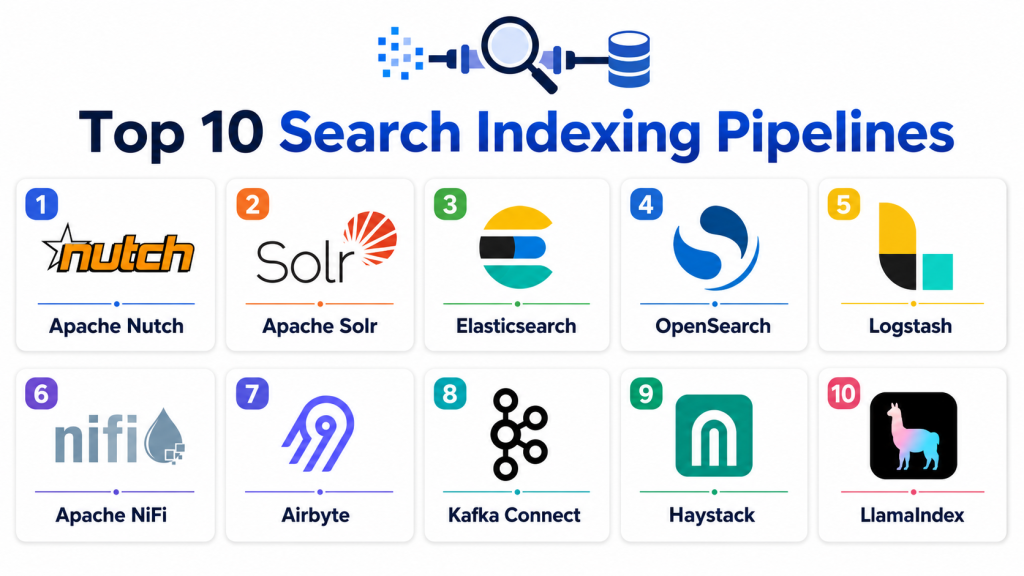
Top 10 Search Indexing Pipelines
1- Elastic Stack
Short description: Elastic Stack is a powerful search, ingestion, and analytics ecosystem used to collect, transform, enrich, and index data into Elasticsearch. It is widely used for application search, enterprise search, observability, log analytics, and custom search pipelines.
Key Features
- Elasticsearch indexing engine
- Logstash ingestion pipelines
- Beats and agent-based data collection
- Ingest pipelines for enrichment
- Full-text and vector search support
- Kibana monitoring and dashboards
- Scalable distributed indexing
Pros
- Mature search and indexing ecosystem
- Strong flexibility for custom pipelines
- Good support for structured and unstructured search workloads
Cons
- Requires tuning and administration expertise
- Large clusters can become costly
- Complex pipelines need careful monitoring
Platforms / Deployment
- Linux / Windows / macOS / Kubernetes
- Cloud / Self-hosted / Hybrid
Security & Compliance
- RBAC
- SSO integration
- Encryption
- Audit logging
- Index-level access controls
- Security features vary by deployment and plan
Integrations & Ecosystem
Elastic Stack integrates with many data sources, search applications, observability systems, and AI workflows.
- Logstash pipelines
- Beats and Elastic Agent
- Databases and APIs
- Cloud platforms
- Web applications
- RAG and semantic search frameworks
Support & Community
Elastic has a large developer community, extensive documentation, enterprise support options, and a mature ecosystem for production search infrastructure.
2- OpenSearch and OpenSearch Ingestion
Short description: OpenSearch is an open-source search and analytics platform with indexing, ingestion, dashboarding, observability, and vector search capabilities. OpenSearch Ingestion helps build scalable data pipelines that route, transform, and index data into OpenSearch.
Key Features
- Full-text search indexing
- OpenSearch Ingestion pipelines
- Vector search support
- Dashboards and analytics
- Data transformation pipelines
- Log and document ingestion
- Distributed search architecture
Pros
- Strong open-source search stack
- Good fit for AWS and self-hosted environments
- Supports both search and analytics use cases
Cons
- Operational tuning required at scale
- Some advanced workflows need engineering effort
- Ecosystem maturity varies by use case
Platforms / Deployment
- Linux / Docker / Kubernetes
- Cloud / Self-hosted / Hybrid
Security & Compliance
- RBAC
- Encryption
- Audit logging
- Authentication integration
- Index-level access controls
- Security depends on deployment model
Integrations & Ecosystem
OpenSearch integrates with data pipelines, observability tools, cloud environments, and search applications.
- OpenSearch Dashboards
- Data Prepper
- AWS services
- Log pipelines
- APIs
- Vector search workflows
Support & Community
OpenSearch has an active open-source community, cloud provider support options, and growing adoption for search and analytics pipelines.
3- Apache Solr
Short description: Apache Solr is an enterprise search platform built on Apache Lucene, used for full-text search, faceted search, distributed indexing, rich document handling, and scalable search applications.
Key Features
- Full-text indexing
- Faceted search
- Distributed indexing
- Rich document processing
- Query caching
- Replication and clustering
- REST-like APIs
Pros
- Mature enterprise search platform
- Strong indexing and faceting features
- Good fit for large structured and unstructured content collections
Cons
- Requires schema and relevance tuning
- Operational complexity at scale
- Less AI-native than newer vector-first tools
Platforms / Deployment
- Linux / Windows / macOS / Java environments
- Cloud / Self-hosted / Hybrid
Security & Compliance
- Authentication support
- Authorization controls
- Encryption support
- Audit visibility depends on deployment
- Security configuration requires planning
Integrations & Ecosystem
Solr integrates well with document processing, content management, and enterprise search pipelines.
- Apache Lucene
- Apache Tika
- Databases
- CMS platforms
- Web crawlers
- Custom APIs
Support & Community
Apache Solr has a mature open-source community, long-standing enterprise adoption, and strong documentation for search engineering teams.
4- Apache Nutch
Short description: Apache Nutch is an open-source web crawler designed for large-scale web crawling and search indexing pipelines. It is useful for teams that need customizable crawling, link discovery, content fetching, and indexing workflows.
Key Features
- Web crawling
- Link graph discovery
- Configurable crawl policies
- Plugin-based architecture
- Indexing pipeline integration
- Scalable crawling workflows
- Search engine export support
Pros
- Strong open-source crawler foundation
- Highly customizable crawl behavior
- Useful for web-scale indexing projects
Cons
- Requires technical setup
- Not a complete search engine by itself
- Crawling quality depends on configuration
Platforms / Deployment
- Linux / Java environments
- Self-hosted / Hybrid
Security & Compliance
- Not publicly stated
- Security depends on deployment, network controls, and crawler configuration
Integrations & Ecosystem
Apache Nutch is commonly used with search engines and content processing systems.
- Solr
- Elasticsearch
- OpenSearch
- Apache Tika
- Hadoop ecosystem
- Custom indexing workflows
Support & Community
Apache Nutch has open-source community support and is best suited for engineering teams comfortable with crawler configuration and pipeline customization.
5- Apache ManifoldCF
Short description: Apache ManifoldCF is an open-source framework for connecting content repositories to search indexes. It is especially useful for enterprise search pipelines that require connectors, access control handling, and repository-aware indexing.
Key Features
- Enterprise content connectors
- Repository crawling
- Incremental indexing
- Access control propagation
- Job scheduling
- Pipeline transformation support
- Search engine output connectors
Pros
- Strong enterprise connector model
- Useful for permission-aware indexing
- Good fit for internal search use cases
Cons
- Requires enterprise search expertise
- Interface and setup can feel technical
- Connector behavior needs careful testing
Platforms / Deployment
- Linux / Windows / Java environments
- Self-hosted / Hybrid
Security & Compliance
- Access control propagation
- Authentication integration
- Repository permission support
- Security depends on connector and deployment configuration
Integrations & Ecosystem
ManifoldCF connects enterprise repositories to search platforms.
- SharePoint-style repositories
- File systems
- Databases
- Solr
- Elasticsearch
- OpenSearch
Support & Community
Apache ManifoldCF has open-source support and is useful for organizations with internal content repositories and permission-sensitive enterprise search requirements.
6- Apache NiFi
Short description: Apache NiFi is a dataflow automation platform used to collect, route, transform, enrich, and deliver data across systems. It can be used to build search indexing pipelines that process content before sending it into search engines.
Key Features
- Visual dataflow design
- Real-time data routing
- Content transformation
- Back-pressure handling
- Provenance tracking
- Connector-based ingestion
- Scalable pipeline execution
Pros
- Flexible visual pipeline design
- Strong data movement and transformation features
- Good for event-driven indexing workflows
Cons
- Not a search engine or crawler by itself
- Complex flows require governance
- Performance tuning needed for high-volume workloads
Platforms / Deployment
- Linux / Windows / macOS / Java environments
- Cloud / Self-hosted / Hybrid
Security & Compliance
- Authentication support
- Authorization controls
- Encryption
- Data provenance
- Access control policies
Integrations & Ecosystem
NiFi integrates with search engines, databases, messaging systems, and file systems.
- Elasticsearch
- OpenSearch
- Solr
- Kafka
- Databases
- Cloud storage
Support & Community
Apache NiFi has a strong open-source community, enterprise adoption, and broad usage across data engineering and ingestion workflows.
7- Apache Tika
Short description: Apache Tika is a content detection and extraction toolkit used to parse documents, extract text, detect file types, and pull metadata from many file formats before indexing them into search engines.
Key Features
- Text extraction from documents
- Metadata extraction
- File type detection
- Language detection support
- OCR integration patterns
- Rich document parsing
- Search pipeline integration
Pros
- Excellent document parsing utility
- Works with many file formats
- Useful for enterprise document search
Cons
- Not a complete indexing pipeline by itself
- Large document processing may require scaling design
- OCR and complex file extraction need careful testing
Platforms / Deployment
- Java environments / Server mode
- Self-hosted / Hybrid
Security & Compliance
- Not publicly stated
- Security depends on how Tika is deployed and isolated
- File parsing should be sandboxed for untrusted content
Integrations & Ecosystem
Tika is commonly used inside search indexing and document processing pipelines.
- Solr
- Elasticsearch
- OpenSearch
- Apache Nutch
- Apache NiFi
- Custom ingestion pipelines
Support & Community
Apache Tika has mature open-source support and is widely used in document search, content extraction, and metadata indexing workflows.
8- FSCrawler
Short description: FSCrawler is an open-source file system crawler commonly used to index local or network file system content into Elasticsearch-compatible search environments. It is practical for teams building document search over folders, PDFs, office files, and shared drives.
Key Features
- File system crawling
- Document text extraction
- Metadata extraction
- Elasticsearch indexing
- Incremental crawl support
- PDF and office document handling
- Simple configuration model
Pros
- Practical for file indexing
- Easier setup than large crawler frameworks
- Useful for document search prototypes and internal search
Cons
- Best suited for Elasticsearch-style environments
- Limited enterprise governance compared to larger platforms
- Scaling requires pipeline and infrastructure planning
Platforms / Deployment
- Linux / Windows / macOS / Java environments
- Self-hosted / Hybrid
Security & Compliance
- Security depends on file system permissions and deployment configuration
- Authentication and access control require careful architecture planning
Integrations & Ecosystem
FSCrawler fits simple file-to-search indexing workflows.
- Elasticsearch
- OpenSearch-compatible patterns
- Apache Tika-style extraction
- File systems
- Shared folders
- Custom document search apps
Support & Community
FSCrawler has open-source community support and is useful for search teams that need file-based indexing without building a crawler from scratch.
9- Haystack
Short description: Haystack is an AI search and retrieval framework used to build indexing and retrieval pipelines for semantic search, RAG, question answering, and document intelligence applications.
Key Features
- Document indexing pipelines
- RAG workflow support
- Vector store integrations
- Document preprocessing
- Retriever and ranker components
- Embedding pipeline support
- AI application orchestration
Pros
- Strong AI retrieval workflow support
- Good for semantic search and RAG
- Flexible pipeline components
Cons
- Requires AI engineering knowledge
- Not a traditional enterprise crawler
- Production deployment needs careful architecture
Platforms / Deployment
- Python environments / Linux / Docker
- Cloud / Self-hosted / Hybrid
Security & Compliance
- Security depends on deployment model
- Access controls must be implemented through surrounding infrastructure
- Enterprise governance requires additional design
Integrations & Ecosystem
Haystack integrates with vector databases, search engines, and AI model providers.
- Elasticsearch
- OpenSearch
- Weaviate
- Pinecone
- Hugging Face
- LLM and embedding workflows
Support & Community
Haystack has an active AI developer community, documentation, and strong adoption among teams building semantic search and RAG systems.
10- Vespa
Short description: Vespa is an open-source platform for large-scale search, recommendation, indexing, ranking, and real-time AI serving. It is well suited for teams building high-performance search and recommendation pipelines.
Key Features
- Large-scale indexing
- Full-text and vector search
- Real-time ranking
- Machine-learned ranking support
- Structured and unstructured data support
- Recommendation workflows
- Distributed serving architecture
Pros
- Strong large-scale serving architecture
- Good for ranking-heavy search systems
- Supports search and recommendation together
Cons
- Requires engineering expertise
- Operational learning curve
- Smaller mainstream ecosystem than Elasticsearch
Platforms / Deployment
- Linux / Kubernetes / Cloud infrastructure
- Cloud / Self-hosted / Hybrid
Security & Compliance
- Authentication support
- Encryption support
- Access controls
- Deployment-based security configuration
Integrations & Ecosystem
Vespa integrates with search, recommendation, and AI ranking pipelines.
- APIs
- Kubernetes
- Machine learning models
- Data pipelines
- Application backends
- Cloud infrastructure
Support & Community
Vespa has open-source community support, technical documentation, and commercial support options for production search and recommendation workloads.
Comparison Table
| Tool Name | Best For | Platforms Supported | Deployment | Standout Feature | Public Rating |
|---|---|---|---|---|---|
| Elastic Stack | Full search indexing pipelines | Linux / Windows / macOS / Kubernetes | Cloud / Self-hosted / Hybrid | Flexible ingestion and indexing ecosystem | N/A |
| OpenSearch and OpenSearch Ingestion | Open-source search indexing | Linux / Docker / Kubernetes | Cloud / Self-hosted / Hybrid | Open search and analytics pipelines | N/A |
| Apache Solr | Enterprise search indexing | Java environments / Cross-platform | Cloud / Self-hosted / Hybrid | Mature Lucene-based indexing | N/A |
| Apache Nutch | Web crawling and indexing | Linux / Java environments | Self-hosted / Hybrid | Customizable web crawler | N/A |
| Apache ManifoldCF | Enterprise repository indexing | Linux / Windows / Java environments | Self-hosted / Hybrid | Permission-aware content connectors | N/A |
| Apache NiFi | Dataflow-based indexing pipelines | Linux / Windows / macOS | Cloud / Self-hosted / Hybrid | Visual ingestion and routing flows | N/A |
| Apache Tika | Document parsing for indexing | Java environments | Self-hosted / Hybrid | Text and metadata extraction | N/A |
| FSCrawler | File system document indexing | Linux / Windows / macOS | Self-hosted / Hybrid | Simple file-to-search indexing | N/A |
| Haystack | AI search and RAG indexing | Python / Docker / Linux | Cloud / Self-hosted / Hybrid | Semantic retrieval pipelines | N/A |
| Vespa | Large-scale search and ranking | Linux / Kubernetes | Cloud / Self-hosted / Hybrid | Real-time indexing and ranking | N/A |
Evaluation & Scoring of Search Indexing Pipelines
| Tool Name | Core 25% | Ease 15% | Integrations 15% | Security 10% | Performance 10% | Support 10% | Value 15% | Weighted Total |
|---|---|---|---|---|---|---|---|---|
| Elastic Stack | 9.4 | 7.8 | 9.4 | 9.0 | 9.2 | 9.1 | 8.4 | 8.95 |
| OpenSearch and OpenSearch Ingestion | 9.0 | 7.9 | 8.9 | 8.8 | 8.9 | 8.5 | 8.8 | 8.67 |
| Apache Solr | 9.1 | 7.4 | 8.8 | 8.4 | 9.0 | 8.8 | 9.0 | 8.70 |
| Apache Nutch | 8.4 | 6.8 | 8.2 | 7.4 | 8.3 | 8.0 | 9.1 | 8.11 |
| Apache ManifoldCF | 8.7 | 7.0 | 8.7 | 8.4 | 8.2 | 8.0 | 8.8 | 8.26 |
| Apache NiFi | 8.8 | 8.1 | 9.0 | 8.7 | 8.6 | 8.6 | 8.7 | 8.64 |
| Apache Tika | 8.5 | 8.2 | 8.7 | 7.8 | 8.4 | 8.7 | 9.2 | 8.50 |
| FSCrawler | 7.8 | 8.5 | 7.8 | 7.3 | 7.9 | 7.7 | 9.0 | 8.03 |
| Haystack | 8.6 | 8.0 | 8.8 | 7.8 | 8.5 | 8.3 | 8.7 | 8.43 |
| Vespa | 9.0 | 7.0 | 8.6 | 8.3 | 9.4 | 8.3 | 8.6 | 8.55 |
These scores are comparative and intended to help organizations evaluate fit rather than identify one universal winner. Tools like Elastic Stack, OpenSearch, and Solr are strong for full indexing and search infrastructure, while Apache Tika, Nutch, ManifoldCF, and NiFi are often used as pipeline components. AI-focused teams may prefer Haystack when indexing is part of semantic search or RAG workflows.
Which Search Indexing Pipeline Is Right for You?
Solo / Freelancer
Solo developers and small teams usually need simple indexing with minimal infrastructure. FSCrawler, Apache Tika, and Haystack are practical options for document search prototypes, local indexing, and AI retrieval experiments.
SMB
SMBs often need reliable indexing for websites, files, product data, or support content without excessive operational complexity. OpenSearch, Elasticsearch, Solr, and Apache NiFi are strong options depending on whether the team needs a full search stack or a flexible dataflow layer.
Mid-Market
Mid-sized organizations usually require incremental indexing, monitoring, multiple data sources, and stronger control over search relevance. Elastic Stack, OpenSearch, Apache ManifoldCF, and Apache NiFi are strong choices for growing search programs.
Enterprise
Large enterprises typically require permission-aware indexing, connectors, distributed indexing, governance, monitoring, and scale. Elastic Stack, OpenSearch, Apache Solr, Apache ManifoldCF, and Vespa are strong enterprise-focused options.
Budget vs Premium
Open-source tools like Solr, Nutch, NiFi, Tika, FSCrawler, Haystack, and Vespa can reduce licensing costs but require engineering skill. Managed search platforms reduce operational burden but may increase long-term usage cost.
Feature Depth vs Ease of Use
Elastic Stack and OpenSearch provide deep search infrastructure flexibility but need tuning. FSCrawler is simpler for file indexing. Apache NiFi is easier for visual dataflow orchestration. Vespa is powerful for real-time ranking but has a steeper learning curve.
Integrations & Scalability
Organizations indexing many enterprise repositories should prioritize connector depth and permission handling. Organizations indexing web content should prioritize crawler control. AI teams should prioritize chunking, embeddings, metadata, vector stores, and RAG integrations.
Security & Compliance Needs
Security-focused teams should prioritize authentication, RBAC, encryption, audit logs, permission-aware indexing, secure parsing isolation, and access-control propagation. Enterprise search pipelines must ensure that indexed results never expose content users are not allowed to see.
Frequently Asked Questions
1. What is a Search Indexing Pipeline?
A Search Indexing Pipeline collects, parses, transforms, enriches, and sends content into a search engine or retrieval system. It prepares raw content so it can be searched quickly and accurately.
2. Why are search indexing pipelines important?
They make content searchable across websites, files, databases, applications, and enterprise repositories. Without a good pipeline, search results may be stale, incomplete, duplicated, or poorly ranked.
3. What is the difference between crawling and indexing?
Crawling discovers and collects content from sources, while indexing structures that content inside a search engine so it can be queried efficiently.
4. What is incremental indexing?
Incremental indexing updates only changed, added, or deleted content instead of rebuilding the entire index. This reduces processing cost and keeps search results fresher.
5. What is permission-aware indexing?
Permission-aware indexing preserves source access controls inside the search system. This ensures users only see search results they are authorized to access.
6. What are common implementation mistakes?
Common mistakes include poor metadata design, ignoring permissions, weak duplicate handling, no failure monitoring, indexing too much irrelevant content, and skipping relevance testing.
7. Can indexing pipelines support AI and RAG systems?
Yes. Modern indexing pipelines can chunk documents, extract metadata, generate embeddings, store vectors, and prepare content for semantic retrieval and AI assistants.
8. What integrations are most important?
Important integrations include search engines, file repositories, databases, content management systems, APIs, message queues, document parsers, vector databases, and identity systems.
9. Should organizations build or buy indexing pipelines?
Teams with complex custom requirements may build pipelines using open-source tools. Organizations that need faster deployment, support, and governance may prefer managed or enterprise search platforms.
10. What should buyers evaluate before choosing a tool?
Buyers should evaluate source connectors, parsing accuracy, indexing speed, permissions, scalability, monitoring, search engine compatibility, AI readiness, deployment model, and total operational cost.
Conclusion
Search Indexing Pipelines are essential for building reliable search, enterprise knowledge discovery, product search, document search, and AI retrieval systems. The right pipeline can keep content fresh, preserve metadata and permissions, improve relevance, support semantic retrieval, and reduce the operational burden of managing large search indexes. Elastic Stack, OpenSearch, and Solr are strong choices for full search infrastructure, while Apache Nutch, ManifoldCF, NiFi, Tika, and FSCrawler provide specialized crawling, connector, dataflow, and parsing capabilities. Haystack is useful for AI search and RAG indexing workflows, while Vespa supports large-scale indexing, ranking, and recommendation systems. The best choice depends on content sources, scale, security needs, search engine preference, AI readiness, and engineering maturity. Shortlist two or three tools, test them with real content, validate parsing and indexing quality, check permission handling carefully, and confirm that the pipeline can scale with your long-term search and AI retrieval roadmap.