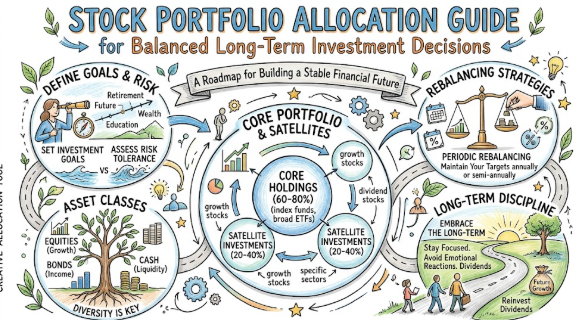
Introduction
Many beginners enter the stock market with excitement, but they often feel confused when prices move up and down quickly. One day a stock looks attractive because everyone is talking about it, and the next day the same stock falls sharply. This creates fear, doubt, and pressure. For many new investors, the biggest challenge is not only choosing stocks but understanding how those stocks should fit together inside one complete portfolio.
A stock portfolio is not just a list of random shares. It is a planned collection of investments that should match your goals, risk comfort, time horizon, income level, and financial discipline. When beginners do not understand this, they may buy stocks based on tips, social media posts, news headlines, or short-term excitement. This can create poor decisions, emotional investing, and unnecessary financial stress.
The real problem is that many people focus only on “which stock should I buy?” but ignore a more important question: “How should I build a portfolio that can handle risk, market volatility, and long-term goals?” This difference matters. A single good stock may not protect your money if your overall portfolio is weak, unbalanced, or too risky.
Learning How to Build a Strong Stock Portfolio helps beginners think beyond quick gains. It teaches them how to balance growth, safety, diversification, patience, and regular review. A strong portfolio does not mean a risk-free portfolio. The stock market always carries risk. However, a thoughtful portfolio can help reduce avoidable mistakes and improve decision-making.
This blog is useful for beginners, salaried employees, students, new investors, traders, small business owners, finance bloggers, and people who want to understand investing in a practical way. It explains portfolio building in simple language without fake promises, unrealistic profit claims, or confusing jargon.
You will learn how stocks work, why diversification matters, how risk and return are connected, how to review your portfolio, what mistakes to avoid, and how to think like a disciplined investor. The focus is on financial awareness, not quick money.
Practical understanding is always better than emotional decisions. When you understand what you are doing, why you are doing it, and how much risk you can handle, you are more likely to make balanced choices. This is the foundation of a strong stock portfolio.
Understanding How to Build a Strong Stock Portfolio in Simple Words
A stock portfolio means a group of stocks and other investments owned by an investor. Building a strong stock portfolio means selecting and managing these investments in a planned way so they support your financial goals while keeping risk under control.
In simple words, portfolio building is like preparing a balanced meal. If you eat only one food item every day, your body may not get complete nutrition. In the same way, if you invest all your money in one stock or one sector, your portfolio becomes weak and risky. A better approach is to include different types of stocks, sectors, and investment styles.
A strong stock portfolio usually includes companies from different areas such as banking, technology, consumer goods, healthcare, energy, manufacturing, and other sectors. It may also include different types of stocks such as large-cap, mid-cap, and small-cap stocks, depending on the investor’s risk capacity.
People search for How to Build a Strong Stock Portfolio because they want clarity. They may already have some money to invest, but they do not know where to start. Some may have made losses by following random tips. Others may want to invest for long-term goals such as retirement, children’s education, wealth creation, or financial independence.
Portfolio building connects directly with money management, investing, financial planning, risk awareness, tax planning, and long-term discipline. It is not only about buying stocks. It is also about understanding how much to invest, when to review, when to avoid panic, and how to protect yourself from emotional decisions.
For example, imagine a beginner invests all savings in one popular stock because a friend recommended it. If the company performs poorly or the sector faces pressure, the investor may suffer heavy loss. But if the same investor spreads money across quality companies from different sectors, the impact of one weak stock may be reduced.
A common misunderstanding is that a strong portfolio means a portfolio that always gives high returns. This is not true. No portfolio can guarantee profits. A strong portfolio is one that is built with research, balance, patience, and risk awareness.
Practical takeaway: A strong stock portfolio is not built by excitement. It is built by planning, diversification, research, discipline, and regular review.
Why to Build a Strong Stock Portfolio Is Important
Learning How to Build a Strong Stock Portfolio is important because your investment decisions affect your savings, future goals, emotional peace, and long-term financial stability.
For salaried people, a strong portfolio can help convert monthly savings into long-term investment discipline. Instead of keeping all money idle or investing randomly, they can create a structured plan. For small business owners, portfolio building may help separate business risk from personal wealth planning. For students and young earners, it creates early awareness about compounding, patience, and risk.
A strong stock portfolio also helps investors avoid overdependence on one stock, one sector, or one market trend. Markets can move up and down due to company performance, economic conditions, interest rates, global events, and investor sentiment. If your entire investment depends on one theme, your risk becomes high.
Portfolio building is also connected to borrowing and tax planning. For example, an investor should not take a high-interest loan only to invest in risky stocks. Similarly, investors should understand that capital gains, dividends, and trading activity may have tax implications. When people ignore these areas, they may face financial pressure later.
For crypto learners, stock portfolio discipline is also useful because it teaches risk allocation. Even though stocks and crypto are different, the idea of not putting all money into one risky asset remains important. For traders, portfolio understanding helps separate long-term investing from short-term speculation.
A short practical scenario can explain this better. Suppose Ramesh earns a monthly salary and invests based only on social media tips. He buys five stocks from the same sector. When that sector falls, his entire portfolio turns negative. Later, he learns diversification and starts spreading investments across different sectors and risk levels. His portfolio still faces market ups and downs, but it becomes more balanced.
The better approach is to build a portfolio based on goals, risk capacity, research, and time horizon. Emotional decision-making may feel exciting in the beginning, but long-term financial discipline is usually more useful.
The Real Problem Readers Face With Portfolio Building
The biggest problem beginners face is confusion. They hear many different opinions from friends, videos, social media, news channels, market experts, and online forums. One person says buy growth stocks. Another says buy dividend stocks. Someone else says focus only on small-cap stocks. This creates information overload.
Many beginners also enter the market without knowing their own risk capacity. They may invest money needed for rent, education, medical emergencies, or monthly expenses. When the market falls, they panic because the invested money was not actually meant for long-term risk.
Another common issue is emotional decision-making. When prices rise, beginners may feel greed and buy at high levels. When prices fall, they may feel fear and sell in panic. This cycle can damage portfolio performance and confidence.
Poor planning is also a major problem. Some investors buy stocks without checking the company’s business, debt, profitability, management quality, valuation, or sector risk. Others keep adding new stocks until their portfolio becomes too crowded and difficult to track.
Weak comparison is another challenge. Beginners may compare two stocks only by price. A stock trading at a lower price is not automatically cheaper, and a stock trading at a higher price is not automatically expensive. Valuation, earnings, business quality, and future prospects matter more than price alone.
Unrealistic expectations can also create problems. Some beginners expect fast returns and become disappointed when investments do not grow immediately. Stock investing requires patience. Even good companies can face temporary price corrections.
Depending only on social media advice is risky because not every opinion is suitable for your financial situation. Some content may be biased, promotional, incomplete, or based on short-term hype. The right next step is to learn the basics, create a plan, and avoid decisions based only on noise.
A strong portfolio starts when investors stop chasing random ideas and start thinking systematically.
How to Build a Strong Stock Portfolio Step by Step
Step 1: Define Your Investment Goal
Your investment goal explains why you are investing. It may be retirement, wealth creation, children’s education, home purchase, or long-term savings.
This matters because different goals need different strategies. A short-term goal should not be handled the same way as a long-term goal.
To apply this, write your goal clearly before buying any stock. For example, “I want to invest for long-term wealth creation over many years” is more useful than “I want to make fast money.”
A common mistake is investing without a purpose. This makes it easy to panic during market corrections.
The better approach is to connect every investment with a clear goal and expected time horizon.
Step 2: Understand Your Risk Capacity
Risk capacity means how much market movement or possible loss you can handle without damaging your financial life.
This matters because the stock market is volatile. Prices can move sharply in the short term.
To apply this, check your income stability, emergency fund, monthly expenses, debt level, and emotional comfort. If you cannot handle large price falls, avoid building an aggressive portfolio.
For example, a salaried person with stable income and no debt may take moderate risk, while someone with high loans and unstable income should be more careful.
A common mistake is copying someone else’s portfolio without knowing their risk level.
The better approach is to invest according to your own situation.
Step 3: Create an Emergency Fund First
An emergency fund is money kept aside for urgent needs such as medical expenses, job loss, family emergencies, or unexpected bills.
This matters because stock investments should not be sold in panic for short-term expenses.
To apply this, keep emergency money separate from investment money. This money should be easily accessible and not exposed to high market risk.
For example, if you invest your emergency money in stocks and the market falls during an emergency, you may be forced to sell at a loss.
A common mistake is investing all savings without keeping cash safety.
The better approach is to build a basic safety cushion before taking market risk.
Step 4: Learn Stock Market Basics
Before building a portfolio, understand what stocks are, how companies earn money, why prices move, and how risk works.
This matters because investing without knowledge can lead to random decisions.
To apply this, learn basic concepts such as market capitalization, earnings, valuation, dividends, sectors, volatility, and diversification.
For example, buying a stock only because its price is low is not proper research. The business quality matters.
A common mistake is treating the stock market like a shortcut to wealth.
The better approach is to treat investing as a learning-based financial activity.
Step 5: Diversify Across Sectors and Stock Types
Diversification means spreading investment across different stocks, sectors, and categories.
This matters because no single sector performs well all the time.
To apply this, avoid putting all money into one company or one industry. Include companies from different sectors based on research and suitability.
For example, a portfolio with only technology stocks may suffer if the technology sector faces pressure.
A common mistake is overinvesting in trending sectors.
The better approach is to balance growth opportunities with risk control.
Step 6: Research Before Buying
Research means studying the company before investing. It includes business model, revenue, profit, debt, competition, management quality, and valuation.
This matters because stock prices are connected to business performance over time.
To apply this, create a simple checklist before buying any stock. Ask: What does the company do? Is it profitable? Is debt high? Is the valuation reasonable? What risks exist?
For example, a company with strong sales but heavy debt may still be risky.
A common mistake is buying based only on tips or headlines.
The better approach is to make research-based decisions.
Step 7: Decide Position Size Carefully
Position size means how much money you invest in one stock.
This matters because even a good company can face unexpected problems. If too much money is placed in one stock, portfolio risk increases.
To apply this, set a limit for each stock based on your risk capacity. Beginners should avoid making one stock too large in the portfolio.
For example, investing 60% of your money in one company can be dangerous if that company faces trouble.
A common mistake is becoming overconfident in one stock.
The better approach is to keep position sizes balanced.
Step 8: Review and Rebalance Regularly
Portfolio review means checking whether your investments still match your goals and risk level. Rebalancing means adjusting the portfolio when it becomes too concentrated or unsuitable.
This matters because markets and companies change over time.
To apply this, review your portfolio monthly or quarterly. Check performance, business updates, sector exposure, and risk concentration.
For example, if one stock grows too much and becomes a very large part of your portfolio, you may need to review the risk.
A common mistake is buying stocks and never checking them again.
The better approach is disciplined review without unnecessary panic.
Key Factors That Influence Portfolio Strength
Risk and Return
Risk and return are connected. Higher expected return usually comes with higher uncertainty. Beginners should not focus only on returns. They should first ask how much risk they are taking.
The better approach is to compare potential reward with possible downside.
Time Horizon
Your time horizon is how long you plan to stay invested. Long-term goals can usually handle more market volatility than short-term goals.
A common mistake is investing for a short-term need in volatile stocks.
The better approach is to match investment type with goal duration.
Market Volatility
Volatility means price movement. Stocks can rise and fall due to news, earnings, economic changes, and investor emotions.
Beginners often fear volatility because they do not expect it.
The better approach is to prepare mentally before investing.
Research Quality
Good research improves decision-making. Poor research creates dependence on tips.
Research does not remove risk, but it helps investors understand what they own.
The better approach is to study business quality, valuation, and risk before investing.
Diversification
Diversification reduces the impact of one wrong decision. It does not guarantee profit, but it can reduce concentration risk.
A common mistake is owning many stocks without real diversification.
The better approach is to diversify across sectors, not just stock names.
Emotional Control
Fear and greed are common in the stock market. Emotional investing can lead to buying high and selling low.
The better approach is to follow a written plan.
Portfolio Review
A portfolio needs regular review because companies and markets change.
Review does not mean daily panic checking. It means structured monitoring.
Long-Term Discipline
Strong portfolios are usually built with patience. Frequent unnecessary changes can increase mistakes.
The better approach is disciplined investing with periodic learning.
Detailed Breakdown of How to Build a Strong Stock Portfolio
Stock Market Basics
The stock market is a place where investors buy and sell shares of listed companies. When you buy a stock, you own a small part of that company. Your return may come from price appreciation, dividends, or both. However, stock prices can fall, and there is no guaranteed return.
Beginners should understand that a stock is not just a ticker symbol. It represents a real business. If the business performs well over time, the stock may benefit. If the business struggles, the stock may decline.
How Stocks Work
Stock prices move because of demand and supply, company performance, earnings expectations, economic conditions, interest rates, global factors, and investor sentiment. Sometimes prices move even when business fundamentals have not changed.
This is why beginners should not react to every short-term price movement. A strong portfolio is based on understanding both business quality and market behavior.
Investing vs Trading
Investing focuses on long-term ownership of quality assets. Trading focuses on shorter-term price movements. Both require knowledge, but they are different activities.
A beginner should not confuse long-term investing with quick trading. If you buy a stock for long-term goals but sell it because of one bad day, your strategy is unclear.
Risk and Return
Every stock investment carries risk. Even strong companies can face business challenges, regulatory changes, competition, or market corrections. A strong stock portfolio accepts risk but manages it through planning.
The goal is not to avoid all risk. The goal is to take suitable risk.
Market Volatility
Volatility is normal in stock investing. A portfolio may show temporary losses even when the long-term plan is reasonable. Beginners often feel uncomfortable because they expect smooth returns.
The better approach is to prepare for volatility before investing.
Long-Term vs Short-Term Approach
Short-term investing requires careful timing and risk management. Long-term investing focuses on business growth, patience, and compounding. Beginners usually benefit from understanding long-term discipline first.
This does not mean long-term investing is risk-free. It means the investor gives quality businesses time to perform.
Research Basics
Research starts with simple questions:
- What does the company do?
- How does it earn money?
- Is it profitable?
- Is debt manageable?
- Is management reliable?
- Is the industry growing?
- Is the stock valuation reasonable?
- What risks can affect the business?
A beginner does not need to become an expert overnight. But basic research is necessary before investing.
Fundamental Understanding
Fundamental analysis studies the business behind the stock. It looks at revenue, profit, debt, cash flow, margins, industry position, and management quality.
This helps investors avoid buying weak businesses only because prices look low.
Technical Understanding
Technical analysis studies price charts and market trends. It may be useful for traders and short-term investors. However, beginners should not depend only on charts without understanding the business.
For long-term portfolio building, fundamentals usually matter more than short-term chart signals.
Diversification
Diversification is the heart of portfolio strength. It helps reduce damage if one stock or sector performs badly.
However, too much diversification can also create confusion. Owning too many stocks without understanding them can make the portfolio hard to manage.
Portfolio Thinking
Portfolio thinking means looking at your investments as one complete structure. A stock may be good individually, but if your portfolio already has similar exposure, adding it may increase risk.
For example, buying five different banking stocks may look diversified by name, but the portfolio is still heavily exposed to one sector.
Emotional Control
Investors often lose discipline because of emotions. Greed appears when markets rise quickly. Fear appears when markets fall. Both can damage decisions.
A written investment plan helps reduce emotional mistakes.
Beginner Mistakes
Common beginner mistakes include following random tips, investing without goals, ignoring risk, overtrading, buying only popular stocks, and not reviewing the portfolio.
The better approach is slow, steady, and research-based investing.
Importance of Patience and Discipline
A strong stock portfolio is not built in one day. It develops through learning, reviewing, correcting mistakes, and staying disciplined.
Patience does not mean ignoring problems. It means avoiding unnecessary panic while staying aware.
Why Following Random Tips Is Risky
Random tips may not match your financial situation, risk level, or time horizon. Some tips may be incomplete or biased.
The better approach is to use advice only as a starting point for your own research, not as the final decision.
Common Mistakes Beginners Make With Portfolio Building
Following Random Advice
This happens because beginners want quick answers. It is risky because the advice may not suit their goals or risk capacity. They may buy unsuitable stocks and suffer losses. Instead, they should research before acting.
Ignoring Risk
Many investors focus only on possible returns. This is risky because every stock can fall. The better approach is to check downside risk first.
Not Comparing Options
Beginners may buy the first stock they hear about. This can lead to poor selection. Instead, compare companies within the same sector before investing.
Trusting Fake Profit Claims
Some people promote unrealistic returns. This is risky because no genuine investment can guarantee stock market profits. Instead, avoid guaranteed-return claims in equity investing.
Making Emotional Decisions
Fear and greed lead to poor timing. Investors may buy during hype and sell during panic. Instead, follow a written plan.
Using Emergency Money for Risky Activities
This is dangerous because emergencies can force you to sell during market downturns. Emergency money should stay separate.
Not Reading Terms and Conditions
For platforms, brokers, advisory services, or financial products, ignoring terms can lead to confusion about charges, risks, or responsibilities. Always read carefully.
Sharing Sensitive Financial Information
Beginners may share account details, OTPs, or personal data with unknown sources. This can lead to fraud. Protect all sensitive information.
Ignoring Tax and Compliance Responsibilities
Investment gains may have tax implications. Ignoring tax responsibilities can create problems later. Consult a qualified professional where required.
Depending Only on Social Media Advice
Social media can be useful for learning, but it should not replace research. Always verify information.
Don’t Do This Checklist
- Do not invest only because a stock is trending.
- Do not put all money into one company.
- Do not use emergency funds for risky investments.
- Do not trust guaranteed profit claims.
- Do not copy someone else’s portfolio blindly.
- Do not ignore taxes and charges.
- Do not panic sell without reviewing facts.
- Do not share OTPs, passwords, or account details.
- Do not trade aggressively without knowledge.
- Do not invest money you cannot afford to risk.
Practical Real-Life Examples of Portfolio Building
Example 1: Salaried Person Managing Monthly Savings
Rohit saves a fixed amount from his salary every month. Earlier, he invested randomly in popular stocks. Later, he created a goal-based plan and diversified across sectors.
Learning: Monthly investing becomes stronger when it follows a structured portfolio plan.
Example 2: Beginner Investor Avoiding Random Stock Tips
Neha received a stock tip from a friend and almost invested without research. She checked the company’s debt, business model, and valuation before deciding.
Learning: A tip should never replace personal research.
Example 3: Trader Separating Trading and Investing Money
Amit used the same account for trading and long-term investing. This created confusion. He separated short-term trading capital from long-term investment capital.
Learning: Clear separation helps reduce emotional and financial mistakes.
Example 4: Small Business Owner Planning Personal Wealth
Priya runs a small business and faces income fluctuations. She avoided putting all savings in high-risk stocks and built a balanced portfolio slowly.
Learning: Business owners should consider income stability before taking investment risk.
Example 5: Crypto Learner Understanding Risk Allocation
Karan was interested in crypto and stocks. Instead of putting most money into high-volatility assets, he learned risk allocation and kept his portfolio balanced.
Learning: Risky assets should be handled with strict limits and awareness.
Two Useful Tables for Better Understanding
Table 1: Weak Portfolio vs Strong Portfolio
| Area | Weak Portfolio Approach | Strong Portfolio Approach |
|---|---|---|
| Stock Selection | Based on tips and hype | Based on research and suitability |
| Diversification | Too much in one stock or sector | Spread across sectors and stock types |
| Risk Control | Ignored or unclear | Reviewed before investing |
| Time Horizon | No clear plan | Linked with financial goals |
| Emergency Fund | Often invested in stocks | Kept separate and accessible |
| Review Method | Random checking | Periodic structured review |
| Emotional Control | Panic and greed driven | Plan and discipline driven |
Table 2: Investing vs Trading for Beginners
| Point | Investing | Trading |
|---|---|---|
| Main Focus | Long-term business growth | Short-term price movement |
| Time Period | Usually longer | Usually shorter |
| Research Type | Fundamentals, business quality, valuation | Charts, trends, price action, risk setup |
| Risk Style | Market and business risk | Market, timing, and execution risk |
| Suitable For | Patient long-term investors | Skilled, disciplined, risk-aware participants |
| Common Mistake | Ignoring review | Overtrading and poor risk control |
| Better Approach | Build a balanced portfolio | Use strict risk management |
Tools, Methods, and Frameworks Readers Can Use
Stock Watchlist
A stock watchlist is a list of companies you want to track before investing. It helps beginners avoid impulsive buying. You can use it to observe price, results, news, and valuation before making a decision. It helps avoid the mistake of buying only because of excitement.
Investment Journal
An investment journal records why you bought a stock, your expected holding period, risk, and review notes. This helps you learn from decisions. Beginners can use a simple notebook or spreadsheet. It helps avoid repeated mistakes.
Portfolio Review Method
A portfolio review method means checking your investments at fixed intervals. Review business performance, sector exposure, risk concentration, and goal alignment. This helps avoid neglecting weak investments.
Risk Allocation Method
Risk allocation means deciding how much money should go into low, moderate, and high-risk investments. Beginners can use this to avoid putting too much money into risky stocks. It helps control emotional overexposure.
Fundamental Analysis Checklist
This checklist includes revenue, profit, debt, cash flow, management, valuation, and sector outlook. It helps beginners study the business before investing. It avoids blind buying.
Goal Planner
A goal planner connects investments with financial goals. It helps you decide whether your portfolio is for long-term wealth, retirement, education, or another purpose. It prevents random investing.
Monthly Money Review System
This method reviews income, expenses, savings, debt, and investments every month. It helps salaried people and beginners stay financially organized. It also ensures that investing does not disturb basic needs.
Expert Tips to Make Better Investment Decisions
1. Learn Before Taking Action
Learning reduces avoidable mistakes. Before buying stocks, understand basic market terms, risk, diversification, and valuation. Apply this by reading beginner-friendly educational content and reviewing examples.
2. Check Risk Before Expected Return
Many beginners ask how much they can earn, but they should first ask how much they can lose. This matters because risk affects financial stability. Apply this by checking downside scenarios before investing.
3. Keep Emergency Money Separate
Emergency funds protect you from forced selling. If you invest emergency money in stocks, you may need to sell during a market fall. Keep this money in safer, accessible options.
4. Avoid Blindly Copying Others
Someone else’s portfolio may not match your income, goals, or risk level. Use others’ ideas only for learning. Make decisions based on your own situation.
5. Start Small and Learn Gradually
Starting small helps beginners learn without taking excessive risk. You can increase investment size as your knowledge and confidence improve.
6. Diversify with Purpose
Diversification is not about buying many stocks randomly. It means spreading risk across different sectors and quality businesses. Review whether your holdings are truly different.
7. Review Your Portfolio Regularly
Regular review helps identify overexposure, weak performance, or changes in business quality. Avoid daily panic checking, but do not ignore your portfolio completely.
8. Avoid Emotional Decisions
Fear and greed can damage returns. Create rules for buying, holding, and reviewing. Written rules reduce emotional pressure.
9. Understand What You Own
Do not buy a stock if you cannot explain what the company does. Understanding the business helps you stay calm during volatility.
10. Watch Valuation
A good company may not always be a good investment at any price. Valuation helps you avoid overpaying. Learn basic valuation indicators gradually.
11. Keep Records for Tax and Review
Investment records help with taxation, performance tracking, and decision review. Keep transaction details, statements, and notes properly.
12. Be Careful With Leverage
Borrowing money to invest can increase pressure and losses. Beginners should avoid leverage unless they fully understand the risk.
13. Avoid Fake Profit Promises
No genuine stock market investment can guarantee fixed profits. Avoid schemes, tips, or services that promise certain returns.
14. Take Professional Advice When Needed
If you are unsure about tax, legal, or investment suitability, consult a qualified professional. This is especially important for large financial decisions.
15. Focus on Long-Term Discipline
Strong portfolios require patience. Do not expect every investment to perform immediately. Stay focused on process, review, and learning.
Case Studies: How Better Understanding Changes Decisions
Case Study 1: The Salaried Beginner
Profile: Rakesh, a salaried employee with regular monthly income.
Situation: He wanted to invest for long-term wealth creation.
Problem: He bought stocks based on office discussions and social media posts.
Wrong Approach: He invested most of his savings in two trending stocks without checking risk.
Better Approach: He built an emergency fund, created a monthly investment plan, diversified across sectors, and started reviewing quarterly.
Result or Learning: He understood that slow and structured investing is better than random excitement.
Key Takeaway: A salaried investor should connect portfolio building with income stability, goals, and risk capacity.
Case Study 2: The Overconfident Trader
Profile: Meena, a beginner interested in both trading and investing.
Situation: She made a few profitable trades and became overconfident.
Problem: She started using long-term investment money for short-term trades.
Wrong Approach: She mixed trading capital and investment capital, which created emotional pressure.
Better Approach: She separated her trading account from her investment portfolio and used strict risk limits.
Result or Learning: She learned that investing and trading need different plans.
Key Takeaway: Clear boundaries help protect long-term portfolio discipline.
Case Study 3: The Small Business Owner
Profile: Arjun, a small business owner with irregular income.
Situation: He wanted to invest surplus money in stocks.
Problem: Business income was unstable, but he invested aggressively in high-risk stocks.
Wrong Approach: He ignored liquidity needs and business uncertainty.
Better Approach: He kept cash reserves, reduced concentration risk, and invested gradually in researched companies.
Result or Learning: He realized that portfolio strength depends on personal financial stability.
Key Takeaway: Business owners should balance investment goals with cash flow needs.
Risk Awareness: What Readers Must Check First
Market Risk
Market risk means the possibility that stock prices may fall due to broad market conditions. It matters because even good stocks can decline during market corrections. You can reduce this risk through diversification, long-term thinking, and avoiding panic decisions.
Company Risk
Company risk means a specific business may perform poorly due to weak earnings, debt, competition, or management issues. Reduce this risk by researching before investing and avoiding overexposure to one company.
Sector Risk
Sector risk happens when one industry faces pressure. For example, regulation, demand slowdown, or cost increases can affect an entire sector. Reduce this risk by investing across different sectors.
Liquidity Risk
Liquidity risk means you may not be able to sell an investment easily at a fair price. It is more common in less-traded stocks. Beginners should be careful with low-volume stocks.
Emotional Risk
Emotional risk comes from fear, greed, impatience, and panic. It matters because poor emotions can lead to poor decisions. Reduce it with a written plan and regular review.
Misinformation Risk
Misinformation can come from social media, fake experts, rumors, or incomplete analysis. Reduce this risk by verifying information from reliable sources and doing your own research.
Tax-Related Risk
Capital gains, dividends, and trading income may have tax implications. Ignoring this can create compliance issues. Consult a qualified tax professional where required.
Fraud Risk
Fraud risk includes fake advisory services, guaranteed return schemes, phishing, and account scams. Protect personal data and avoid sharing sensitive details.
Over-Concentration Risk
This happens when too much money is invested in one stock or sector. Reduce it by setting position limits and reviewing exposure.
Readers should always verify details and consult a qualified financial, tax, legal, or investment professional before making major decisions.
Checklist Before Taking Investment Action
- I understand the company or investment clearly.
- I know why I am investing.
- My financial goal is written.
- My time horizon is clear.
- My emergency fund is separate.
- I have checked my risk capacity.
- I have compared options properly.
- I have reviewed company basics.
- I have checked sector exposure.
- I am not investing because of hype.
- I am not trusting guaranteed return claims.
- I have protected my personal and financial data.
- I have considered tax and compliance impact.
- I have avoided emotional decision-making.
- I have written my investment reason.
- I know when I will review the investment.
- I have considered professional advice where needed.
Use this checklist before buying, selling, or changing your portfolio. It helps you slow down, think clearly, and avoid avoidable mistakes.
Strategic Insights for Better Decision-Making
Position Sizing
Position sizing means deciding how much money to invest in one stock. It helps protect your portfolio from one wrong decision. Beginners should avoid making any single stock too large.
Portfolio Review
A portfolio review checks whether your investments still match your goals. Review company performance, sector exposure, and risk concentration. Avoid reviewing only when the market falls.
Diversification
Diversification spreads risk across companies and sectors. It does not remove risk, but it reduces dependence on one investment. A beginner-friendly example is owning companies from different industries instead of only one sector.
Risk Allocation
Risk allocation means dividing money based on risk levels. For example, a beginner may choose a mix of stable companies and limited exposure to higher-risk stocks. This creates better balance.
Long-Term Mindset
A long-term mindset helps investors avoid reacting to daily price movements. It encourages patience and business-focused thinking.
Avoiding Herd Mentality
Herd mentality means following the crowd without independent thinking. It can lead to buying overpriced stocks during hype. The better approach is research-based investing.
Investment Discipline
Discipline means following your plan even when markets are noisy. It includes regular investing, review, risk control, and avoiding emotional actions.
Key Terms Explained for Beginners
- Stock: A stock represents ownership in a company. When you buy a stock, you own a small part of that business.
- Portfolio: A portfolio is a collection of investments such as stocks, mutual funds, or other assets.
- Diversification: Diversification means spreading investments across different companies or sectors to reduce concentration risk.
- Risk: Risk means the chance of losing money or facing an unexpected result.
- Return: Return means the gain or loss from an investment over time.
- Volatility: Volatility means fast price movement. Stocks can rise or fall sharply in the short term.
- Market Capitalization: Market capitalization shows the total market value of a company. It is often used to classify companies as large-cap, mid-cap, or small-cap.
- Large-Cap Stocks: These are shares of large, established companies. They may be relatively stable but still carry risk.
- Mid-Cap Stocks: These are shares of medium-sized companies. They may offer growth potential with higher risk than large-cap stocks.
- Small-Cap Stocks: These are shares of smaller companies. They can be more volatile and risky.
- Dividend: A dividend is a portion of profit a company may distribute to shareholders.
- Valuation: Valuation helps investors understand whether a stock price is reasonable compared to the company’s earnings, assets, or growth.
- Fundamental Analysis: Fundamental analysis studies the business quality, financial performance, management, and future prospects of a company.
- Technical Analysis: Technical analysis studies price charts and trading patterns.
- Rebalancing: Rebalancing means adjusting your portfolio when it becomes too concentrated or no longer matches your plan.
Who Should Read This Blog
Beginners
Beginners can use this blog to understand portfolio building from the ground level without confusing jargon.
Students
Students can learn early financial awareness and understand how investing works before taking real risk.
Salaried Employees
Salaried people can learn how to convert regular savings into a structured long-term portfolio.
Small Business Owners
Business owners can understand how to balance investment planning with irregular income and business risk.
New Investors
New investors can learn how to avoid random stock selection and build a balanced approach.
Traders
Traders can understand why trading capital and long-term investment capital should be separated.
Loan Seekers
Loan seekers can learn why borrowed money should not be used carelessly for risky investments.
Crypto Learners
Crypto learners can understand risk allocation, diversification, and volatility management.
Casino Content Creators
Casino content creators can learn the value of responsible financial language, risk awareness, and user trust.
Finance Bloggers
Finance bloggers can use this structure to explain investment topics in a reader-first and educational way.
People Improving Money Awareness
Anyone trying to avoid financial mistakes can learn practical risk control and planning habits.
Frequently Asked Questions
1. What is a strong stock portfolio?
A strong stock portfolio is a planned collection of investments that matches your goals, risk capacity, and time horizon. It usually includes diversification, research, and regular review. It does not mean guaranteed profit or zero risk.
2. Why is How to Build a Strong Stock Portfolio important for beginners?
Learning How to Build a Strong Stock Portfolio helps beginners avoid random investing and emotional decisions. It teaches them how to balance risk, research, diversification, and long-term discipline.
3. How can beginners start building a portfolio safely?
Beginners can start by defining goals, keeping an emergency fund, learning basics, and investing small amounts. They should research before buying and avoid depending only on tips.
4. What is the biggest mistake in portfolio building?
The biggest mistake is investing without a clear plan. Many beginners buy stocks based on hype, social media, or friends’ advice. A better approach is to research and invest according to personal goals.
5. Is portfolio building useful for salaried people?
Yes, salaried people can benefit from portfolio building because they usually have regular income. A structured plan can help them invest monthly while keeping emergency money separate.
6. How many stocks should a beginner hold?
There is no fixed number suitable for everyone. Beginners should hold only as many stocks as they can understand and review properly. Quality and diversification matter more than quantity.
7. Does diversification remove all risk?
No, diversification does not remove all risk. It reduces concentration risk by spreading investments, but market risk still remains. Investors should still review and manage risk.
8. Should I invest based on stock tips?
Stock tips should not be your final decision. You can use them as a starting point for research, but you must verify the business, valuation, risk, and suitability yourself.
9. How often should I review my stock portfolio?
A monthly or quarterly review is useful for many beginners. Daily checking can create stress, while no review can lead to neglect. The right review frequency depends on your investment style.
10. Can How to Build a Strong Stock Portfolio help with financial planning?
Yes, understanding How to Build a Strong Stock Portfolio can support long-term financial planning. It helps connect investments with goals, risk capacity, and disciplined money habits.
11. Should I take professional advice before investing?
Professional advice can be helpful, especially for large investments, tax matters, or complex financial situations. A qualified expert can guide you based on your personal financial condition.
12. What is the best next step after reading this blog?
The best next step is to write your goals, check your risk capacity, build an emergency fund, and create a simple portfolio plan. Start with learning and avoid rushing into decisions.
Conclusion and Next Steps
Building a strong stock portfolio is not about finding one perfect stock or chasing fast returns. It is about creating a thoughtful investment structure that matches your goals, income, risk capacity, and time horizon. For beginners, this understanding is very important because the stock market can be exciting, confusing, and emotionally challenging at the same time.
This blog explained How to Build a Strong Stock Portfolio using practical steps, examples, risks, tools, case studies, and beginner-friendly explanations. You learned why a portfolio should not be built on tips, hype, or fear. You also learned why diversification, research, position sizing, review, and emotional control matter.
A strong portfolio does not promise guaranteed returns. No honest financial education should make that claim. Markets can move against expectations, companies can face problems, and short-term volatility is normal. However, a disciplined investor can reduce avoidable mistakes by planning carefully and staying informed.
Beginners should remember a few important points. First, never invest without understanding what you are buying. Second, keep emergency money separate from stock investments. Third, avoid putting too much money into one stock or sector. Fourth, review your portfolio regularly, but do not panic over every price movement. Fifth, take professional advice when the decision is large, complex, or tax-related.
Your next step should be simple. Write down your financial goals. Check how much risk you can handle. Create a watchlist of companies you understand. Study their business basics. Decide how much money you can invest without disturbing essential expenses. Then build your portfolio slowly and carefully.
Long-term investing requires patience. Some decisions will work well, and some may teach you lessons. What matters is whether you keep learning, reviewing, and improving your process. A strong investor is not someone who never makes mistakes. A strong investor is someone who learns to manage risk, avoid emotional pressure, and make informed decisions.
Financial awareness is the foundation of better investing. When you understand your money, your risk, and your goals, you become more confident and careful. That is the real value of portfolio building.
Build slowly. Learn continuously. Review honestly. Avoid hype. Respect risk. These habits can help you create a stronger and more responsible investment journey.
One thing that often gets overlooked in portfolio allocation is correlation risk. It’s not enough to just split money across equity, debt, and gold—assets that move together can still expose the portfolio to hidden concentration risk during market stress.