Introduction
Knowledge Graph Databases are specialized graph-based data platforms designed to model, connect, query, and analyze highly related data using nodes, edges, relationships, and semantic structures. Unlike traditional relational databases, knowledge graph systems focus on understanding relationships between entities, making them highly effective for AI, recommendation engines, fraud detection, semantic search, enterprise knowledge management, and real-time analytics.
As organizations increasingly adopt AI-driven analytics, large language models, semantic search systems, and connected enterprise data architectures, knowledge graph databases have become critical for enabling contextual intelligence, entity resolution, graph analytics, and explainable AI workflows. Modern platforms also support RDF, property graph models, graph machine learning, semantic reasoning, and hybrid cloud scalability.
Real-world use cases include:
- Building enterprise AI knowledge systems
- Fraud detection and relationship analysis
- Recommendation engines and personalization
- Semantic search and intelligent assistants
- Customer 360 and master data intelligence
Buyers evaluating Knowledge Graph Databases should consider:
- Graph query performance
- RDF and property graph support
- AI and machine learning integration
- Scalability for large graph workloads
- Semantic reasoning capabilities
- Real-time graph analytics support
- Security and governance controls
- Cloud-native deployment flexibility
- API and analytics ecosystem integrations
- Visualization and graph exploration capabilities
Best for: AI engineering teams, enterprise architects, data scientists, fraud analytics teams, semantic web developers, recommendation engine developers, and organizations managing highly connected data environments.
Not ideal for: Simple transactional workloads or environments where relational databases are sufficient for operational requirements.
Key Trends in Knowledge Graph Databases
- AI and large language model integration is accelerating rapidly.
- Graph machine learning adoption is expanding across enterprises.
- Semantic search and retrieval-augmented generation workflows are growing.
- Hybrid RDF and property graph support is becoming more common.
- Cloud-native graph databases are increasing in popularity.
- Real-time graph analytics adoption is expanding in fraud detection and cybersecurity.
- Graph visualization and low-code exploration tools are improving rapidly.
- Vector search and graph integration are converging for AI workloads.
- Distributed graph scalability is improving significantly.
- Knowledge graphs are becoming foundational for enterprise AI architectures.
How We Selected These Tools
The tools in this list were selected based on graph performance, semantic capabilities, scalability, ecosystem maturity, AI integration support, and enterprise adoption.
Selection criteria included:
- Graph modeling flexibility
- Query performance and scalability
- RDF and property graph compatibility
- AI and graph analytics capabilities
- Security and governance controls
- Visualization and exploration support
- Cloud-native deployment flexibility
- Integration ecosystem maturity
- Developer and operational experience
- Suitability for enterprise AI and analytics workloads
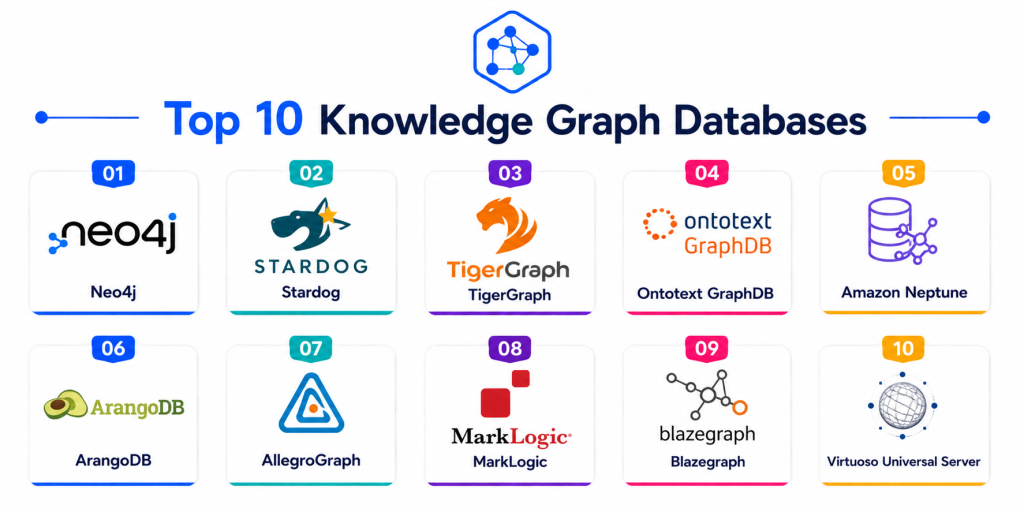
Top 10 Knowledge Graph Databases
1- Neo4j
Short description: Neo4j is one of the most widely adopted graph databases, providing property graph modeling, graph analytics, AI integration, and enterprise-scale relationship intelligence capabilities.
Key Features
- Property graph architecture
- Cypher graph query language
- Graph analytics and algorithms
- Real-time relationship querying
- Graph visualization tools
- AI and machine learning integration
- Distributed clustering support
Pros
- Excellent graph query performance
- Strong enterprise ecosystem
- Large developer and analytics community
Cons
- Advanced clustering may require enterprise licensing
- Large-scale graph optimization requires expertise
- RDF support is more limited than semantic-focused platforms
Platforms / Deployment
- Linux / Windows / macOS / Kubernetes
- Cloud / Self-hosted / Hybrid
Security & Compliance
- RBAC
- Encryption
- Audit logging
- SSO integration
- Fine-grained access controls
Integrations & Ecosystem
Neo4j integrates with analytics, AI, and enterprise ecosystems.
- Python
- Spark
- Kafka
- GraphQL
- Cloud platforms
- AI frameworks
Support & Community
Very large graph database ecosystem with strong enterprise and developer adoption.
2- Amazon Neptune
Short description: Amazon Neptune is a fully managed graph database service supporting RDF and property graph models for AI, recommendation systems, and semantic analytics workloads.
Key Features
- RDF and property graph support
- Managed cloud infrastructure
- SPARQL and Gremlin queries
- Graph analytics capabilities
- Real-time graph processing
- High availability architecture
- AI integration support
Pros
- Strong AWS ecosystem integration
- Managed operational model
- Good scalability for enterprise graph workloads
Cons
- Best suited for AWS-centric environments
- Advanced graph tuning may require expertise
- Vendor lock-in considerations
Platforms / Deployment
- AWS Cloud infrastructure
- Cloud
Security & Compliance
- IAM integration
- Encryption
- Audit logging
- Network isolation
- Compliance controls
Integrations & Ecosystem
Amazon Neptune integrates with AWS analytics and AI ecosystems.
- SageMaker
- Lambda
- S3
- IAM
- Analytics services
- AI platforms
Support & Community
Strong AWS ecosystem support and growing enterprise graph adoption.
3- Stardog
Short description: Stardog provides enterprise knowledge graph and semantic data platform capabilities focused on AI-ready data fabrics, reasoning, and semantic analytics.
Key Features
- RDF knowledge graph architecture
- Semantic reasoning engine
- Virtual graph federation
- AI-ready semantic layer
- SPARQL querying
- Metadata-driven governance
- Graph visualization
Pros
- Strong semantic reasoning capabilities
- Good enterprise knowledge graph support
- Useful virtual graph federation
Cons
- Enterprise operational complexity
- Requires semantic web expertise
- Premium licensing considerations
Platforms / Deployment
- Linux / Kubernetes / Enterprise infrastructure
- Cloud / Self-hosted / Hybrid
Security & Compliance
- RBAC
- Encryption
- Audit logging
- Identity integration
- Governance controls
Integrations & Ecosystem
Stardog integrates with enterprise AI and semantic ecosystems.
- APIs
- GraphQL
- AI frameworks
- Databases
- Analytics tools
- Cloud platforms
Support & Community
Strong semantic AI ecosystem and enterprise knowledge graph adoption.
4- TigerGraph
Short description: TigerGraph is a distributed graph analytics platform optimized for real-time graph processing, fraud detection, AI analytics, and large-scale relationship intelligence.
Key Features
- Distributed graph architecture
- Real-time graph analytics
- Parallel graph processing
- Graph machine learning support
- Deep link analysis
- Visual graph exploration
- High-performance querying
Pros
- Excellent distributed graph scalability
- Strong real-time analytics performance
- Good graph AI integration
Cons
- Operational learning curve
- Enterprise licensing model
- Advanced optimization requires expertise
Platforms / Deployment
- Linux / Kubernetes / Cloud infrastructure
- Cloud / Self-hosted / Hybrid
Security & Compliance
- RBAC
- Encryption
- Audit logging
- Identity integration
- Secure distributed execution
Integrations & Ecosystem
TigerGraph integrates with enterprise analytics and AI environments.
- Kafka
- Spark
- AI frameworks
- APIs
- Cloud platforms
- Analytics systems
Support & Community
Growing enterprise analytics ecosystem and strong fraud detection adoption.
5- Ontotext GraphDB
Short description: Ontotext GraphDB is a semantic graph database designed for RDF knowledge graphs, semantic reasoning, linked data, and AI-driven enterprise analytics.
Key Features
- RDF graph storage
- Semantic reasoning engine
- Linked data support
- SPARQL querying
- Knowledge graph visualization
- Data federation
- AI-ready semantic architecture
Pros
- Strong RDF and semantic support
- Good linked data capabilities
- Useful reasoning and inference features
Cons
- Requires semantic web expertise
- Smaller ecosystem than Neo4j
- Enterprise scalability planning required
Platforms / Deployment
- Linux / Enterprise infrastructure
- Cloud / Self-hosted / Hybrid
Security & Compliance
- RBAC
- Encryption
- Audit logging
- Authentication integration
- Governance controls
Integrations & Ecosystem
GraphDB integrates with semantic AI and linked data ecosystems.
- SPARQL endpoints
- APIs
- AI systems
- Analytics platforms
- Databases
- Cloud infrastructure
Support & Community
Strong semantic web ecosystem and enterprise knowledge graph adoption.
6- ArangoDB
Short description: ArangoDB is a multi-model database supporting graph, document, and key-value data models for flexible analytics and AI workloads.
Key Features
- Multi-model database architecture
- Native graph capabilities
- Distributed clustering
- Graph analytics support
- Flexible query language
- Real-time querying
- Cloud-native deployment
Pros
- Flexible multi-model architecture
- Good developer experience
- Useful distributed scalability
Cons
- Smaller ecosystem than Neo4j
- Advanced graph analytics may require tuning
- Enterprise governance capabilities are less mature
Platforms / Deployment
- Linux / Windows / macOS / Kubernetes
- Cloud / Self-hosted / Hybrid
Security & Compliance
- RBAC
- Encryption
- Authentication integration
- Audit logging
- Secure APIs
Integrations & Ecosystem
ArangoDB integrates with analytics and cloud-native ecosystems.
- Kubernetes
- APIs
- Cloud platforms
- AI systems
- Analytics tools
- Databases
Support & Community
Growing multi-model database ecosystem and developer adoption.
7- Azure Cosmos DB Gremlin API
Short description: Azure Cosmos DB Gremlin API provides globally distributed graph database capabilities for cloud-native applications, AI analytics, and relationship intelligence workloads.
Key Features
- Globally distributed graph storage
- Gremlin graph querying
- Cloud-native scalability
- Multi-region replication
- Real-time graph analytics
- Managed infrastructure
- High availability support
Pros
- Strong Azure ecosystem integration
- Excellent global scalability
- Managed operational model
Cons
- Best suited for Azure environments
- Cost optimization requires planning
- Limited semantic RDF capabilities
Platforms / Deployment
- Azure Cloud infrastructure
- Cloud
Security & Compliance
- RBAC
- Encryption
- Audit logging
- Microsoft Entra ID integration
- Compliance controls
Integrations & Ecosystem
Azure Cosmos DB integrates with Microsoft cloud analytics ecosystems.
- Azure AI
- Power BI
- APIs
- Analytics systems
- Cloud infrastructure
- AI services
Support & Community
Strong Microsoft cloud ecosystem and enterprise adoption.
8- JanusGraph
Short description: JanusGraph is an open-source distributed graph database optimized for large-scale graph storage and analytics across distributed infrastructure environments.
Key Features
- Distributed graph architecture
- Scalable graph storage
- Gremlin query support
- Backend database flexibility
- Real-time graph querying
- Open-source extensibility
- Cloud-native deployment support
Pros
- Open-source flexibility
- Strong scalability for large graphs
- Useful distributed backend compatibility
Cons
- Requires distributed systems expertise
- Operational complexity at scale
- Advanced tuning required
Platforms / Deployment
- Linux / Kubernetes / Distributed infrastructure
- Cloud / Self-hosted / Hybrid
Security & Compliance
- Authentication integration
- Encryption support
- Operational security depends on deployment
Integrations & Ecosystem
JanusGraph integrates with distributed analytics and storage ecosystems.
- Cassandra
- HBase
- Elasticsearch
- Kubernetes
- APIs
- Analytics systems
Support & Community
Strong open-source ecosystem and distributed graph adoption.
9- AllegroGraph
Short description: AllegroGraph is a semantic graph database focused on RDF storage, semantic reasoning, AI knowledge graphs, and graph analytics workflows.
Key Features
- RDF graph storage
- Semantic reasoning
- SPARQL querying
- AI knowledge graph support
- Entity-event relationship modeling
- Distributed graph analytics
- Semantic search capabilities
Pros
- Strong semantic AI capabilities
- Good reasoning and ontology support
- Useful linked data workflows
Cons
- Requires semantic expertise
- Smaller ecosystem compared to Neo4j
- Enterprise deployments require planning
Platforms / Deployment
- Linux / Enterprise infrastructure
- Cloud / Self-hosted / Hybrid
Security & Compliance
- RBAC
- Encryption
- Audit logging
- Identity integration
- Governance controls
Integrations & Ecosystem
AllegroGraph integrates with semantic AI and linked data ecosystems.
- APIs
- AI systems
- SPARQL endpoints
- Analytics tools
- Cloud infrastructure
- Databases
Support & Community
Established semantic graph ecosystem and enterprise knowledge graph adoption.
10- Oracle Spatial and Graph
Short description: Oracle Spatial and Graph provides enterprise graph analytics, semantic querying, and relationship intelligence capabilities integrated with Oracle database environments.
Key Features
- Property graph support
- RDF semantic querying
- Graph analytics algorithms
- Enterprise integration
- Spatial and graph analysis
- Distributed querying
- AI-ready graph analytics
Pros
- Strong Oracle ecosystem integration
- Good enterprise analytics support
- Useful combined spatial and graph capabilities
Cons
- Best suited for Oracle-centric environments
- Enterprise complexity at scale
- Licensing considerations
Platforms / Deployment
- Linux / Enterprise infrastructure
- Cloud / Self-hosted / Hybrid
Security & Compliance
- RBAC
- Encryption
- Audit logging
- Identity integration
- Governance controls
Integrations & Ecosystem
Oracle integrates with enterprise analytics and operational ecosystems.
- Oracle databases
- Analytics systems
- APIs
- Cloud platforms
- AI systems
- Enterprise applications
Support & Community
Strong Oracle enterprise ecosystem and global enterprise support.
Comparison Table
| Tool Name | Best For | Platforms Supported | Deployment | Standout Feature | Public Rating |
|---|---|---|---|---|---|
| Neo4j | Enterprise graph analytics | Linux / Windows / macOS | Cloud / Self-hosted / Hybrid | Property graph ecosystem | N/A |
| Amazon Neptune | Managed cloud knowledge graphs | AWS Cloud | Cloud | RDF and property graph support | N/A |
| Stardog | Semantic enterprise knowledge graphs | Linux / Kubernetes | Cloud / Self-hosted / Hybrid | Semantic reasoning engine | N/A |
| TigerGraph | Real-time distributed graph analytics | Linux / Kubernetes | Cloud / Self-hosted / Hybrid | Distributed graph processing | N/A |
| Ontotext GraphDB | RDF semantic knowledge graphs | Linux / Enterprise infrastructure | Cloud / Self-hosted / Hybrid | Linked data reasoning | N/A |
| ArangoDB | Multi-model graph workloads | Linux / Windows / macOS | Cloud / Self-hosted / Hybrid | Multi-model architecture | N/A |
| Azure Cosmos DB Gremlin API | Globally distributed graph workloads | Azure Cloud | Cloud | Global graph distribution | N/A |
| JanusGraph | Open-source distributed graph storage | Linux / Kubernetes | Cloud / Self-hosted / Hybrid | Backend storage flexibility | N/A |
| AllegroGraph | Semantic AI knowledge graphs | Linux / Enterprise infrastructure | Cloud / Self-hosted / Hybrid | Semantic AI reasoning | N/A |
| Oracle Spatial and Graph | Enterprise graph analytics | Linux / Enterprise infrastructure | Cloud / Self-hosted / Hybrid | Spatial and graph integration | N/A |
Evaluation & Scoring of Knowledge Graph Databases
| Tool Name | Core 25% | Ease 15% | Integrations 15% | Security 10% | Performance 10% | Support 10% | Value 15% | Weighted Total |
|---|---|---|---|---|---|---|---|---|
| Neo4j | 9.5 | 8.5 | 9.3 | 9.0 | 9.2 | 9.2 | 8.5 | 9.08 |
| Amazon Neptune | 9.1 | 8.3 | 9.0 | 9.2 | 9.0 | 8.9 | 8.2 | 8.79 |
| Stardog | 9.0 | 7.7 | 8.9 | 9.1 | 8.9 | 8.7 | 7.9 | 8.57 |
| TigerGraph | 9.3 | 7.5 | 8.8 | 9.0 | 9.5 | 8.8 | 8.0 | 8.79 |
| Ontotext GraphDB | 8.9 | 7.6 | 8.7 | 8.9 | 8.8 | 8.5 | 8.1 | 8.48 |
| ArangoDB | 8.8 | 8.2 | 8.6 | 8.6 | 8.7 | 8.4 | 8.8 | 8.59 |
| Azure Cosmos DB Gremlin API | 8.9 | 8.1 | 8.9 | 9.1 | 9.0 | 8.8 | 8.2 | 8.73 |
| JanusGraph | 8.8 | 7.1 | 8.5 | 8.4 | 9.0 | 8.3 | 9.0 | 8.43 |
| AllegroGraph | 8.7 | 7.3 | 8.5 | 8.8 | 8.7 | 8.3 | 8.0 | 8.32 |
| Oracle Spatial and Graph | 8.9 | 7.5 | 8.8 | 9.0 | 8.9 | 8.8 | 7.8 | 8.48 |
These scores are comparative and intended to help organizations evaluate operational fit rather than identify a universal winner. Property graph platforms score highly for developer accessibility and graph analytics performance, while semantic RDF platforms excel in AI reasoning and knowledge graph capabilities. Buyers should align platform selection with AI strategy, scalability requirements, operational expertise, and ecosystem alignment.
Which Knowledge Graph Database Is Right for You?
Solo / Freelancer
Independent developers and smaller analytics teams often prioritize flexibility, affordability, and ease of development. ArangoDB and Neo4j Community Edition are practical choices for smaller graph workloads.
SMB
SMBs usually need scalable graph analytics with manageable operational complexity. Neo4j, ArangoDB, and Amazon Neptune provide strong graph capabilities for growing AI and analytics environments.
Mid-Market
Mid-sized organizations often require stronger graph analytics scalability, distributed querying, and AI integration support. TigerGraph, Stardog, and Azure Cosmos DB Gremlin API are strong options for expanding graph intelligence operations.
Enterprise
Large enterprises typically require semantic reasoning, governance controls, distributed scalability, and AI-ready knowledge graph architectures. Neo4j, Stardog, Amazon Neptune, Ontotext GraphDB, and Oracle Spatial and Graph are strong enterprise-focused solutions.
Budget vs Premium
Open-source graph platforms reduce licensing costs but require stronger operational expertise. Enterprise graph platforms provide advanced governance, AI reasoning, and distributed analytics capabilities with higher operational investment.
Feature Depth vs Ease of Use
Property graph databases provide easier developer adoption and operational simplicity, while semantic RDF platforms offer deeper reasoning, ontology management, and AI-ready semantic intelligence.
Integrations & Scalability
Organizations already invested in AWS, Azure, Oracle, Kubernetes, Spark, or AI analytics ecosystems should prioritize graph platforms aligned with existing infrastructure environments.
Security & Compliance Needs
Security-focused organizations should prioritize RBAC, encryption, audit logging, identity integration, governance controls, and secure distributed graph processing capabilities. Enterprise graph databases generally provide stronger governance support.
Frequently Asked Questions
1. What is a Knowledge Graph Database?
A Knowledge Graph Database stores and analyzes connected data using nodes, relationships, and graph structures to model complex entity relationships.
2. Why are graph databases important?
They improve relationship analysis, AI reasoning, recommendation systems, fraud detection, semantic search, and enterprise knowledge intelligence.
3. What is the difference between RDF and property graph models?
RDF focuses on semantic triples and ontology-based reasoning, while property graphs focus on flexible node and relationship properties for graph analytics.
4. What industries commonly use knowledge graph databases?
Finance, healthcare, cybersecurity, telecommunications, retail, logistics, government, and AI-driven enterprises commonly rely on graph database technologies.
5. What are common implementation mistakes?
Common mistakes include poor graph modeling, weak relationship indexing, insufficient governance planning, overcomplicated schemas, and inadequate query optimization.
6. Can knowledge graph databases support AI workloads?
Yes. Modern graph databases increasingly support semantic reasoning, graph machine learning, retrieval-augmented generation, and AI knowledge systems.
7. What integrations are most important?
Important integrations include AI frameworks, analytics systems, APIs, cloud platforms, graph visualization tools, distributed processing engines, and semantic web technologies.
8. Should organizations choose graph databases or relational databases?
Graph databases complement relational systems rather than replacing them entirely. Many organizations combine graph and relational architectures for optimized analytics and operational workflows.
9. What is graph machine learning?
Graph machine learning analyzes relationships and network structures to improve recommendations, fraud detection, classification, and predictive analytics.
10. What should buyers evaluate before selecting a graph database?
Buyers should evaluate scalability, graph query performance, AI integration support, semantic capabilities, governance controls, operational complexity, and ecosystem compatibility.
Conclusion
Knowledge Graph Databases are becoming foundational for organizations building AI-ready architectures, semantic analytics systems, recommendation engines, fraud detection platforms, and enterprise relationship intelligence environments. The right graph database can improve connected data analysis, enable semantic reasoning, strengthen AI workflows, simplify relationship modeling, and accelerate enterprise analytics innovation. Neo4j remains one of the most widely adopted graph analytics platforms, while Amazon Neptune provides strong managed cloud graph capabilities. Stardog and Ontotext GraphDB excel in semantic reasoning and enterprise knowledge graph architectures, while TigerGraph strengthens distributed real-time graph analytics. ArangoDB delivers flexible multi-model capabilities, Azure Cosmos DB Gremlin API supports globally distributed cloud-native graph workloads, and JanusGraph provides open-source distributed scalability. AllegroGraph enhances semantic AI reasoning, and Oracle Spatial and Graph strengthens enterprise graph analytics integration. The best choice depends on AI strategy, semantic requirements, scalability needs, governance maturity, and ecosystem alignment. Shortlist two or three graph platforms, validate graph query performance and relationship modeling using production-like datasets, test AI and analytics integrations carefully, and ensure the selected platform can support long-term enterprise intelligence and AI growth initiatives.