Introduction
Recommendation engines are systems that analyze user behavior, preferences, and contextual data to suggest relevant products, content, or actions. They power everything from e-commerce product suggestions to streaming playlists and personalized news feeds.
Modern recommendation engines rely heavily on AI, machine learning, and real-time data processing to deliver highly accurate and dynamic suggestions. These systems use techniques like collaborative filtering, content-based filtering, and deep learning to predict user preferences and improve engagement.
Common Use Cases
- Product recommendations in e-commerce
- Content recommendations (videos, articles, music)
- Personalized search results
- Cross-sell and upsell optimization
- Customer journey personalization
What Buyers Should Evaluate
- Real-time recommendation capabilities
- AI/ML sophistication and algorithm flexibility
- Data integration (CDP, CRM, analytics)
- Scalability for large datasets
- Customization and control over ranking logic
- Deployment model (API, cloud, self-hosted)
- Latency and performance
- Experimentation and A/B testing support
- Privacy and data governance
Best for: E-commerce platforms, SaaS companies, media platforms, and enterprises aiming to increase engagement, retention, and revenue through personalization.
Not ideal for: Small websites with low traffic or limited data, where recommendation accuracy and ROI may be minimal.
Key Trends in Recommendation Engines
- AI-powered deep learning models for better prediction accuracy
- Real-time recommendation pipelines using streaming data
- Hybrid recommendation systems combining multiple algorithms
- Integration with personalization and CDPs
- Edge-based recommendation delivery for low latency
- Explainable AI for transparent recommendations
- Cross-channel recommendation engines (web, mobile, email)
- Generative AI-driven recommendations
- Privacy-first recommendation systems (cookieless tracking)
- Data warehouse-native recommendation architectures
How We Selected These Tools (Methodology)
The tools were selected based on:
- Market adoption and enterprise usage
- Depth of recommendation capabilities
- AI/ML sophistication and real-time processing
- Integration ecosystem (CDP, CRM, e-commerce platforms)
- Scalability and performance
- Ease of implementation and developer experience
- Deployment flexibility (cloud, API-first, hybrid)
- Security and governance features
- Innovation in AI and predictive analytics
- Suitability across SMB, mid-market, and enterprise
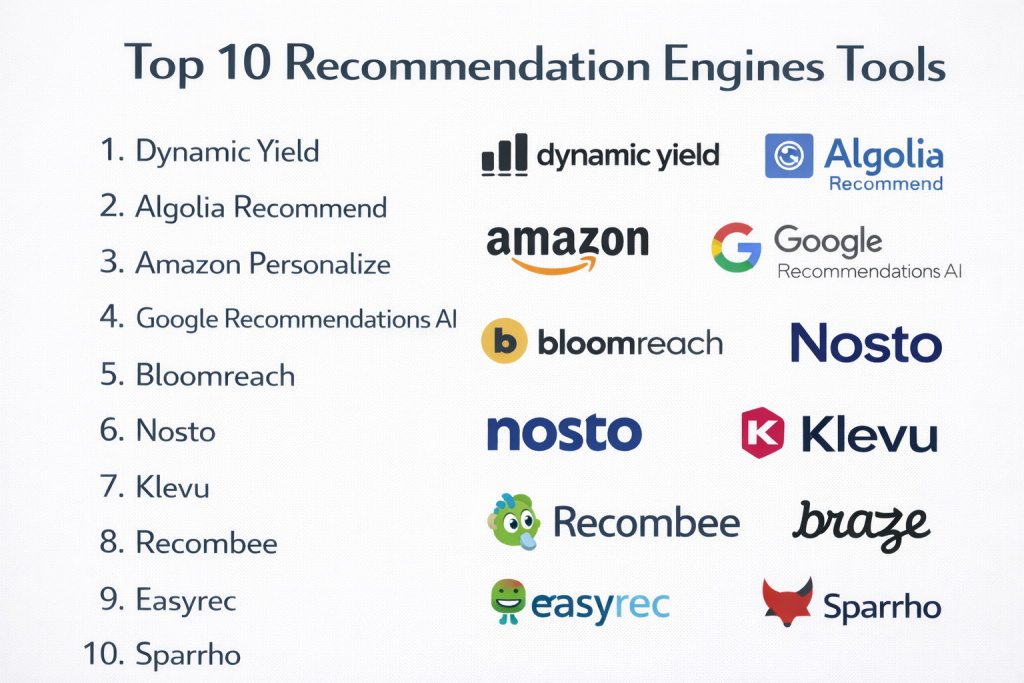
Top 10 Recommendation Engines Tools
#1 — Dynamic Yield
Short description: A leading personalization and recommendation platform focused on real-time product and content recommendations.
Key Features
- AI-driven recommendation engine
- Real-time personalization
- Product and content recommendations
- A/B testing and experimentation
- Omnichannel delivery
- Behavioral targeting
Pros
- Strong enterprise capabilities
- Real-time adaptive recommendations
Cons
- Expensive
- Requires setup and integration
Platforms / Deployment
Web
Cloud
Security & Compliance
Not publicly stated
Integrations & Ecosystem
Integrates with major marketing and commerce platforms.
- CDPs
- E-commerce platforms
- APIs
- Analytics tools
Support & Community
Enterprise support with strong documentation.
#2 — Algolia Recommend
Short description: A developer-friendly recommendation engine integrated with search and discovery capabilities.
Key Features
- Behavior-based recommendations
- Real-time updates
- Search + recommendation synergy
- API-first architecture
- Merchandising controls
- Headless support
Pros
- Highly customizable
- Strong developer experience
Cons
- Requires technical setup
- Pricing varies
Platforms / Deployment
Web
Cloud
Security & Compliance
Not publicly stated
Integrations & Ecosystem
Strong API ecosystem.
- E-commerce platforms
- APIs
- Analytics tools
Support & Community
Strong developer community.
#3 — Amazon Personalize
Short description: A managed AWS service that delivers real-time personalized recommendations using machine learning.
Key Features
- Real-time recommendations
- Pre-built ML models
- Personalization APIs
- Event tracking
- Scalable infrastructure
- Deep learning models
Pros
- Highly scalable
- Managed service (no ML expertise required)
Cons
- AWS dependency
- Requires data setup
Platforms / Deployment
Web
Cloud
Security & Compliance
- AWS security standards
- Encryption, IAM controls
Integrations & Ecosystem
Deep AWS ecosystem integration.
- Data pipelines
- APIs
- Analytics tools
Support & Community
Strong enterprise support via AWS.
#4 — Google Recommendations AI
Short description: A recommendation engine within Google Cloud designed for retail and e-commerce personalization.
Key Features
- AI-powered product recommendations
- Retail-focused models
- Real-time predictions
- Integration with Google Cloud
- Personalization APIs
- AutoML capabilities
Pros
- Strong AI capabilities
- Easy integration with Google ecosystem
Cons
- Limited outside Google ecosystem
- Requires setup
Platforms / Deployment
Web
Cloud
Security & Compliance
Not publicly stated
Integrations & Ecosystem
Google ecosystem integrations.
- Analytics
- Cloud services
- APIs
Support & Community
Enterprise support.
#5 — Bloomreach
Short description: A commerce-focused recommendation engine combining search, personalization, and AI.
Key Features
- AI-driven recommendations
- Search + recommendation integration
- Real-time personalization
- Customer segmentation
- Omnichannel delivery
- Predictive analytics
Pros
- Strong for e-commerce
- Unified platform
Cons
- Pricing varies
- Requires integration
Platforms / Deployment
Web
Cloud
Security & Compliance
Not publicly stated
Integrations & Ecosystem
Commerce-focused integrations.
- E-commerce platforms
- APIs
- Marketing tools
Support & Community
Enterprise support.
#6 — Nosto
Short description: An e-commerce personalization platform with strong recommendation capabilities.
Key Features
- Product recommendations
- Behavioral targeting
- AI personalization
- Merchandising tools
- Email and ad personalization
- Analytics
Pros
- Easy to use
- Strong for Shopify and commerce
Cons
- Limited enterprise depth
- Pricing scales with usage
Platforms / Deployment
Web
Cloud
Security & Compliance
Not publicly stated
Integrations & Ecosystem
E-commerce integrations.
- Shopify
- Magento
- APIs
Support & Community
Strong SMB-focused support.
#7 — Klevu
Short description: A search and recommendation engine focused on e-commerce personalization.
Key Features
- AI product recommendations
- Visual search
- Real-time personalization
- Search + recommendation integration
- Behavioral analytics
- Merchandising tools
Pros
- Strong search integration
- Real-time updates
Cons
- Commerce-focused only
- Limited outside retail
Platforms / Deployment
Web
Cloud
Security & Compliance
Not publicly stated
Integrations & Ecosystem
Commerce integrations.
- E-commerce platforms
- APIs
Support & Community
Moderate support.
#8 — Recombee
Short description: A flexible recommendation engine API designed for developers and product teams.
Key Features
- Real-time recommendations
- Personalization APIs
- A/B testing
- Behavioral analytics
- Custom algorithms
- SDKs
Pros
- Highly flexible
- Developer-friendly
Cons
- Requires technical expertise
- Limited UI
Platforms / Deployment
Web
Cloud
Security & Compliance
Not publicly stated
Integrations & Ecosystem
API-first ecosystem.
- SDKs
- Data pipelines
Support & Community
Growing developer community.
#9 — Easyrec
Short description: An open-source recommendation engine providing personalized suggestions via REST APIs.
Key Features
- Personalized recommendations
- Collaborative filtering
- REST API integration
- Open-source flexibility
- Ranking algorithms
- Plugin support
Pros
- Open-source
- Flexible deployment
Cons
- Outdated UI
- Requires maintenance
Platforms / Deployment
Web
Self-hosted
Security & Compliance
Not publicly stated
Integrations & Ecosystem
API-based integrations.
- Web apps
- CMS
Support & Community
Limited community support.
#10 — Sparrho
Short description: A content recommendation platform focused on scientific and research discovery.
Key Features
- Content recommendations
- NLP-based personalization
- User profiling
- Research discovery
- Machine learning models
- Adaptive feeds
Pros
- Unique niche use case
- Strong content discovery
Cons
- Limited general-purpose use
- Niche audience
Platforms / Deployment
Web
Cloud
Security & Compliance
Not publicly stated
Integrations & Ecosystem
Content-focused integrations.
- APIs
- Research platforms
Support & Community
Niche community.
Comparison Table (Top 10)
| Tool Name | Best For | Platform(s) Supported | Deployment | Standout Feature | Public Rating |
|---|---|---|---|---|---|
| Dynamic Yield | Enterprise personalization | Web | Cloud | Real-time recommendations | N/A |
| Algolia Recommend | Developers | Web | Cloud | Search + recommendations | N/A |
| Amazon Personalize | ML-powered recommendations | Web | Cloud | Managed ML service | N/A |
| Google Recommendations AI | Retail AI | Web | Cloud | AutoML recommendations | N/A |
| Bloomreach | Commerce personalization | Web | Cloud | Search + personalization | N/A |
| Nosto | SMB e-commerce | Web | Cloud | Easy setup | N/A |
| Klevu | Retail search + recommendations | Web | Cloud | Visual search | N/A |
| Recombee | API-based recommendations | Web | Cloud | Custom algorithms | N/A |
| Easyrec | Open-source | Web | Self-hosted | Free recommendation engine | N/A |
| Sparrho | Content discovery | Web | Cloud | Research recommendations | N/A |
Evaluation & Scoring of Recommendation Engines
| Tool Name | Core (25%) | Ease (15%) | Integrations (15%) | Security (10%) | Performance (10%) | Support (10%) | Value (15%) | Weighted Total |
|---|---|---|---|---|---|---|---|---|
| Dynamic Yield | 10 | 7 | 9 | 8 | 9 | 9 | 6 | 8.6 |
| Algolia | 9 | 7 | 9 | 7 | 9 | 8 | 7 | 8.2 |
| Amazon Personalize | 9 | 6 | 9 | 9 | 10 | 9 | 7 | 8.5 |
| Google AI | 9 | 7 | 9 | 8 | 9 | 8 | 7 | 8.3 |
| Bloomreach | 8 | 7 | 8 | 7 | 8 | 8 | 7 | 7.9 |
| Nosto | 8 | 8 | 7 | 7 | 8 | 8 | 7 | 7.8 |
| Klevu | 8 | 8 | 7 | 7 | 8 | 7 | 7 | 7.7 |
| Recombee | 8 | 6 | 8 | 7 | 8 | 7 | 8 | 7.7 |
| Easyrec | 7 | 5 | 6 | 6 | 7 | 6 | 9 | 6.9 |
| Sparrho | 7 | 7 | 6 | 6 | 7 | 6 | 7 | 6.9 |
How to interpret scores:
- Higher scores indicate stronger AI and scalability
- Cloud providers score high in performance and infrastructure
- Open-source tools score high in value but lower in ease
- Developer-first tools require technical expertise
- Choose based on your data maturity and use case
Which Recommendation Engine Is Right for You?
Solo / Freelancer
- Best options: Nosto, Easyrec
- Focus on ease and cost
SMB
- Best options: Nosto, Klevu
- Quick deployment and ROI
Mid-Market
- Best options: Algolia, Recombee
- Balance customization and scalability
Enterprise
- Best options: Dynamic Yield, Amazon Personalize, Google AI
- Focus on AI, scale, and real-time performance
Budget vs Premium
- Budget: Easyrec, Recombee
- Premium: Dynamic Yield, Amazon Personalize
Feature Depth vs Ease of Use
- Advanced: Amazon Personalize, Google AI
- Easy: Nosto, Bloomreach
Integrations & Scalability
- Strong integrations: AWS, Google
- Lightweight: Recombee
Security & Compliance Needs
- High compliance: Cloud providers
- Basic needs: Open-source tools
Frequently Asked Questions (FAQs)
What is a recommendation engine?
A system that suggests products or content based on user behavior and data.
How do recommendation engines work?
They analyze user interactions and use AI models to predict preferences.
What types of recommendation algorithms exist?
Collaborative filtering, content-based filtering, and hybrid models.
Are recommendation engines only for e-commerce?
No, they are used in media, SaaS, education, and more.
Do I need AI expertise?
Some tools require it, while managed services simplify usage.
Can recommendation engines run in real time?
Yes, modern systems process streaming data for instant suggestions.
Are they expensive?
Costs vary from open-source to enterprise-level pricing.
Do they improve conversions?
Yes, personalized recommendations increase engagement and sales.
What are common challenges?
Cold-start problem, data quality, and scalability.
Which tool is best overall?
Depends on your use case, scale, and technical capabilities.
Conclusion
Recommendation engines are essential for delivering personalized, engaging, and revenue-driving digital experiences.