Introduction
When you step into the world of the stock market for the first time, you are often flooded with financial terms. You see headlines about people making quick gains through intraday trading, and at the same time, you hear veteran wealth creators talking about the power of long-term compounding. This often creates a massive layer of confusion for beginners, students, and salaried professionals alike. Many people enter the market thinking they are investing, only to realize they are actually taking high-risk, short-term bets.
Understanding the fundamental difference between trading and investing before risking your hard-earned money is critical. Making the wrong move can lead to severe financial distress, while making an informed choice can help you align your market activities with your actual financial goals. This comprehensive guide from Stocksmantra.com aims to break down the mechanics, mindsets, risks, and strategies of both approaches. By the end of this article, you will have complete clarity on which path fits your current lifestyle, risk tolerance, and financial situation.
What Is Trading?
In simple terms, trading is the act of buying and selling financial instruments within a relatively short time frame to capitalize on price fluctuations. Traders do not necessarily care about the long-term future or the internal health of a company. Instead, their entire focus remains locked on market sentiment, supply and demand, and price momentum. A trader attempts to buy a stock at a lower price and sell it as soon as the price goes up, which can happen within weeks, days, hours, or even minutes.
Because the time frame is so compressed, trading requires constant attention, fast reflexes, and deep emotional control. Stock trading for beginners often looks highly attractive because of the potential for quick returns, but it demands active monitoring of live price charts. Traders rely heavily on technical analysis, mathematical indicators, and volume trends to predict where the price might move next.
There are several sub-categories within the trading world, each requiring different levels of time commitment. Intraday traders buy and sell stocks within the exact same business day, leaving no open positions overnight. Swing traders hold stocks for a few days to a couple of weeks to capture a specific price “swing.” Positional traders might hold an asset for a few months if they see a strong, sustained trend. Regardless of the style, short-term trading is an active job that treats the stock market like a fast-moving marketplace rather than a place to store wealth.
What Is Investing?
Investing is the process of putting your money into financial assets with the expectation of growing it over a prolonged period. When you buy a share of a company as an investor, you are not just buying a piece of paper or a moving ticker symbol; you are buying a fractional ownership stake in a real living business. Therefore, stock investing for beginners focuses heavily on the underlying business value, revenue trends, profit margins, and corporate governance.
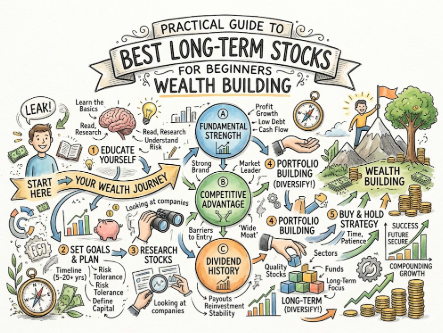
The core engine of investing is long-term investing, which allows the mathematical magic of compounding to take effect. Rather than trying to outsmart the daily noise of the stock market, investors look for companies that can consistently expand their operations, solve customer problems, and generate healthy cash flows over five, ten, or twenty years. Volatility is not seen as a threat, but rather as an opportunity to buy great businesses at a discount.
Investing is generally a more passive activity compared to trading. It does not require you to sit in front of a computer screen watching red and green candles all day. Instead, it demands deep initial research followed by steady patience and periodic reviews. Investors understand that wealth building is a slow, methodical journey. This approach can be highly suitable depending on goals like retirement planning, funding a child’s higher education, or purchasing a home.
Trading vs Investing Comparison
| Point of Difference | Trading | Investing |
| Time Horizon | Short-term, from minutes to weeks | Long-term, usually months to years |
| Main Focus | Price movement and market timing | Business value and long-term growth |
| Analysis Style | Technical analysis, charts, patterns | Fundamental analysis, financial strength |
| Risk Level | Usually higher due to short-term volatility | Risk exists but may reduce with time and diversification |
| Skill Needed | Fast decision-making, discipline, risk control | Patience, research, goal-based planning |
| Monitoring | Requires frequent tracking | Requires periodic review |
| Suitable For | Active market participants with risk control | Long-term wealth builders and goal-based investors |
Key Differences Between Trading and Investing Explained Simply
1. The Horizon of Time
The most obvious dividing line is time. Trading operates in the world of the immediate present. Days, hours, and minutes dictate success or failure. On the other hand, investing operates across years or decades. An investor gives the company’s management time to execute business strategies and expand operations.
2. Analytical Mechanisms
Traders and investors look at the exact same stock screen but see completely different things. Traders utilize technical analysis. They study price charts, moving averages, support and resistance lines, and candlestick patterns. Investors utilize fundamental analysis. They read balance sheets, profit and loss statements, annual reports, and industry growth forecasts.
3. Capital Growth Engines
A trader generates profits through the raw spread between the buy price and sell price, driven by quick price changes. An investor builds wealth through capital appreciation over time, alongside corporate rewards such as regular dividends, bonus shares, and stock splits.
4. Risk Profiles and Volatility
Short-term trading exposes your money directly to sudden news, global events, and market noise, making the immediate risk profile significantly higher. Long-term investing still carries market risk, but holding high-quality diversified assets over a long period can help smooth out the impact of temporary market drops.
5. Emotional and Psychological Strain
Trading demands high emotional discipline and immediate stress management, as watching live capital fluctuate can trigger panic or greed. Investing requires deep patience, a calm mindset, and the ability to ignore daily market gossip while remaining focused on long-term goals.
6. Transaction Frequencies and Overhead Costs
Because traders buy and sell frequently, they incur higher transactional costs, including brokerage fees, Securities Transaction Tax (STT), stamp duty, and exchange charges. Investors trade infrequently, which minimizes these frictional costs over time.
7. Tax Implications in India
In the Indian tax framework, short-term trading capital gains or intraday profits are taxed at higher rates (with intraday trading treated as speculative business income). Long-term capital gains (LTCG) on investments held for more than a year enjoy lower tax rates, making investing highly tax-efficient.
8. Systemic Capital Requirements
Trading often requires a larger upfront chunk of active risk capital to make short-term price moves financially meaningful. Investing allows for a structured investment strategy for beginners through methods like a Systematic Investment Plan (SIP), where you can start building a portfolio with small, regular amounts.
9. Time Allocation and Monitoring
Trading is almost a full-time job or an active secondary career requiring hours of daily focus during market hours. Investing is a passive endeavor that can comfortably fit around the schedule of a salaried professional or student, requiring only a few hours a month for periodic portfolio reviews.
10. Ultimate Objective
The ultimate objective of trading is to generate regular, active income from the market’s daily inefficiencies. The ultimate objective of investing is to protect your savings from inflation and create long-term wealth that secures your financial future.
How Traders Usually Make Decisions
Traders do not guess; they rely on structural frameworks to read market psychology. Here is how active traders make decisions every day:
- Analyzing Price Charts: They use bar, line, or candlestick charts to identify repeating patterns in human behavior.
- Tracking Technical Indicators: Indicators like the Relative Strength Index (RSI), MACD, and moving averages help them identify overbought or oversold conditions.
- Evaluating Volume: High trading volume confirms whether a price move is backed by institutional players or just retail noise.
- Defining Entry and Exit Points: Before entering a trade, a disciplined trader knows exactly at what price they will buy and at what price they will exit.
- Executing Stop-Loss Orders: A stop-loss is an automatic sell order placed at a specific price to limit potential losses if the market goes against the trade.
- Managing Risk-Reward Ratios: Traders aim for setups where the potential profit is at least double or triple the potential loss.
- Monitoring Micro-News: They stay updated on daily earnings announcements, policy changes, and global cues that cause short-term spikes.
Crucial Warning: Trading without proper knowledge, formal education, or strict risk management can lead to rapid capital destruction. It is highly advisable to learn the mechanics thoroughly before risking real capital.
How Investors Usually Make Decisions
Investors think like business owners. They do not look at daily stock tickers; they look at corporate fundamentals to make decisions:
- Studying Business Models: They analyze how a company actually makes money, its competitive advantages, and its market share.
- Evaluating Financial Statements: Investors check if the company’s revenue and net profit have been growing consistently over the past 5 to 10 years.
- Checking Debt Metrics: Companies with low or manageable debt levels are generally preferred, as heavy debt can crush a business during economic downturns.
- Assessing Management Quality: They look at the track record, integrity, and capital allocation skills of the CEOs and founders running the company.
- Analyzing Valuation: Even a great company can be a poor investment if bought at a bubble-era price. Investors use metrics like the Price-to-Earnings (P/E) ratio to check if a stock is fairly priced.
- Focusing on Diversification: Investors allocate their funds across multiple companies, sectors, or mutual funds to avoid placing all their eggs in one basket.
Which Is Better for Beginners: Trading or Investing?
For a beginner stepping into the stock market basics, investing is generally considered a more practical and realistic starting point. The reason is simple: investing forgives minor timing mistakes. If you buy a fundamentally strong stock and its price drops the next day, time is on your side, and the business can still grow over the long term.
Trading, by contrast, is unforgiving. A single mistake, a missed stop-loss, or an emotional panic reaction can wipe out a significant portion of a beginner’s trading account within hours. It requires a rare blend of rapid analytical skills, technical expertise, and an iron mindset that few beginners possess on day one.
Before picking a path, your individual risk appetite, daily time availability, and financial goals must be evaluated. If you have a full-time job or a demanding college schedule, long-term investing or automated mutual fund SIPs fit naturally into your life. If you want to trade, you should treat it as a skill that requires months of practice. Using virtual simulators or paper trading to understand market mechanics before using real money can be incredibly useful.
Real-Life Example: Trader vs Investor Mindset
Let us look at a practical scenario to see how these two distinct minds operate when facing the exact same asset in the market.
Imagine a well-known Indian automobile manufacturing company that has just announced a new electric vehicle lineup. The stock is currently priced at ₹500 per share.
- The Trader’s Approach: The trader opens a 15-minute candlestick chart and notices a sharp surge in volume breakout. The price has just crossed a key resistance level of ₹495. The trader buys 1,000 shares at ₹500, sets a strict stop-loss order at ₹490 (limiting risk to ₹10 per share), and targets an exit at ₹525 based on historical chart patterns. If the stock hits ₹525 tomorrow afternoon, the trader happily exits with a profit of ₹25,000, completely unconcerned about what the automobile company does next year.
- The Investor’s Approach: The investor ignores the 15-minute chart completely. They spend the evening reading the company’s quarterly earnings reports, studying management’s expansion plans, and assessing the growth potential of the Indian EV market. They realize the company has an excellent balance sheet and a strong distribution network. The investor buys shares at ₹500 with the intention of holding them for the next seven years, fully expecting the stock price to reflect the business’s long-term compounding growth.
Risks in Trading
Understanding the specific hazards associated with short-term market plays can help keep your expectations realistic.
- Severe Short-Term Volatility: Stock prices can swing wildly within seconds due to rumors, global events, or unexpected news breakouts.
- Emotional Traps and Decisions: Human psychology can easily lead to greed or panic selling, causing traders to abandon their trading plans.
- The Danger of Overtrading: Trading too frequently out of boredom or a desire to “revenge trade” after a loss can quickly deplete capital through frictional costs.
- Amplified Leverage Risk: Many beginners use margins or derivatives to trade with money they do not own, which can multiply losses during unfavorable market moves.
- Failure of Stop-Loss Discipline: Failing to set or moving a stop-loss down out of hope can turn a small, controlled loss into a catastrophic financial setback.
- Accumulated Transaction Overhead: High transaction volumes mean that brokerage fees, clearing charges, and government taxes can eat into net profits.
Risks in Investing
Investing is far safer than gambling, but it is incorrect to believe it is completely risk-free. Every investor should be aware of these challenges:
- Inherent Market Risk: No matter how great a company is, macro-economic factors like recessions, inflation, or geopolitical friction can depress the entire market for an extended period.
- Company and Sector Risks: A business can suffer from poor internal management, or an entire sector can become obsolete due to new technological disruptions.
- Poor Valuation Choices: Buying an exceptional company at an extremely high price during a market mania can result in zero or negative returns for years.
- The Danger of Over-Concentration: Putting too much money into just one or two favorite stocks can leave your entire life savings vulnerable if those specific companies fail.
- Emotional Capitulation During Crashes: Watching your portfolio drop by 20% or 30% during a temporary market correction can trigger panic selling, turning paper losses into actual permanent losses.
- Neglecting Portfolio Reviews: Buying a stock and forgetting about it for ten years without checking if the business is still healthy can leave you holding a declining company.
Beginner Decision Checklist
| Checklist Question | If Your Answer Is Yes | What It May Indicate |
| Do you have time to monitor markets daily? | Yes/No | Trading needs more active tracking |
| Can you handle short-term losses calmly? | Yes/No | Trading requires emotional control |
| Do you prefer long-term wealth building? | Yes/No | Investing may suit goal-based planning |
| Do you understand risk management? | Yes/No | Important before trading or investing |
| Do you have an emergency fund? | Yes/No | Avoid using emergency money in markets |
| Can you research companies patiently? | Yes/No | Useful for long-term investing |
| Are you following tips without learning? | Yes/No | This is risky for both trading and investing |
Common Mistakes Beginners Make
- Confusing Trading with Investing: Buying a stock for a short-term trade, watching it drop, and then holding it for years out of hope, calling it a “long-term investment.”
- Chasing the Momentum Momentum: Buying a stock simply because its price chart has gone straight up over the last month, often entering right at the top of a bubble.
- Blindly Following Social Media Tips: Risking real money based on unverified advice from social media chat rooms, videos, or messaging channels.
- Trading Without a Proper Stop-Loss: Entering an active, short-term trade without an automatic exit trigger to protect capital when a trade goes wrong.
- Investing Blankly Without Basic Research: Putting capital into a company without looking at its basic financial reports, product offerings, or debt burdens.
- Deploying Essential Emergency Funds: Investing or trading with capital that is needed for immediate living expenses, rent, or medical emergencies.
- Expecting Unrealistic or Instant Riches: Entering the stock market with the false impression that it is a quick money-making machine rather than a professional discipline.
- Panicking and Liquidating During Corrections: Selling off long-term quality investments during a standard market correction instead of holding through the cycle.
- Overtrading Due to Pure Boredom: Executing multiple trades a day simply for the thrill or dopamine rush, which mostly benefits the brokerage houses.
- Refusing to Diversify Capital Assets: Concentrating an entire net worth into a single speculative stock or sector, creating a single point of failure.
- Ignoring Frictional Transaction Costs: Forgetting to account for STT, GST, and brokerage fees, which can quietly turn a break-even trading account into a losing one.
- Borrowing Money to Fund Market Positions: Taking personal loans or borrowing from family to invest or trade, which introduces devastating emotional pressure.
Practical Tips for Beginners
- Prioritize Foundation Education First: Spend your first few weeks reading classic financial books, taking basic courses, and understanding market terminology.
- Define Your Capital Allocation Goals Clearly: Know exactly whether the money you are putting into the market is intended for short-term growth or long-term financial milestones.
- Begin with Small, Scaled Commitments: Start with a small amount of money that you can comfortably afford to lose while learning how your emotions react to real market movements.
- Keep an Independent Emergency Cushion: Never let your market capital overlap with your basic emergency cash. Keep at least six months of living expenses safe in a standard bank account or liquid fund.
- Commit to Absolute Risk Protocols: Whether trading or investing, ensure that no single position can ruin your overall financial health if it loses value.
- Ignore the Hype of Online Tip Culture: Build the confidence to perform your own basic stock screening and fundamental checks rather than relying on anonymous tips.
- Maintain an Analytical Market Journal: Write down exactly why you bought a stock, what your planned exit parameters were, and review your mistakes honestly every month.
- Consider consulting a qualified financial advisor if needed: If you feel overwhelmed by the sheer volume of choices, seek professional guidance to map out your journey safely.
Can You Do Both Trading and Investing?
Yes, many experienced market participants balance both activities successfully. However, they do not mix them up. They maintain a strict wall between their trading activities and their investment portfolios.
To do this effectively, you should use completely separate broker demat accounts—one dedicated exclusively to long-term wealth creation (like blue-chip stocks, mutual funds, or ETFs) and another separate account with limited capital for short-term trading.
The money allocated to your trading account should be seen as active risk capital. Your long-term investment core should never be liquidated, pledged, or compromised to fund short-term trading margins or cover unexpected trading losses. Beginners should focus on mastering one approach—usually investing—before attempting to manage both concurrently.
When Should You Take Professional Help?
Navigating the financial markets can sometimes feel overwhelming. It is important to know when to step back and seek guidance from professionals:
- You find yourself unable to understand basic market risk metrics or read a company’s financial statements.
- You are planning to commit a major portion of your life savings or a large inheritance into the market.
- You are confused about how to allocate capital across different assets to meet specific life goals.
- You find that daily market movements are causing you genuine emotional stress, anxiety, or sleepless nights.
- You need comprehensive, tax-efficient planning that aligns with the latest domestic financial regulations.
- You have been actively buying and selling for months but keep losing capital without understanding where your strategy is failing.
Frequently Asked Questions
1. What is the difference between trading and investing in simple words?
Answer: Trading involves buying and selling stocks within short timeframes (minutes to weeks) to profit from rapid price movements. Investing involves buying a share of a business to hold it for a long period (months to years) to benefit from the company’s long-term growth and compounding.
2. Is trading or investing better for beginners?
Answer: Investing is generally safer and more practical for beginners because it requires less time to monitor daily and forgives timing mistakes. Trading requires specialized knowledge, quick decision-making skills, and strict emotional discipline that takes time to develop.
3. Can I start stock investing with a small amount of money?
Answer: Yes, you can start small. Through tools like Systematic Investment Plans (SIPs) in mutual funds or by purchasing single shares of fundamentally strong companies, you can comfortably build a portfolio over time with manageable monthly amounts.
4. How much risk is involved in short-term trading?
Answer: Short-term trading carries a high level of risk because asset prices can fluctuate wildly due to unexpected news or market sentiment. Without proper stop-loss discipline and risk management protocols, it is possible to lose your trading capital quickly.
5. What is fundamental analysis in stock market basics?
Answer: Fundamental analysis is the practice of evaluating a company’s financial health by examining its balance sheets, profit margins, management competency, and industry growth trends. This helps long-term investors determine if a stock is a sound business to own.
6. What is technical analysis in stock trading for beginners?
Answer: Technical analysis involves studying historical price charts, volume data, and mathematical indicators to predict future price movements. Traders use these patterns to time their entry and exit points in the market without focusing on the business’s internal financials.
7. How do taxes differ for trading and investing in India?
Answer: Long-term investments held over a year enjoy lower capital gains tax rates, making them tax-efficient. Short-term trading gains and intraday trading are taxed at higher rates or treated as business income, which can impact your net returns.
8. What is a stop-loss and why is it important?
Answer: A stop-loss is a predetermined order placed with your broker to automatically sell a stock if its price falls to a specific level. It acts as an essential safety net in trading to limit your losses when the market moves against you.
9. Why do many beginners lose money in the stock market?
Answer: Most beginners lose money because they treat the market like a lottery. They often follow unverified tips, trade without a stop-loss, confuse trading with investing, use emergency funds, or let emotions guide their buying and selling decisions.
10. When should I consult a qualified financial advisor?
Answer: You should consult an advisor if you are managing a large amount of capital, feel confused about building a balanced portfolio, are experiencing high stress due to market volatility, or need an asset allocation strategy tailored to your long-term life goals.
Conclusion
Understanding the difference between trading and investing is the foundation of a successful stock market journey. Neither path is universally “better” than the other; rather, they serve completely different purposes, require different skill sets, and carry different risk profiles. Trading is an active, high-intensity pursuit aimed at generating short-term income from price movements. Investing is a patient, disciplined journey focused on building long-term wealth by participating in actual business growth.
For most beginners, starting with a grounded, research-driven investment strategy is a reliable way to get comfortable with market volatility. As your experience grows, your understanding of risk management deepens, and your financial situation stabilizes, you can choose to allocate a separate, controlled portion of your capital to short-term trading if it fits your personal goals.
The article talks about stock selection well, but portfolio survival matters too. Most beginners fail because they don’t maintain emergency funds and are forced to sell during market corrections.
In real scenarios, regular investment planning like SIP is very important. It helps in building wealth slowly without high risk.