Introduction
Credit Scoring Platforms are software systems used by lenders, banks, and fintech companies to evaluate the creditworthiness of individuals or businesses. These platforms analyze financial data, payment behavior, and risk indicators to generate a score that predicts the likelihood of repayment.
They are critical because modern lending requires fast, accurate, and data-driven decisions. Traditional scoring models are being replaced by AI-powered systems that continuously update risk profiles in real time. Common use cases include loan approval, credit limit assignment, fraud detection, underwriting support, and portfolio risk monitoring.
Buyers should evaluate AI capabilities, data integration, explainability, scalability, compliance readiness, decision automation, analytics, real-time scoring, deployment flexibility, and vendor support.
Best for: Banks, NBFCs, fintech lenders, credit bureaus, and enterprises managing credit risk at scale.
Not ideal for: Small businesses with minimal lending needs or organizations relying on simple manual credit checks.
Key Trends in Credit Scoring Platforms
- AI-driven credit scoring models improving prediction accuracy
- Real-time scoring updates using dynamic data inputs
- Alternative data usage like mobile behavior and transaction data
- Explainable AI (XAI) for regulatory compliance
- Cloud-native scoring platforms replacing legacy systems
- Integration with open banking APIs
- Behavioral analytics improving risk insights
- Automated credit decisioning engines
- Continuous monitoring of borrower risk
- Embedded credit scoring in fintech ecosystems
How We Selected These Tools
- Strong adoption in banking and fintech ecosystems
- Ability to automate credit scoring and decisioning
- Support for AI, ML, and advanced analytics
- Integration with credit bureaus and financial systems
- Scalability for high-volume credit evaluation
- Availability of cloud-based deployment
- Compliance and regulatory readiness signals
- Usability for risk and underwriting teams
- Vendor ecosystem and extensibility
- Fit across SMB, mid-market, and enterprise segments
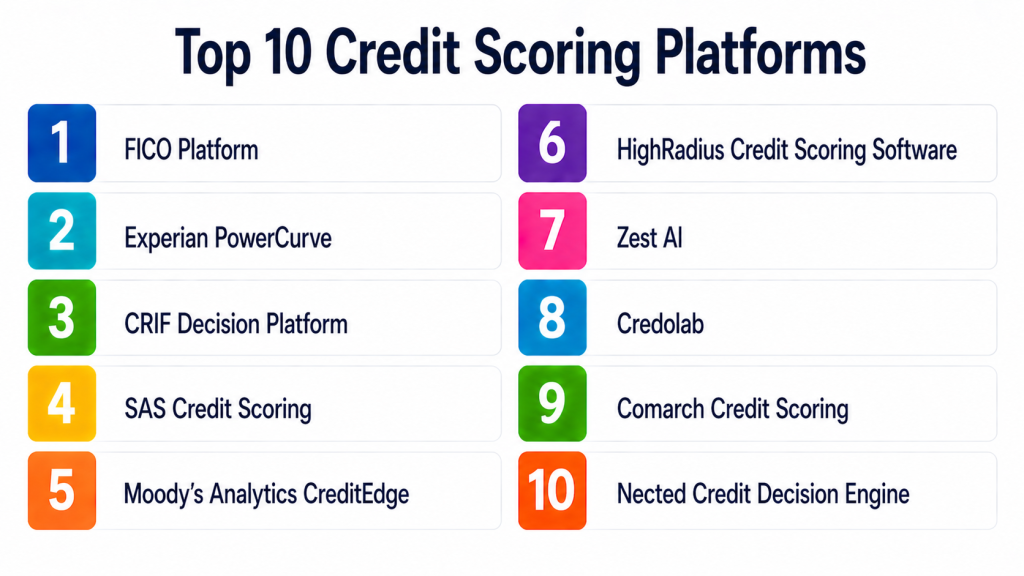
Top 10 Credit Scoring Platforms
#1 — HighRadius Credit Scoring Software
Short description: HighRadius offers an AI-powered credit scoring platform that automates credit evaluation, risk classification, and decisioning. It is widely used by enterprises for real-time credit risk management.
Key Features
- AI-driven credit scoring
- Automated credit decisioning
- Real-time risk monitoring
- ERP and CRM integration
- Analytics dashboards
- Workflow automation
Pros
- Strong AI capabilities
- Real-time scoring
- Scalable
- Enterprise-ready
Cons
- Enterprise-focused
- Pricing varies
- Implementation effort
- Requires configuration
Platforms / Deployment
Web
Cloud
Security & Compliance
Not publicly stated
Integrations & Ecosystem
HighRadius integrates with enterprise systems for unified credit decisioning.
- ERP systems
- CRM tools
- Financial platforms
- Analytics systems
Support & Community
Enterprise support with onboarding services.
#2 — FICO Platform
Short description: FICO is one of the most widely recognized credit scoring platforms, providing standardized scoring models used globally by lenders.
Key Features
- Credit scoring models
- Risk analytics
- Decision management
- Fraud detection
- Data integration
Pros
- Industry-standard scoring
- Reliable
- Highly trusted
- Strong analytics
Cons
- Limited customization
- Enterprise-focused
- Pricing varies
- Requires integration
Platforms / Deployment
Web
Cloud / Hybrid
Security & Compliance
Not publicly stated
Integrations & Ecosystem
FICO integrates with financial institutions and credit bureaus.
- Credit bureaus
- Banking systems
- Analytics tools
Support & Community
Strong global ecosystem and support.
#3 — Experian PowerCurve
Short description: Experian PowerCurve is a decisioning and credit scoring platform that combines analytics with automation to improve credit decisions.
Key Features
- Decision engine
- Credit scoring models
- Risk analytics
- Workflow automation
- Integration APIs
Pros
- Strong analytics
- Global adoption
- Scalable
- Flexible
Cons
- Requires expertise
- Pricing varies
- Integration complexity
- Enterprise focus
Platforms / Deployment
Web
Cloud
Security & Compliance
Not publicly stated
Integrations & Ecosystem
Experian integrates with credit data and financial systems.
- Credit bureaus
- CRM tools
- Data platforms
Support & Community
Enterprise support available.
#4 — CRIF Decision Platform
Short description: CRIF provides credit scoring and decisioning solutions with strong analytics and alternative data capabilities.
Key Features
- Credit scoring
- Risk segmentation
- Alternative data analysis
- Workflow automation
- Reporting dashboards
Pros
- Strong analytics
- Flexible
- Scalable
- Good for global markets
Cons
- Requires setup effort
- Pricing varies
- Integration complexity
- Enterprise focus
Platforms / Deployment
Web
Cloud
Security & Compliance
Not publicly stated
Integrations & Ecosystem
CRIF integrates with financial and credit data systems.
- Credit bureaus
- CRM tools
- Analytics platforms
Support & Community
Support available with analytics expertise.
#5 — SAS Credit Scoring
Short description: SAS provides advanced analytics and credit scoring capabilities with strong data processing and modeling tools.
Key Features
- Advanced analytics
- Predictive modeling
- Risk scoring
- Data integration
- Reporting tools
Pros
- Strong analytics engine
- Scalable
- Reliable
- Flexible
Cons
- Requires SAS expertise
- Pricing varies
- Complex setup
- Enterprise-focused
Platforms / Deployment
Web / Windows
Cloud / On-prem
Security & Compliance
Not publicly stated
Integrations & Ecosystem
SAS integrates with enterprise data systems.
- Data warehouses
- Analytics tools
- Reporting systems
Support & Community
Strong global support ecosystem.
#6 — Moody’s Analytics CreditEdge
Short description: CreditEdge provides credit risk analytics and scoring for enterprises, focusing on default risk and portfolio analysis.
Key Features
- Credit risk analytics
- Default prediction
- Portfolio analysis
- Data integration
- Reporting tools
Pros
- Strong analytics
- Reliable
- Scalable
- Enterprise-grade
Cons
- Complex implementation
- Pricing varies
- Requires expertise
- Enterprise focus
Platforms / Deployment
Web
Cloud
Security & Compliance
Not publicly stated
Integrations & Ecosystem
Moody’s integrates with financial systems.
- Banking systems
- Analytics platforms
- Data systems
Support & Community
Enterprise support available.
#7 — Credolab
Short description: Credolab is an AI-based credit scoring platform that uses alternative data and behavioral analytics for decision-making.
Key Features
- AI-driven scoring
- Alternative data analysis
- Real-time decisioning
- Risk analytics
- API integrations
Pros
- Strong AI capabilities
- Innovative data usage
- Scalable
- Flexible
Cons
- Requires integration
- Pricing varies
- Niche focus
- Enterprise adoption growing
Platforms / Deployment
Web
Cloud
Security & Compliance
Not publicly stated
Integrations & Ecosystem
Credolab integrates with fintech and lending systems.
- Mobile data platforms
- CRM tools
- Analytics systems
Support & Community
Support available with AI expertise.
#8 — Zest AI
Short description: Zest AI provides machine learning-based credit scoring and underwriting tools for lenders.
Key Features
- Machine learning models
- Risk scoring
- Decision automation
- Data integration
- Analytics dashboards
Pros
- Strong AI capabilities
- Improves approval accuracy
- Scalable
- Modern platform
Cons
- Requires data expertise
- Pricing varies
- Integration setup needed
- Enterprise focus
Platforms / Deployment
Web
Cloud
Security & Compliance
Not publicly stated
Integrations & Ecosystem
Zest AI integrates with lending platforms.
- Data systems
- CRM tools
- Analytics platforms
Support & Community
Support available with ML expertise.
#9 — Nected Credit Decision Engine
Short description: Nected provides a low-code credit decisioning and scoring platform with strong workflow automation.
Key Features
- Low-code decision engine
- Credit scoring models
- Workflow automation
- API integrations
- Analytics dashboards
Pros
- Easy to configure
- Flexible
- Scalable
- Good for fintech
Cons
- Limited enterprise maturity
- Pricing varies
- Integration setup needed
- Smaller ecosystem
Platforms / Deployment
Web
Cloud
Security & Compliance
Not publicly stated
Integrations & Ecosystem
Nected integrates with fintech and business systems.
- CRM tools
- Data platforms
- API integrations
Support & Community
Support available with developer resources.
#10 — Comarch Credit Scoring
Short description: Comarch offers credit scoring solutions focused on financial institutions with strong compliance and analytics capabilities.
Key Features
- Credit scoring
- Risk assessment
- Workflow automation
- Reporting tools
- Integration APIs
Pros
- Strong compliance focus
- Scalable
- Reliable
- Enterprise-ready
Cons
- Implementation complexity
- Pricing varies
- Requires expertise
- Enterprise focus
Platforms / Deployment
Web
Cloud / On-prem
Security & Compliance
Not publicly stated
Integrations & Ecosystem
Comarch integrates with financial systems.
- Banking systems
- CRM tools
- Analytics platforms
Support & Community
Enterprise support available.
Comparison Table
| Tool Name | Best For | Platform(s) Supported | Deployment | Standout Feature | Public Rating |
|---|---|---|---|---|---|
| HighRadius | Enterprises | Web | Cloud | AI credit scoring | N/A |
| FICO | Global lenders | Web | Cloud/Hybrid | Industry-standard scoring | N/A |
| Experian | Banks | Web | Cloud | Decision engine | N/A |
| CRIF | Global markets | Web | Cloud | Alternative data scoring | N/A |
| SAS | Analytics-driven | Web/Windows | Hybrid | Advanced analytics | N/A |
| Moody’s | Risk analytics | Web | Cloud | Default prediction | N/A |
| Credolab | Fintech | Web | Cloud | Behavioral scoring | N/A |
| Zest AI | AI lending | Web | Cloud | Machine learning models | N/A |
| Nected | Low-code users | Web | Cloud | Decision engine | N/A |
| Comarch | Enterprises | Web | Hybrid | Compliance focus | N/A |
Evaluation & Scoring
| Tool | Core | Ease | Integrations | Security | Performance | Support | Value | Total |
|---|---|---|---|---|---|---|---|---|
| HighRadius | 9 | 8 | 8.5 | 8 | 8.5 | 8 | 7.5 | 8.3 |
| FICO | 9.5 | 7 | 8.5 | 8.5 | 9 | 8.5 | 7 | 8.4 |
| Experian | 9 | 7.5 | 8.5 | 8 | 8.5 | 8 | 7.5 | 8.3 |
| CRIF | 8.5 | 7.5 | 8 | 8 | 8.5 | 8 | 7.5 | 8.1 |
| SAS | 8.5 | 7 | 8.5 | 8 | 8.5 | 8 | 7.5 | 8.1 |
| Moody’s | 9 | 7 | 8 | 8.5 | 9 | 8 | 7 | 8.2 |
| Credolab | 8.5 | 8 | 8 | 7.5 | 8.5 | 7.5 | 8 | 8.1 |
| Zest AI | 8.5 | 7.5 | 8 | 8 | 8.5 | 8 | 7.5 | 8.1 |
| Nected | 8 | 8.5 | 8 | 7.5 | 8 | 7.5 | 8 | 8.0 |
| Comarch | 8.5 | 7.5 | 8 | 8 | 8.5 | 8 | 7.5 | 8.1 |
These scores are comparative and reflect relative strengths. Enterprise platforms rank higher in analytics and scalability, while newer tools perform better in usability and flexibility.
Which Credit Scoring Platform Is Right for You?
Solo / Freelancer
Not required; basic credit checks are sufficient.
SMB
Choose Nected or Credolab for ease of use and flexibility.
Mid-Market
Consider CRIF, Zest AI, or Experian for scalability.
Enterprise
Use FICO, HighRadius, or Moody’s for advanced risk management.
Budget vs Premium
Budget tools focus on usability, while premium platforms offer advanced analytics and compliance.
Feature Depth vs Ease of Use
Enterprise tools provide deeper analytics, while modern tools focus on usability.
Integrations & Scalability
Ensure integration with credit bureaus, LOS, and analytics systems.
Security & Compliance Needs
Verify compliance, audit trails, and explainability before selection.
Frequently Asked Questions
1. What is a credit scoring platform?
It is software that evaluates creditworthiness and predicts repayment risk using data and analytics.
2. Why is it important?
It helps lenders make faster and more accurate credit decisions while reducing risk.
3. Who uses these platforms?
Banks, fintech lenders, credit bureaus, and financial institutions.
4. What features matter most?
AI models, data integration, analytics, and decision automation.
5. Are these platforms cloud-based?
Most modern credit scoring systems are cloud-based.
6. Can they use AI?
Yes, AI improves prediction accuracy and enables real-time scoring.
7. How long does implementation take?
It varies from weeks to months depending on complexity.
8. Do they use alternative data?
Yes, many platforms use behavioral and non-traditional data sources.
9. Are they secure?
Security varies by vendor and should be evaluated carefully.
10. What are alternatives?
Manual credit analysis or traditional scorecards, though they are less scalable.
Conclusion
Credit Scoring Platforms are essential for modern lending and financial decision-making.
They enable faster approvals, better risk assessment, and improved portfolio performance.
Enterprise solutions like FICO, Experian, and Moody’s provide strong analytics and global reliability.
Meanwhile, platforms like Credolab and Nected offer flexible and innovative approaches using AI and alternative data. The right choice depends on your lending scale, risk appetite, and data strategy.
Organizations should evaluate automation, integrations, and compliance carefully before selecting a platform. Running a pilot implementation can help validate performance and decision accuracy.
Ultimately, the best platform aligns with your credit risk strategy and business goals.