Introduction
Reinsurance Management Tools are specialized software platforms that help insurers manage risk transfer agreements with reinsurers. These tools handle complex processes such as treaty and facultative contracts, premium calculations, claims recovery, accounting, and regulatory reporting. Instead of relying on spreadsheets and manual reconciliation, insurers use these systems to automate and centralize reinsurance operations.
These tools are critical because reinsurance involves high-volume financial transactions, complex contracts, and strict regulatory requirements. Common use cases include treaty management, claims recovery tracking, bordereaux processing, financial reconciliation, and risk exposure analysis.
Buyers should evaluate contract management capabilities, automation of premium and claims calculations, reporting and analytics, integration with core insurance systems, scalability, compliance readiness, auditability, workflow automation, and deployment flexibility.
Best for: Insurance carriers, reinsurers, MGAs, finance teams, and enterprise risk management departments handling complex reinsurance programs.
Not ideal for: Small insurers with minimal reinsurance exposure or organizations managing only simple risk-sharing arrangements.
Key Trends in Reinsurance Management Tools
- Automation replacing spreadsheets for treaty and facultative management
- AI-driven risk analytics improving capital allocation decisions
- Cloud-based reinsurance platforms enabling scalability
- Real-time reporting and dashboards for financial transparency
- End-to-end lifecycle platforms covering underwriting to accounting
- API-driven integration with policy, claims, and finance systems
- Enhanced auditability and compliance tracking
- Digital bordereaux processing reducing manual errors
- Predictive modeling for catastrophe risk
- Workflow automation for claims recovery and settlements
How We Selected These Tools
- Strong adoption in reinsurance and insurance operations
- Coverage of treaty, facultative, and retrocession processes
- Automation capabilities for premium, claims, and accounting
- Integration with policy, claims, and financial systems
- Scalability for enterprise and global insurers
- Availability of cloud or hybrid deployment models
- Reporting, analytics, and audit capabilities
- Vendor ecosystem and extensibility
- Usability for finance, underwriting, and operations teams
- Suitability across mid-market and enterprise segments
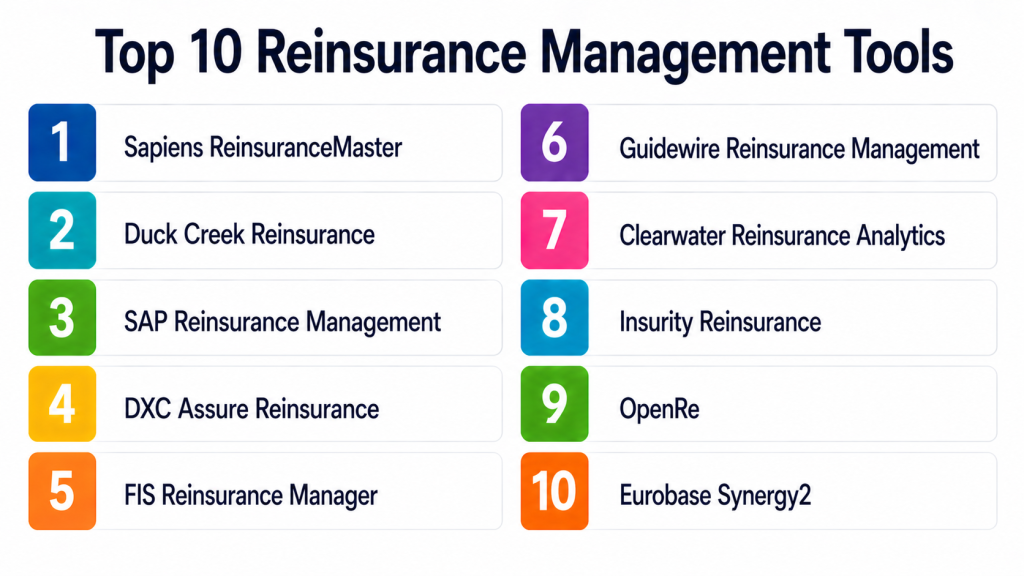
Top 10 Reinsurance Management Tools
#1 — Sapiens ReinsuranceMaster
Short description: Sapiens ReinsuranceMaster is a comprehensive platform for managing the full reinsurance lifecycle. It supports treaty and facultative business, financial reconciliation, and reporting. It is best suited for large insurers and reinsurers managing complex portfolios.
Key Features
- Treaty and facultative management
- Premium and claims calculations
- Reinsurance accounting
- Exposure analysis
- Multi-currency support
- Regulatory reporting
- Workflow automation
Pros
- Full lifecycle management
- Strong automation
- Enterprise scalability
- Reduces manual processing
Cons
- Complex implementation
- Requires configuration expertise
- Enterprise-focused
- Pricing varies
Platforms / Deployment
Web
Cloud
Security & Compliance
Not publicly stated
Integrations & Ecosystem
Sapiens integrates with insurance core systems to centralize reinsurance operations.
- Policy systems
- Claims platforms
- Financial systems
- Analytics tools
Support & Community
Enterprise-grade support with strong implementation ecosystem.
#2 — Duck Creek Reinsurance
Short description: Duck Creek Reinsurance provides a cloud-ready platform that centralizes reinsurance contracts and automates workflows. It is suitable for insurers looking to modernize legacy systems.
Key Features
- Treaty and facultative processing
- Automated premium calculations
- Claims recovery tracking
- Workflow automation
- Reporting dashboards
- Integration APIs
Pros
- Flexible and configurable
- Cloud-first architecture
- Strong integration capabilities
- Scalable
Cons
- Implementation complexity
- Requires skilled resources
- Enterprise-focused
- Pricing varies
Platforms / Deployment
Web
Cloud
Security & Compliance
Not publicly stated
Integrations & Ecosystem
Duck Creek integrates with insurance core systems and financial tools.
- Policy systems
- Claims systems
- CRM tools
- Data analytics
Support & Community
Enterprise support with partner ecosystem.
#3 — SAP Reinsurance Management
Short description: SAP Reinsurance Management is an enterprise-grade solution designed for insurers using SAP financial systems. It focuses on financial governance and compliance.
Key Features
- Reinsurance accounting
- Financial reconciliation
- Contract management
- Workflow automation
- Reporting tools
Pros
- Strong financial controls
- Enterprise scalability
- Reliable performance
- Integrated with SAP ecosystem
Cons
- Requires SAP environment
- Complex setup
- High cost
- Limited flexibility outside SAP
Platforms / Deployment
Web
Cloud / Hybrid
Security & Compliance
Enterprise-grade controls may be available
Certifications: Not publicly stated
Integrations & Ecosystem
SAP integrates reinsurance with financial and enterprise systems.
- ERP systems
- Financial platforms
- Analytics tools
- Compliance systems
Support & Community
Strong enterprise support and global ecosystem.
#4 — DXC Assure Reinsurance
Short description: DXC Assure Reinsurance is a modular platform designed for managing reinsurance contracts, accounting, and reporting across global insurers.
Key Features
- Contract management
- Claims tracking
- Financial reporting
- Workflow automation
- Multi-line support
Pros
- Mature platform
- Reliable performance
- Strong enterprise capabilities
- Compliance-ready
Cons
- Implementation effort required
- Less flexible for smaller teams
- Pricing varies
- Integration complexity
Platforms / Deployment
Web
Cloud / On-prem
Security & Compliance
Not publicly stated
Integrations & Ecosystem
DXC integrates with enterprise insurance systems.
- Policy systems
- Claims systems
- Financial platforms
- Data analytics
Support & Community
Enterprise-level support with implementation services.
#5 — FIS Reinsurance Manager
Short description: FIS Reinsurance Manager is a scalable platform designed to automate reinsurance operations and improve transparency across financial processes.
Key Features
- Reinsurance program automation
- Financial reconciliation
- Claims processing
- Reporting and analytics
- Audit tracking
Pros
- Strong financial transparency
- Scalable
- Improves efficiency
- Centralized operations
Cons
- Enterprise-focused
- Setup complexity
- Pricing varies
- Limited SMB adoption
Platforms / Deployment
Web
Cloud
Security & Compliance
Not publicly stated
Integrations & Ecosystem
FIS integrates with financial and insurance systems.
- Accounting systems
- Policy systems
- Claims platforms
- Analytics tools
Support & Community
Support available with enterprise focus.
#6 — Guidewire Reinsurance Management
Short description: Guidewire offers reinsurance capabilities integrated with its core insurance suite, enabling seamless data flow across policy and claims systems.
Key Features
- Reinsurance contract management
- Claims recovery tracking
- Integration with core systems
- Workflow automation
- Reporting tools
Pros
- Strong ecosystem integration
- Reliable platform
- Enterprise scalability
- Unified data model
Cons
- Requires Guidewire ecosystem
- Complex implementation
- High cost
- Limited standalone use
Platforms / Deployment
Web
Cloud / Hybrid
Security & Compliance
Not publicly stated
Integrations & Ecosystem
Guidewire integrates reinsurance with core insurance operations.
- Policy systems
- Claims platforms
- Billing systems
- Analytics tools
Support & Community
Strong enterprise support and partner network.
#7 — Clearwater Reinsurance Analytics
Short description: Clearwater focuses on financial analytics and transparency for reinsurance portfolios, helping insurers track performance and exposure.
Key Features
- Financial analytics
- Portfolio reporting
- Risk analysis
- Data visualization
- Automation tools
Pros
- Strong analytics
- Good financial visibility
- Easy reporting
- Useful for finance teams
Cons
- Limited operational workflows
- Not full lifecycle tool
- Integration needs
- Pricing varies
Platforms / Deployment
Web
Cloud
Security & Compliance
Not publicly stated
Integrations & Ecosystem
Clearwater integrates with financial and reporting systems.
- Data platforms
- Accounting systems
- Analytics tools
- Reporting tools
Support & Community
Support available with analytics focus.
#8 — Insurity Reinsurance
Short description: Insurity offers reinsurance capabilities within its broader insurance platform, focusing on automation and configurability.
Key Features
- Reinsurance workflows
- Contract management
- Reporting dashboards
- Integration APIs
- Cloud deployment
Pros
- Cloud-native
- Flexible workflows
- Good for mid-market
- Easy deployment
Cons
- Limited enterprise depth
- Integration complexity
- Pricing varies
- Feature limitations
Platforms / Deployment
Web
Cloud
Security & Compliance
Not publicly stated
Integrations & Ecosystem
Insurity integrates reinsurance with insurance systems.
- Policy systems
- Claims platforms
- CRM tools
- Analytics tools
Support & Community
Support available with onboarding resources.
#9 — OpenRe
Short description: OpenRe is a modular reinsurance management solution designed for small to mid-sized insurers looking for flexibility and cost efficiency.
Key Features
- Modular architecture
- Contract management
- Reporting tools
- Workflow automation
- Integration APIs
Pros
- Cost-effective
- Flexible
- Easy to deploy
- Suitable for SMBs
Cons
- Limited enterprise features
- Smaller ecosystem
- Integration limitations
- Less scalability
Platforms / Deployment
Web
Cloud
Security & Compliance
Not publicly stated
Integrations & Ecosystem
OpenRe supports integration with core insurance tools.
- Policy systems
- Claims systems
- Reporting tools
- API integrations
Support & Community
Limited community compared to enterprise platforms.
#10 — Eurobase Synergy2
Short description: Synergy2 is a full lifecycle reinsurance platform covering underwriting, accounting, claims, and analytics. It is designed for global reinsurers managing complex portfolios.
Key Features
- End-to-end lifecycle management
- Contract and claims management
- Financial reconciliation
- Analytics dashboards
- Integration capabilities
Pros
- Comprehensive platform
- Strong analytics
- Global support
- Enterprise-ready
Cons
- Implementation complexity
- High cost
- Requires expertise
- Enterprise-focused
Platforms / Deployment
Web
Cloud / Hybrid
Security & Compliance
Not publicly stated
Integrations & Ecosystem
Synergy2 integrates with enterprise insurance systems.
- Policy systems
- Claims platforms
- Financial systems
- Data analytics
Support & Community
Enterprise support with implementation services.
Comparison Table
| Tool Name | Best For | Platform(s) Supported | Deployment | Standout Feature | Public Rating |
|---|---|---|---|---|---|
| Sapiens ReinsuranceMaster | Enterprise reinsurers | Web | Cloud | Full lifecycle management | N/A |
| Duck Creek Reinsurance | Modern insurers | Web | Cloud | Configurable workflows | N/A |
| SAP Reinsurance | SAP users | Web | Cloud/Hybrid | Financial governance | N/A |
| DXC Assure | Global insurers | Web | Cloud/On-prem | Operational reliability | N/A |
| FIS Reinsurance Manager | Finance teams | Web | Cloud | Auditability and transparency | N/A |
| Guidewire Reinsurance | Guidewire users | Web | Cloud/Hybrid | Core system integration | N/A |
| Clearwater | Analytics teams | Web | Cloud | Financial insights | N/A |
| Insurity Reinsurance | Mid-market insurers | Web | Cloud | Cloud-native workflows | N/A |
| OpenRe | SMB insurers | Web | Cloud | Modular flexibility | N/A |
| Synergy2 | Global reinsurers | Web | Cloud/Hybrid | End-to-end lifecycle | N/A |
Evaluation & Scoring
| Tool | Core | Ease | Integrations | Security | Performance | Support | Value | Total |
|---|---|---|---|---|---|---|---|---|
| Sapiens | 9 | 7.5 | 8.5 | 8 | 8.5 | 8 | 7.5 | 8.2 |
| Duck Creek | 8.5 | 7.5 | 8.5 | 8 | 8.5 | 8 | 7.5 | 8.1 |
| SAP | 9 | 7 | 8.5 | 8.5 | 9 | 8 | 7 | 8.2 |
| DXC | 8.5 | 7 | 8 | 8 | 8.5 | 8 | 7.5 | 8.0 |
| FIS | 8.5 | 7.5 | 8 | 8 | 8.5 | 8 | 7.5 | 8.1 |
| Guidewire | 8.5 | 7 | 8.5 | 8 | 8.5 | 8 | 7 | 8.0 |
| Clearwater | 7.5 | 8 | 7.5 | 7.5 | 8 | 7.5 | 8 | 7.7 |
| Insurity | 7.5 | 8 | 7.5 | 7.5 | 8 | 7.5 | 8 | 7.7 |
| OpenRe | 7 | 8.5 | 7 | 7 | 7.5 | 7 | 8.5 | 7.5 |
| Synergy2 | 9 | 7 | 8.5 | 8 | 8.5 | 8 | 7 | 8.1 |
These scores are comparative and highlight relative strengths. Enterprise tools score higher in scalability and compliance, while lightweight tools offer better usability and cost efficiency.
Which Reinsurance Management Tool Is Right for You?
Solo / Freelancer
Not required; basic spreadsheets or accounting tools are sufficient.
SMB
Choose OpenRe or Insurity for cost-effective and simple solutions.
Mid-Market
Consider Duck Creek or Sapiens for scalability and automation.
Enterprise
Use SAP, Guidewire, DXC, or Synergy2 for full-scale operations.
Budget vs Premium
Budget tools focus on simplicity, while premium tools provide automation, analytics, and compliance.
Feature Depth vs Ease of Use
Lightweight tools are easier to use, while enterprise platforms provide deeper control.
Integrations & Scalability
Ensure integration with policy, claims, and financial systems.
Security & Compliance Needs
Verify audit trails, access controls, and compliance features before selection.
Frequently Asked Questions
1. What is reinsurance management software?
It is software that helps insurers manage reinsurance contracts, claims, and financial processes in one system.
2. Why is it important?
It improves efficiency, reduces errors, and ensures compliance with regulatory requirements.
3. Who uses these tools?
Insurance carriers, reinsurers, MGAs, and finance teams.
4. What features matter most?
Contract management, automation, reporting, and integration capabilities.
5. Are these tools cloud-based?
Most modern tools offer cloud or hybrid deployment options.
6. Can they automate claims recovery?
Yes, many platforms automate claims and premium calculations.
7. How long does implementation take?
It varies from weeks to months depending on complexity.
8. Do they integrate with other systems?
Yes, they integrate with policy, claims, and financial platforms.
9. Are they secure?
Security varies by vendor; buyers should verify controls.
10. What are alternatives?
Spreadsheets or legacy systems, though they lack scalability.
Conclusion
Reinsurance management tools are essential for insurers to manage risk transfer efficiently and accurately. They help automate complex processes, improve financial transparency, and reduce operational risk. Enterprise platforms like Sapiens, SAP, and DXC provide deep functionality for large insurers. Meanwhile, tools like OpenRe and Insurity offer flexible solutions for smaller organizations.
The right tool depends on the size of your operations, complexity of reinsurance programs, and compliance requirements. Organizations should carefully evaluate automation, integration, and scalability before selecting a platform. Running a pilot implementation can help validate performance and usability.
Ultimately, the best tool is one that aligns with your financial, operational, and risk management goals.