Introduction
DDI (DNS, DHCP, and IP Address Management) Platforms combine three critical network services into a single unified system for managing IP resources, device connectivity, and network automation. These platforms ensure that devices receive the correct IP addresses, resolve domain names efficiently, and maintain visibility across the entire network.
In modern IT environments driven by multi-cloud, hybrid infrastructure, and billions of connected devices, managing DNS, DHCP, and IPAM separately leads to complexity, errors, and downtime. DDI platforms solve this by providing centralized control, automation, and real-time visibility, making them essential for enterprise-grade networking.
Real-World Use Cases
- Automating IP address allocation and lifecycle management
- Managing DNS and DHCP services centrally
- Preventing IP conflicts and misconfigurations
- Enforcing network policies and compliance
- Supporting multi-cloud and hybrid network environments
What Buyers Should Evaluate
- Integration of DNS, DHCP, and IPAM (DDI maturity)
- Automation and workflow orchestration
- Multi-cloud and hybrid support
- Security features (DNS protection, RBAC, auditing)
- Scalability across large distributed networks
- API support and DevOps integration
- Reporting, analytics, and visibility
- Ease of deployment and usability
Best for: Enterprises, telecom providers, cloud-native organizations, and IT teams managing large-scale or distributed networks.
Not ideal for: Small networks where standalone DNS or DHCP tools are sufficient.
Key Trends in DDI Platforms
- AI-driven DNS security and anomaly detection
- Integration with cloud-native and multi-cloud environments
- API-first and Infrastructure-as-Code (IaC) adoption
- Automation of IP provisioning and lifecycle management
- Convergence with network security platforms
- Real-time visibility into IP and DNS usage
- Increased adoption of IPv6
- Integration with SDN and network automation tools
- Centralized management across hybrid infrastructures
- Focus on zero-trust networking and DNS security
How We Selected These Tools (Methodology)
- Market leadership and enterprise adoption
- Depth of DDI integration and automation
- Scalability across hybrid and cloud environments
- Security and compliance capabilities
- Integration with DevOps and IT ecosystems
- Performance and reliability
- Vendor support and ecosystem strength
- Balance of enterprise and emerging solutions
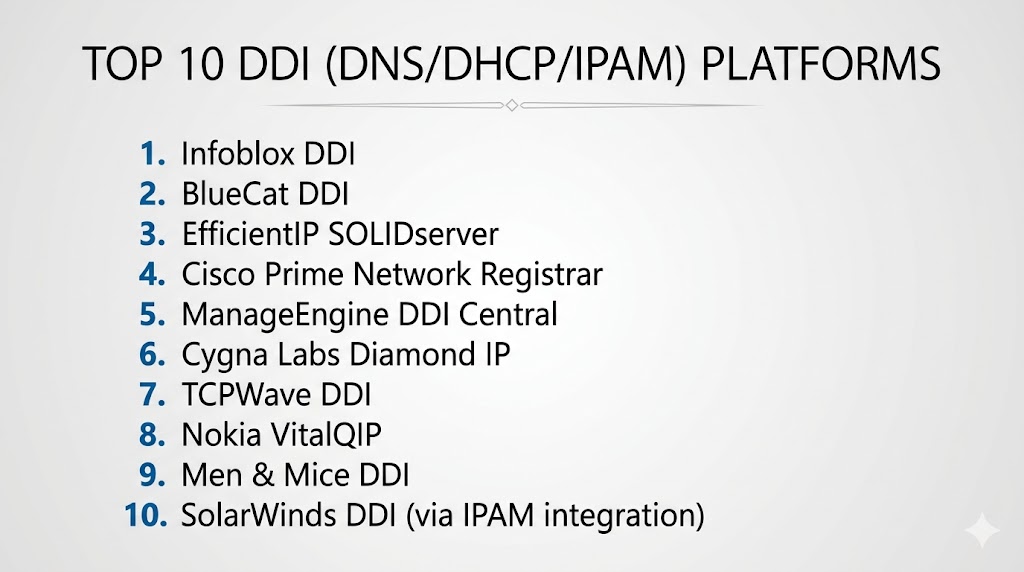
Top 10 DDI (DNS/DHCP/IPAM) Platforms
#1 — Infoblox DDI (NIOS / BloxOne)
Short description: Industry-leading enterprise DDI platform offering unified management and advanced DNS security.
Key Features
- Integrated DNS, DHCP, IPAM
- Advanced DNS security and threat intelligence
- Automation and APIs
- Multi-cloud support
- Real-time analytics
Pros
- Market leader
- Strong security and automation
Cons
- Expensive
- Complex deployment
Platforms / Deployment
Web
Cloud / Hybrid
Security & Compliance
RBAC, DNS security, audit logs
Not publicly stated
Integrations & Ecosystem
- Cloud platforms
- DevOps tools
- Security systems
Support & Community
Enterprise-grade support
#2 — BlueCat DDI (Integrity / Micetro)
Short description: A scalable DDI solution for enterprise network automation and visibility.
Key Features
- Centralized DDI management
- Automation workflows
- API-first design
- Cloud integration
- Policy enforcement
Pros
- Strong enterprise capabilities
- Flexible deployment
Cons
- Pricing
- Learning curve
Platforms / Deployment
Web
Cloud / Hybrid
Security & Compliance
Not publicly stated
Integrations & Ecosystem
- Cloud platforms
- DevOps tools
Support & Community
Enterprise support
#3 — EfficientIP SOLIDserver
Short description: A high-performance DDI platform focused on DNS security and automation.
Key Features
- Smart DDI automation
- DNS security
- IPAM visualization
- Cloud integration
- Analytics
Pros
- Strong performance
- Advanced security
Cons
- Pricing
- Complex setup
Platforms / Deployment
Web
Cloud / Hybrid
Security & Compliance
DNS security features
Not publicly stated
Integrations & Ecosystem
- Security tools
- Cloud platforms
Support & Community
Enterprise support
#4 — Cisco Prime Network Registrar
Short description: A robust DDI solution for managing DNS, DHCP, and IP resources in enterprise networks.
Key Features
- Centralized DNS/DHCP/IPAM
- Automation
- High availability
- Scalability
- Reporting
Pros
- Reliable
- Enterprise-ready
Cons
- Vendor ecosystem dependency
- Complex setup
Platforms / Deployment
Web
On-premise / Hybrid
Security & Compliance
Not publicly stated
Integrations & Ecosystem
- Cisco ecosystem
Support & Community
Enterprise support
#5 — ManageEngine DDI Central
Short description: A cost-effective DDI platform for centralized network service management.
Key Features
- Unified DNS/DHCP/IPAM
- IP discovery and tracking
- Automation
- Reporting
- Policy-based management
Pros
- Affordable
- Easy to deploy
Cons
- Limited enterprise features
- UI complexity
Platforms / Deployment
Web
Cloud / Self-hosted
Security & Compliance
Not publicly stated
Integrations & Ecosystem
- IT tools
- Network systems
Support & Community
Vendor support
#6 — Cygna Labs Diamond IP
Short description: A centralized DDI solution with strong IPAM and automation capabilities.
Key Features
- IP address management
- DNS/DHCP integration
- Automation
- Analytics
- Reporting
Pros
- Strong IPAM
- Enterprise-grade
Cons
- Pricing
- Limited awareness
Platforms / Deployment
Web
Cloud / Hybrid
Security & Compliance
Not publicly stated
Integrations & Ecosystem
- Enterprise systems
Support & Community
Enterprise support
#7 — TCPWave DDI
Short description: A modern DDI platform with AI-driven automation and analytics.
Key Features
- Integrated DDI services
- AI/ML analytics
- Automation
- Security features
- Multi-cloud support
Pros
- Modern architecture
- AI capabilities
Cons
- Smaller ecosystem
- Learning curve
Platforms / Deployment
Web
Cloud / Hybrid
Security & Compliance
Not publicly stated
Integrations & Ecosystem
- Cloud platforms
- DevOps tools
Support & Community
Growing support
#8 — Nokia VitalQIP
Short description: A scalable DDI platform for telecom and enterprise networks.
Key Features
- IP address management
- DNS/DHCP integration
- Automation
- Reporting
- Compliance
Pros
- Telecom-grade
- Scalable
Cons
- Complex setup
- Niche adoption
Platforms / Deployment
Web
On-premise / Hybrid
Security & Compliance
Not publicly stated
Integrations & Ecosystem
- Enterprise systems
Support & Community
Enterprise support
#9 — Men & Mice Micetro
Short description: A flexible DDI overlay solution for managing DNS and IP resources.
Key Features
- Centralized DDI management
- Automation
- API support
- Reporting
- Multi-cloud support
Pros
- Flexible
- Easy integration
Cons
- Limited native DNS/DHCP
- Smaller ecosystem
Platforms / Deployment
Web
Cloud / Hybrid
Security & Compliance
Not publicly stated
Integrations & Ecosystem
- DNS servers
- DevOps tools
Support & Community
Strong support
#10 — SolarWinds DDI (IPAM-based)
Short description: A DDI-capable solution built on SolarWinds IPAM and DNS/DHCP integration.
Key Features
- IPAM
- DNS/DHCP integration
- Monitoring
- Alerts
- Reporting
Pros
- Easy to use
- Good visibility
Cons
- Limited enterprise features
- Windows dependency
Platforms / Deployment
Windows
Self-hosted
Security & Compliance
RBAC
Not publicly stated
Integrations & Ecosystem
- SolarWinds ecosystem
Support & Community
Strong support
Comparison Table (Top 10)
| Tool Name | Best For | Platform(s) Supported | Deployment | Standout Feature | Public Rating |
|---|---|---|---|---|---|
| Infoblox | Enterprise | Web | Hybrid | DNS security | N/A |
| BlueCat | Enterprise | Web | Hybrid | Automation | N/A |
| EfficientIP | Enterprise | Web | Hybrid | DNS security | N/A |
| Cisco | Enterprise | Web | Hybrid | Reliability | N/A |
| ManageEngine | SMB | Web | Hybrid | Affordability | N/A |
| Cygna Labs | Enterprise | Web | Hybrid | IPAM strength | N/A |
| TCPWave | Modern teams | Web | Hybrid | AI automation | N/A |
| Nokia | Telecom | Web | Hybrid | Scalability | N/A |
| Men & Mice | Flexibility | Web | Hybrid | Overlay model | N/A |
| SolarWinds | SMB | Windows | Self-hosted | Visibility | N/A |
Evaluation & Scoring of DDI Platforms
| Tool Name | Core | Ease | Integrations | Security | Performance | Support | Value | Weighted Total |
|---|---|---|---|---|---|---|---|---|
| Infoblox | 10 | 7 | 9 | 10 | 9 | 9 | 6 | 9.0 |
| BlueCat | 9 | 7 | 9 | 9 | 9 | 9 | 7 | 8.8 |
| EfficientIP | 9 | 7 | 8 | 10 | 9 | 9 | 7 | 8.8 |
| Cisco | 9 | 7 | 8 | 9 | 9 | 9 | 7 | 8.7 |
| ManageEngine | 8 | 8 | 8 | 8 | 8 | 8 | 9 | 8.4 |
| Cygna Labs | 9 | 7 | 8 | 9 | 9 | 8 | 7 | 8.5 |
| TCPWave | 9 | 7 | 8 | 8 | 9 | 8 | 7 | 8.4 |
| Nokia | 9 | 6 | 7 | 8 | 9 | 8 | 6 | 8.2 |
| Men & Mice | 8 | 8 | 8 | 7 | 8 | 8 | 8 | 8.1 |
| SolarWinds | 8 | 8 | 8 | 7 | 8 | 8 | 8 | 8.1 |
How to interpret scores:
These scores are comparative across enterprise and mid-market tools. Platforms like Infoblox, BlueCat, and EfficientIP excel in security and scalability, while tools like ManageEngine and SolarWinds offer better value and ease of use.
Which DDI Platform Is Right for You?
Solo / Freelancer
DDI is typically unnecessary; use standalone DNS and DHCP tools.
SMB
ManageEngine DDI Central or SolarWinds for affordability and simplicity.
Mid-Market
Men & Mice or TCPWave for flexibility and automation.
Enterprise
Infoblox, BlueCat, or EfficientIP for scalability and security.
Budget vs Premium
- Budget: ManageEngine, SolarWinds
- Premium: Infoblox, BlueCat
Feature Depth vs Ease of Use
- Feature-rich: Infoblox
- Easy-to-use: ManageEngine
Integrations & Scalability
- Best integrations: BlueCat
- Scalable: Infoblox
Security & Compliance Needs
- Strong security: EfficientIP, Infoblox
- Moderate: SolarWinds
Frequently Asked Questions (FAQs)
What is DDI?
DDI stands for DNS, DHCP, and IP Address Management combined into one platform.
Why is DDI important?
It centralizes network services, reduces errors, and improves visibility.
Do DDI platforms replace DNS and DHCP tools?
Yes, they integrate and enhance them in a unified system.
Are DDI tools cloud-based?
Most modern platforms support cloud, hybrid, and on-premise deployments.
Do they support automation?
Yes, automation is a core feature.
Can small businesses use DDI?
Usually overkill unless scaling rapidly.
What industries use DDI?
IT, telecom, finance, and government sectors.
Are DDI platforms secure?
Yes, many include DNS security and access controls.
Do they support IPv6?
Yes, most modern platforms support IPv6.
What is the best DDI platform?
Depends on scale, budget, and infrastructure complexity.
Conclusion
DDI (DNS/DHCP/IPAM) Platforms are foundational to modern network infrastructure, providing centralized control, automation, and security across core network services. As organizations scale across cloud and hybrid environments, these platforms become essential for maintaining visibility, preventing misconfigurations, and ensuring seamless connectivity. Enterprise solutions like Infoblox, BlueCat, and EfficientIP dominate in scalability and security, while mid-market options offer flexibility and cost efficiency. The best choice depends on your network size, complexity, and operational goals—so start by shortlisting a few platforms, running a pilot, and validating integrations and security before full deployment.