Introduction
Enterprise search platforms are systems designed to help organizations find, retrieve, and unify information across multiple internal and external data sources—including documents, emails, databases, SaaS apps, and more. Unlike basic search tools, these platforms use AI, natural language processing, and machine learning to deliver context-aware and permission-based results.
As organizations generate massive volumes of data, employees often struggle to locate relevant information quickly. Enterprise search solves this by acting as a central intelligence layer, improving productivity and decision-making. Modern platforms now go beyond keyword search, offering semantic understanding, AI assistants, and workflow automation.
Common Use Cases
- Internal knowledge discovery across tools and systems
- Customer support and helpdesk search
- Research and market intelligence analysis
- Document and compliance search
- Developer and engineering search workflows
What Buyers Should Evaluate
- Search relevance and AI capabilities
- Data source coverage and connectors
- Permissions and security model
- Scalability and performance
- Integration ecosystem
- Ease of deployment and onboarding
- Customization and APIs
- Analytics and reporting
- Cost and licensing model
Best for: Large organizations, IT teams, data-driven enterprises, and companies managing multiple tools and large datasets.
Not ideal for: Small teams with limited data or simple document storage needs where basic search functionality is sufficient.
Key Trends in Enterprise Search Platforms
- AI-powered conversational search replacing traditional keyword queries
- Unified search across SaaS ecosystems (Slack, CRM, ERP, etc.)
- Permission-aware search results ensuring secure data access
- Generative AI summaries and answers for faster insights
- Agent-based automation enabling workflow execution from search
- Real-time indexing and data freshness improvements
- Hybrid architectures combining cloud and on-premise systems
- Personalized relevance based on user behavior
- Search analytics and knowledge gap detection
- Integration with large language models (LLMs) for deeper reasoning
How We Selected These Tools (Methodology)
The tools were selected based on:
- Market adoption and enterprise usage
- Feature depth and AI capabilities
- Performance and scalability
- Security and compliance readiness
- Integration breadth across enterprise tools
- Developer and API flexibility
- Usability and onboarding experience
- Vendor reputation and innovation
- Suitability for multiple industries
- Ability to handle structured and unstructured data
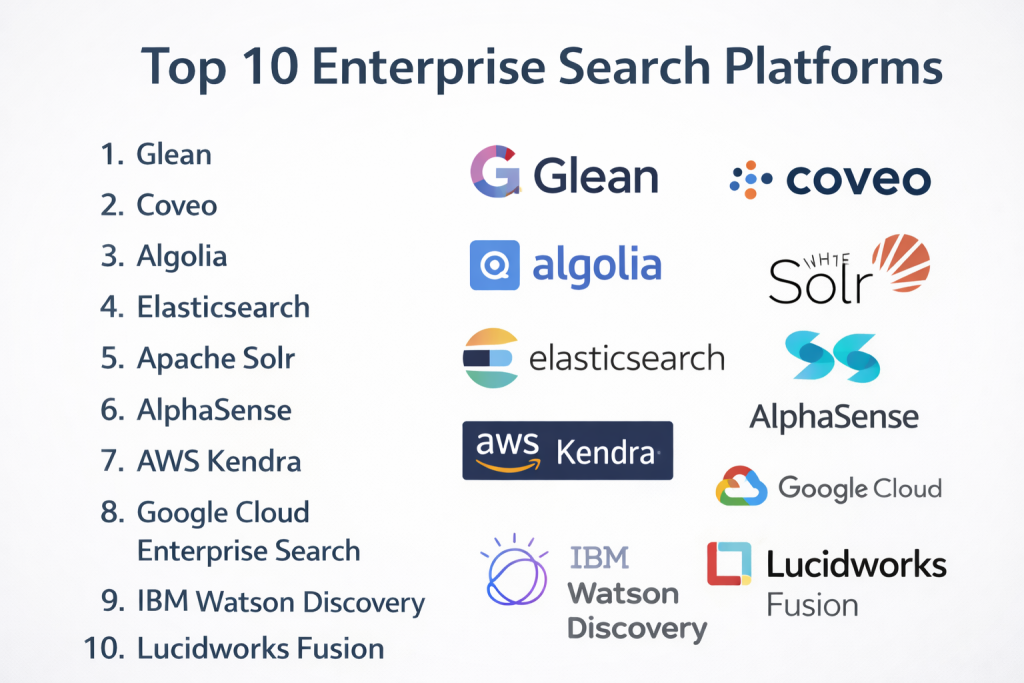
Top 10 Enterprise Search Platforms
#1 — Glean
Short description: An AI-powered enterprise search platform that connects workplace tools and delivers personalized, permission-aware results.
Key Features
- AI assistant with conversational search
- Enterprise graph for contextual understanding
- 100+ integrations
- Personalized relevance
- Workflow automation via AI agents
- Unified search across apps
Pros
- Strong AI and personalization
- Fast setup across tools
Cons
- Pricing not transparent
- Requires integration setup
Platforms / Deployment
Web
Cloud
Security & Compliance
- Permission-aware indexing
- Additional certifications: Not publicly stated
Integrations & Ecosystem
Glean integrates deeply with workplace apps and tools.
- Slack
- Google Workspace
- Microsoft 365
- CRM and dev tools
Support & Community
Enterprise-grade support; growing ecosystem.
#2 — Coveo
Short description: A powerful AI-driven search platform for both internal enterprise use and customer-facing applications.
Key Features
- Semantic search with NLP
- AI recommendations
- Generative answering
- Personalization engine
- Real-time indexing
- Analytics
Pros
- Strong AI relevance engine
- Suitable for multiple use cases
Cons
- Complex implementation
- Pricing varies
Platforms / Deployment
Web
Cloud
Security & Compliance
- Enterprise-grade security
- Additional certifications: Not publicly stated
Integrations & Ecosystem
Broad enterprise integrations.
- Salesforce
- Slack
- Microsoft tools
- Zendesk
Support & Community
Strong enterprise support and documentation.
#3 — Algolia
Short description: A developer-first search API platform focused on fast, scalable, and customizable search experiences.
Key Features
- API-first architecture
- Real-time indexing
- Typo tolerance
- Personalization
- Analytics
- Search UI components
Pros
- Extremely fast performance
- Highly customizable
Cons
- Requires development effort
- Not plug-and-play
Platforms / Deployment
Web
Cloud
Security & Compliance
Not publicly stated
Integrations & Ecosystem
Strong developer ecosystem.
- E-commerce platforms
- CMS systems
- APIs
Support & Community
Extensive developer documentation.
#4 — Elasticsearch
Short description: A widely used open-source search and analytics engine for large-scale enterprise data.
Key Features
- Full-text search
- Distributed architecture
- Real-time analytics
- REST APIs
- Data visualization support
- Scalability
Pros
- Highly scalable
- Flexible and powerful
Cons
- Requires technical expertise
- Setup complexity
Platforms / Deployment
Web / Linux / Windows / macOS
Cloud / Self-hosted
Security & Compliance
- RBAC, encryption
- Additional compliance: Not publicly stated
Integrations & Ecosystem
Part of a large open-source ecosystem.
- Log tools
- Data pipelines
- APIs
Support & Community
Large global developer community.
#5 — Apache Solr
Short description: An open-source enterprise search platform built on Lucene, known for scalability and advanced search capabilities.
Key Features
- Full-text search
- Faceted search
- Real-time indexing
- Distributed search
- Document handling
- REST APIs
Pros
- Open-source and flexible
- High scalability
Cons
- Complex setup
- Requires expertise
Platforms / Deployment
Web
Self-hosted
Security & Compliance
Not publicly stated
Integrations & Ecosystem
Highly extensible via APIs.
- Database integrations
- APIs
Support & Community
Strong open-source community.
#6 — AlphaSense
Short description: A market intelligence and enterprise search platform combining internal and external data sources.
Key Features
- AI-powered document search
- External data integration
- Alerts and dashboards
- Collaboration tools
- NLP-based insights
- Monitoring tools
Pros
- Strong for research use cases
- Combines internal and external data
Cons
- Niche focus
- Pricing not transparent
Platforms / Deployment
Web
Cloud
Security & Compliance
- SOC 2 (reported)
- Additional compliance: Not publicly stated
Integrations & Ecosystem
Focuses on research and analytics.
- APIs
- Data feeds
Support & Community
Enterprise-level support.
#7 — AWS Kendra
Short description: A cloud-native enterprise search service designed for intelligent document search within AWS ecosystems.
Key Features
- Natural language search
- Pre-built connectors
- Machine learning ranking
- Document indexing
- Security filtering
- Analytics
Pros
- Easy integration with AWS
- Strong AI capabilities
Cons
- Vendor lock-in
- Pricing complexity
Platforms / Deployment
Web
Cloud
Security & Compliance
- IAM integration
- Encryption
- Additional compliance: Not publicly stated
Integrations & Ecosystem
Deep AWS ecosystem integration.
- AWS services
- SaaS connectors
Support & Community
Strong AWS support infrastructure.
#8 — Google Cloud Enterprise Search
Short description: A search platform built on Google’s search technology for enterprise data discovery.
Key Features
- Natural language search
- AI-powered recommendations
- Document indexing
- Context-aware results
- Scalability
- Analytics
Pros
- Strong AI and search quality
- Scalable infrastructure
Cons
- Ecosystem dependency
- Pricing varies
Platforms / Deployment
Web
Cloud
Security & Compliance
- IAM, encryption
- Additional compliance: Not publicly stated
Integrations & Ecosystem
Integrates with Google ecosystem.
- Google Workspace
- APIs
Support & Community
Enterprise-level support.
#9 — IBM Watson Discovery
Short description: An AI-powered search and analytics platform focused on extracting insights from unstructured data.
Key Features
- NLP-based search
- Document understanding
- AI enrichment
- Data extraction
- Analytics dashboards
- Custom models
Pros
- Strong AI capabilities
- Good for complex data
Cons
- Requires setup
- Learning curve
Platforms / Deployment
Web
Cloud
Security & Compliance
- Encryption, RBAC
- Additional compliance: Not publicly stated
Integrations & Ecosystem
Enterprise integrations available.
- APIs
- IBM ecosystem
Support & Community
Strong enterprise support.
#10 — Lucidworks Fusion
Short description: An enterprise search and AI platform built on Apache Solr for advanced search applications.
Key Features
- AI-driven relevance
- Data ingestion pipelines
- Personalization
- Analytics
- Workflow automation
- Scalable architecture
Pros
- Powerful customization
- Enterprise-ready
Cons
- Complex deployment
- Requires expertise
Platforms / Deployment
Web
Cloud / Self-hosted
Security & Compliance
Not publicly stated
Integrations & Ecosystem
Enterprise-focused integrations.
- APIs
- Data sources
Support & Community
Enterprise support with specialized services.
Comparison Table (Top 10)
| Tool Name | Best For | Platform(s) Supported | Deployment | Standout Feature | Public Rating |
|---|---|---|---|---|---|
| Glean | Productivity search | Web | Cloud | AI assistant | N/A |
| Coveo | AI search | Web | Cloud | Personalization engine | N/A |
| Algolia | Developers | Web | Cloud | High-speed API search | N/A |
| Elasticsearch | Large-scale data | Multi-platform | Cloud/Self-hosted | Distributed search | N/A |
| Apache Solr | Open-source | Web | Self-hosted | Faceted search | N/A |
| AlphaSense | Market research | Web | Cloud | External + internal data | N/A |
| AWS Kendra | AWS users | Web | Cloud | ML-based ranking | N/A |
| Google Cloud Search | Google ecosystem | Web | Cloud | Google-grade search | N/A |
| IBM Watson Discovery | AI insights | Web | Cloud | NLP data extraction | N/A |
| Lucidworks Fusion | Enterprise search | Web | Hybrid | AI relevance tuning | N/A |
Evaluation & Scoring of Enterprise Search Platforms
| Tool Name | Core (25%) | Ease (15%) | Integrations (15%) | Security (10%) | Performance (10%) | Support (10%) | Value (15%) | Weighted Total |
|---|---|---|---|---|---|---|---|---|
| Glean | 9 | 8 | 9 | 8 | 9 | 8 | 7 | 8.4 |
| Coveo | 9 | 7 | 9 | 8 | 9 | 8 | 7 | 8.3 |
| Algolia | 8 | 6 | 9 | 7 | 10 | 7 | 7 | 7.9 |
| Elasticsearch | 9 | 5 | 8 | 8 | 9 | 8 | 9 | 8.2 |
| Apache Solr | 8 | 5 | 7 | 7 | 9 | 7 | 9 | 7.8 |
| AlphaSense | 8 | 7 | 7 | 8 | 8 | 8 | 6 | 7.6 |
| AWS Kendra | 8 | 8 | 8 | 8 | 9 | 8 | 6 | 7.9 |
| Google Cloud Search | 8 | 8 | 8 | 8 | 9 | 8 | 6 | 7.9 |
| IBM Watson Discovery | 8 | 6 | 7 | 8 | 8 | 8 | 6 | 7.5 |
| Lucidworks Fusion | 9 | 5 | 8 | 8 | 9 | 8 | 7 | 7.9 |
How to interpret scores:
- Scores are comparative within this category
- Higher scores indicate balanced performance across criteria
- Open-source tools score high in value but lower in ease
- Enterprise tools score higher in integrations and security
- Choose based on use case rather than total score
Which Enterprise Search Platform Is Right for You?
Solo / Freelancer
- Not recommended; tools are overkill
SMB
- Best options: Algolia, AWS Kendra
- Focus on ease and scalability
Mid-Market
- Best options: Glean, Coveo
- Balance between AI and integrations
Enterprise
- Best options: Elasticsearch, Google Cloud Search, IBM Watson
- Focus on scale, control, and compliance
Budget vs Premium
- Budget: Apache Solr, Elasticsearch
- Premium: Glean, AlphaSense
Feature Depth vs Ease of Use
- Deep features: Elasticsearch, Lucidworks
- Easy to use: Glean, Google Cloud Search
Integrations & Scalability
- Strong integrations: Glean, Coveo
- Custom setups: Elasticsearch
Security & Compliance Needs
- High compliance: AWS, Google, IBM
- Basic: Open-source tools
Frequently Asked Questions (FAQs)
What is enterprise search?
It is a system that enables organizations to search across internal and external data sources.
How is it different from regular search?
It includes security controls, integrations, and AI-driven relevance.
Are these platforms expensive?
Most enterprise tools use custom pricing models.
Can enterprise search integrate with SaaS tools?
Yes, most platforms support integrations with common business tools.
Is AI important in enterprise search?
Yes, AI improves relevance, summarization, and user experience.
How long does deployment take?
It varies from days to months depending on complexity.
Can open-source tools be used?
Yes, but they require technical expertise.
What industries use enterprise search?
Technology, finance, healthcare, and large enterprises.
Is data secure in these platforms?
Most offer strong security, but configurations matter.
Can enterprise search replace knowledge bases?
It complements them by improving discoverability.
Conclusion
Enterprise search platforms are becoming a core layer of modern digital workplaces, enabling organizations to unlock the full value of their data.