Introduction
Entering the stock market for the first time can feel like standing at the edge of a vast ocean. You hear stories of wealth creation, but you also hear whispers of risk and market volatility. This fear is normal—it is what we call the “investor’s hesitation.”
The truth is, the stock market isn’t a gambling den; it is a platform for wealth creation that has powered the growth of millions of Indian families. If you are a student, a salaried professional, or a small business owner, the key to success isn’t luck—it’s a systematic, long-term approach.
In this guide, we will strip away the jargon and provide a simple, actionable roadmap to start your investment journey safely and confidently.
What is Stock Market Investing in India?
At its core, a “stock” or “share” represents a tiny piece of ownership in a company. When you buy a share, you become a shareholder—a part-owner of that business.
In India, this exchange happens primarily on two major platforms:
- NSE (National Stock Exchange): The largest exchange in India, known for high liquidity and modern digital trading.
- BSE (Bombay Stock Exchange): Asia’s oldest stock exchange, a pillar of Indian financial history.
When you invest, you are essentially betting on the growth and profitability of Indian businesses.
Why You Should Invest in the Stock Market
- Wealth Creation: Historically, equities have outperformed traditional instruments like savings accounts and fixed deposits over the long term.
- Inflation Protection: Inflation reduces the purchasing power of your cash. Stock market returns generally outpace inflation, helping your money maintain its real value.
- Long-term Growth: Through the power of compounding, even small, consistent investments can turn into a significant corpus over 10–20 years.
How the Stock Market Works
Imagine the market as a massive digital marketplace. Companies “list” themselves to raise money to expand.
- Buyers and Sellers: Prices move based on supply and demand. If many people want a share (high demand), the price goes up. If many want to sell, the price goes down.
- The Role of Performance: Over the long run, share prices usually track a company’s performance. If a company makes more profit, its share value often rises.
Step-by-Step Roadmap to Start Investing
You don’t need a degree in finance to start. Follow these six steps:
- Open a Demat Account: You cannot hold physical shares anymore. You need a Demat (Dematerialized) account to hold shares electronically. Choose a SEBI-registered broker (e.g., Zerodha, Groww, or Angel One).
- Complete KYC Process: You will need your PAN card, Aadhaar card (linked to your mobile number), and a bank account. Most platforms complete this via a digital verification process.
- Add Funds: Use UPI or net banking to add a small amount from your bank account to your trading wallet.
- Learn the Basics: Do not buy a stock just because you “heard” it’s good. Look at the company’s history and profit margins.
- Start Small: Begin with a Systematic Investment Plan (SIP) in an index fund (like Nifty 50) before picking individual stocks.
- Track Your Portfolio: Check your performance periodically, but avoid the “daily refresh” trap. Investing is a marathon, not a sprint.
Types of Investment
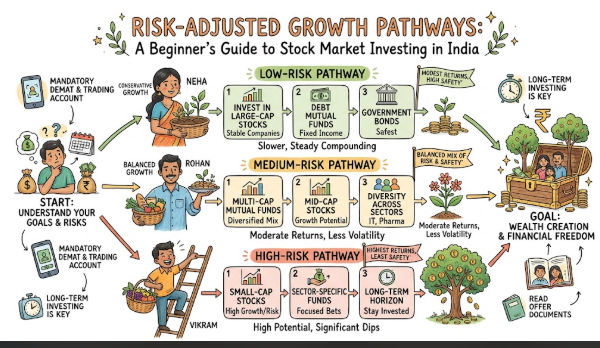
- Stocks (Equity): Owning shares of a specific company. Higher risk, potentially higher reward.
- Mutual Funds: A basket of stocks managed by a professional fund manager. Perfect for those with less time for research.
- ETFs (Exchange Traded Funds): These trade like stocks but represent a basket of securities. They are low-cost and offer instant diversification.
- IPOs (Initial Public Offerings): Buying shares in a company the very first time it hits the public market.
Risks in Stock Market Investing
- Market Volatility: Prices will fluctuate daily. A drop in price doesn’t always mean the company is failing; it is part of the market nature.
- Emotional Investing: The biggest enemy of an investor is panic. Selling when prices dip (panic selling) often leads to unnecessary losses.
- Lack of Research: Buying stocks based on “tips” from social media groups is the fastest way to lose money.
- Wrong Stock Selection: Not every company is a winner. Avoid “penny stocks”—shares trading for ₹1–₹10—as they are often highly speculative and carry significant risk.
Safe Investing Strategies for Beginners
- SIP Investing: Invest a fixed amount every month. It averages out your purchase cost and reduces the stress of trying to time the market.
- Diversification: Never put all your money in one company. Spread it across different sectors (e.g., IT, Banks, FMCG).
- Long-term Holding: The magic of the market happens over years. Stay invested through market cycles.
- Avoid Hype Stocks: If everyone is talking about a “guaranteed” high-return stock, proceed with extreme caution.
Practical Value: The Power of Small Starts
If you start investing just ₹5,000 per month into a diversified index fund earning an average of 12% returns, your money grows exponentially.
| Investment Duration | Monthly Investment | Total Invested | Estimated Value (@12%) |
| 5 Years | ₹5,000 | ₹3,00,000 | ~₹4,08,000 |
| 15 Years | ₹5,000 | ₹9,00,000 | ~₹25,22,000 |
| 25 Years | ₹5,000 | ₹15,00,000 | ~₹94,87,000 |
Real-Life Examples for Beginner Investors
| Example Profile | Strategy Used | Outcome/Lesson |
| The Student (Anjali) | Started a ₹500 monthly SIP in a Nifty 50 Index Fund. | Learned discipline early; saw her small contributions grow steadily over 3 years. |
| The Salaried Professional (Vikram) | Invested in 5 different sectors (IT, Pharma, Banking, FMCG, Auto). | Reduced risk; even when the IT sector dipped, his Banking and FMCG stocks kept the portfolio stable. |
| The “Tip” Follower (Sunil) | Invested ₹50,000 in a “hot” penny stock recommended on WhatsApp. | Lost 70% of his capital; learned that hype is not a substitute for company research. |
| The Patient Planner (Priya) | Started an SIP of ₹10,000 in a Blue-chip Mutual Fund at age 28. | Remained invested during market corrections; her portfolio grew steadily due to the “staying invested” effect. |
| The Over-Trader (Rohan) | Tried intraday trading to make quick profits daily. | Lost money on brokerage fees and wrong calls; learned that short-term trading is not investing. |
Frequently Asked Questions (FAQs)
- What is the best way to start?
Start by opening a Demat account and beginning a monthly SIP in a Nifty 50 Index Fund. - How much money do I need?
You can start with as little as ₹100–₹500. There is no large “minimum” requirement. - Is the stock market safe?
It involves risk, but it is a regulated and transparent system in India. Use diversification to manage risk. - What is a Demat account?
It is a digital vault where your shares and mutual fund units are stored electronically. - Which stocks are best for beginners?
Start with “Large-cap” companies—well-known, established businesses that you personally interact with daily. - Can I lose all my money?
While possible in extreme cases of bad stock picking, investing in diversified funds significantly lowers this risk. - How long should I hold stocks?
Ideally, 5–10 years or more. Long-term holding is the key to wealth creation. - Is intraday trading safe for beginners?
No. Avoid intraday trading initially as it is highly risky and requires advanced technical knowledge. - Do I need a huge bank balance?
Not at all. Consistency is more important than the initial amount. - Where can I learn more?
Visit the official NSE India investor education portal for unbiased resources.
Conclusion
The journey of wealth creation through the stock market is less about predicting the next “big thing” and more about the consistency of your habits. As you embark on this path, remember that the stock market is a reflection of the economy’s growth; as long as businesses continue to innovate, produce, and serve customers, they will create value.
Your greatest advantage as a beginner is not a high salary or inside information—it is time. By staying invested through market ups and downs, you allow the principle of compounding to work in your favor. True financial independence comes from avoiding the noise of daily market fluctuations and maintaining a long-term vision. Treat your investments with the same care and seriousness you would give to your career or personal development. Continue learning, stay disciplined, and always prioritize knowledge over speculation. Start small, stay consistent, and remember that every rupee invested today is a seed for a more secure and prosperous tomorrow.
I think future investing guides should discuss liquidity planning more deeply. Investors without emergency cash are usually forced to exit equities during the worst possible market conditions.
From my experience, market volatility can impact decisions a lot. It would help to include how to stay consistent during uncertain conditions.
The article highlights an important mindset shift: successful investing is not always about finding the highest-return opportunities but about achieving sustainable growth with manageable levels of risk.