Introduction
RAG (Retrieval-Augmented Generation) Tooling refers to platforms and frameworks that combine information retrieval systems with generative AI models to produce more accurate, context-aware, and grounded responses. Instead of relying solely on pre-trained knowledge, RAG systems fetch relevant data from external sources—such as documents, databases, or APIs—and use it to enhance AI-generated outputs.
With the rise of enterprise AI applications, RAG has become essential for reducing hallucinations and ensuring factual accuracy. Organizations are increasingly adopting RAG pipelines to power chatbots, knowledge assistants, search systems, and internal AI tools that rely on up-to-date and proprietary data.
Common use cases include:
- Enterprise knowledge assistants
- AI-powered search systems
- Customer support automation
- Document question answering
- Internal data retrieval and insights
Key evaluation criteria:
- Retrieval accuracy and indexing capabilities
- Integration with vector databases
- LLM compatibility and flexibility
- Scalability and performance
- Data security and access controls
- Ease of pipeline orchestration
- Support for structured and unstructured data
- Real-time query processing
Best for: AI engineers, data teams, enterprises building LLM-powered applications, and organizations managing large document repositories.
Not ideal for: Small projects with static data or applications that do not require dynamic knowledge retrieval.
Key Trends in RAG (Retrieval-Augmented Generation) Tooling for 2026 and Beyond
- Hybrid search combining vector and keyword retrieval
- Real-time indexing and streaming data pipelines
- AI-powered document chunking and embedding optimization
- Multi-modal RAG supporting text, images, and audio
- Built-in evaluation and feedback loops
- Integration with AI agents and autonomous workflows
- Privacy-preserving retrieval techniques
- Fine-tuned embeddings for domain-specific use cases
- Serverless and managed RAG platforms
- End-to-end orchestration with observability
How We Selected These Tools (Methodology)
- Evaluated adoption across AI and developer communities
- Assessed retrieval and generation integration capabilities
- Compared support for vector databases and embeddings
- Reviewed scalability and production readiness
- Analyzed integration with modern AI stacks
- Considered ease of use and developer experience
- Included both open-source and enterprise solutions
- Focused on real-world deployment scenarios
- Balanced flexibility with performance
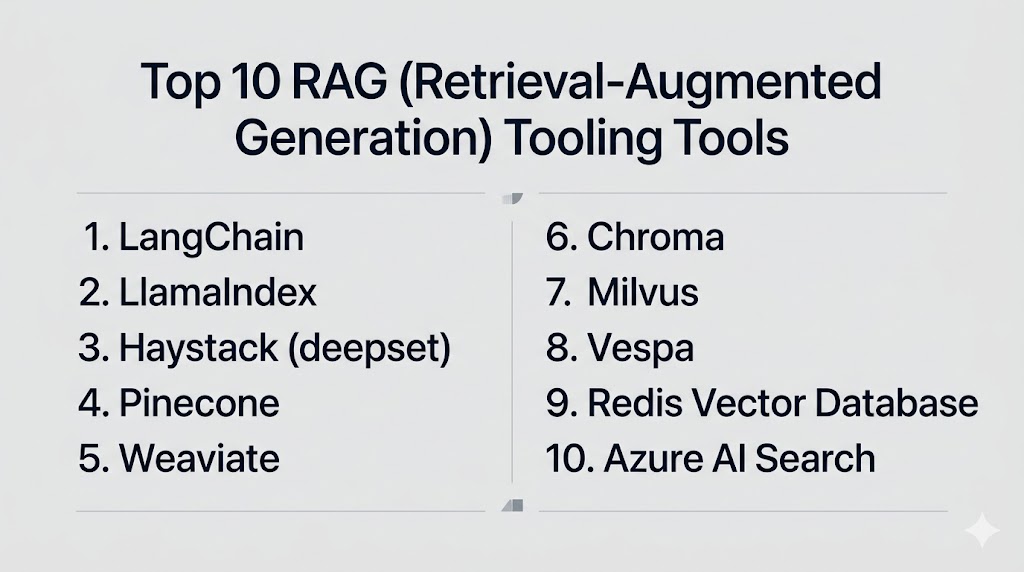
Top 10 RAG (Retrieval-Augmented Generation) Tooling Tools
#1 — LangChain
Short description:
LangChain is one of the most widely used frameworks for building RAG applications, enabling developers to connect LLMs with external data sources and create complex AI workflows.
Key Features
- Chain-based orchestration
- Document loaders and retrievers
- Memory and context handling
- Integration with vector databases
- Agent-based workflows
Pros
- Highly flexible and extensible
- Large developer community
Cons
- Steep learning curve
- Rapid changes can cause instability
Platforms / Deployment
Cloud / Self-hosted
Security & Compliance
Varies / N/A
Integrations & Ecosystem
LangChain integrates with a wide range of AI tools, vector databases, and APIs, making it a central hub for RAG development.
- OpenAI
- Pinecone
- Weaviate
- FAISS
Support & Community
Extremely active community with extensive documentation.
#2 — LlamaIndex
Short description:
LlamaIndex is designed specifically for building RAG pipelines by connecting LLMs with structured and unstructured data sources.
Key Features
- Data connectors
- Indexing and retrieval
- Query engines
- Embedding optimization
- Document parsing
Pros
- Purpose-built for RAG
- Easy data integration
Cons
- Limited beyond RAG use cases
- Requires technical setup
Platforms / Deployment
Cloud / Self-hosted
Security & Compliance
Varies / N/A
Integrations & Ecosystem
LlamaIndex integrates with data sources and vector stores to enable efficient retrieval.
- APIs
- Vector databases
- File systems
Support & Community
Growing community with strong developer support.
#3 — Haystack (deepset)
Short description:
Haystack is an open-source framework for building search systems and RAG pipelines with strong support for NLP workflows.
Key Features
- Document indexing
- Retrieval pipelines
- Multi-model support
- Evaluation tools
- REST APIs
Pros
- Production-ready
- Flexible architecture
Cons
- Setup complexity
- Requires infrastructure management
Platforms / Deployment
Cloud / Self-hosted
Security & Compliance
Varies / N/A
Integrations & Ecosystem
Supports integration with search systems and databases for scalable retrieval.
- Elasticsearch
- OpenSearch
- FAISS
Support & Community
Active open-source community.
#4 — Pinecone
Short description:
Pinecone is a managed vector database optimized for similarity search, making it a core component of many RAG systems.
Key Features
- Vector search
- Real-time indexing
- Scalability
- Low-latency queries
- Managed infrastructure
Pros
- High performance
- Fully managed service
Cons
- Cost considerations
- Vendor lock-in
Platforms / Deployment
Cloud
Security & Compliance
Encryption, access controls
Integrations & Ecosystem
Pinecone integrates with major AI frameworks and tools to enable fast vector search.
- LangChain
- LlamaIndex
- OpenAI
Support & Community
Strong documentation and enterprise support.
#5 — Weaviate
Short description:
Weaviate is an open-source vector database with built-in AI capabilities for semantic search and RAG applications.
Key Features
- Vector search
- Graph-based relationships
- Hybrid search
- Schema management
- API-first design
Pros
- Open-source flexibility
- Built-in ML capabilities
Cons
- Requires setup
- Scaling complexity
Platforms / Deployment
Cloud / Self-hosted
Security & Compliance
RBAC, encryption
Integrations & Ecosystem
Weaviate integrates with AI frameworks and supports custom extensions.
- APIs
- ML tools
- Vector pipelines
Support & Community
Active community and documentation.
#6 — Chroma
Short description:
Chroma is a lightweight vector database designed for embedding storage and retrieval in RAG applications.
Key Features
- Embedding storage
- Fast retrieval
- Simple API
- Lightweight design
- Local deployment
Pros
- Easy to use
- Developer-friendly
Cons
- Limited enterprise features
- Scaling limitations
Platforms / Deployment
Self-hosted
Security & Compliance
Varies / N/A
Integrations & Ecosystem
Chroma integrates easily with RAG frameworks and local workflows.
- LangChain
- Python
Support & Community
Growing developer community.
#7 — Milvus
Short description:
Milvus is a high-performance open-source vector database designed for large-scale similarity search in AI applications.
Key Features
- Distributed architecture
- High scalability
- Vector indexing
- Real-time search
- Multi-cloud support
Pros
- Highly scalable
- Open-source
Cons
- Complex setup
- Requires infrastructure
Platforms / Deployment
Cloud / Self-hosted
Security & Compliance
RBAC, encryption
Integrations & Ecosystem
Milvus integrates with AI pipelines and vector search ecosystems.
- Kubernetes
- AI frameworks
- APIs
Support & Community
Strong open-source community.
#8 — Vespa
Short description:
Vespa is a real-time data serving platform designed for search, recommendation, and RAG systems at scale.
Key Features
- Real-time indexing
- Hybrid search
- Ranking models
- Distributed system
- Low latency
Pros
- High performance
- Scalable architecture
Cons
- Complex deployment
- Learning curve
Platforms / Deployment
Cloud / Self-hosted
Security & Compliance
Not publicly stated
Integrations & Ecosystem
Supports integration with large-scale data systems and search pipelines.
- APIs
- Data pipelines
Support & Community
Active community with enterprise backing.
#9 — Redis Vector Database
Short description:
Redis offers vector search capabilities as part of its in-memory database, enabling fast retrieval for RAG applications.
Key Features
- In-memory vector search
- Low latency
- Real-time updates
- Scalable architecture
- Multi-purpose database
Pros
- Extremely fast
- Versatile
Cons
- Memory cost
- Requires tuning
Platforms / Deployment
Cloud / Self-hosted
Security & Compliance
RBAC, encryption
Integrations & Ecosystem
Redis integrates with many applications and frameworks for real-time data retrieval.
- APIs
- Cloud platforms
- AI frameworks
Support & Community
Large global community.
#10 — Azure AI Search
Short description:
Azure AI Search provides enterprise-grade search and indexing capabilities integrated with Microsoft’s AI ecosystem for RAG applications.
Key Features
- Cognitive search
- Indexing pipelines
- AI enrichment
- Hybrid search
- Scalability
Pros
- Enterprise-ready
- Strong Azure integration
Cons
- Azure dependency
- Pricing complexity
Platforms / Deployment
Cloud
Security & Compliance
MFA, RBAC, encryption
Integrations & Ecosystem
Deep integration with Microsoft services and enterprise systems.
- Azure
- Power BI
- APIs
Support & Community
Enterprise-level support from Microsoft.
Comparison Table (Top 10)
| Tool Name | Best For | Platform(s) Supported | Deployment | Standout Feature | Public Rating |
|---|---|---|---|---|---|
| LangChain | RAG orchestration | Python/Web | Cloud/Self | Workflow chaining | N/A |
| LlamaIndex | Data indexing | Python | Cloud/Self | RAG-focused indexing | N/A |
| Haystack | Search pipelines | Web/API | Cloud/Self | NLP pipelines | N/A |
| Pinecone | Vector search | Web | Cloud | Managed DB | N/A |
| Weaviate | Semantic search | Web/API | Cloud/Self | Hybrid search | N/A |
| Chroma | Lightweight RAG | Python | Self-hosted | Simple embeddings | N/A |
| Milvus | Large-scale search | Web/API | Cloud/Self | Distributed system | N/A |
| Vespa | Real-time search | Web/API | Cloud/Self | Low latency | N/A |
| Redis Vector | Fast retrieval | Multi-platform | Cloud/Self | In-memory search | N/A |
| Azure AI Search | Enterprise search | Web | Cloud | AI enrichment | N/A |
Evaluation & Scoring of RAG (Retrieval-Augmented Generation) Tooling
| Tool Name | Core (25%) | Ease (15%) | Integrations (15%) | Security (10%) | Performance (10%) | Support (10%) | Value (15%) | Weighted Total (0–10) |
|---|---|---|---|---|---|---|---|---|
| LangChain | 9 | 7 | 9 | 6 | 8 | 9 | 8 | 8.2 |
| LlamaIndex | 9 | 8 | 8 | 6 | 8 | 8 | 8 | 8.1 |
| Haystack | 8 | 7 | 8 | 6 | 8 | 7 | 8 | 7.8 |
| Pinecone | 9 | 8 | 9 | 8 | 9 | 8 | 7 | 8.5 |
| Weaviate | 8 | 7 | 8 | 7 | 8 | 7 | 8 | 7.9 |
| Chroma | 7 | 9 | 7 | 5 | 7 | 6 | 9 | 7.5 |
| Milvus | 9 | 6 | 8 | 7 | 9 | 7 | 8 | 8.1 |
| Vespa | 8 | 6 | 7 | 6 | 9 | 7 | 7 | 7.6 |
| Redis Vector | 8 | 8 | 8 | 7 | 9 | 8 | 7 | 8.2 |
| Azure AI Search | 9 | 7 | 9 | 9 | 9 | 9 | 7 | 8.6 |
How to interpret scores:
These scores represent a comparative view across performance, usability, and ecosystem strength. Higher scores indicate tools that are more balanced and production-ready, while others may excel in specific niches like lightweight development or large-scale enterprise deployments.
Which RAG (Retrieval-Augmented Generation) Tooling Tool Is Right for You?
Solo / Freelancer
Use Chroma or LlamaIndex for simple and lightweight RAG applications without heavy infrastructure.
SMB
LangChain combined with Pinecone offers a scalable and manageable setup for growing teams.
Mid-Market
Weaviate or Redis Vector provide a balance of performance and flexibility.
Enterprise
Azure AI Search, Pinecone, and Milvus are ideal for large-scale, production-ready deployments.
Budget vs Premium
- Budget: Chroma, Haystack
- Premium: Pinecone, Azure AI Search
Feature Depth vs Ease of Use
- Deep features: LangChain, Milvus
- Easy to use: Chroma, LlamaIndex
Integrations & Scalability
Choose tools with strong API ecosystems and compatibility with your AI stack.
Security & Compliance Needs
Enterprises should prioritize tools with strong access controls and compliance support.
Frequently Asked Questions (FAQs)
What is RAG in AI?
RAG combines retrieval systems with generative models to produce more accurate and context-aware responses by using external data sources.
Why is RAG important?
It reduces hallucinations and ensures AI outputs are grounded in real data, improving reliability.
Do I need a vector database for RAG?
Yes, most RAG systems rely on vector databases for efficient similarity search.
Can RAG work with any LLM?
Most modern LLMs can be integrated with RAG pipelines using APIs and frameworks.
Is RAG suitable for real-time applications?
Yes, many tools support low-latency retrieval for real-time use cases.
How secure are RAG systems?
Security depends on implementation, but enterprise tools provide encryption and access controls.
What industries use RAG?
Finance, healthcare, e-commerce, and SaaS companies widely use RAG systems.
Is RAG expensive to implement?
Costs vary depending on infrastructure and tools used.
Can I build RAG without coding?
Some platforms offer low-code solutions, but most require development effort.
How do I choose the right RAG tool?
Focus on scalability, integration, and your specific use case requirements.
Conclusion
RAG (Retrieval-Augmented Generation) tooling has quickly become a foundational layer for building reliable and context-aware AI applications. As organizations move beyond basic generative AI use cases, the need for accurate, up-to-date, and grounded responses is driving the adoption of RAG architectures. These tools help bridge the gap between static model knowledge and dynamic real-world data, significantly improving output quality. The ecosystem offers a wide range of solutions—from lightweight frameworks like LlamaIndex and Chroma to enterprise-grade platforms like Azure AI Search and Pinecone—each designed for different scales and complexity levels. There is no single best tool, as the right choice depends on your data architecture, team expertise, and performance requirements. Teams should carefully evaluate factors like retrieval accuracy, scalability, integration capabilities, and security before making a decision. A practical approach is to start with a small prototype, test retrieval performance, and gradually scale based on real-world usage. As RAG systems evolve, combining them with observability and evaluation tools will become increasingly important for maintaining quality. Investing in the right RAG tooling early can significantly accelerate AI adoption while reducing risks associated with hallucinations and outdated information. Start by shortlisting two or three tools that align with your stack, run pilot implementations, and validate resultsbefore full-scale deployment.