Introduction
Observability Platforms are tools that help teams understand the health, performance, and behavior of applications, infrastructure, and systems by analyzing telemetry data such as logs, metrics, and traces.
Unlike traditional monitoring (which tells you what is wrong), observability explains why something is happening, enabling faster debugging and proactive issue resolution.
In modern environments powered by cloud-native architectures, microservices, Kubernetes, and AI-driven systems, observability has become a critical capability. Organizations rely on these platforms to ensure uptime, optimize performance, and maintain a high-quality user experience across distributed systems.
Real-World Use Cases
- Monitoring application performance and uptime
- Troubleshooting production incidents
- Analyzing user experience and behavior
- Managing cloud and Kubernetes environments
- Detecting anomalies and preventing outages
What Buyers Should Evaluate
- Support for logs, metrics, and traces (full-stack visibility)
- Real-time monitoring and alerting capabilities
- Integration with cloud, DevOps, and CI/CD tools
- Scalability across distributed environments
- AI-driven anomaly detection and root cause analysis
- Visualization dashboards and reporting
- Cost efficiency and data ingestion pricing
- Ease of deployment and onboarding
Best for: DevOps teams, SREs, platform engineers, and enterprises managing complex distributed systems.
Not ideal for: Small applications with minimal infrastructure or teams needing only basic uptime monitoring.
Key Trends in Observability Platforms
- AI-driven anomaly detection and automated root cause analysis
- Shift toward unified telemetry (logs + metrics + traces)
- OpenTelemetry becoming a standard for instrumentation
- Growth of cloud-native and Kubernetes observability
- Integration with DevSecOps workflows
- Real-time, end-to-end visibility across systems
- Cost optimization and telemetry pipeline control
- Observability for AI/ML systems and data pipelines
- Increased adoption of open-source observability stacks
- Developer-first observability experiences
How We Selected These Tools (Methodology)
- Market adoption and industry relevance
- Full-stack observability capabilities
- Integration with cloud-native ecosystems
- Performance and scalability signals
- Security and compliance capabilities
- Ecosystem maturity and extensibility
- Support for modern architectures (microservices, containers)
- Balance between enterprise and open-source tools
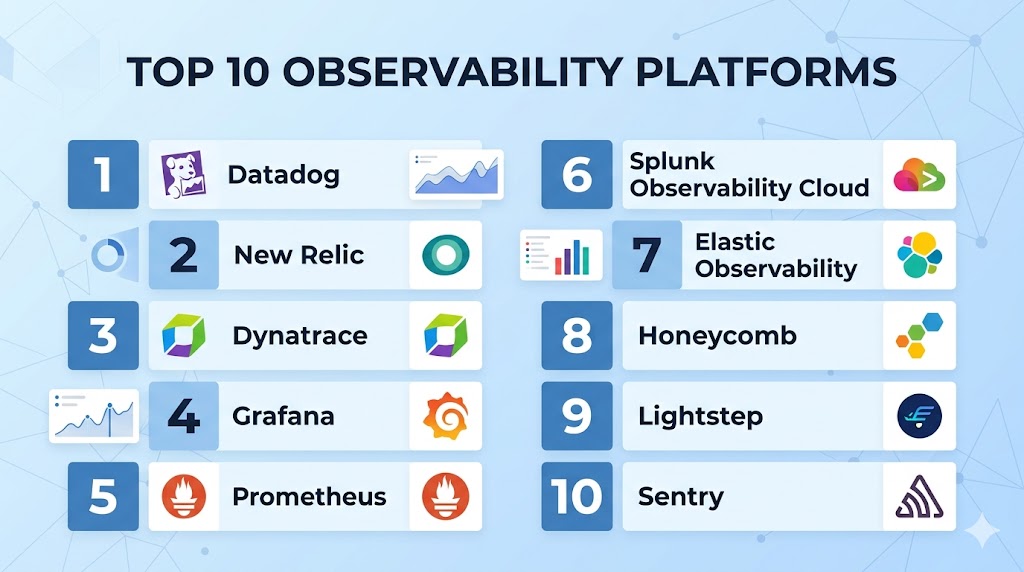
Top 10 Observability Platforms
#1 — Datadog
Short description: A leading cloud-native observability platform offering full-stack monitoring across applications, infrastructure, and logs.
Key Features
- Metrics, logs, and traces in one platform
- Real-time dashboards
- AI-powered anomaly detection
- Infrastructure and APM monitoring
- Cloud and Kubernetes support
Pros
- Unified observability experience
- Strong integrations
Cons
- Expensive at scale
- Pricing complexity
Platforms / Deployment
Web
Cloud
Security & Compliance
RBAC, audit logs
Not publicly stated
Integrations & Ecosystem
Integrates with major cloud providers and DevOps tools.
- AWS
- Azure
- Kubernetes
- CI/CD tools
Support & Community
Strong enterprise support and large community.
#2 — New Relic
Short description: A full-stack observability platform focused on application performance and telemetry insights.
Key Features
- APM monitoring
- Distributed tracing
- Logs and metrics analysis
- Real-time alerts
- Visualization dashboards
Pros
- Developer-friendly
- Flexible pricing model
Cons
- Complex UI for beginners
- Data ingestion costs
Platforms / Deployment
Web
Cloud
Security & Compliance
RBAC, encryption
Not publicly stated
Integrations & Ecosystem
- Cloud platforms
- DevOps tools
- APIs
Support & Community
Strong documentation and support.
#3 — Dynatrace
Short description: An enterprise-grade observability platform with AI-driven automation and deep system visibility.
Key Features
- Full-stack observability
- AI-powered root cause analysis
- Real user monitoring
- Automatic dependency mapping
- Cloud-native support
Pros
- Strong automation
- Deep insights
Cons
- Expensive
- Learning curve
Platforms / Deployment
Web
Cloud / Hybrid
Security & Compliance
RBAC, audit logs
Not publicly stated
Integrations & Ecosystem
- Cloud platforms
- DevOps tools
- CI/CD pipelines
Support & Community
Enterprise-grade support.
#4 — Grafana
Short description: An open-source platform for visualization and observability dashboards.
Key Features
- Custom dashboards
- Multi-data source support
- Metrics, logs, and traces visualization
- Alerting system
- Plugin ecosystem
Pros
- Highly customizable
- Open-source
Cons
- Requires setup
- Not full-stack by default
Platforms / Deployment
Windows / macOS / Linux
Cloud / Self-hosted
Security & Compliance
Not publicly stated
Integrations & Ecosystem
- Prometheus
- Elasticsearch
- CloudWatch
Support & Community
Large open-source community.
#5 — Prometheus + Grafana Stack
Short description: A popular open-source observability stack for monitoring metrics and visualization.
Key Features
- Time-series metrics collection
- Alerting system
- Integration with Kubernetes
- Open-source ecosystem
- Flexible querying
Pros
- Free and powerful
- Strong Kubernetes support
Cons
- Requires multiple tools
- Maintenance overhead
Platforms / Deployment
Linux / Cloud
Self-hosted
Security & Compliance
Not publicly stated
Integrations & Ecosystem
- Kubernetes
- Cloud-native tools
Support & Community
Strong community support.
#6 — Splunk Observability Cloud
Short description: A platform combining observability, analytics, and machine data insights.
Key Features
- Log and metrics analysis
- Real-time monitoring
- AI-driven insights
- APM capabilities
- Dashboards
Pros
- Powerful analytics
- Enterprise-ready
Cons
- Expensive
- Complex setup
Platforms / Deployment
Web
Cloud
Security & Compliance
RBAC, encryption
Not publicly stated
Integrations & Ecosystem
- Enterprise tools
- DevOps platforms
Support & Community
Enterprise support.
#7 — Elastic Observability
Short description: A platform built on the Elastic Stack for logs, metrics, and APM.
Key Features
- Log management
- Metrics monitoring
- Distributed tracing
- Search and analytics
- Dashboards
Pros
- Strong search capabilities
- Flexible deployment
Cons
- Setup complexity
- Resource-intensive
Platforms / Deployment
Windows / macOS / Linux
Cloud / Self-hosted
Security & Compliance
Encryption, RBAC
Not publicly stated
Integrations & Ecosystem
- Elasticsearch ecosystem
- DevOps tools
Support & Community
Strong open-source and enterprise support.
#8 — Honeycomb
Short description: A modern observability platform focused on debugging complex systems.
Key Features
- Event-based observability
- High-cardinality data analysis
- Distributed tracing
- Query-based exploration
- Debugging tools
Pros
- Great for debugging
- Developer-focused
Cons
- Learning curve
- Pricing
Platforms / Deployment
Web
Cloud
Security & Compliance
Not publicly stated
Integrations & Ecosystem
- OpenTelemetry
- DevOps tools
Support & Community
Growing community.
#9 — Lightstep
Short description: A cloud-native observability tool focused on distributed tracing and performance.
Key Features
- Distributed tracing
- Performance monitoring
- Real-time insights
- Cloud-native support
- Root cause analysis
Pros
- Strong tracing capabilities
- Kubernetes support
Cons
- Limited full-stack features
- Paid solution
Platforms / Deployment
Web
Cloud
Security & Compliance
Not publicly stated
Integrations & Ecosystem
- Kubernetes
- OpenTelemetry
Support & Community
Enterprise support.
#10 — Netdata
Short description: A real-time observability platform for monitoring infrastructure and applications.
Key Features
- Real-time monitoring
- Auto-discovery
- Metrics visualization
- Machine learning alerts
- Lightweight agent
Pros
- Fast and lightweight
- Easy setup
Cons
- Limited enterprise features
- Smaller ecosystem
Platforms / Deployment
Windows / macOS / Linux
Cloud / Self-hosted
Security & Compliance
Not publicly stated
Integrations & Ecosystem
- Cloud platforms
- DevOps tools
Support & Community
Active open-source community.
Comparison Table (Top 10)
| Tool Name | Best For | Platform(s) Supported | Deployment | Standout Feature | Public Rating |
|---|---|---|---|---|---|
| Datadog | Cloud teams | Web | Cloud | Full-stack observability | N/A |
| New Relic | Dev teams | Web | Cloud | APM insights | N/A |
| Dynatrace | Enterprise | Web | Hybrid | AI automation | N/A |
| Grafana | Open-source | Multi-OS | Hybrid | Dashboards | N/A |
| Prometheus Stack | Kubernetes | Linux | Self-hosted | Metrics monitoring | N/A |
| Splunk | Enterprises | Web | Cloud | Analytics | N/A |
| Elastic | Logs/search | Multi-OS | Hybrid | Search engine | N/A |
| Honeycomb | Debugging | Web | Cloud | Event-based analysis | N/A |
| Lightstep | Tracing | Web | Cloud | Distributed tracing | N/A |
| Netdata | Real-time | Multi-OS | Hybrid | Lightweight monitoring | N/A |
Evaluation & Scoring of Observability Platforms
| Tool Name | Core | Ease | Integrations | Security | Performance | Support | Value | Weighted Total |
|---|---|---|---|---|---|---|---|---|
| Datadog | 10 | 8 | 10 | 9 | 9 | 9 | 7 | 9.0 |
| New Relic | 9 | 8 | 9 | 9 | 8 | 9 | 8 | 8.7 |
| Dynatrace | 10 | 7 | 9 | 10 | 9 | 9 | 7 | 9.0 |
| Grafana | 8 | 7 | 9 | 8 | 9 | 8 | 10 | 8.6 |
| Prometheus | 8 | 6 | 8 | 8 | 9 | 8 | 10 | 8.3 |
| Splunk | 10 | 7 | 9 | 9 | 9 | 9 | 6 | 8.8 |
| Elastic | 9 | 7 | 9 | 8 | 8 | 8 | 8 | 8.4 |
| Honeycomb | 8 | 7 | 8 | 8 | 8 | 7 | 8 | 8.0 |
| Lightstep | 8 | 7 | 8 | 8 | 8 | 7 | 8 | 8.0 |
| Netdata | 8 | 9 | 7 | 7 | 9 | 7 | 10 | 8.2 |
How to interpret scores:
These scores compare tools based on features, usability, and value. Enterprise tools score higher in security and automation, while open-source tools offer better cost efficiency and flexibility.
Which Observability Platform Is Right for You?
Solo / Freelancer
Netdata and Grafana provide lightweight and cost-effective solutions.
SMB
New Relic and Datadog offer ease of use and scalability.
Mid-Market
Elastic and Splunk provide strong analytics and flexibility.
Enterprise
Dynatrace and Datadog excel in large-scale environments.
Budget vs Premium
- Budget: Prometheus + Grafana
- Premium: Dynatrace, Datadog
Feature Depth vs Ease of Use
- Feature-rich: Dynatrace
- Easy-to-use: New Relic
Integrations & Scalability
- Best integrations: Datadog
- Scalable: Splunk
Security & Compliance Needs
- Strong security: Dynatrace
- Moderate: Grafana
Frequently Asked Questions (FAQs)
What is an observability platform?
It provides visibility into system performance using logs, metrics, and traces.
How is observability different from monitoring?
Monitoring shows what happened; observability explains why.
Do these tools support Kubernetes?
Most modern tools support Kubernetes environments.
Are observability tools expensive?
Some enterprise tools are costly; open-source options are cheaper.
Do they integrate with CI/CD?
Yes, integration is a core feature.
Can small teams use observability tools?
Yes, especially lightweight or open-source tools.
What data do they collect?
Logs, metrics, traces, and events.
Are they secure?
Most include encryption and access control features.
What is the best observability tool?
Depends on your infrastructure and requirements.
Do they support AI-based insights?
Many modern tools include AI-driven analytics.
Conclusion
Observability Platforms are essential for managing modern, distributed systems and ensuring reliable software performance. By combining logs, metrics, and traces, these tools provide deep insights into system behavior and enable faster troubleshooting. Whether you choose enterprise-grade solutions like Datadog and Dynatrace or open-source stacks like Prometheus and Grafana, the right platform depends on your scale, budget, and technical requirements. As systems grow more complex, investing in observability is no longer optional—it is a foundational requirement for delivering high-quality, resilient applications. Start by shortlisting a few platforms, testing them in your environment, and validating their ability to deliver actionable insights.