Introduction
AI Governance & Policy Tools are platforms designed to ensure that artificial intelligence systems are used responsibly, ethically, and in compliance with legal and organizational standards. These tools help organizations monitor AI behavior, enforce policies, manage risks, and ensure transparency across the AI lifecycle.
As AI systems move from experimentation to production, governance has become critical. Organizations must manage risks such as bias, compliance violations, data misuse, and lack of accountability. AI governance tools provide structured frameworks to monitor models, enforce policies, and build trust in AI-driven decisions.
Real-world use cases include:
- Monitoring AI models for bias and fairness
- Ensuring compliance with regulations (GDPR, AI laws)
- Managing AI model lifecycle and risk
- Enforcing enterprise AI policies
- Auditing AI decisions and outputs
Key evaluation criteria for buyers:
- Policy enforcement and governance capabilities
- Risk management and compliance features
- Model monitoring and explainability
- Integration with AI/ML pipelines
- Data privacy and security controls
- Auditability and reporting
- Scalability across enterprise environments
- Ease of use and governance workflows
- Multi-model and multi-agent support
- Cost and operational complexity
Best for:
AI governance tools are ideal for enterprises, compliance teams, AI engineers, risk managers, and regulated industries.
Not ideal for:
Small teams running experimental AI projects without regulatory or compliance requirements.
Key Trends in AI Governance & Policy Tools
- Shift from guidelines to enforceable AI governance systems
- Real-time monitoring of AI behavior and decisions
- Integration with LLMs, agents, and AI pipelines
- Regulatory-driven adoption (AI compliance laws expanding globally)
- Focus on bias detection and fairness metrics
- Automated audit trails and compliance reporting
- Governance for multi-agent AI ecosystems
- Data-centric governance with privacy controls
- Explainability and transparency tools gaining importance
- Centralized AI inventory and risk tracking systems
How We Selected These Tools (Methodology)
- Evaluated governance coverage across the AI lifecycle
- Assessed policy enforcement and compliance capabilities
- Reviewed risk management and monitoring features
- Checked integration with ML and AI platforms
- Considered enterprise scalability and deployment flexibility
- Examined security, privacy, and audit capabilities
- Evaluated ease of implementation and usability
- Reviewed community and enterprise adoption
- Considered open-source vs enterprise tools
- Ensured applicability across regulated and non-regulated environments
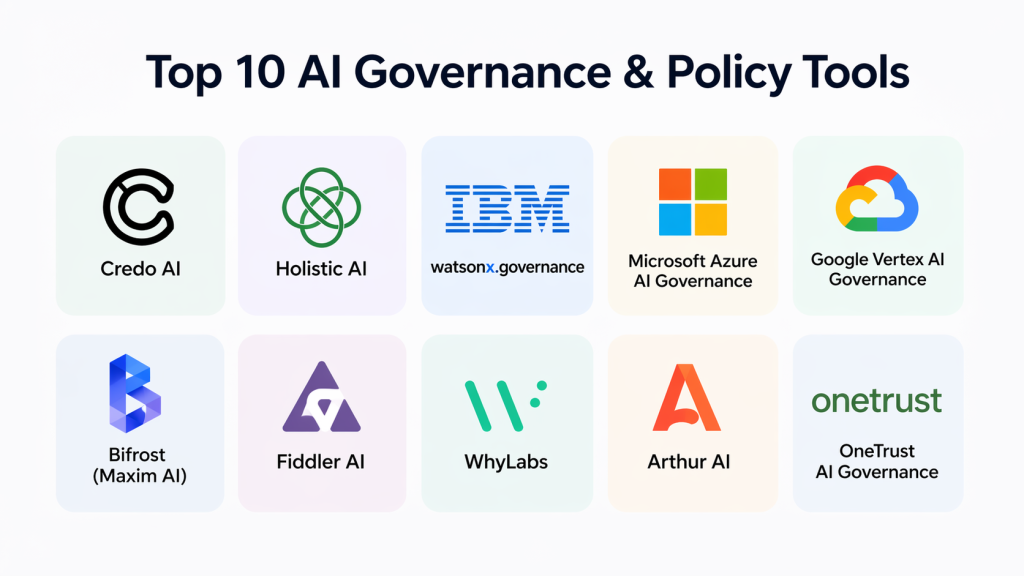
Top 10 AI Governance & Policy Tools
#1 — Credo AI
Short description (3-4 lines): Credo AI is an enterprise-grade AI governance platform focused on risk management, compliance, and policy enforcement across AI systems.
Key Features
- AI policy management
- Risk assessment frameworks
- Compliance automation
- Model monitoring
- Governance workflows
- Audit reporting
Pros
- Strong compliance features
- Enterprise-ready
Cons
- Complex setup
- Premium pricing
Platforms / Deployment
- Cloud
Security & Compliance
- Supports GDPR, SOC 2, ISO frameworks
Integrations & Ecosystem
- ML platforms, enterprise systems
Support & Community
- Enterprise support
#2 — Holistic AI
Short description: Holistic AI provides end-to-end governance including bias detection, compliance tracking, and performance monitoring.
Key Features
- Bias detection
- Risk management
- Model monitoring
- Compliance tracking
- AI inventory
Pros
- Full lifecycle governance
- Strong analytics
Cons
- Enterprise-focused
- Complex
Platforms / Deployment
- Cloud
Security & Compliance
- Regulatory compliance features
Integrations & Ecosystem
- APIs, ML tools
Support & Community
- Enterprise support
#3 — IBM AI Governance (Watson OpenScale)
Short description: IBM provides governance tools focused on fairness, explainability, and lifecycle monitoring.
Key Features
- Bias detection
- Explainability
- Model monitoring
- Risk management
- Compliance tools
Pros
- Strong explainability
- Enterprise integration
Cons
- IBM ecosystem dependency
- Learning curve
Platforms / Deployment
- Cloud / Hybrid
Security & Compliance
- Enterprise-grade controls
Integrations & Ecosystem
- IBM AI ecosystem
Support & Community
- Enterprise support
#4 — Microsoft Responsible AI (Azure AI Governance)
Short description: Microsoft offers governance capabilities integrated with Azure AI services for compliance and monitoring.
Key Features
- Responsible AI dashboards
- Policy enforcement
- Model monitoring
- Bias analysis
- Governance workflows
Pros
- Strong enterprise integration
- Scalable
Cons
- Azure dependency
- Limited flexibility
Platforms / Deployment
- Cloud
Security & Compliance
- Enterprise compliance
Integrations & Ecosystem
- Azure ecosystem
Support & Community
- Microsoft support
#5 — Google AI Governance (Vertex AI Governance)
Short description: Google provides governance tools within Vertex AI for monitoring, explainability, and compliance.
Key Features
- Model monitoring
- Explainability tools
- Data governance
- Risk management
- AI lifecycle tracking
Pros
- Scalable
- Strong ML integration
Cons
- Google dependency
- Learning curve
Platforms / Deployment
- Cloud
Security & Compliance
- IAM, encryption
Integrations & Ecosystem
- Google Cloud
Support & Community
- Google support
#6 — Bifrost (Maxim AI)
Short description: Bifrost combines LLM gateway capabilities with governance, monitoring, and policy enforcement.
Key Features
- LLM governance
- Policy enforcement
- Cost control
- Observability
- Access management
Pros
- High performance
- Modern architecture
Cons
- Newer platform
- Limited ecosystem
Platforms / Deployment
- Cloud / On-prem
Security & Compliance
- Policy enforcement controls
Integrations & Ecosystem
- APIs
Support & Community
- Growing community
#7 — Fiddler AI
Short description: Fiddler AI focuses on model monitoring, explainability, and responsible AI practices.
Key Features
- Model monitoring
- Explainability
- Bias detection
- Performance tracking
- Alerts
Pros
- Strong monitoring
- Easy visualization
Cons
- Limited policy enforcement
- Paid
Platforms / Deployment
- Cloud
Security & Compliance
- Enterprise controls
Integrations & Ecosystem
- ML pipelines
Support & Community
- Active community
#8 — WhyLabs
Short description: WhyLabs provides AI observability and monitoring for model performance and data drift.
Key Features
- Data monitoring
- Drift detection
- Observability
- Alerts
- Analytics
Pros
- Strong observability
- Scalable
Cons
- Limited governance depth
- Developer-focused
Platforms / Deployment
- Cloud
Security & Compliance
- Standard controls
Integrations & Ecosystem
- ML tools
Support & Community
- Active community
#9 — Arthur AI
Short description: Arthur AI offers model monitoring and governance for enterprise AI systems.
Key Features
- Model monitoring
- Bias detection
- Explainability
- Performance tracking
- Alerts
Pros
- Enterprise-ready
- Strong monitoring
Cons
- Expensive
- Complex setup
Platforms / Deployment
- Cloud / Hybrid
Security & Compliance
- Enterprise compliance
Integrations & Ecosystem
- ML pipelines
Support & Community
- Enterprise support
#10 — DataRobot AI Governance
Short description: DataRobot provides governance tools integrated with its AI lifecycle platform.
Key Features
- Model lifecycle management
- Compliance tracking
- Risk assessment
- Monitoring
- Reporting
Pros
- End-to-end solution
- Enterprise integration
Cons
- Vendor lock-in
- Cost
Platforms / Deployment
- Cloud / Hybrid
Security & Compliance
- Enterprise-grade
Integrations & Ecosystem
- DataRobot ecosystem
Support & Community
- Enterprise support
Comparison Table
| Tool | Best For | Platform | Deployment | Standout Feature | Rating |
|---|---|---|---|---|---|
| Credo AI | Compliance | Cloud | Cloud | Policy enforcement | N/A |
| Holistic AI | Full governance | Cloud | Cloud | End-to-end lifecycle | N/A |
| IBM | Explainability | Multi | Hybrid | Transparency | N/A |
| Microsoft | Enterprise | Cloud | Cloud | Responsible AI | N/A |
| ML governance | Cloud | Cloud | Model tracking | N/A | |
| Bifrost | LLM governance | Multi | Hybrid | Policy control | N/A |
| Fiddler | Monitoring | Cloud | Cloud | Explainability | N/A |
| WhyLabs | Observability | Cloud | Cloud | Drift detection | N/A |
| Arthur | Enterprise monitoring | Multi | Hybrid | AI monitoring | N/A |
| DataRobot | Lifecycle | Multi | Hybrid | Full platform | N/A |
Evaluation & Scoring
| Tool | Core | Ease | Integration | Security | Performance | Support | Value | Total |
|---|---|---|---|---|---|---|---|---|
| Credo AI | 10 | 7 | 9 | 10 | 9 | 9 | 8 | 9.1 |
| Holistic AI | 9 | 7 | 8 | 9 | 9 | 8 | 8 | 8.6 |
| IBM | 9 | 7 | 9 | 10 | 8 | 8 | 7 | 8.5 |
| Microsoft | 8 | 8 | 9 | 10 | 8 | 8 | 7 | 8.4 |
| 8 | 7 | 9 | 9 | 9 | 8 | 7 | 8.3 | |
| Bifrost | 8 | 7 | 8 | 9 | 9 | 7 | 8 | 8.2 |
| Fiddler | 8 | 8 | 8 | 8 | 8 | 7 | 7 | 7.9 |
| WhyLabs | 7 | 8 | 8 | 7 | 8 | 7 | 8 | 7.8 |
| Arthur | 8 | 7 | 8 | 9 | 8 | 8 | 7 | 8.0 |
| DataRobot | 9 | 7 | 9 | 10 | 8 | 8 | 7 | 8.6 |
Which AI Governance Tool Is Right for You?
Solo / Freelancer
WhyLabs or Fiddler is best for monitoring and experimentation.
SMB
Holistic AI or Bifrost offers scalable governance with flexibility.
Mid-Market
Google or Microsoft provides integration and growth.
Enterprise
Credo AI, IBM, or DataRobot delivers full governance, compliance, and control.
Frequently Asked Questions (FAQs)
What is an AI governance tool?
An AI governance tool ensures that AI systems operate ethically, securely, and in compliance with regulations. It monitors models, enforces policies, and tracks risk across the AI lifecycle. These tools are critical for responsible AI deployment.
Why is AI governance important?
AI systems can introduce risks such as bias, privacy violations, and incorrect decisions. Governance tools help mitigate these risks by enforcing rules and ensuring transparency. This builds trust and ensures compliance with regulations.
What features should I look for?
Look for policy enforcement, risk management, monitoring, explainability, and compliance tracking. Integration with existing AI systems is also important for seamless adoption.
Can AI governance tools detect bias?
Yes, many tools include bias detection features that analyze outputs and training data. They help identify unfair patterns and provide recommendations to improve fairness.
Are these tools required for all organizations?
Not always. They are most critical for enterprises and regulated industries. Smaller teams may not need full governance platforms unless they scale AI usage.
Do AI governance tools integrate with ML pipelines?
Yes, most tools integrate with machine learning pipelines, APIs, and data systems. This allows real-time monitoring and enforcement across workflows.
Are AI governance tools scalable?
Yes, enterprise tools are designed to scale across large AI deployments. They can manage multiple models, agents, and workflows simultaneously.
What industries use AI governance tools?
Industries like finance, healthcare, insurance, and government use these tools extensively due to strict regulatory requirements.
What are the limitations?
Limitations include complexity, cost, and integration challenges. Proper implementation and expertise are required for effective use.
How to choose the right tool?
Choose based on your compliance needs, AI maturity, integration requirements, and budget. Testing tools with real use cases helps in making the right decision.
Conclusion
AI governance and policy tools are becoming a foundational requirement as organizations scale AI across critical business functions. Tools like Credo AI and DataRobot provide full lifecycle governance with strong compliance capabilities, while platforms like IBM and Microsoft focus on explainability and enterprise integration. Mid-market organizations benefit from flexible solutions like Holistic AI and Bifrost that balance performance and scalability. For teams focused on monitoring and observability, tools like WhyLabs and Fiddler provide efficient and lightweight solutions. Choosing the right AI governance tool depends on your regulatory environment, risk tolerance, and AI maturity. A practical approach is to start with monitoring, expand into policy enforcement, and gradually build a comprehensive governance framework aligned with your business goals.