Introduction
Speech Recognition Platforms are technologies that convert spoken language into text using advanced AI and deep learning models. These platforms enable applications to understand, transcribe, and process human speech, making them essential for voice assistants, transcription services, call analytics, and accessibility solutions.
As voice-driven interfaces continue to grow across industries, speech recognition platforms play a key role in automating workflows, improving user experience, and enabling real-time communication analysis. They combine natural language processing, acoustic modeling, and cloud infrastructure to deliver accurate and scalable voice solutions.
Real-world use cases include:
- Voice assistants and chatbots
- Call center transcription and analytics
- Medical dictation and clinical documentation
- Voice search and smart devices
- Accessibility tools for speech-to-text conversion
Key evaluation criteria for buyers:
- Speech-to-text accuracy and language support
- Real-time vs batch transcription
- Noise handling and speaker recognition
- Custom vocabulary and model training
- Integration with APIs and applications
- Scalability and performance
- Security, compliance, and data privacy
- Multi-language and accent support
- Ease of use and developer tools
- Deployment flexibility (cloud/on-prem/hybrid)
Best for:
Speech recognition platforms are ideal for developers, AI engineers, enterprises, and customer support teams building voice-enabled applications.
Not ideal for:
Organizations without voice data use cases or those focused only on structured data processing.
Key Trends in Speech Recognition Platforms
- AI-powered real-time transcription systems
- Multilingual and accent-aware models
- Integration with conversational AI and chatbots
- Voice biometrics and speaker identification
- Cloud-native speech services with APIs
- Edge-based speech recognition for low latency
- Custom speech models for domain-specific use cases
- Integration with analytics and BI tools
- Enhanced noise reduction and accuracy improvements
- Compliance-focused voice processing solutions
How We Selected These Tools (Methodology)
- Evaluated speech recognition accuracy and performance
- Assessed real-time and batch processing capabilities
- Reviewed language and accent support
- Checked integration with APIs and ML pipelines
- Considered scalability and cloud infrastructure
- Examined security and compliance features
- Evaluated ease of use and developer experience
- Reviewed customization and training capabilities
- Considered open-source vs managed platforms
- Ensured applicability across SMB to enterprise environments
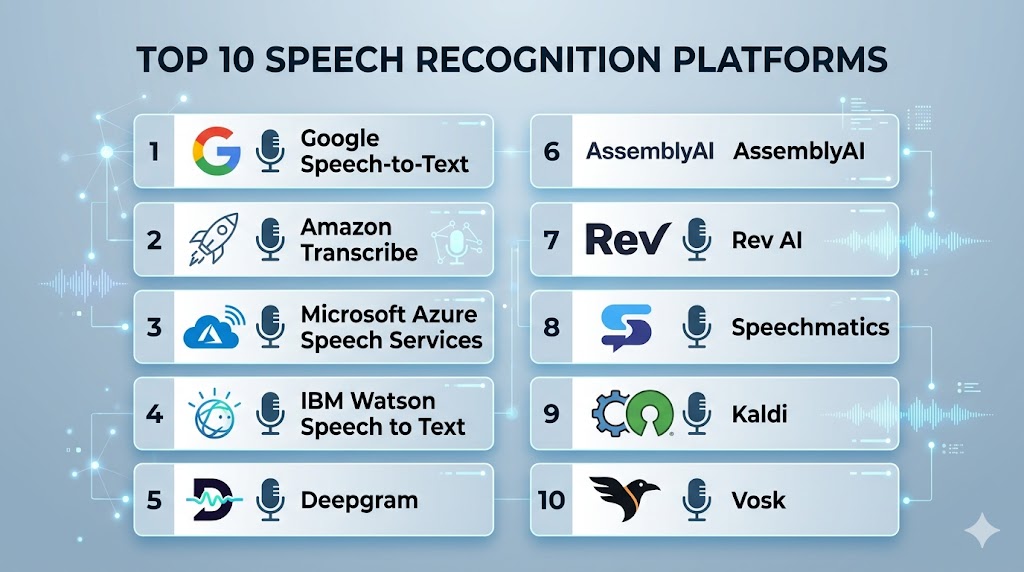
Top 10 Speech Recognition Platforms
#1 — Google Speech-to-Text
Short description (3-4 lines): Google Speech-to-Text provides highly accurate speech recognition using deep neural networks, supporting real-time transcription and multiple languages.
Key Features
- Real-time and batch transcription
- Multi-language support
- Automatic punctuation
- Speaker diarization
- Custom vocabulary models
- Noise-robust recognition
Pros
- High accuracy
- Scalable cloud infrastructure
Cons
- Cloud-only
- Cost scaling
Platforms / Deployment
- Cloud
Security & Compliance
- Encryption, IAM
Integrations & Ecosystem
- Google Cloud, APIs
Support & Community
- Google support
#2 — Amazon Transcribe
Short description: Amazon Transcribe offers real-time and batch speech-to-text capabilities with deep integration into AWS services.
Key Features
- Real-time transcription
- Speaker identification
- Custom vocabulary
- Call analytics
- Multi-language support
Pros
- Fully managed
- Real-time capabilities
Cons
- AWS-only
- Pricing complexity
Platforms / Deployment
- Cloud
Security & Compliance
- IAM, encryption
Integrations & Ecosystem
- AWS services
Support & Community
- AWS support
#3 — Azure Speech Services
Short description: Azure Speech Services provides speech recognition, translation, and voice capabilities within the Azure ecosystem.
Key Features
- Speech-to-text and translation
- Real-time processing
- Custom speech models
- Speaker recognition
- Multi-language support
Pros
- Enterprise integration
- Scalable
Cons
- Azure dependency
- Learning curve
Platforms / Deployment
- Cloud
Security & Compliance
- RBAC, encryption
Integrations & Ecosystem
- Azure AI services
Support & Community
- Microsoft support
#4 — IBM Watson Speech to Text
Short description: IBM Watson provides speech recognition with customization for enterprise use cases.
Key Features
- Speech-to-text conversion
- Custom language models
- Speaker recognition
- Real-time processing
- Industry-specific tuning
Pros
- Strong customization
- Enterprise-ready
Cons
- Cost
- Limited ecosystem
Platforms / Deployment
- Cloud / Hybrid
Security & Compliance
- Encryption, RBAC
Integrations & Ecosystem
- IBM Cloud
Support & Community
- Enterprise support
#5 — Deepgram
Short description: Deepgram is a developer-focused speech recognition platform optimized for speed and accuracy.
Key Features
- Real-time transcription
- AI-powered speech models
- Custom model training
- Streaming APIs
- Noise reduction
Pros
- High performance
- Developer-friendly
Cons
- Smaller ecosystem
- Paid platform
Platforms / Deployment
- Cloud
Security & Compliance
- Encryption
Integrations & Ecosystem
- APIs, ML tools
Support & Community
- Active community
#6 — AssemblyAI
Short description: AssemblyAI offers advanced speech recognition with features like sentiment analysis and summarization.
Key Features
- Speech-to-text
- Sentiment analysis
- Summarization
- Speaker detection
- Real-time APIs
Pros
- Advanced features
- Easy integration
Cons
- Paid tiers
- Cloud-only
Platforms / Deployment
- Cloud
Security & Compliance
- Encryption
Integrations & Ecosystem
- APIs
Support & Community
- Developer community
#7 — Rev AI
Short description: Rev AI provides accurate transcription services for audio and video files.
Key Features
- High-accuracy transcription
- Batch processing
- API integration
- Multi-language support
- Audio analysis
Pros
- High accuracy
- Reliable
Cons
- Limited real-time features
- Cost
Platforms / Deployment
- Cloud
Security & Compliance
- Encryption
Integrations & Ecosystem
- APIs
Support & Community
- Support available
#8 — Speechmatics
Short description: Speechmatics offers enterprise-grade speech recognition with global language support.
Key Features
- Real-time transcription
- Multi-language support
- Speaker recognition
- Custom models
- High accuracy
Pros
- Strong global language support
- Accurate
Cons
- Enterprise pricing
- Limited ecosystem
Platforms / Deployment
- Cloud / On-prem
Security & Compliance
- Encryption
Integrations & Ecosystem
- APIs
Support & Community
- Enterprise support
#9 — Kaldi
Short description: Kaldi is an open-source speech recognition toolkit widely used for research and custom applications.
Key Features
- Speech recognition toolkit
- Custom model training
- Acoustic modeling
- Open-source flexibility
- Research-focused
Pros
- Free and flexible
- Highly customizable
Cons
- Complex setup
- Requires expertise
Platforms / Deployment
- Linux / Windows
Security & Compliance
- Depends on deployment
Integrations & Ecosystem
- ML frameworks
Support & Community
- Open-source community
#10 — Vosk
Short description: Vosk is an offline speech recognition toolkit supporting multiple languages and edge devices.
Key Features
- Offline speech recognition
- Multi-language support
- Lightweight models
- Edge deployment
- Real-time processing
Pros
- Works offline
- Lightweight
Cons
- Limited accuracy vs cloud tools
- Smaller ecosystem
Platforms / Deployment
- Linux / Windows / macOS
Security & Compliance
- Depends on deployment
Integrations & Ecosystem
- APIs, ML tools
Support & Community
- Community support
Comparison Table
| Tool | Best For | Platform | Deployment | Standout Feature | Rating |
|---|---|---|---|---|---|
| Google STT | Accuracy | Cloud | Cloud | Multi-language AI | N/A |
| Transcribe | AWS users | Cloud | Cloud | Real-time analytics | N/A |
| Azure Speech | Enterprise | Cloud | Cloud | Custom models | N/A |
| IBM Watson | Enterprise AI | Cloud | Hybrid | Customization | N/A |
| Deepgram | Developers | Cloud | Cloud | Speed | N/A |
| AssemblyAI | Advanced features | Cloud | Cloud | Summarization | N/A |
| Rev AI | Accuracy | Cloud | Cloud | Transcription | N/A |
| Speechmatics | Global use | Multi | Hybrid | Language support | N/A |
| Kaldi | Research | Local | On-prem | Flexibility | N/A |
| Vosk | Offline use | Multi | Local | Edge deployment | N/A |
Evaluation & Scoring
| Tool | Core | Ease | Integration | Security | Performance | Support | Value | Total |
|---|---|---|---|---|---|---|---|---|
| Google STT | 9 | 8 | 8 | 8 | 9 | 8 | 7 | 8.2 |
| Transcribe | 8 | 8 | 8 | 8 | 8 | 7 | 7 | 7.8 |
| Azure Speech | 8 | 8 | 8 | 8 | 8 | 7 | 7 | 7.8 |
| IBM Watson | 8 | 7 | 7 | 8 | 8 | 7 | 7 | 7.6 |
| Deepgram | 8 | 8 | 7 | 7 | 9 | 7 | 7 | 7.8 |
| AssemblyAI | 8 | 8 | 7 | 7 | 8 | 7 | 7 | 7.7 |
| Rev AI | 8 | 7 | 7 | 7 | 8 | 7 | 7 | 7.4 |
| Speechmatics | 8 | 7 | 7 | 7 | 8 | 7 | 7 | 7.4 |
| Kaldi | 7 | 6 | 6 | 7 | 7 | 7 | 9 | 7.0 |
| Vosk | 7 | 7 | 6 | 7 | 7 | 7 | 8 | 7.1 |
Which Speech Recognition Platform Is Right for You?
Solo / Freelancer
Kaldi or Vosk is ideal for offline and low-cost usage.
SMB
Deepgram or AssemblyAI offers ease of use and APIs.
Mid-Market
Azure Speech or Amazon Transcribe provides scalability.
Enterprise
Google Speech-to-Text or IBM Watson offers advanced capabilities and compliance.
Frequently Asked Questions (FAQs)
What is a speech recognition platform?
A speech recognition platform converts spoken language into text using AI models trained on large datasets. It processes audio input, identifies words and phrases, and outputs text for further analysis or action. These platforms are widely used in voice assistants, transcription tools, and customer service automation systems.
How accurate are speech recognition platforms?
Accuracy depends on factors such as audio quality, language, accents, and background noise. Modern AI-based platforms achieve high accuracy, especially in controlled environments. Custom models and domain-specific training can further improve accuracy for specialized use cases.
Can speech recognition work in real time?
Yes, many platforms support real-time speech recognition, allowing instant transcription of live audio streams. This is particularly useful in applications like call centers, live captioning, and voice assistants where immediate responses are required.
Do these platforms support multiple languages?
Most modern speech recognition platforms support multiple languages and accents. Some platforms also provide automatic language detection and translation features, making them suitable for global applications.
Can I train custom speech models?
Yes, many platforms allow custom model training to improve recognition accuracy for specific industries or vocabularies. This is especially useful in domains like healthcare or legal services where specialized terminology is common.
Are speech recognition platforms secure?
Enterprise platforms provide security features such as encryption, access control, and compliance with data protection regulations. Security also depends on deployment choices and how data is handled within the system.
Can these platforms integrate with other systems?
Yes, most platforms provide APIs and SDKs that allow integration with applications, databases, and ML pipelines. This enables seamless automation and workflow integration.
Are there offline speech recognition options?
Yes, tools like Vosk and Kaldi support offline speech recognition, making them suitable for edge devices or environments with limited internet connectivity.
What industries use speech recognition?
Speech recognition is used in healthcare, finance, customer service, automotive, education, and entertainment industries. It enables automation, analytics, and improved user experiences.
How to choose the right platform?
Choosing the right platform depends on your use case, budget, accuracy requirements, and deployment needs. It is recommended to test multiple platforms with real data to evaluate performance and integration capabilities.
Conclusion
Speech recognition platforms are transforming how organizations interact with voice data, enabling automation, accessibility, and real-time insights across industries. Open-source tools like Kaldi and Vosk provide flexibility for developers and offline use cases, while platforms like Deepgram and AssemblyAI offer modern APIs and ease of integration for growing teams. Mid-market organizations can leverage scalable cloud services such as Azure Speech and Amazon Transcribe for robust performance and reliability. Enterprises requiring high accuracy, global language support, and compliance can rely on Google Speech-to-Text or IBM Watson for advanced capabilities. Selecting the right platform depends on factors like accuracy, scalability, integration, and cost. A practical approach is to pilot a few platforms with real audio data and choose the one that best aligns with your technical and business requirements.