Introduction
Synthetic data generation tools are platforms that create artificial datasets that mimic the statistical properties and patterns of real-world data without exposing sensitive information. These tools use techniques like generative models, statistical simulations, and rule-based systems to produce high-quality, privacy-preserving datasets.
In modern AI and data-driven systems, access to real data is often limited due to privacy regulations, cost, or availability. Synthetic data solves this challenge by enabling teams to generate scalable, customizable, and compliant datasets for machine learning, testing, and analytics.
Real-world use cases include:
- Training machine learning models without exposing sensitive data
- Testing software and applications with realistic datasets
- Data augmentation for improving AI model accuracy
- Simulation of rare scenarios (fraud, anomalies, edge cases)
- Generating datasets for research and experimentation
Key evaluation criteria for buyers:
- Data type support (tabular, image, text, time-series)
- Data realism and statistical accuracy
- Privacy and compliance (GDPR, HIPAA, etc.)
- Scalability and performance
- Integration with ML pipelines and data systems
- Customization and control over generation
- Real-time vs batch generation
- Ease of use and APIs
- Deployment flexibility (cloud/on-prem/hybrid)
- Cost and licensing model
Best for:
Synthetic data tools are ideal for data scientists, ML engineers, QA teams, and enterprises working with sensitive or limited datasets.
Not ideal for:
Teams that already have abundant, clean, and compliant real-world data may not require synthetic data generation.
Key Trends in Synthetic Data Generation Tools
- Generative AI (GANs, VAEs) driving realistic data creation
- Privacy-first data generation replacing sensitive PII datasets
- Support for multimodal data (text, images, video, tabular)
- Integration with MLOps and feature stores
- Cloud-native synthetic data platforms
- Real-time synthetic data generation for testing pipelines
- Simulation-based data generation for autonomous systems
- Explainable synthetic data models
- Industry-specific tools (healthcare, finance, retail)
- Automation of the full synthetic data lifecycle
How We Selected These Tools (Methodology)
- Evaluated data realism and statistical fidelity
- Assessed privacy and compliance capabilities
- Reviewed support for multiple data types
- Checked integration with ML pipelines and cloud platforms
- Considered scalability and performance
- Examined customization and control features
- Evaluated ease of use and developer experience
- Reviewed open-source vs enterprise offerings
- Assessed community support and documentation
- Ensured suitability across SMB, mid-market, and enterprise environments
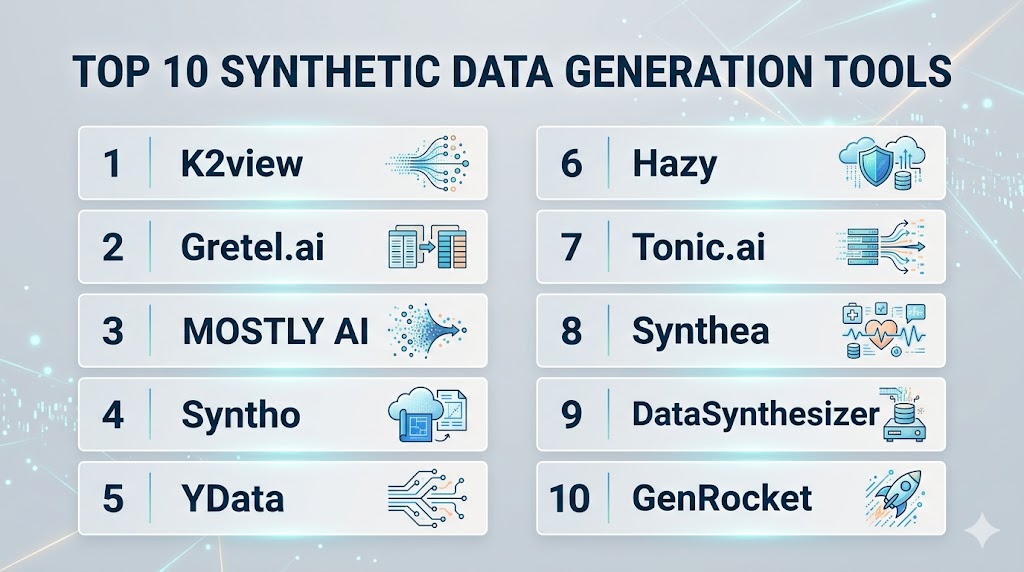
Top 10 Synthetic Data Generation Tools
#1 — K2view
Short description (3-4 lines): K2view is an enterprise-grade synthetic data platform that combines AI-based generation, rule-based logic, and data masking to create realistic and compliant datasets.
Key Features
- AI-powered synthetic data generation
- Rule-based and data cloning methods
- Data masking for privacy compliance
- Real-time and batch data generation
- Full synthetic data lifecycle management
- Integration with CI/CD pipelines
Pros
- Highly accurate and enterprise-ready
- Supports multiple generation methods
Cons
- Enterprise pricing
- Complex setup
Platforms / Deployment
- Cloud / On-prem / Hybrid
Security & Compliance
- GDPR, HIPAA support
- Encryption, RBAC
Integrations & Ecosystem
- Data pipelines, testing tools, ML workflows
Support & Community
- Enterprise support
#2 — Gretel.ai
Short description: Gretel.ai is a developer-focused platform for generating privacy-safe synthetic data using APIs and machine learning models.
Key Features
- API-based synthetic data generation
- Privacy-preserving models
- Text and tabular data support
- Model training and evaluation tools
- Data anonymization
Pros
- Developer-friendly APIs
- Strong privacy features
Cons
- Cloud-first platform
- Paid tiers for advanced features
Platforms / Deployment
- Cloud
Security & Compliance
- Encryption, privacy controls
Integrations & Ecosystem
- ML pipelines, cloud services
Support & Community
- Active community
#3 — MOSTLY AI
Short description: MOSTLY AI is an enterprise synthetic data platform focused on privacy-safe data sharing and analytics.
Key Features
- Privacy-preserving synthetic data
- Tabular and relational data support
- Data simulation and sharing
- High-fidelity data generation
- Enterprise analytics support
Pros
- Strong privacy compliance
- High-quality data generation
Cons
- Enterprise-focused pricing
- Limited open-source access
Platforms / Deployment
- Cloud / On-prem
Security & Compliance
- GDPR compliance
- Encryption, RBAC
Integrations & Ecosystem
- Data warehouses, ML tools
Support & Community
- Enterprise support
#4 — Syntho
Short description: Syntho provides automated synthetic data generation with strong privacy and data quality features.
Key Features
- Automated data generation
- Privacy and compliance support
- Data quality validation
- Tabular data generation
- Integration with pipelines
Pros
- Easy to use
- Strong privacy focus
Cons
- Limited advanced customization
- Enterprise pricing
Platforms / Deployment
- Cloud / On-prem
Security & Compliance
- GDPR support
- Encryption
Integrations & Ecosystem
- ML tools, data platforms
Support & Community
- Enterprise support
#5 — YData
Short description: YData is a data-centric AI platform that enhances datasets using synthetic data generation.
Key Features
- Synthetic data generation
- Data quality improvement
- AI model training support
- Data profiling tools
- Visualization dashboards
Pros
- Improves dataset quality
- Strong analytics features
Cons
- Requires ML expertise
- Limited open-source features
Platforms / Deployment
- Cloud / Hybrid
Security & Compliance
- Encryption, access control
Integrations & Ecosystem
- ML frameworks, cloud platforms
Support & Community
- Active community
#6 — Hazy
Short description: Hazy specializes in generating privacy-preserving synthetic data using advanced AI models.
Key Features
- Differential privacy support
- Tabular and time-series data generation
- Data anonymization
- Enterprise-grade pipelines
- Realistic data simulation
Pros
- Strong privacy guarantees
- High-quality synthetic data
Cons
- Enterprise pricing
- Limited open-source tools
Platforms / Deployment
- Cloud / Hybrid
Security & Compliance
- GDPR compliance
- Encryption
Integrations & Ecosystem
- Data pipelines, ML tools
Support & Community
- Enterprise support
#7 — Tonic.ai
Short description: Tonic.ai provides synthetic test data generation for software development and QA workflows.
Key Features
- Test data generation
- Data anonymization
- Schema-aware data creation
- Integration with development pipelines
- Realistic dataset generation
Pros
- Excellent for testing environments
- Easy integration
Cons
- Focused on test data
- Limited ML-specific features
Platforms / Deployment
- Cloud / On-prem
Security & Compliance
- HIPAA, GDPR support
- Encryption
Integrations & Ecosystem
- DevOps tools, CI/CD pipelines
Support & Community
- Enterprise support
#8 — Synthea
Short description: Synthea is an open-source tool for generating synthetic healthcare datasets.
Key Features
- Synthetic patient records
- Healthcare-specific datasets
- Open-source platform
- Realistic simulation models
- Data export capabilities
Pros
- Free and open-source
- Highly specialized
Cons
- Limited to healthcare
- Requires setup
Platforms / Deployment
- Linux / Windows / macOS
Security & Compliance
- Depends on usage
Integrations & Ecosystem
- Healthcare analytics tools
Support & Community
- Open-source community
#9 — DataSynthesizer
Short description: DataSynthesizer is a Python-based tool for generating synthetic datasets with differential privacy.
Key Features
- Privacy-preserving data generation
- Statistical modeling
- Python integration
- Dataset anonymization
- Easy setup
Pros
- Open-source
- Strong privacy features
Cons
- Limited scalability
- Basic UI
Platforms / Deployment
- Linux / Windows / macOS
Security & Compliance
- Differential privacy
Integrations & Ecosystem
- Python ecosystem
Support & Community
- Open-source community
#10 — GenRocket
Short description: GenRocket provides real-time synthetic data generation for testing and QA environments.
Key Features
- Real-time data generation
- Test data automation
- Rule-based data generation
- Integration with CI/CD
- High scalability
Pros
- Real-time capabilities
- Strong for QA workflows
Cons
- Enterprise pricing
- Less focus on ML
Platforms / Deployment
- Cloud / On-prem
Security & Compliance
- Encryption, RBAC
Integrations & Ecosystem
- DevOps tools, pipelines
Support & Community
- Enterprise support
Comparison Table
| Tool | Best For | Platform | Deployment | Standout Feature | Rating |
|---|---|---|---|---|---|
| K2view | Enterprise data | Multi | Hybrid | Multi-method generation | N/A |
| Gretel | Developers | Cloud | Cloud | API-driven generation | N/A |
| MOSTLY AI | Privacy-safe data | Multi | Hybrid | High-fidelity data | N/A |
| Syntho | Easy generation | Multi | Hybrid | Automation | N/A |
| YData | Data-centric AI | Multi | Hybrid | Data improvement | N/A |
| Hazy | Privacy-focused | Multi | Hybrid | Differential privacy | N/A |
| Tonic | Test data | Multi | Hybrid | Dev integration | N/A |
| Synthea | Healthcare | Multi | Local | Patient simulation | N/A |
| DataSynthesizer | Open-source | Multi | Local | Privacy modeling | N/A |
| GenRocket | QA testing | Multi | Hybrid | Real-time generation | N/A |
Evaluation & Scoring
| Tool | Core | Ease | Integration | Security | Performance | Support | Value | Total |
|---|---|---|---|---|---|---|---|---|
| K2view | 9 | 7 | 8 | 9 | 9 | 8 | 7 | 8.4 |
| Gretel | 8 | 8 | 8 | 8 | 8 | 7 | 7 | 7.8 |
| MOSTLY AI | 9 | 8 | 8 | 9 | 9 | 8 | 7 | 8.5 |
| Syntho | 8 | 8 | 7 | 8 | 8 | 7 | 7 | 7.7 |
| YData | 8 | 7 | 8 | 8 | 8 | 7 | 7 | 7.7 |
| Hazy | 8 | 7 | 7 | 9 | 8 | 7 | 7 | 7.8 |
| Tonic | 7 | 8 | 7 | 8 | 7 | 7 | 7 | 7.3 |
| Synthea | 7 | 6 | 6 | 7 | 7 | 6 | 8 | 6.8 |
| DataSynthesizer | 7 | 7 | 6 | 8 | 7 | 6 | 8 | 7.1 |
| GenRocket | 8 | 7 | 7 | 8 | 9 | 7 | 7 | 7.7 |
Which Synthetic Data Tool Is Right for You?
Solo / Freelancer
DataSynthesizer or Synthea is ideal for lightweight, open-source usage.
SMB
Gretel or Syntho offers ease of use and cloud scalability.
Mid-Market
YData or Tonic provides balanced performance and integration.
Enterprise
K2view, MOSTLY AI, or Hazy delivers advanced privacy, governance, and scalability.
Frequently Asked Questions (FAQs)
What is synthetic data?
Artificially generated data that mimics real-world datasets.
Why use synthetic data?
It solves privacy, cost, and data scarcity challenges.
Is synthetic data accurate?
Yes, it preserves statistical patterns of real data.
Can it replace real data?
It complements but doesn’t fully replace real data.
Is it secure?
Yes, it removes sensitive information.
What types of data can be generated?
Tabular, text, image, and time-series data.
Is it scalable?
Yes, it can generate large datasets on demand.
Can it be used for ML training?
Yes, widely used for training AI models.
Are there open-source tools?
Yes, tools like Synthea and DataSynthesizer.
How to choose a tool?
Based on data type, privacy needs, and scale.
Conclusion
Synthetic data generation tools are becoming a critical enabler for modern AI, helping organizations overcome data scarcity, privacy restrictions, and compliance challenges. Open-source tools like DataSynthesizer and Synthea provide accessible entry points for experimentation, while platforms like Gretel and Syntho offer user-friendly solutions for growing teams. Mid-market organizations benefit from YData and Tonic, which balance usability and integration capabilities. Enterprises requiring high accuracy, scalability, and strict compliance can rely on platforms like K2view, MOSTLY AI, and Hazy. Choosing the right synthetic data tool depends on your data type, privacy requirements, scalability needs, and integration with ML pipelines. A practical approach is to pilot multiple tools, evaluate data quality and performance, and select the platform that best aligns with your AI and data strategy.